

This desk has priced twenty Polymarket boards since 28 August, and the TIME Person of the Year 2026 board is the first one where the arithmetic breaks before the analysis starts. Twenty-two legs were quoted at 07:22 UTC on 18 September 2026. Their midpoints add to 158.2%. Their best offers add to 214.5%. A board that cannot be bought for less than twice certainty is not a forecast of anything; it is a set of prices that have drifted apart because almost nobody is trading them. The event has taken $50,269 in lifetime volume across all twenty-two legs, and three of those legs account for 78.9% of it. The other nineteen have effectively been left to the market makers, whose posted depth sits at roughly $20,000 per leg regardless of whether anyone has ever hit it.
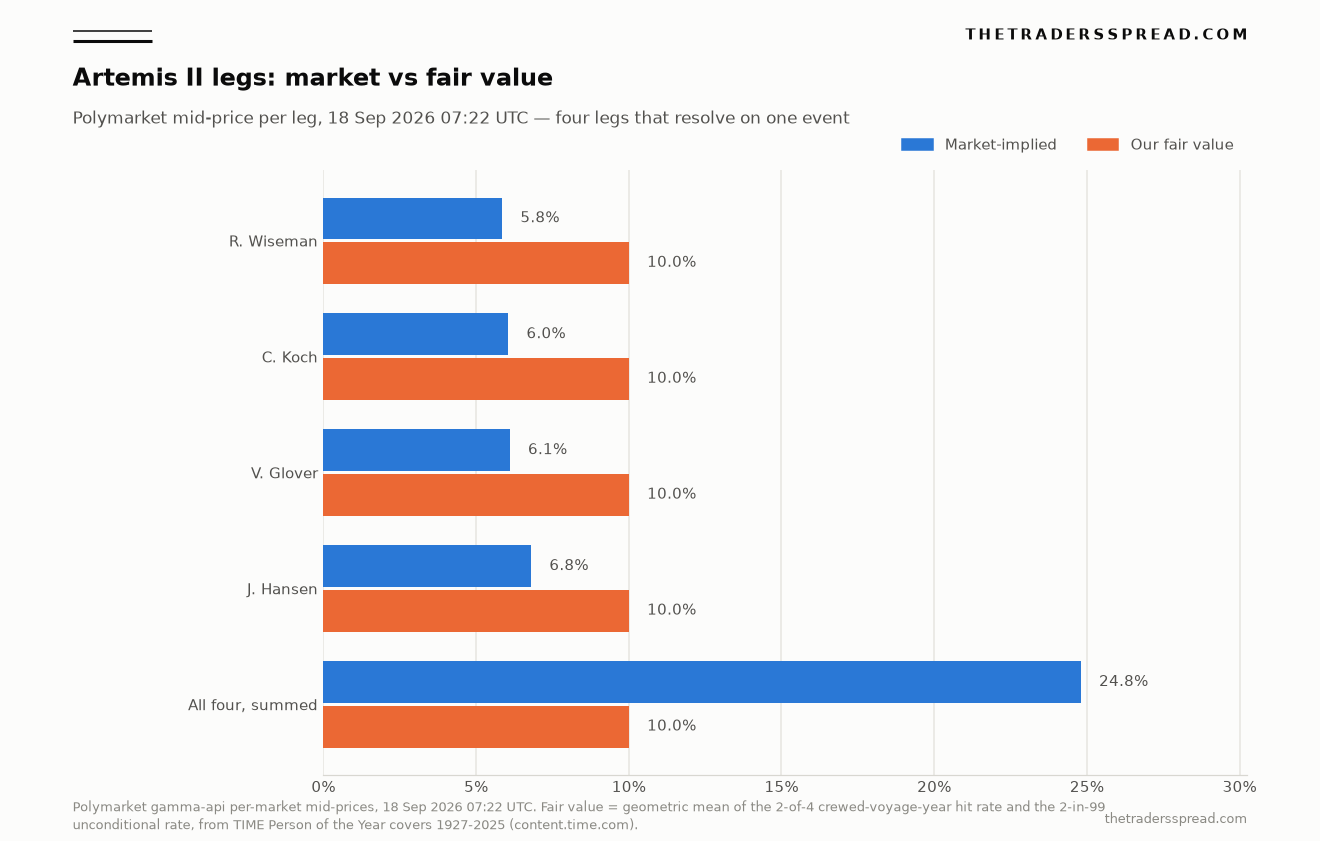
Here is where that leaves the biggest distortion. Four of the twenty-two legs are the four astronauts who flew Artemis II: Reid Wiseman, Victor Glover, Christina Koch and Jeremy Hansen. They are one event, not four. If TIME names the crew, all four pay; if it names anyone else, none of them do. Between them those four legs carry 24.8 of the board's 158.2 points, on a combined lifetime volume of $378. That is 0.75% of the money setting 15.7% of the board. When the market opened on 27 May the same four legs were quoted at 44.0, 43.5, 43.0 and 40.5 cents, which summed to 171% on a single outcome. You can see the full board on Polymarket's TIME Person of the Year 2026 event page. Links to Polymarket are affiliate links, from which The Traders Spread may earn a commission at no cost to you.
Key facts
- 22 legs, midpoints summing to 158.2%, best offers summing to 214.5%, best bids summing to 101.9% — Polymarket gamma-api, 18 Sep 2026 07:22 UTC
- $50,269 lifetime volume across the whole board; the Mamdani, Pope Leo XIV and Ghalibaf legs are 78.9% of it — Polymarket gamma-api, 18 Sep 2026
- The four Artemis II legs: $378 of lifetime volume, 24.8 points of implied probability, $90,915 of posted depth — Polymarket gamma-api, 18 Sep 2026
- Artemis II launched 1 April 2026 and splashed down 10 April 2026 after 9 days, 1 hour, 32 minutes — NASA mission page, retrieved 18 Sep 2026
- TIME has made 99 selections since 1927; explorers or astronauts have been the subject twice — TIME cover archive, retrieved 18 Sep 2026
- In the four years when humans completed a voyage nobody had made before, TIME named the voyagers twice — TIME cover archive, 1928, 1962, 1969 and 1970 covers
- Our fair value on the Artemis II outcome: 10.0%, against a four-leg average mid of 6.20% and an average best offer of 10.75%
The rules decide this market, and they are unusual
Read the resolution text before the names. Polymarket's own rules for this event do three things that almost no other board does.
First, they allow more than one leg to win. "If multiple people are explicitly named person of the year, both people will be considered TIME Person of the Year." Second, and more consequentially, they extend a group or concept win to individuals: if the selection is a concept, group or thing, a person still resolves Yes if they are "directly associated with the concept, group or thing named as person of the Year and are pictured on any official TIME cover announcing the Person of the Year." Third, they set a hard backstop. If no selection is announced by 30 June 2027 at 11:59 PM ET, every leg resolves No.
The resolution source is named precisely: the TIME cover or covers announcing the 2026 selection, with the feature article available as a secondary reference. That matters more than it sounds. A concept win that pictures hardware rather than people pays nobody. If TIME were to name something like the return to deep space and put an Orion capsule on the cover, all four astronaut legs resolve No despite the concept being about them. The rules are explicit that a listed entity qualifies only when it is synonymous with the announced selection, and they use ChatGPT versus AI as the worked example of two things that are conceptually linked but not synonymous.
So a sum above 100% is not automatically wrong here. Some of it is the multi-winner clause doing legitimate work. The question is how much, and the answer is nowhere near 58 points.
Four legs, one event, four different prices
NASA's mission page records Artemis II as a crewed lunar flyby that launched on 1 April 2026 and returned on 10 April after nine days, one hour and thirty-two minutes. The agency's own mission record lists the four crew: Wiseman as commander, Glover as pilot, Koch and Hansen as mission specialists, Hansen flying for the Canadian Space Agency. NASA's 9 September release describes them as "the first humans to travel to lunar orbit in more than 50 years."
Four people, one flight, one cover if it comes. The market does not price them that way.
| Leg | Best bid | Mid | Best offer | Spread | Lifetime volume |
|---|---|---|---|---|---|
| Jeremy Hansen | 1.6¢ | 6.80¢ | 12.0¢ | 10.4¢ | $75 |
| Victor Glover | 2.4¢ | 6.10¢ | 9.8¢ | 7.4¢ | $60 |
| Christina Koch | 0.7¢ | 6.05¢ | 11.4¢ | 10.7¢ | $135 |
| Reid Wiseman | 1.9¢ | 5.85¢ | 9.8¢ | 7.9¢ | $108 |
| All four | 6.6¢ | 24.80¢ | 43.0¢ | — | $378 |
The mission specialist with the lowest volume of the four carries the highest mid. Koch's market is 0.7 bid at 11.4 offered, a ten-and-a-half-cent quote around a six-cent claim. Nothing distinguishes these four outcomes except who happens to have posted an order. Hansen's leg has traded $75 in four months.
The CLOB history makes the point harder. On 10 June the four legs printed at 10.0, 27.0, 28.0 and 37.5 cents on the same day. A 27.5-point dispersion across four claims that resolve identically is not a difference of opinion about the crew. It is four order books drifting independently because none of them has enough flow to keep them tethered. They have since converged into a 0.95-point band, which is better, and still wrong by construction.
Where the other 39 points come from
Collapse the quartet to a single 6.20% claim and the board still sums to 139.6%. The remaining excess sits in clusters that are correlated but not identical. The AI names are the clearest: Dario Amodei at 6.85%, Artificial Intelligence at 5.65%, ChatGPT at 4.75% and Sam Altman at 4.25%, a combined 21.5%. TIME's 2025 selection was the Architects of AI, and the rules would pay Altman and Amodei together if a similar cover ran again. They would not pay the ChatGPT leg unless ChatGPT itself were named, because the rules require synonymity rather than association for a non-person entity. Two of those four legs can win together; all four cannot.
Then there is the volume map, which explains the rest. Zohran Mamdani, whose office at nyc.gov confirms him as New York City's sitting mayor, trades 30.0 bid at 31.0 on $17,167. Pope Leo XIV, elected on 8 May 2025 according to the Holy See's own record of the 267th pontificate, trades 15.0 at 17.0 on $13,438. Mohammad-Bagher Ghalibaf trades 3.0 at 4.1 on $9,057. Those three are the only legs on the board with a spread under two cents, and they are the only legs where the quoted price reflects anything a trader actually did.
| Board measure | Value | What it implies |
|---|---|---|
| Sum of 22 mids | 158.2% | Expected winning legs of 1.58 |
| Sum of 22 best offers | 214.5% | Full board costs 2.15x certainty |
| Sum of 22 best bids | 101.9% | Selling the full board raises 1.02x |
| After collapsing the Artemis quartet | 139.6% | 39.6 points still unexplained |
| Board volume in the top three legs | 78.9% | 19 legs quoted on $10,606 combined |
A mid-sum of 158.2% is a claim that TIME will, on average, hand this board 1.58 winning legs. Across 99 selections the magazine has named two individuals together seven times, and never a pre-listed pair drawn from a September prediction board. The modal outcome for a 22-name list is one winner or none. That is the gap, and the board is not structured to close it, because on Polymarket each leg is its own contract and nobody is paid to keep the set coherent. We wrote up the mirror image of this problem when the Nobel Peace Prize board left 40.5% off the board — the same absence of an arbitrage mechanism, pointing the other way.
What ninety-nine covers say about the crew
A base rate needs a reference class you can defend. Ours is narrow on purpose: calendar years in which human beings completed a voyage no human had made before. In the 99 selections TIME has made since 1927, there are four such years.
1927, when Charles Lindbergh flew the Atlantic alone and nonstop in May, and TIME's 2 January 1928 cover named him. 1961, when Yuri Gagarin became the first human in space in April, and the 5 January 1962 cover named John F. Kennedy. 1968, when Apollo 8 carried three men around the Moon in December, and the 3 January 1969 cover named Anders, Borman and Lovell together. And 1969, when Apollo 11 landed in July, and the 5 January 1970 cover named the Middle Americans.
Two hits in four. The conditional rate is 50.0%.
The unconditional rate is the other bookend. Explorers and astronauts have been the subject of a TIME selection twice in ninety-nine years, which is 2.02%. Those two numbers differ by a factor of 24.8, and each has a defect. The conditional rate asks the right question on a sample of four. The unconditional rate has ninety-nine observations but ignores the fact that the conditioning event happened in April.
We take the geometric mean, which is the log-midpoint of two estimates when there is no basis for preferring either: the square root of 0.500 times 0.0202 is 0.1005. Call it 10.0%. Readers who weight the conditional rate more heavily get a larger number; readers who think TIME's editorial taste has moved permanently away from exploration get something close to 2%. Both bookends are on the table so the weighting is yours rather than ours.
Against that, the four legs average a 6.20% mid and a 10.75% best offer. The edge at the midpoint is 3.80 points. The average spread is 9.10 points, which is 2.4 times the edge. Two of the four offers sit at 9.8¢, marginally under fair value; the other two sit at 11.4¢ and 12.0¢, above it. On the other side, the bids sum to 6.6¢ against a 10.0% fair value for the same event. Both directions are priced through fair value by the width of the quote.
The Apollo 11 problem
The case against our own number is the strongest single fact in the reference class, so it goes here rather than buried in a caveat.
In July 1969 human beings walked on the Moon. It is the most widely recognised achievement of the twentieth century. TIME's selection that year was the Middle Americans — a mood piece about domestic sentiment in a country five months past the landing. The mid-year achievement lost to the story that was live in November. Apollo 8, by contrast, splashed down on 27 December 1968, days before the issue closed, at maximum salience.
Artemis II splashed down on 10 April. By the time TIME's editors sit down, the mission will be eight months old, which is closer to the Apollo 11 timing than the Apollo 8 timing. NASA itself has started closing the chapter: its release 26-074 of 9 September 2026 announced that Glover and Wiseman are moving to emeritus status at Johnson Space Center this month.
"Together, they took on one of the most challenging missions in human spaceflight and helped return America to the lunar environment," said Jared Isaacman, NASA Administrator, in that release. "As Reid and Victor transition to emeritus status, I'm grateful they will continue sharing what they learned with our astronauts, flight controllers, and engineers as we prepare for Artemis III in 2027." Wiseman's own line in the same document — "I'm thrilled to continue serving future missions and programs through the emeritus program" — reads like a man moving on from the thing the market is pricing.
RelatedSpain's Next PM Odds: Feijóo Leads the Book at 79.5¢
The counterweight is Lindbergh. He flew in May 1927 and TIME named him for the year anyway, on the first cover of its kind. A mid-year voyage has won before.
The call
Our fair value for the Artemis II outcome is 10.0%, built from a 50.0% conditional rate over four voyage years and a 2.02% rate over ninety-nine selections, reconciled at the log-midpoint. The market's four legs average 6.20% at the mid and 10.75% at the offer. The edge exists at the midpoint and is entirely inside the spread, which is the least satisfying finding a prediction-market piece can produce and the honest one. This board is not mispriced so much as un-priced: the quartet has traded $378 since May, the quotes are ten cents wide, and the summed 24.8% for one event tells you the legs have never been reconciled against each other.
Resolution runs one of four ways. TIME names a single individual, and at most one leg pays. TIME names the Artemis II crew and pictures all four, and all four pay — the 1969 cover did exactly that with Anders, Borman and Lovell. TIME names a concept about the lunar return and pictures hardware, and none of them pay, because the rules require a person to be "pictured on any official TIME cover announcing the Person of the Year." Or nothing is announced by 30 June 2027, and the whole board resolves No. The second and third cases look similar from the outside and settle in opposite directions, which is the specific risk in these legs that the price does not express.
What would change our mind, in order of force. A TIME feature in October or November built around the lunar return would push the conditional rate towards the top bookend and our 10.0% with it. A cover story that centres Mamdani's first year, or a repeat of the 2025 AI framing, would do the reverse and take the quartet under 4%. And if the four legs start dispersing again the way they did on 10 June, the market is telling us it prices partial-naming risk that we have set close to zero, which would be a signal worth taking seriously rather than trading against. For a board where the thin-book problem produced a sharper conclusion, see our read on the 2028 Democratic nominee market; for an awards market with a deeper book and a narrower question, the Ballon d'Or 2026 board. The AI cluster's relevance to equity positioning runs through names like Microsoft, where the same 2025 framing has a price attached.
Frequently asked questions
Why do the four astronaut legs not trade at the same price?
Because each leg is a separate contract with its own order book and there is no mechanism on Polymarket that forces them to agree. A trader who spotted the gap would have to take four positions to express it, paying four spreads. With $378 of lifetime volume across all four, nobody has bothered. The convergence to a 0.95-point band since August happened passively, not through arbitrage.
Does a 158% sum mean the board is definitely wrong?
Not by itself. The resolution rules let several legs win at once, so some excess is legitimate. But collapsing the Artemis quartet to a single claim still leaves 139.6%, and TIME has named two individuals together seven times in ninety-nine years. A mid-sum of 158.2% implies 1.58 winning legs from a 22-name list where the winner may not be listed at all.
What exactly is the reference class behind the 10% figure?
Calendar years in which people completed a voyage nobody had made before: 1927, 1961, 1968 and 1969. TIME named the voyagers in 1927 and 1968, and named Kennedy and the Middle Americans in the other two. That is 50.0%, reconciled against the 2.02% rate at which explorers have been the subject across all ninety-nine selections. The geometric mean of the two is 10.05%.
Could TIME name only the commander?
It is possible and it is the scenario the market may be quietly pricing. The 1969 precedent points the other way: TIME's cover named Anders, Borman and Lovell jointly rather than singling out the commander. If a single-astronaut cover ran instead, three of the four legs would resolve No while one paid at full value.
When does this market actually settle?
TIME has historically announced in December — the Giuliani selection ran on the 31 December 2001 cover and the Gingrich selection on 25 December 1995. The Polymarket event carries an end date of 31 December 2026, and the rules add a backstop: no announcement by 30 June 2027 at 11:59 PM ET resolves every leg No. Wiseman's contract carries the same terms as the other twenty-one.
Is the posted depth real?
The quoted liquidity is roughly $20,000 on almost every leg, including legs that have traded under $100 in four months. That uniformity suggests seeded market-maker depth rather than organic interest. The $90,915 posted across the four Artemis legs sits against $378 of lifetime volume, a ratio of 240 to one.
Disclaimer
This article is analysis and information, not investment advice. Prediction-market contracts can resolve to zero and capital is at risk. Probabilities quoted here are estimates derived from public sources, and the figures reported were correct at the retrieval times stated. Readers are responsible for their own decisions and for checking whether these markets are available to them.