

I have had the Nobel Peace Prize 2026 book open on a second monitor since it listed on Polymarket on 16 October 2025, six days after Maria Corina Machado walked off with the 2025 prize, and the thing that has kept me coming back is not any one name. It is the shape. Twenty-three days out from the announcement, with $24.1m of volume through it, this market still has no favourite worth more than nine cents. I have watched election books and court-ruling books converge as their resolution dates closed in. This one has done the opposite. The top of the board has rotated four times since February and the leader has never once broken double digits.
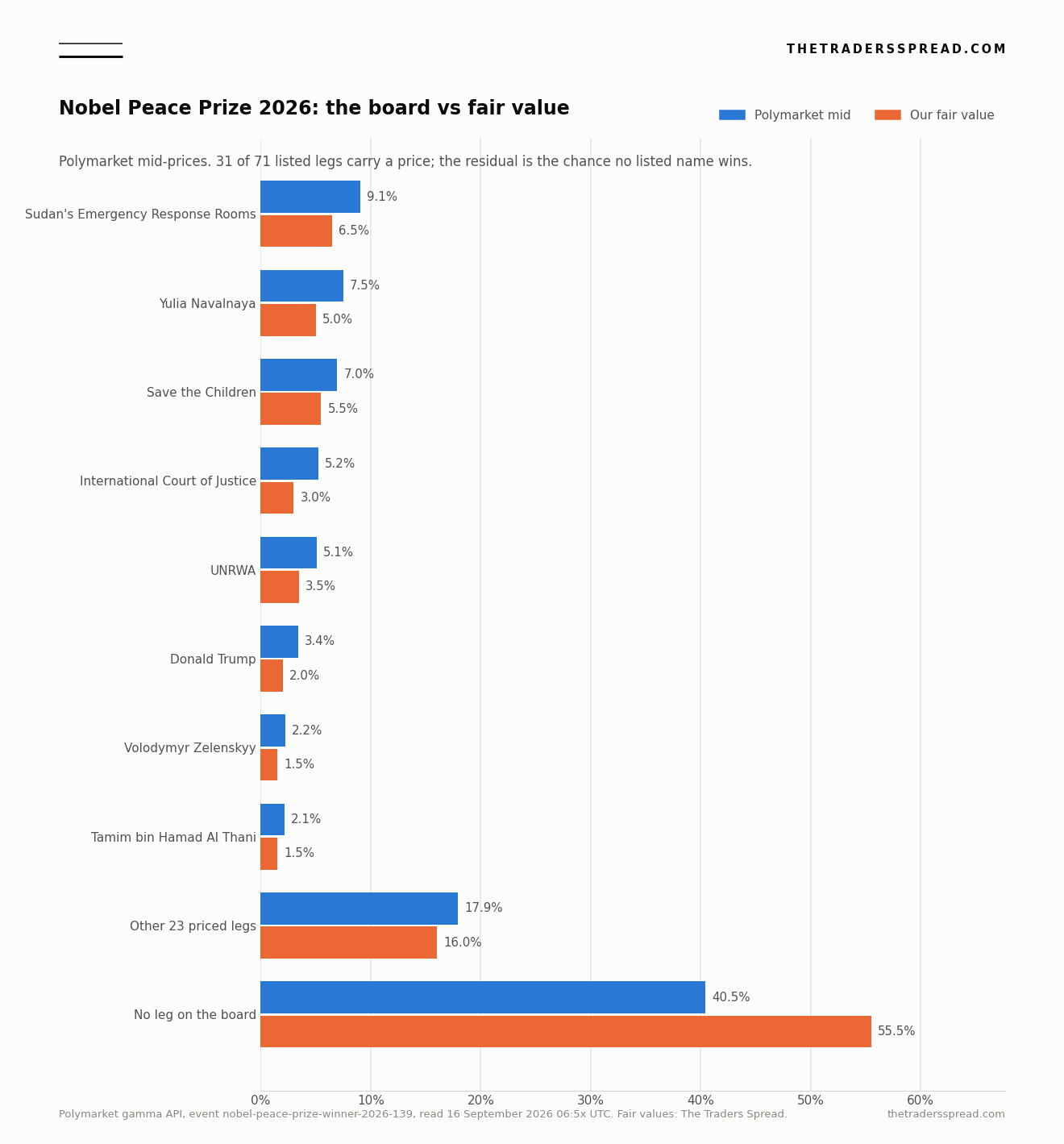
Add up every YES price on the board and you get 59.55%. That is the whole of it. The 71 legs Polymarket lists for the 2026 Nobel Peace Prize collectively account for barely three-fifths of the probability mass, which means the market is pricing a 40.45% chance that on 9 October the Norwegian Nobel Committee reads out a name that has no leg at all. The residual is the largest position on the board, bigger than the top four listed candidates combined. And you cannot buy it. That is the part that explains why the listed legs sit where they do.
The event is nobel-peace-prize-winner-2026-139, and every number in this piece came out of its gamma API endpoint at 06:5x UTC on 16 September 2026, not out of a screenshot. Links to Polymarket are affiliate links, from which The Traders Spread may earn a commission at no cost to you.
Key facts
- Event volume $24,119,463 and liquidity $1,758,900 across 71 legs — Polymarket gamma API, 16 September 2026
- Sum of the 31 legs that carry a live price: 59.55% at the mid, leaving a 40.45% residual — author's calculation from the same pull
- 287 candidates were registered for the 2026 prize, 208 individuals and 79 organisations, down from 338 in 2025 — Norwegian Nobel Institute, 30 April 2026
- The announcement is Friday 9 October at 11:00 CEST at the Norwegian Nobel Institute, made by committee chair Jorgen Watne Frydnes — Nobel Institute press calendar
- Donald Trump's leg has taken $4,758,859, the most money of any leg on the board, and trades at 3.40% — Polymarket gamma API, 16 September 2026
- The current leader, Sudan's Emergency Response Rooms at 9.05%, has taken $9,785 — 0.2% of the Trump leg's volume — from the same pull
- The PRIO Director's list has named the eventual laureate in 3 of the last 11 years — author's count from PRIO's published lists and the Nobel Prize API
How I got to 59.55%, and why the number moves
The method matters here more than usual, so here it is in full. Polymarket returns each leg's outcomePrices as a JSON string; the first element is the YES price, and it is the midpoint of the best bid and the best ask. I parsed all 71, discarded the 40 that return nothing, and summed the 31 that remain. That gives 59.55%. Summing lastTradePrice instead gives 60.00%, which is close enough to confirm the mid is not being dragged around by one stale quote.
Then the number stops being a single number.
Sum the best bids and you get 50.90%, so the residual is 49.10%. Sum the best asks and you get 68.20%, so the residual is 31.80%. The honest statement is that the market prices the field at somewhere between 32% and 49% depending on which side of the spread you are forced to cross, and the mid sits at 40.45% in the middle of a band 17.3 points wide. Anyone who quotes the residual to two decimal places without saying which side they took is quoting a convenience, not a price.
Average leg spread across the 31 priced legs is 0.56 points. Tight, until you notice it sits on prices averaging 1.9 cents.
The board, the money, and the gap between them
Here is the top of the book on the morning of 16 September, with bid and ask alongside the mid so the width is visible, and cumulative volume last. Price and money are almost unrelated.
| Leg | Bid | Mid | Ask | Volume | On PRIO's 2026 list? |
|---|---|---|---|---|---|
| Sudan's Emergency Response Rooms | 8.50% | 9.05% | 9.60% | $9,785 | Yes |
| Yulia Navalnaya | 7.00% | 7.50% | 8.00% | $298,211 | No |
| Save the Children | 6.90% | 6.95% | 7.00% | $6,936 | Yes |
| International Court of Justice | 4.60% | 5.25% | 5.90% | $914,882 | Yes |
| UNRWA | 4.50% | 5.10% | 5.70% | $2,052,211 | No |
| Donald Trump | 2.90% | 3.40% | 3.90% | $4,758,859 | No |
| Sara Al-Saqqa | 1.10% | 3.20% | 5.30% | $3,730 | No |
| Volodymyr Zelenskyy | 2.20% | 2.25% | 2.30% | $823,254 | No |
| Tamim bin Hamad Al Thani | 2.00% | 2.15% | 2.30% | $789,306 | No |
| Ahmed al-Sharaa | 1.40% | 1.50% | 1.60% | $1,274,629 | No |
Read the first and last columns together. The leg at the top of the board has taken under ten thousand dollars. The leg in sixth place has taken nearly five million. Sara Al-Saqqa's line is the clearest illustration of what a mid can hide: bid 1.10%, ask 5.30%, a 4.2-point gulf on $3,730 of lifetime volume, and a printed mid of 3.20% that no one has ever traded at. Three of the ten most expensive legs have taken less than $11,000 each. If you want to see the current state of the 2026 Nobel Peace Prize board yourself, the leg-by-leg volumes are on the event page and they have not tightened up since the spring.
Split the 31 priced legs by type and the organisations carry 30.90% against 28.65% for the individuals, tracking the nomination pool closely: 79 of the 287 registered candidates are organisations. On composition the board is fine. On concentration it is not.
Where the board's names actually came from
Every October, commentators treat prediction-market Nobel odds as independent research. They are not. Cross-reference the board against the one public shortlist with institutional weight and the overlap is immediate.
The Peace Research Institute Oslo publishes a Director's list each spring. Nina Graeger, then PRIO's Director, published the 2026 edition on 18 March: Mykola Kuleba and Save the Children, Sudan's Emergency Response Rooms, the World Trade Organization, the Committee to Protect Journalists, and the International Court of Justice together with the International Criminal Court. Three of those five occupy four of Polymarket's sixteen legs priced at or above 1%, including the leader and the third-placed name. Graeger's own reasoning for the top of her list was that the Emergency Response Rooms show "the power of everyday citizens to serve humanity in difficult times" in a conflict where formal aid has collapsed.
Two of her five entries have no leg on Polymarket at all.
The World Trade Organization is absent. So is Mykola Kuleba, the founder of Save Ukraine, whom PRIO names in the same entry as Save the Children — the leg Polymarket lists is the charity alone. A publicly shortlisted candidate from the most-cited list in the field is sitting inside that unbuyable 40.45% residual, and so is the individual half of the market's number-three name. That is not a market failing to price information. That is a market with no instrument for it.
PRIO is candid about what the list is. Its own page states that it "neither confirms nor formally endorses any candidate, and is not in any way based on privileged access to the decision-making of the Norwegian Nobel Committee." Nobody has that access. The register is sealed for fifty years.
The base rate nobody checks
I pulled all eleven PRIO Director's lists from 2015 to 2025 and checked each against the Nobel Prize API's official laureate record. The list names five candidates a year. It has caught the eventual laureate three times: Denis Mukwege and Nadia Murad in 2018, Abiy Ahmed in 2019, and Narges Mohammadi in 2023. Three hits in eleven years, from 55 slots.
The misses are more instructive than the hits. In 2015 the prize went to Tunisia's National Dialogue Quartet, on nobody's list. In 2017, to ICAN. In 2020, to the World Food Programme, which PRIO had listed two years earlier and dropped. In 2022, to Ales Bialiatski, Memorial and the Center for Civil Liberties. In 2024, to Nihon Hidankyo. And in 2025, to Maria Corina Machado, whose Polymarket leg had taken $2.24m against Donald Trump's $13.95m on the same board.
Recycling a name does not hurt it, incidentally. Mukwege sat on PRIO's 2015 and 2016 lists before winning off the 2018 one. But the persistent entries have a dismal conversion record: the International Court of Justice has now appeared five years running, from 2022 to 2026, without winning. The Committee to Protect Journalists has appeared in 2020, 2025 and 2026. Sudan's Emergency Response Rooms is on its third consecutive listing.
Why the residual stays underpriced
This is a negative-risk market, so each leg is its own YES/NO binary and there is no single contract representing the field. Polymarket does list an "Other" leg. I checked it: no outcomePrices, zero volume, zero liquidity, best bid 0 and best ask 1, and active set to false. The same is true of the forty "Person L" through "Person AX" placeholder shells that pad the leg count from 31 to 71. The instrument that would express the residual exists as a row in a database and nowhere else.
So the only way to take the other side of the listed field is to sell YES across all 31 legs, one at a time, paying a spread on each. The bid-side sum of 50.90% against the ask-side sum of 68.20% means that round trip costs 17.3 points of edge before any view is expressed, and it ties up capital in 31 positions for three weeks to collect a theoretical few points. Nobody runs that trade. The correcting flow that would normally push a fat set of longshots toward fair value never arrives, and the legs drift up on one-sided buying.
That is classic longshot bias with a structural reason attached to it. We have seen the same asymmetry in a crowded candidate field before, in the Democratic nominee 2028 book, where a thin order book let a single leg hold a price no depth supported, and in the French presidential book, where the tail legs collectively carried more probability than the polling justified.
The resolution text is doing more work than the prices
Peace Prizes are frequently shared. Three of the last eleven went to more than one recipient, and 2022's went to one individual and two organisations. Polymarket's rules therefore carry a precedence ladder most traders have never read.
If more than one listed party wins, the market resolves to a single leg. If Donald Trump, Volodymyr Zelenskyy, Benjamin Netanyahu, Vladimir Putin or Elon Musk is among the recipients, it resolves to the highest-ranked of those five, in that exact order. Failing that, if the prize is split between a listed individual and a listed organisation, the individual takes it. Failing that, alphabetical order by surname or entity name decides. If no announcement has been made by 31 March 2027, everything resolves to "Other".
The Trump leg is therefore not a bet on Trump winning alone. It is a bet on Trump being named anywhere in the citation, with an override that beats every other listed party. The Zelenskyy leg carries a weaker version of the same option. Meanwhile UNRWA, the ICJ, Save the Children and every other organisation on the board lose any shared prize to a listed individual co-laureate. Resolution mechanics that quietly reallocate probability between legs are a recurring feature of these books; the same thing happened in the Berlin state election market, where a tie-break clause handed the outcome to the party nobody was pricing.
One more small thing. The market's listed end date is 10 October, a day after the committee actually speaks.
The committee itself had a bad year
The body making this decision spent the spring rebuilding its governance. On 31 March 2026, after allegations against a former member, the Nobel Committee published an ethics framework requiring annual disclosure of members' employment, financial interests, gifts and travel, audited, with a NOK 500 threshold for declarable gifts.
Related97.8% Bank of Japan No-Change Odds Sit Above Fair Value
"For an institution such as the Nobel Committee, it is no longer enough to point to tradition, history and good intentions," wrote Jorgen Watne Frydnes, Chair of the Norwegian Nobel Committee, and Kristian Berg Harpviken, Director of the Norwegian Nobel Institute and the committee's secretary, in the statement accompanying the new rules. "We must clearly communicate how we work, what rules apply, and how we improve those rules when necessary."
Harpviken is worth a second look. He wrote PRIO's Director's lists in 2015 and 2016, the same public speculation exercise the Polymarket board is now anchored to, and he now runs the secretariat that processes the real nominations. The man who used to publish the guesses sits with the answers, and says nothing. Whether a committee under governance scrutiny turns conservative or assertive is unknowable, and it is one more reason 2026 is a poor candidate for confident forecasting.
The call
My fair value for Sudan's Emergency Response Rooms, the current leader, is 6.5% against a market mid of 9.05%. The PRIO list converts at roughly 5.5% per named slot on eleven years of evidence, and I mark the Emergency Response Rooms above that line because Sudan is the most acute humanitarian emergency the committee can point to, and because a decentralised volunteer network fits the 2022 and 2024 awards better than a head of state does. It does not get to 9%. The leg is held up by $9,785 of lifetime volume and a shortlist citation, not by depth.
The wider view is the one I actually hold. I put the whole listed board at 44.5% against the market's 59.55%, which puts the unlisted field at 55.5% rather than 40.45%. That gap is where the money is, and the reason it persists is that there is no instrument to close it. Every listed leg carries a slice of the same overpricing, and the ICJ at 5.25% after five fruitless years on PRIO's list, and UNRWA at 5.10% with a shared-prize rule that hands any joint award to an individual co-laureate, are the two I mark furthest above fair.
The bull case for the board deserves a hearing: 31 names is a lot of names, the committee has picked from public speculation three times in eleven years, and Machado was a listed leg in 2025. If Oslo wants a Ukraine, Sudan or press-freedom prize, the board covers it. That gets the listed field to maybe 50%, not 59.55%.
What would change my mind. A credible leak or a heavy, sustained bid on a single leg that takes the leader through 15% would tell me informed money has arrived and the residual should compress. So would the appearance of a genuine, funded "Other" market with two-sided quotes, because that would give the field a price instead of a leftover. Watch the bid-side sum rather than the mid; if it climbs from 50.90% toward 60%, the board is being bought with real size rather than marked up by thin asks. Current odds and depth are on the Polymarket event page, and they will move fast in the last week of September.
FAQ
When is the 2026 Nobel Peace Prize announced?
Friday 9 October 2026 at 11:00 CEST, at the Norwegian Nobel Institute on Henrik Ibsens gate in Oslo. Committee chair Jorgen Watne Frydnes makes the announcement in the Institute's Grand Hall, and the award ceremony follows on 10 December at Oslo City Hall. Polymarket's event page lists an end date of 10 October, one day after the committee actually speaks.
Why do the Polymarket odds add up to less than 100%?
Because 40 of the 71 legs carry no price at all and the 31 that do sum to 59.55% at the midpoint. The shortfall is the market-implied chance that the laureate is nobody listed. In most books the sum runs slightly over 100% because of spreads; here it runs far under because the field itself has no tradable leg.
Does the PRIO shortlist predict the winner?
Rarely. Across the eleven lists from 2015 to 2025, PRIO's five annual picks included the eventual laureate three times, in 2018, 2019 and 2023. Long-running entries have done worse than one-off ones: the International Court of Justice has been listed five years in a row without winning. The list is a serious piece of commentary, not a leak.
Why does Donald Trump's leg have the most volume but a low price?
Volume records how much money has changed hands, not what the market believes now. His leg has taken $4.76m and trades at 3.40%. The same pattern ran through 2025, when a standalone Trump market took $29.85m and resolved No, while Maria Corina Machado's leg on the winner board had taken $2.24m and resolved Yes.
Can you trade the "nobody listed" outcome directly?
No. The "Other" leg exists in Polymarket's data but carries no order book, no liquidity and an inactive flag. Expressing that view means selling YES across all 31 priced legs and paying a spread on each, which costs roughly 17 points of round-trip edge. That friction is the main reason the listed legs hold prices above what the history supports.
Disclaimer
This article is analysis and information, not investment or trading advice. Prediction-market contracts can settle at zero and capital is at risk. Prices quoted were read from Polymarket's public API at 06:5x UTC on 16 September 2026 and will have moved since. Anyone acting on this material does so on their own judgement and should consider whether event contracts are legal and appropriate in their jurisdiction. Related coverage of how resolution rules and source documents drive these books is in our piece on the Venezuela leader market.