

Will the Supreme Court grant review in a copyright dispute about artificial intelligence before the written deadline, or will that deadline pass with the docket still silent on any such grant? That is the question the contract we are reading actually settles. The Polymarket page titles it as a yes-or-no on whether the Court accepts an artificial-intelligence copyright case, and the payout follows the longer test under that title.
On the gamma record we pulled at 06:59 UTC on 16 November 2026, the Yes token's outcomePrices field read 0.115 and the No token read 0.885. The same record showed a best bid of 0.11, a best ask of 0.12 and a last trade of 0.06, so the displayed 11.5 cents is the middle of a one-cent book rather than the last print. volumeNum stood at 1,457.98 and liquidityNum at 395.43, with 23.97 of volume in the prior day. The contract is live on Polymarket. Links to Polymarket are affiliate links, from which The Traders Spread may earn a commission at no cost to you.
Updated 16 November 2026 after we re-read the contract text, the gamma fields and the Court's orders page for the current term.
Start with the question the contract settles
Yes requires an order of the Supreme Court of the United States granting certiorari, by 31 December 2026 at 11:59pm Eastern, in a case whose claims or defenses meet a written copyright test. Gamma's endDate is 2027-01-01T04:59:00Z and endDateIso is 2027-01-01, the same instant, because late December is Eastern Standard Time, five hours behind UTC. Argument, a calendar slot and a final opinion sit outside the question. What has to exist is the grant, including certiorari before judgment, and a qualifying grant still pays Yes if the case is later dismissed, settled or taken off the docket.
A case qualifies when at least one claim or defense, in the petition or in the decision under review, concerns training on copyrighted works, infringing outputs and who is liable for them, authorship of work made by a model, or any other Title 17 claim, including the Digital Millennium Copyright Act, arising from training or from outputs. A model here is any system that learns from data or generates content, and the papers can qualify even when they never use the words artificial intelligence. A grant limited to procedure, jurisdiction or remedy still counts in a qualifying case. A developer on the caption, with no claim on that list, fails the screen and leaves the contract on No.
The written rules outrank the headline
We read the description field before the title. Polymarket's resolution documentation, opened on 16 November 2026, says the title describes the question and the rules define the resolution, which is the page at the resolution guide. A headline can say the Court accepted a case when the paper is a GVR, an invitation to the Solicitor General, or a relist, and this text puts each of those on the No side. The bonded proposal and the challenge window are the machine we have already walked through on proposal versus dispute. What changes here is the document the proposer holds up: an order of the Supreme Court, dated inside the window, in a case that meets the copyright screen.
The 11.5 cent display is a thin reference print, one cent between bid and ask, with the last trade on that gamma record at 6 cents. A fair probability for the December grant is a model we have left unbuilt, so the call on this page stays in line and the fair-value field stays empty.
The order date is the clock
The grant has to appear on the Court's official orders list or docket, dated on or before 31 December 2026 at 11:59pm Eastern, and the date of the order governs regardless of when reporting confirms it. The orders index for the 2026 term, opened on 16 November 2026, says the vast majority of cases are disposed of by unsigned orders, that a denial of certiorari is the ordinary example, and that regularly scheduled lists issue on each Monday the Court sits while miscellaneous orders may issue in a single case at any time. Scheduled lists are posted on the day of issuance. Miscellaneous orders are posted that day or the next.
The homepage that morning carried a line for Monday 16 November 2026 and said an order list would be released at 9:30am. A press release dated 24 September 2012, listing Kathleen L. Arberg as the contact, announced that from October Term 2012 those lists would come out at 9:30am rather than 10am, and it is still on the public-information page. On a sitting day, 9:30am is the release time, separate from the date printed on the order. A miscellaneous order dated on the deadline and posted the next morning still carries the order's own date. The date on the order, not the hour a headline appears, is the clock the rules name, and reporting leaves that date where the Court printed it.
Sort the paper the Court issued
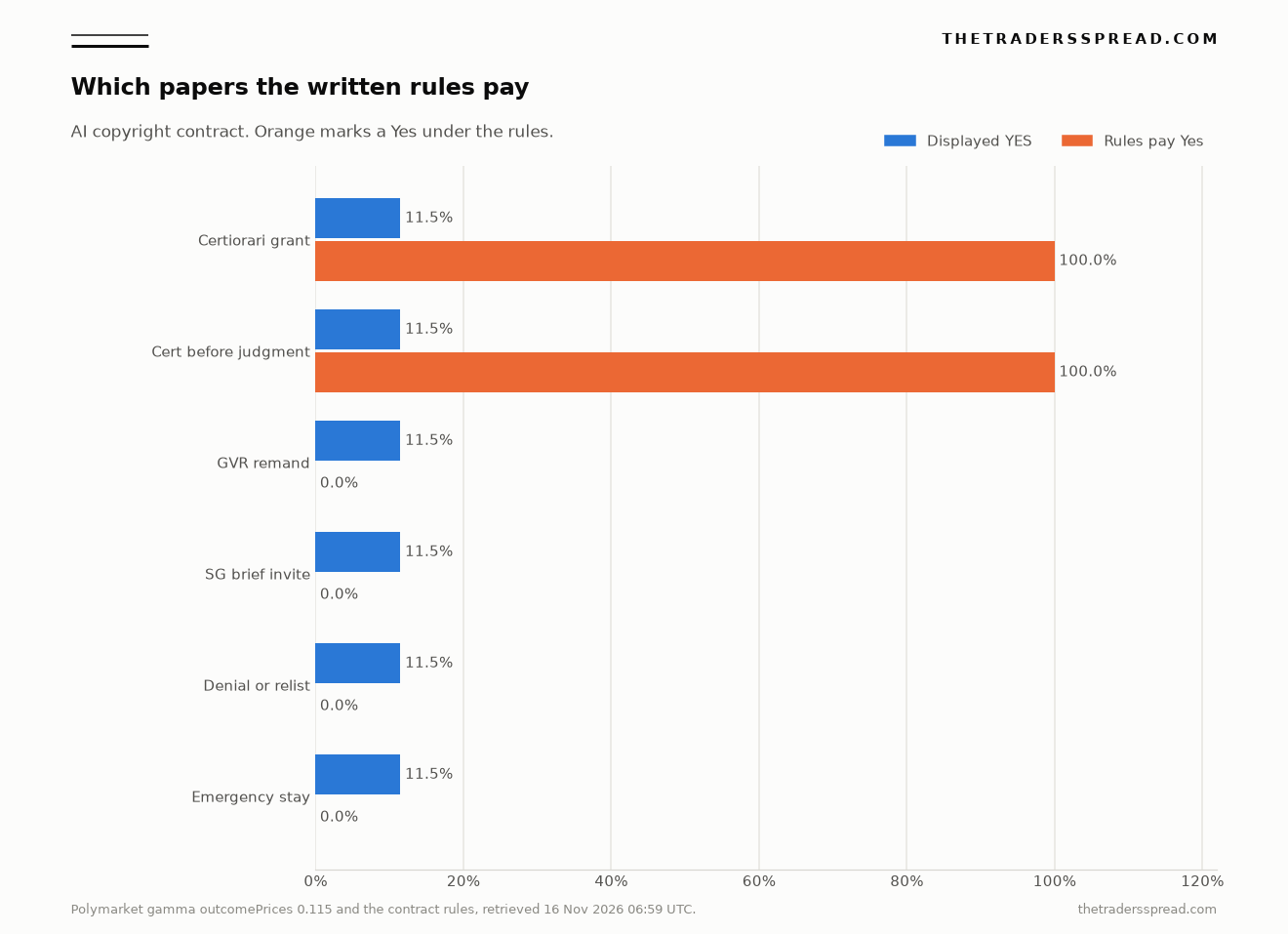
In the chart, the blue bar is the same displayed Yes price, 11.5, on every row. The orange bar records the written gate as 100 where the rules pay Yes and as 0 where they leave the contract on No. Orange is a reading of the rule text beside the price gamma displayed at 06:59 UTC, kept apart from any forecast of the December docket.
| Paper on the Court's site | Where the written rules put it | The sentence we are applying |
|---|---|---|
| Order granting certiorari in a qualifying case | Yes | A grant dated inside the window pays, and the case need not be argued or decided by then. |
| Certiorari before judgment | Yes | The rules include certiorari before judgment inside the definition of a grant. |
| Grant limited to procedure, jurisdiction or remedy | Yes | The narrower question still counts when the case itself qualifies. |
| Qualifying grant, then a later dismissal or settlement | Yes | A later exit from the docket leaves the Yes in place. |
| GVR: grant, vacate and remand without further review | No | The rules say a GVR fails to qualify. |
| Invitation to the Solicitor General | No | An invitation for a brief is listed with the papers that fail. |
| Denial of certiorari | No | A denial, including one with a separate writing, fails the grant test. |
| Relist of a petition | No | A relist keeps the petition alive and is still short of a grant. |
| Emergency application or stay | No | A ruling on an application or a stay fails the grant test. |
| Developer on the caption, no qualifying claim | No | Identity, without a claim on the four-subject list, fails the screen. |
The row that causes the arguments is the GVR, because it grants certiorari on the way to vacating and remanding without further review. Traders who stop at the word grant will file it under Yes, and the rules say that order fails to qualify. An order that grants, vacates, remands and also keeps a question for full briefing sits on the border, and the payout waits until the text is on one side of it. Certiorari before judgment sits inside the definition of a grant, while an invitation to the Solicitor General, a relist and an emergency stay stop short of that grant.
The Court's website is the source of truth
The primary source named in the contract is official information from the Supreme Court, including orders lists and dockets at supremecourt.gov, and a consensus of credible reporting may also be used as a backup when that page is silent or late, while the date of the order still governs. Electronic orders may contain computer-generated errors or deviate from the official printed versions. Within a few months the lists are replaced in a preliminary print of the United States Reports, and a year later by the bound volume. Where print and electronic disagree, the print controls. Where the list disagrees with a later official version, the later version controls.
The market names the Court's official information, and the Court gives the later version the last word on a discrepancy, so a desk that resolves from the 9:30am PDF and a desk that waits for the bound volume are following two documents that usually match. A contract that settles on the first company print, described in our note on beat contracts, leaves the revision to a different question. Here we flag the divergence and leave a real discrepancy to the paper and to the proposal path. A weather contract, written up as a station and a set of readings, pays from the instrument the rules name, and a Court contract pays from the page the rules name.
Two other Supreme Court contracts opened that morning use different tests. The parents-standing market pays Yes if, on or before 31 July 2027 at 11:59pm Eastern, the Court issues an opinion, per curiam decision or judgment in International Partners for Ethical Care, Inc. v. Ferguson, No. 25-840, or a consolidated case, holding that at least one petitioner has standing on at least one challenged claim. Gamma's endDate of 2027-08-01T03:59:00Z matches that July instant, because daylight time is four hours behind UTC. At 05:41 UTC the Yes outcomePrices field read 0.435, the midpoint of a 0.20 bid and a 0.67 ask, with a last trade of 0.58, volumeNum of 1,884.78 and liquidityNum of 497.25. That contract is a standing test, and a dismissal, a mootness vacatur, a settlement or any other ending without a standing holding resolves it to No at once. A fractured decision pays from the judgment. The copyright contract pays on the grant.
The vacancy market pays Yes if a seat becomes vacant between 1 January and 31 December 2026 at 11:59pm Eastern, from an official U.S. government announcement, with the orders list outside that sentence. At 07:01 UTC the Yes field read 0.0515, the midpoint of a 0.017 bid and a 0.086 ask, last trade 0.026, volumeNum 35,366.02 and liquidityNum 1,058.87. Its endDate is 2027-01-02T04:59:00Z, while the written deadline is 2027-01-01T04:59:00Z, a one-day gap between the field and the sentence. All three markets share the resolver 0x65070BE91477460D8A7AeEb94ef92fe056C2f2A7 and a bond field of 500. The reward field is 5 on the copyright and vacancy contracts and 3.5 on the parents contract. The documentation's typical bond of $750 in pUSD is a different number, so we use the field on the market we are describing.
The proposal, the challenge and a second dispute
Prediction markets on that documentation page resolve through UMA's Optimistic Oracle. Anyone may propose an outcome by selecting it, posting a bond and submitting the proposal. A proposal that is right and undisputed returns the bond plus a reward. A proposal that is wrong, or that arrives before the event has concluded, loses the bond. After two hours without a dispute the proposal stands, and a dispute opens a second round, with a further dispute sending the question to UMA's Data Verification Mechanism, a token-holder vote, after a debate of 24 to 48 hours in the channels the page names, #evidence-rationale and #voting-discussion. The page puts an undisputed resolution at about two hours and a disputed one at four to six days. The counter-bond matches the proposer's bond.
RelatedHow China Inflation Band Markets Price the Same Print
A vote can land in four shapes. The proposer can win and the original proposal stands. The disputer can win and a new proposal is required. The vote can mark the proposal too early, which is the shape that matters here before the deadline, because a No filed while the Court can still grant review is a claim the window has yet to settle. The fourth shape is unknown, also called 50-50, and each token then redeems for $0.50. On the clean endings, once the market has resolved, trading stops, winning tokens redeem for $1.00 and losing tokens are worth $0.00, while the fifty-cent ending is the written answer for a question that fits neither outcome.
An unclear order holds the payout
An unclear order is a paper two careful readers can file under two rows. The difference the GVR row actually draws is the phrase "without further review," so a one-line vacatur with nothing left to decide is No, and an order that keeps a question alive is the border. We would want the full order, the docket entry and, where the Court's caution is in play, the later official version, before a headline verb was treated as the payout. A dissent from a denial is still a denial. The orders index describes that habit, an unsigned disposition sometimes carrying a separate writing, and the grant test fails on it however eloquent the writing is.
The same documentation describes a clarification, an "Additional context" note that leaves the fundamental intent of the question intact, is published on-chain, and is meant for proposers and voters. The page points a request toward the #market-review channel. On this contract that note would earn its keep on a real discrepancy between the electronic list and a later United States Reports version, or on an order parked on the GVR border. Until the note exists, the documents on the desk are the market's rules and the Court's pages. Trading continues while the outcome is unresolved. Silence at 11:59pm Eastern on the last day, with no qualifying grant on the list or the docket, is the No the rules' otherwise clause already names.
What a later docket would have to rewrite
A later Supreme Court contract would have to change the written rules before our reading of this one would change, however short the headline stayed. The text would have to say whether a GVR, an invitation to the Solicitor General, a relist or an emergency stay can pay, and whether a qualifying grant survives a later dismissal. It would have to choose between the electronic list, the printed list and the later United States Reports volume when they disagree, and between the gamma endDate and the clock in the rules when those two differ by a day, as they did on the vacancy contract we pulled. It would also have to limit what reporting can add once the Court has dated an order.
Until a later text does that work, the copyright contract still pays on a qualifying grant dated inside the window and still leaves the other papers on No. The 11.5 cent display and the 6 cent last trade are the prints from 06:59 UTC on 16 November 2026. What a later docket would have to change is the wording of that gate, and the wording is what would make two Supreme Court contracts the same bet.
Research for traders, and a description of written rules and of prices pulled from gamma on 16 November 2026. It is not a recommendation to trade any contract. Capital placed on a prediction market can be lost in full.