

At 06:08 UTC on 6 November 2026, Kalshi's order book offered a 25 basis-point Federal Reserve hike at the December meeting for 65 cents while Polymarket's international book asked 67 cents for the same outcome, and the cheaper venue was the one charging the larger fee. Kalshi's general taker formula carries a 0.07 coefficient, and Polymarket's economics markets use 0.05. On a 100-contract purchase at those asks the fees come to $1.60 on Kalshi and $1.1055 on Polymarket, so the all-in cost lands near 66.6 cents a contract on Kalshi and 68.1 cents on Polymarket.
That is why a fair comparison starts from price plus fee. A reader of the fee tables alone would favour Polymarket on this contract, a reader of the quote screen alone would favour Kalshi, and the sum of the two moves every minute. The steps below cover the rest a newer trader needs, from regulation and access through fees, the order book and resolution to withdrawals, all on the December Fed decision so the differences show up on one example.
The Polymarket leg quoted here is the Fed Decision in December event, which had traded $15.39 million in volume at the time of the pull. Links to Polymarket are affiliate links, from which The Traders Spread may earn a commission at no cost to you. Kalshi's matching contract is the KXFEDDECISION-26DEC event, read from Kalshi's public trade API in the same minute.
Updated 6 November 2026
Step 1: Who regulates each venue, and who is allowed in
Kalshi describes itself on its regulation help page as a Designated Contract Market regulated by the Commodity Futures Trading Commission, the federal agency that has overseen US derivatives markets since 1974. An American resident signs up, verifies identity and trades from a dollar balance, and Kalshi's help centre also lists card and crypto withdrawal routes for international accounts.
Polymarket is two products under one brand. Polymarket.com is the international venue, and its geographic restrictions page lists the United States among the regulatory-restricted jurisdictions where users can close existing positions but open nothing new, alongside the United Kingdom, France, Germany and Australia.
US residents use a separate Polymarket US iOS app. Polymarket's help article on the website and the app calls them entirely separate products with separate accounts and support teams. The CFTC's designated contract market record 49571 names QCX LLC d/b/a Polymarket US, status Designated, dated 9 July 2025. Both brands therefore hold a CFTC designation, yet the book quoted in this guide and the UMA process in Step 4 belong to the international venue.
Polymarket's official account announced the US rollout on 3 December 2025, and the post matters here because it marks the moment the brand split into two venues with two separate order books.
Against all odds.
— Polymarket (@Polymarket) December 3, 2025
Polymarket’s U.S app is now being rolled out to those on the waitlist.
We’re launching with sports — followed by markets on everything. pic.twitter.com/WOoVMszrqc
The practical test is short. A US resident compares Kalshi with the Polymarket US app, while someone outside the restricted list compares Kalshi with Polymarket.com, and mixing the two Polymarket books is an easy mistake because contracts, fees and liquidity can all differ.
Step 2: Copy both fee formulas exactly as published
Kalshi's fees help article says the exchange "makes money by charging a transaction fee on the expected earnings on the contract". The general formula Kalshi filed with the CFTC in a rule submission reads: fees = round up(0.07 x C x P x (1-P)), where P is the contract price in dollars, C is the number of contracts and "round up" means to the next cent. S&P 500 and Nasdaq-100 markets use 0.035 instead.
That filing dates from 2022, so we checked it against Kalshi's current API documentation. The fee rounding page works an example in which a buy with $0.055 of revenue carries a model fee of $0.00363825, which equals 0.07 x 0.055 x 0.945 to the last digit. The 0.07 coefficient still stands; the page adds that trade fees are computed to six decimals, with a rounding fee bringing non-direct members back to whole cents.
Maker fees are the second wrinkle. Kalshi's API tags each series with a fee type, and the Fed decision series reads quadratic_with_maker_fees with a multiplier of 1, so resting orders on that contract pay as well. The API reference describes the combo variant as using "a 0.5 maker multiplier instead of 0.25", which puts the standard maker charge at a quarter of the taker formula, about 44 cents on 100 contracts at 50 cents. Cancelling a resting order costs nothing.
Polymarket publishes its formula in the trading fees documentation: fee = C x feeRate x p x (1 - p), with the rate set by category. Crypto pays 0.07; sports, economics, culture, weather and other markets pay 0.05; finance, politics, mentions and tech pay 0.04; geopolitics pays zero. Makers pay zero everywhere, and fees round to five decimal places.
The December Fed event's own API record confirms the tier: feeType economics_fees, rate 0.05, taker-only, with a 0.25 rebate rate that funds Polymarket's daily Maker Rebates Program.
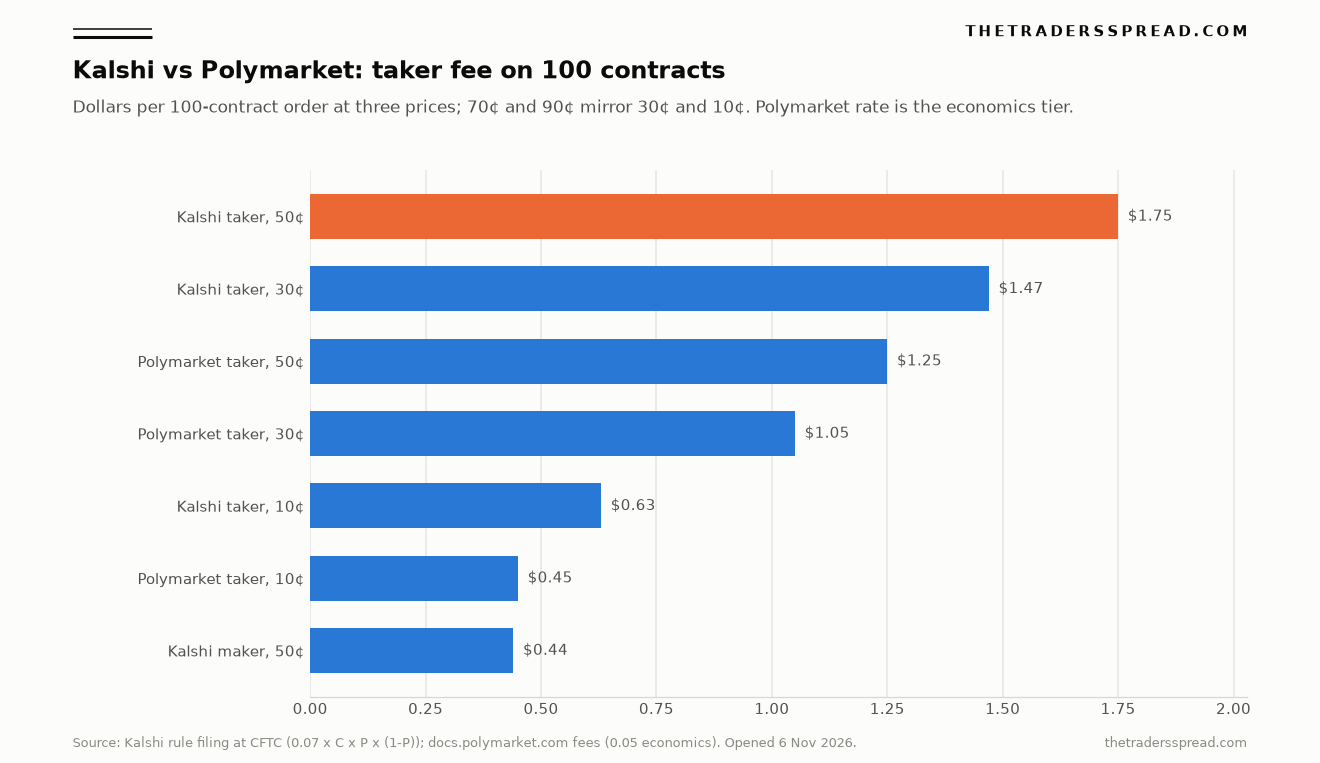
Both formulas peak at 50 cents and fall symmetrically toward the extremes, so a trade at 30 cents costs the same fee as one at 70 cents. On an economics market Kalshi's coefficient yields a fee 40% larger than Polymarket's at every price, before cent rounding adds a fraction more. On crypto the two coefficients match at 0.07, and on geopolitics Polymarket charges nothing.
What the fee does to the price you actually pay
At 06:08 UTC Kalshi's "Hike 25bps" market showed a 64-cent bid and a 65-cent ask, with 8,974 contracts bid and 5,152 offered at the top of the book. Polymarket's "25 bps increase" leg showed 66 cents bid and 67 cents asked, with $612,987 of liquidity on that leg.
Here is the arithmetic for a 100-contract buy at each ask. On Kalshi, 0.07 x 100 x 0.65 x 0.35 = $1.5925, rounded up to $1.60, for a total outlay of $66.60. On Polymarket, 0.05 x 100 x 0.67 x 0.33 = $1.1055, for a total of $68.1055. The 2-cent price gap outweighs the 49.45-cent fee gap, so the all-in Kalshi entry was about $1.51 cheaper per 100 contracts at that minute. A one-cent move on either book is worth $1 per 100 contracts, more than double the fee difference, which is why the answer can change between one refresh and the next.
The "no change" outcome ran the other way. Kalshi showed 34 cents bid and 36 asked for "Fed maintains rate", against 33 and 34 on Polymarket, so a buyer of that outcome met the lower ask and the lower fee on the same venue.
The two venues side by side
| Item | Kalshi | Polymarket.com (international) |
|---|---|---|
| Regulatory status | CFTC Designated Contract Market | US is close-only; US users go to Polymarket US (QCX LLC, CFTC-designated 9 July 2025) |
| Taker fee | round up(0.07 x C x P x (1-P)); 0.035 on S&P 500 and Nasdaq-100 | C x feeRate x p x (1-p); 0.04 to 0.07, zero on geopolitics |
| Maker fee | On flagged series, including the Fed decision | Zero; makers can earn rebates |
| Tick on the Fed contract | $0.01 | 0.01 central legs, 0.001 tails |
| Who decides the outcome | Kalshi, from the Source Agency in the contract terms | UMA Optimistic Oracle proposal, 2-hour challenge |
| Dispute path | Market Outcome Review Process, Rule 6.3(d) | Counter-bond, debate, UMA token-holder vote |
| Time to settle | 1 to 12+ hours to determine; settled by the day after expiration unless under review | About 2 hours undisputed; 4 to 6 days disputed |
| Withdrawal fee | Zero on bank and crypto | Zero from Polymarket; intermediaries may charge |
| Fed December quote, 06:08 UTC 6 Nov | Hike 25bps 64/65 cents; maintain 34/36 | 25 bps increase 66/67 cents; no change 33/34 |
Step 3: Read the order book before the headline number
Both venues run a central limit order book, and the details still change execution. Kalshi's contract terms for the Fed decision set a minimum tick of $0.01 and a position accountability level of $25,000 per member, with last trading at 1:55 PM ET on decision day and expiration at 2:05 PM ET.
Polymarket's API record for the same event shows a tick of 0.01 on the "no change" and "25 bps increase" legs and 0.001 on the three tails, with a minimum order of 5 shares. Its prices and order book page notes that the displayed price is the bid-ask midpoint, or the last trade when the spread exceeds $0.10, while a buyer still pays the ask.
Volume figures need a units check before anyone compares them. Kalshi reports contracts, 1,002,867 on the hike leg, while Polymarket reports dollars, $4.35 million on its matching leg.
Step 4: Find the resolution source and the dispute path
This is where the two designs part most clearly. On Kalshi the exchange itself determines the outcome: its market outcomes help page says Kalshi applies the rules and source named in each contract's terms after expiry, and that determination takes from one hour to more than twelve hours depending on when the source agency's data arrives. For the Fed contract that agency is the Federal Reserve System. Kalshi may open its Market Outcome Review Process under Rule 6.3(d) before settlement, and traders can flag a market through a "Request to Settle" option.
Polymarket hands the job to the UMA Optimistic Oracle. Its resolution documentation sets out the sequence: anyone may propose an outcome by posting a bond, typically $750; a 2-hour challenge window follows; a dispute needs a matching counter-bond and opens a second round; a second dispute goes to UMA token holders after a 24 to 48 hour debate, with voting taking about 48 hours. Undisputed markets resolve in about two hours and disputed ones in four to six days. One outcome exists only on the Polymarket side, "Unknown/50-50", where each token redeems for 50 cents.
The December Fed event's API record lists a UMA bond of 500 and a reward of 5, below the $750 the documentation calls typical, so the figure that counts is the one on the contract in hand. Our explainer on how Polymarket's proposal and dispute stages work walks through the bond arithmetic.
RelatedInitial Jobless Claims vs the Monthly Unemployment Print
The written rules diverge on edge cases as well. Kalshi's terms resolve a cancelled meeting to the "no change" strike. Polymarket's rules default to "No change" if no statement appears by the end date of the next scheduled meeting, and round an off-grid move such as 12.5 basis points up to the next 25-point bracket. Our step-by-step on what settles a Fed decision contract covers those clauses, and the same source-first logic runs through our guide to why US CPI markets on Polymarket miss the first print.
Step 5: Trace the money back to a bank account
Kalshi pays $1 per winning contract, and its settlement documentation puts settlement fees at zero for simple yes/no outcomes. The 2022 fee filing listed a $2 charge on every bank withdrawal; Kalshi's bank withdrawals help page, dated 24 August 2026, now lists zero fees, with funds arriving within a few business days. Crypto withdrawals are also free and typically land within 30 minutes, processed through Zero Hash for US accounts.
Polymarket's international venue settles in pUSD, an ERC-20 token on Polygon backed by USDC. Its help centre says Polymarket charges nothing to deposit or withdraw, though intermediaries such as Coinbase or MoonPay may add charges. A withdrawal swaps through a Uniswap v3 pool, where the interface enforces less than 10 basis points of difference in output and the documentation warns the pool can be exhausted.
Kalshi lands in a bank account in dollars, while Polymarket.com lands in a crypto wallet first, and converting to dollars is a separate step with its own costs.
What would change our mind
Three structural changes would rewrite this comparison. The first is the fee schedule. Kalshi's bank withdrawal fee already went from $2 to zero between the 2022 filing and the current help page, and Polymarket's category table is a protocol setting that can be updated. If Polymarket lifted its economics rate to 0.07, or Kalshi removed maker fees from the Fed series, the fee rows would converge and the choice would rest on price alone.
Regulatory status comes second. If the Polymarket US app listed the same Fed contract with a published fee table and liquidity close to the international venue's $15.39 million, the access row would stop separating the brands for American traders.
Resolution design is the third. A change in UMA's bond sizes or dispute windows, or a Polymarket move toward exchange-determined outcomes, would close the widest procedural gap, while a Kalshi review that reversed a published result would test the case for a single regulated determiner.
Frequently asked questions
What are Kalshi fees?
Kalshi charges a taker fee of round up(0.07 x C x P x (1-P)), rounded to the next cent, on most markets, and uses 0.035 on S&P 500 and Nasdaq-100 contracts. Some series, including the Fed decision market, also charge makers at a quarter of the taker rate. At 50 cents, 100 contracts cost $1.75 in taker fees, and bank and crypto withdrawals are free.
How does Polymarket make money from trading fees?
Polymarket's documentation says taker fees on fee-enabled categories fund its Maker Rebates Program, which redistributes fees to market makers daily, while a tiered Taker Rebate Program returns a share to takers. Geopolitical and world events markets carry zero fees, and Polymarket says it takes no profit from trading on them. Deposits and withdrawals carry no Polymarket charge.
Is Kalshi or Polymarket regulated in the US?
Kalshi is a CFTC Designated Contract Market. Polymarket's US product runs through QCX LLC d/b/a Polymarket US, which the CFTC lists as designated since 9 July 2025, as a separate iOS app with separate accounts. Polymarket.com, the international venue, lists the United States as close-only, so US residents can only exit old positions there.
Can the same event resolve differently on the two venues?
Yes, in edge cases, because each venue writes its own rules. For the December Fed meeting, Kalshi resolves a cancelled meeting to "no change", while Polymarket waits until the end date of the next scheduled meeting before defaulting to "No change", and rounds a 12.5 basis-point move up to 25. Reading both rule sets first keeps two different contracts from being treated as one.
This guide is for information and education only and is not investment advice. Prices are reference data from Kalshi's and Polymarket's public APIs at 06:08 UTC on 6 November 2026 and will have changed. Prediction market contracts can lose their full cost, and fee schedules can change without notice.