

4,942 votes are all that sit behind the leader of the October AI model board. Gemini 4 Argon High, a Google model, is rank 1 on Arena's text leaderboard with style control off, the view this contract uses. The page fetched on 1 October 2026 is dated 30 September. It marks the row Preliminary, prints 1,533 plus or minus 9, and pins the rank spread at 1 to 1.
The surprise is that sample, not the existence of a new model. A favourite priced like a near-lock usually rests on a thick record. This one does not. And the model the benchmark argument is actually about is not the threat on this table: GPT-6 Astra Max sits 72nd, at 1,441. The Google price is a bet that nobody takes the top row before noon in New York on 31 October.
That price, at 07:28 UTC on 1 October, was a last trade of 70.9 cents, with the bid at 70.9, the ask at 71.0 and the gamma outcome price at 70.95. The event is Which company has the best AI model end of October? It is active and not closed. The payload end time is 16:00 UTC on 31 October 2026. Links to Polymarket are affiliate links, from which The Traders Spread may earn a commission at no cost to you.
Key facts
- Google YES last traded at 70.9 cents. Bid 70.9, ask 71.0, gamma outcome price 70.95. Leg volume $232,447, leg liquidity $32,450. Event volume $1,115,775, including $500,141 in the prior 24 hours. Open interest $254,670. Polymarket gamma-api, 07:28 UTC on 1 October 2026. The event record's updatedAt was 07:21 UTC.
- Same pull: Anthropic YES 27.5 cents (bid 27, ask 28, last 26), volume $273,773, liquidity $31,818. OpenAI YES 1.3 cents (bid 0.7, ask 1.9, last 1.9), volume $126,828. Meta YES 0.35 cents (bid 0.3, ask 0.4).
- Active YES prices on 21 live legs add to 100.95 cents. Eleven placeholder legs are inactive, show 0.50 and have zero volume. They are not prices.
- Resolution source: Arena text leaderboard, overall, style control off, Models filter, checked at 12:00 pm ET on 31 October 2026. AutoEval rows are ignored. Rank first, then the unrounded Arena score, then alphabetical company name. Polymarket event rules, read 1 October 2026.
- On that board, dated 30 September 2026, with 8,602,501 votes across 410 models and a vote cutoff of 14:00 UTC: gemini-4-argon-high, 1,533 ±9, Preliminary, 4,942 votes, rank spread 1 to 1. Next is claude-opus-5.5-high at 1,512 ±10 on 3,932 votes. Arena page fetched 1 October 2026.
- Google announced Gemini 4 Argon on 30 September 2026 and is rolling it out to trusted cyber defenders in the Fairwind Program, not to the public. Introductory API price $2 per million input tokens and $10 per million output tokens. Google blog, 30 September 2026.
The check is one afternoon in New York
"Best" here is not a lab's own benchmark card, and it is not the default Arena view with style control on. It is the company that owns the model in first place on one table, at one time.
That table is the Leaderboard tab at arena.ai/leaderboard/text/overall-no-style-control. Style control off. Models, not Labs. The clock is 12:00 pm Eastern Time on 31 October 2026. A rank tie breaks on the unrounded score under the leaderboard, and a score tie breaks on alphabetical company name. At a 21-point gap the alphabet will not come into it.
Models marked AutoEval at the check are thrown out, whether or not a rank is showing. On the 1 October fetch, gemini-4-argon-high carried the word Preliminary and a pre-release flag in the page data. It did not carry an AutoEval mark. Preliminary and AutoEval are not the same word, and the contract only names the second. A tag that appears later is a different case from a tag that is absent today.
A downed leaderboard waits. A source that never returns resolves to Other, which is not a live leg. And the check is one snapshot, not a month average: a model that appears on 30 October can be the whole result. Argon's row is the proof that a few thousand votes can pin a rank.
Rank 1, with the small print attached
The visible order on that 30 September page, top of the Models table:
| Rank | Spread | Model | Company | Score | Votes |
|---|---|---|---|---|---|
| 1 | 1 to 1 | gemini-4-argon-high | 1,533 ±9, Preliminary | 4,942 | |
| 2 | 2 to 6 | claude-opus-5.5-high | Anthropic | 1,512 ±10 | 3,932 |
| 3 | 2 to 6 | claude-fable-5.1-max | Anthropic | 1,511 ±6 | 11,241 |
| 4 | 2 to 6 | claude-opus-5-max | Anthropic | 1,507 ±5 | 28,351 |
| 5 | 2 to 8 | claude-opus-4-6-high | Anthropic | 1,504 ±3 | 77,193 |
| 8 | 5 to 14 | gemini-3.8-flash-high | 1,496 ±5, Preliminary | 24,828 | |
| 10 | 6 to 23 | mimo-v2.6-pro | Xiaomi | 1,491 ±9 | 4,074 |
| 12 | 7 to 19 | muse-spark-1.3-max | Meta | 1,490 ±6 | 11,698 |
| 27 | 21 to 36 | gpt-5.5-high | OpenAI | 1,471 ±4 | 69,312 |
| 49 | 39 to 67 | grok-4.20-beta-0309-reasoning | SpaceXAI | 1,451 ±4 | 66,372 |
| 72 | 47 to 91 | gpt-6-astra-max | OpenAI | 1,441 ±7 | 8,565 |
Read from the resolution page fetched 1 October 2026. The page's own date is 30 September 2026. Ranks 6, 7 and 9, omitted so the table stays readable, are also Anthropic. Rank 11 is a second Meta model. The top nine contains seven Anthropic rows.
Take the displayed margins at face value and the intervals do not overlap. Argon's ±9 runs from 1,524 to 1,542. Opus 5.5 High's ±10 runs from 1,502 to 1,522. Fable 5.1 Max, with a larger sample of 11,241 votes, prints 1,511 ±6, which tops out near 1,517. The heavily sampled Anthropic row, Opus 4.6 High, is 1,504 ±3 on 77,193 votes. Its upper bound sits near 1,507, about 17 points under Argon's lower bound.
The lead is not an artefact of one other thin row. Number two is the thin row. The thick Anthropic rows sit further back. What 4,942 votes threaten is Argon's own point estimate. Nine points of displayed uncertainty is a wide door for a month of new ballots.
The vote cutoff on the page is 14:00 UTC on 30 September. Sundar Pichai's announcement post is timestamped 20:02 UTC the same day, six hours later. The rank-1 row was already in the snapshot. It is not something the afternoon posts created and the leaderboard then invented.
Pichai, chief executive of Google and Alphabet, wrote that day: "It shows frontier performance in complex workflows, cyber defense and software engineering. Teams are using it extensively at Google, from coding to quantum computing." The post is his 30 September thread.
Koray Kavukcuoglu, SVP of Google DeepMind and chief AI architect at Google, put the constraint in the company's 30 September post: "Safely releasing frontier capabilities at this level requires a phased approach." The same post says Argon is rolling out to a set of trusted cyber defenders through the Fairwind Program, that Google is in the US government's voluntary process for pre-release model access, and that developers, enterprises and consumers come later, starting with paid API customers and Google AI Ultra subscribers. No date is given.
Google's own measurements, from that post, are not the payout: 77.9 percent on DeepSWE v1.1, 51.3 percent on Zapier's AutomationBench, 91.7 percent on LVBench, a tie at 68 percent on CWE-bench v1. Output length goes to 1 million tokens, from 64,000. The introductory price is $2 and $10 per million input and output tokens, cached input 95 percent off, then $4 and $20 with no end date stated. A model can lead that card and sit 72nd on the human-preference board. Astra does.
A million dollars of liquidity, and a $32,450 book
Event liquidity on the same gamma pull was $1,076,523. That figure is the wrong one to remember.
It adds up posted size on every leg, including asks at a tenth of a cent with no bid. The Google book was $32,450. Anthropic's was $31,818. Both are two-sided, Google 70.9 to 71.0 and Anthropic 27 to 28, and neither is deep.
We have seen this shape before. On the 2026 rates contract, the zero-cut leg was the one everyone quoted and it was not the leg with the size, a gap we went through in the Fed rate-cuts piece. Here the quoted leg at least has a two-sided touch. It just does not have the million dollars the event total implies.
Lifetime volume tells a different story from the touch. Anthropic has traded $273,773, Google $232,447, OpenAI $126,828, Meta $99,251. The prior 24 hours on the whole event came to $500,141, so the Argon day is in the tape. Open interest was $254,670. The market is not a ghost. It is a busy market with a thin posted book on the two legs that matter.
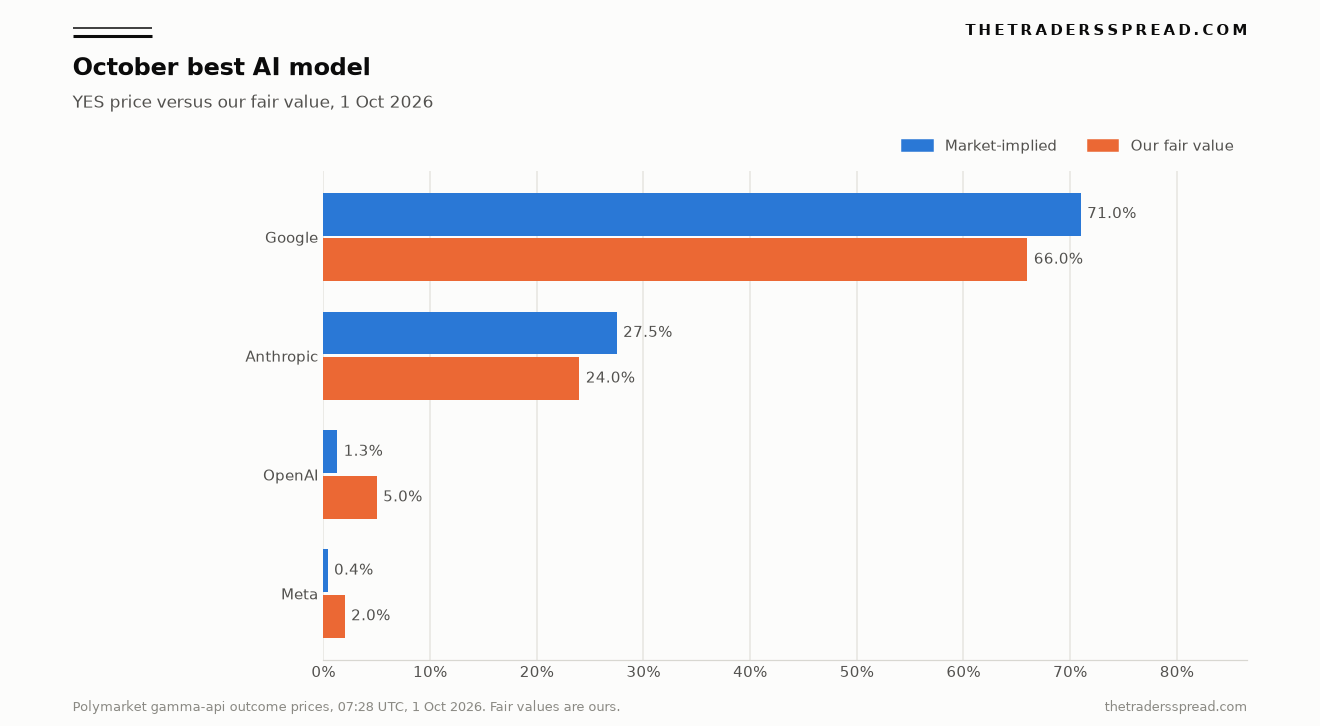
| Leg | Outcome price | Bid / ask | Last | Our fair value |
|---|---|---|---|---|
| 70.95% | 70.9 / 71.0 | 70.9 | 66% | |
| Anthropic | 27.5% | 27 / 28 | 26 | 24% |
| OpenAI | 1.3% | 0.7 / 1.9 | 1.9 | 5% |
| Meta | 0.35% | 0.3 / 0.4 | 0.3 | 2% |
| Everyone else, active | under 1 cent combined | mostly no bid | a tick | 3% |
Prices from the gamma-api pull at 07:28 UTC on 1 October 2026. Fair values are a judgement, built in the last section, and they add to 100. The live legs are the source for everything left of the fair-value column.
Alibaba, Moonshot, DeepSeek, Baidu, Xiaomi, Z.ai, SpaceXAI and the other long shots show an outcome price of 0.0005, an ask at 0.001, and no bid. That is a one-tick stub, not a traded 0.05 percent. Lifetime volume from August is not a price in October.
OpenAI's 1.3 cents is a stub of a different kind. There is a bid, at 0.7 cents, and an ask at 1.9 cents. The last trade on this pull was 1.9 cents, while the outcome price the API publishes is 1.3. Anyone treating 1.3 as "the" OpenAI price is reading a midpoint across a book that is almost three times as wide as the midpoint itself.
Seven Anthropic rows, and a canyon
Anthropic occupies ranks 2, 3, 4, 5, 6, 7 and 9. Seven of the top nine. The scores from 1,512 down to 1,492 are a crowd, not a ladder with daylight in it. Google's second model, Gemini 3.8 Flash High, is rank 8 at 1,496 and is also marked Preliminary. If Argon were dropped from the countable set tomorrow, the next Google row on this snapshot would not be in front. Anthropic would be.
That is the clean way the Google leg loses without a new model. First place is the whole payout. Rank 8 pays zero if a Claude is first.
The other path is a new Claude. Opus 4.6 High through Fable 5.1 already sit in a band of about 20 points, and the thick-sample base near 1,504 is Opus 4.6 High on 77,193 votes. Clearing 1,533 is a larger step than the recent steps inside that band. It is not a fantasy step. The contract pays whoever is on top at a single noon, not whoever led for the longest stretch of October.
OpenAI's gap is why 1.3 cents is less strange than the name GPT-6 suggests. gpt-5.5-high is rank 27 at 1,471 ±4 on 69,312 votes, 62 points behind. GPT-6 Astra Max is rank 72 at 1,441 ±7 on 8,565 votes, rank spread 47 to 91. Astra is already on this table. The table has it in the seventies.
Meta's best row, muse-spark-1.3-max, is rank 12 at 1,490 ±6 on 11,698 votes, 43 points back. Xiaomi's mimo-v2.6-pro is closer, rank 10 at 1,491 ±9 on 4,074 votes, and the Xiaomi leg is a 0.0005 stub. SpaceXAI, the name on Grok's rows, is rank 49 at 1,451 on 66,372 votes: a thick sample and a distant score.
RelatedA US recession by 31 December is priced at 6.5 cents
Nvidia's lead in the largest-company contract is a cousin: a small gap in the underlying, a large gap in the price. Market cap does not get replaced by a Tuesday blog post. An Arena rank does. Anthropic's separate favourite status for the biggest IPO of 2026, with no S-1 on file, is a capital-markets question. We kept the two apart in the IPO note. This market does not pay anyone for a listing.
66 percent
Our fair value for the Google YES is 66 percent. The outcome price, 70.95 cents, sits above it. The gap is real and it is not wide. The leaderboard already has Google first, with the rank spread pinned at 1. 71 cents is a plausible price for that fact. It is a little high for a fact that still says Preliminary, rests on 4,942 votes, and has to survive one afternoon 30 days out.
The 66 is what remains after four judgements:
- Anthropic finishes first: 24 percent. Most of that is a new or improved Claude, not a recount of Opus 4.6 High. A smaller slice is Argon drifting down into the pack as the vote count grows, or being excluded.
- OpenAI finishes first: 5 percent. Almost all of it is a model that is not on the 30 September board. Astra at rank 72 does not carry this number.
- Meta finishes first: 2 percent. Muse Spark is 43 points back. The 0.35 cent price is under that, on a book a tenth of a cent wide.
- Anyone else, including a winner who would resolve as Other: 3 percent. Xiaomi is the closest of this group on the board, and its leg is a 0.0005 stub.
Those four numbers plus 66 are 100. Anthropic at 27.5 cents sits a little above 24. OpenAI at 1.3 cents, last trade 1.9, sits below 5, on a book too wide to treat the midpoint as firm. Google is the tight one: 70.9 bid, 71.0 ask, both above 66.
What would move it: Argon still alone in front after something like 25,000 votes, score still above 1,525, would push the fair value up toward the market. A Claude or an OpenAI model above Argon on this table would push it down by a large step. Argon marked AutoEval or removed, with Gemini 3.8 Flash High still the next Google row at 1,496, would mean Google is not the leader on today's board at all.
Another DeepSWE number would not move it. The contract never looks at that card. The price sitting above our estimate is a description of two figures, not an instruction. The October AI model contract resolves on the rules at noon on 31 October, whatever either number says.
Questions the rules actually answer
What has to be true for Google to win the October AI model contract?
A Google model has to occupy first place on Arena's text leaderboard, overall, with style control off and the Models filter on, at noon Eastern Time on 31 October 2026. Rank comes before score. AutoEval models are skipped. If the site is down, the check waits. The company's benchmark blog is not a resolution source.
Is Gemini 4 Argon something the public can use?
Not on the terms Google published on 30 September 2026. The post says the model is going to trusted cyber defenders through the Fairwind Program, while Google takes part in a voluntary US government pre-release process. Wider access is described as later, starting with paid API customers and Google AI Ultra subscribers, with no date. The Arena row exists anyway. Access and a leaderboard entry are not the same thing.
Why is OpenAI near 1 cent if GPT-6 Astra is a frontier model?
Because this contract does not pay frontier status. On the resolution board dated 30 September, gpt-6-astra-max is rank 72 at 1,441, and OpenAI's best row is gpt-5.5-high at rank 27 and 1,471. The 1.3 cent outcome price is also a messy print: the bid was 0.7 cents and the ask was 1.9 on 1 October. Our fair value of 5 percent is about a model that is not listed yet, not about Astra's current rank.
Should the 0.0005 legs be read as 0.05 percent?
No. On the 1 October pull those outcome prices sit at 0.0005 with an ask at 0.001 and, for the ones we checked against the book, no bid. That is the smallest tick the contract is showing, not a crowd of traders who agree on a twentieth of a percent. Lifetime volume on some of those names does not turn the tick into a forecast.
Does a lower fair value mean the Google price is an instruction?
No. Fair value here is our probability, set beside the market's. The theme on this site prints that comparison as above fair, below fair, or in line. It is not an order. The Google book is only about $32,450 deep. A 71 cent price against a 66 percent estimate can be an accurate description and still be a bad reason to do anything in size.
This is analysis, not a recommendation. Prediction-market contracts can settle at zero, and you can lose what you stake. Leaderboard rows move, preliminary scores move, and the 66 percent figure is a judgement made on 1 October 2026 from the sources named above. It will be stale the moment either board changes.