

| Contract | Yes | Bid / ask | Last | Volume | Liquidity |
|---|---|---|---|---|---|
| Out as secretary by 31 December | 33.5% | 33¢ / 34¢ | 33¢ | $1,896,224 | $124,754 |
| Out as secretary by 30 November | 18.5% | 18¢ / 19¢ | 19¢ | $624,588 | $70,449 |
| Next cabinet departure, Hegseth leg | 29% | 25¢ / 33¢ | 26¢ | $1,021 | $611 |
| House impeachment by 31 December | 60.05% | 60.0¢ / 60.1¢ | 60.0¢ | $127,823 | $53,836 |
Pete Hegseth is priced at 33.5% to be out as secretary inside 54 days, on a one-cent book with $1,896,224 traded, while the cabinet contract asking whether he is the next person to leave shows a displayed 29% across a window two years longer, on $1,021 of volume and an eight-cent spread. The two prints sit badly, because 33.5 cents lies inside the cabinet leg's 25-to-33 range. The book with the depth is the December exit contract. Links to Polymarket are affiliate links, from which The Traders Spread may earn a commission at no cost to you. Every price below is from the Polymarket gamma API, fetched at 21:01 UTC on 7 November 2026.
What moved on the day was the gap between a departure and a vote. House impeachment for 31 December traded at 60.05%, bid 60.0 cents and offered at 60.1, last trade 60.0, up 16 points on the day and 39.5 on the week, on $127,823 of volume and $53,836 of liquidity. The December exit contract fell 2 points that day and 3 on the week, after a month gain of 14.5, and November fell 2 on the day and 5.5 on the week.
Two clocks on one job
The December contract resolves Yes if Pete Hegseth ceases to be United States Secretary of Defense for any period between creation and 31 December at 11:59 pm Eastern Time. An announcement of resignation or removal before the deadline resolves it Yes at once, whatever later date the departure is meant to take effect. Official information from Hegseth and the government is the source, with a consensus of credible reporting as the backstop. The Pete Hegseth Polymarket complex reuses that paragraph on every dated exit leg, and only the deadline changes.
The November leg stops at 30 November at the same hour. Its displayed Yes was 18.5%, bid 18 cents and ask 19, on $624,588 of volume and $70,449 of liquidity, on the November exit contract. About 23 days sit inside that leg from the evening of 7 November, and 31 further days sit in December alone. The 15.0-point gap is the charge for an exit or a qualifying announcement in December, and conditional on him still holding the job through November that slice is 15.0 divided by 81.5, or 18.4%.
Per day the front window costs more: 18.5 points over 23 days is about 0.80 points a day, and the December-only slice is 15.0 points over 31 days, about 0.48 points a day.
Three earlier deadlines settled against an exit
The same wording has already run through three deadlines. Each book settled against an exit, and the closed prints stay in their own table so they stay out of any live quote.
| Deadline | Resolution | When it closed | Volume |
|---|---|---|---|
| 30 June | Settled against an exit | 1 July 2026 | $378,683 |
| 31 July | Settled against an exit | 1 August 2026 | $133,591 |
| 31 October | Settled against an exit | 1 November 2026 | $77,418 |
Under those rules he remained secretary through each deadline, and a qualifying announcement was absent from the record the market used. June closed on 1 July, July on 1 August, and October on 1 November, the morning after that last contract was still a live argument, so the month's 14.5-point December rise followed a market that had just paid the stayers. The same slide of a missed near deadline into the far leg shows up on the Putin exit ladder. Here the far leg carries $1.9 million, and November is the next test.
The cabinet print is an eight-cent spread
The cabinet book asks who is announced next to leave, or who otherwise ceases to be a member. Full chairs through 31 December 2028 at 11:59 pm Eastern Time resolve it to "None before 2029," and an announcement counts immediately. Hegseth's leg displayed 29% at the same pull, bid 25 cents, ask 33, last trade 26, on $1,021 of volume and $611 of liquidity. The event had traded $5,524 since opening at 22:59 UTC on 6 November, with $25,237 of liquidity across the names. That page is the cabinet departure book. Beside the December exit's $124,754 of liquidity, the $611 on his leg is a ratio of about 200 to 1.
Howard Lutnick printed 16%, bid 15 cents and ask 17, last trade 15, on $655 of volume and $3,205 of liquidity, and Marco Rubio displayed 13.5% between 11 and 16 cents. The "none before 2029" leg displayed 11% on a 1-cent bid and a 21-cent ask, and unnamed placeholder rows at 50% carried zero volume.
The questions still differ, because the exit contract pays if he leaves even after someone else has gone first, while the cabinet leg pays only if he is first. Another secretary's November announcement, followed by his in December, is Yes on the dated book and a loss on his cabinet leg. The December bid is 33 cents and the Hegseth cabinet ask is 33 cents, so a share of the gap is simply the midpoint of an eight-cent market.
A House vote pays a different contract
Impeachment is the contract that repriced. Yes on a House impeachment by 31 December was 60.05%, on the Hegseth impeachment book. The House must approve articles by simple majority before 31 December at 11:59 pm Eastern Time. A Senate trial sits outside that payoff, and so does removal. If he vacates the office before the articles pass, impeachment resolves against Yes, because the vote would lack a sitting secretary.
A firing before any floor vote helps the exit contract and hurts impeachment, a vote that leaves him in the chair does the reverse, and a vote followed by a departure helps both. The prices put a floor under the overlap: 60.05 minus 33.5 is 26.5 points of impeachment price that is a vote with him still in the job on 31 December, if the two books share one calendar.
The record of cabinet impeachments is short. Nick Turse, in The Intercept on 6 November 2026, noted William Belknap, secretary of war, in 1876, and Alejandro Mayorkas, secretary of homeland security, in 2024, and the Senate stopped short of conviction both times. Sarah Davis at The Hill on 5 November reported Democrats had secured 54 Senate seats, with Alaska still able to add one, against a Republican majority of 53 to 47. Fifty-four seats complicate a successor's confirmation, while sixty-seven, the conviction line, is a different coalition, so an exit by the December deadline still travels by resignation, firing, or an announcement of either.
A political shock that leaves the officeholder in place is the mistake the Merz chancellor page flagged when a coalition crack was treated as removal. Settlement here still runs through an oracle proposal and, if disputed, a bond, the path in the resolution walkthrough, and the reporting backstop has to describe an announcement or a departure.
What was said on the record
The secretary's own words point at staying. Ryan King and Steven Nelson, in the New York Post on 5 November, reported a video of nearly six minutes filmed outside the Pentagon in which Pete Hegseth said, "Just like the president, we don't back down, and that especially applies now." The Post said the House was expected to take up a resolution Representative Thomas Massie introduced in September when the chamber returned the following week, accusing him of waging the war without congressional authorization.
Mike Brest at the Washington Examiner the same afternoon quoted him saying the department had "only just begun to fight" and would "defend this republic from all enemies foreign and domestic." Hegseth posted the clip himself that afternoon on the official account. An on-camera refusal is the opposite of the announcement the exit rules would treat as an immediate Yes.
At the War Department:
— Secretary of War Pete Hegseth (@SecWar) November 5, 2026
We Stand.
We Fight.
We Defend the Republic. pic.twitter.com/Kkr0DazmCE
President Donald Trump told ABC's Jonathan Karl on Thursday morning that he had "every intention" of keeping Hegseth, Davis reported, while granting that a new nominee would be easier to confirm before the next Congress. Sean Parnell, described by the Post as Hegseth's top spokesman, said on 4 November that Hegseth intends to remain through the term, and Pentagon spokesperson Kingsley Wilson had called a Tennessee Senate rumour "beltway gossip by anonymous sources."
The anonymous line is hotter, and it stays labelled that way. Turse wrote that officials were floating replacements, Florida Governor Ron DeSantis and Mike Waltz among them, and quoted one official calling Hegseth a "dead man walking." That single-source mood stays outside the resolution source until an announcement exists.
Where the wire left it
Reuters carried the same video as a straight item the next morning. A wire record is the sort of page a resolution reviewer opens, which is why the post sits here beside the prices.
US Defense Secretary Pete Hegseth issued a video message vowing to fight efforts in Congress to impeach him and defending the Iran war as ‘courageous and historic’ after voters punished Republicans over it in this week’s midterm elections https://t.co/16EHsRSk2q
— Reuters (@Reuters) November 6, 2026
Set beside that tape, December's 14.5-point rise on the month started near 19% before Tuesday's election, while the cabinet book that opened at 22:59 UTC on 6 November was being read as a ranking a day later.
Where 24% comes from
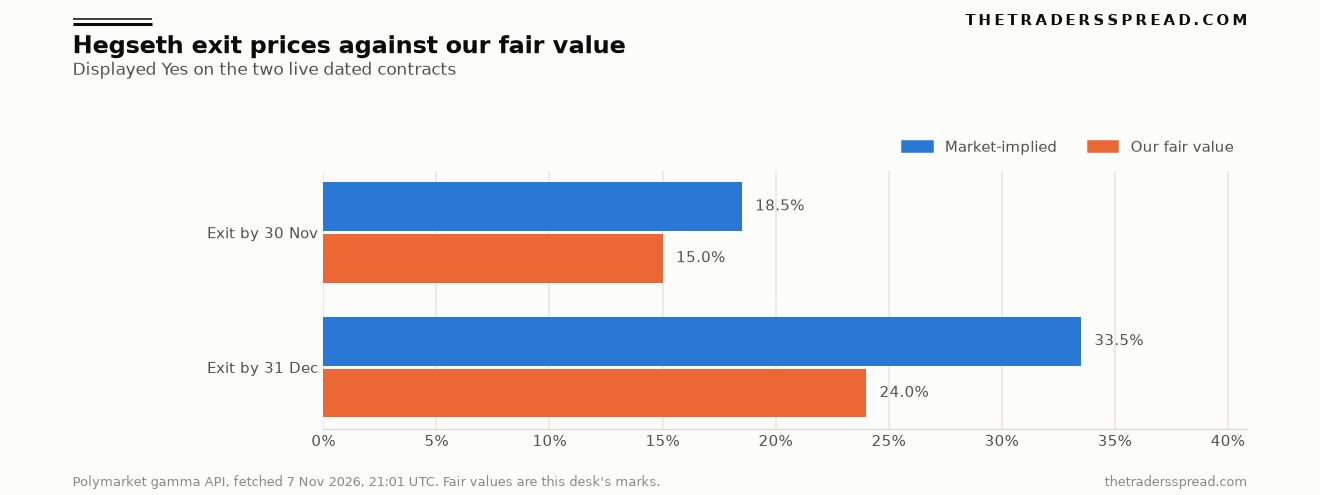
Our fair value on the December exit contract is 24%, and the November contract is marked at 15%. The screens sit above both, 18.5 against 15 and 33.5 against 24, so the December price is rich by 9.5 points on the evidence in hand.
Related7 Steps That Settle a Fed Decision Market Contract
Start from the November display of 18.5% and take off 3.5 points, about a fifth. The dated event inside those 23 days is a House process that the impeachment rules pay on their own contract, so some of the 18.5% is a vote that leaves him in the chair while the larger share remains a real chance he leaves. The announcement clause makes a Yes easier than a rule that waited for him to clear the building, and the 26.5-point bound from the other book is the clue that only a modest slice of that split lands on this near leg.
The market's December-only slice is 15.0 points. We mark it at 9, about 0.29 points a day across 31 days, against 0.65 a day in our November mark and 0.80 in the market's November print. The step is steeper than the book's drop from 0.80 to 0.48 because the House return Massie and the Post placed in the coming session sits in November, and December is the residual of a president who has said he intends to keep the secretary. Added to the 15-point November mark, the sum is 24.
| Piece | Market | Our mark |
|---|---|---|
| Through 30 November | 18.5% | 15% |
| December only | 15.0 points | 9 points |
| Through 31 December | 33.5% | 24% |
Plus 14.5 points on the month puts the older December display near 19%, before the election, and our 24% sits between that level and today's 33.5. Passing the entire 14.5 points into fair value is a separate claim: 16 points of the day's excitement landed in impeachment while the exit contract gave 2 points back.
What would move the 24% mark
The mark rises if November is still above 25% after the House has voted, or after that session passes with the vote still ahead, and he is still secretary, because that price would be about an exit and the 3.5-point haircut would return. The mark falls if November drops under 10% while the White House repeats, on the record, that he stays, which would leave nine points of December risk looking heavy.
An official announcement of resignation or removal takes the mark into the high 90s, because the rules resolve the December book to Yes on the announcement itself, even when the effective date is later. Names in a reported conversation, DeSantis or Waltz, keep the December slice above zero and remain a weak reason to pay 33.5. A House vote that passes, with him still at the podium the next morning, would confirm the separation and leave 24% looking full.
Until one of those prints arrives, 33.5% is above the mark the rules, the term structure, and the on-record reporting will support. The cabinet 29% agrees only as a midpoint, and the eight-cent spread swallows the agreement. The comparison with depth is impeachment at 60.05%, a tight book aimed at a payoff these exit rules ignore.
Frequently asked questions
What does the December exit contract pay on?
It pays Yes if Pete Hegseth ceases to be United States Secretary of Defense for any stretch before 31 December at 11:59 pm Eastern Time, or if a resignation or removal is announced sooner. Official word from him and the government is the source, with credible reporting as the backstop, and at 21:01 UTC on 7 November the displayed Yes was 33.5%, bid 33 cents and ask 34.
Why can the cabinet price sit near the exit price and still differ?
The exit contract pays if he leaves, even when someone else leaves sooner. The cabinet leg pays only if he is next, on a horizon into 2028, and it showed a 25-to-33 spread around 29% on $1,021 of volume. A one-day-old midpoint is a weak rival to the December book, where a 33-cent bid matches the cabinet ask.
Does a House impeachment settle the exit contract?
A House majority settles the impeachment contract, which showed 60.05% for a vote by 31 December on a one-tenth-cent spread. The impeachment rules place a Senate trial and removal outside that payoff, so the exit contract still needs a resignation, a firing, or an announcement. If he leaves before any vote, the impeachment contract resolves against Yes.
What would push this desk's 24% mark?
The mark rises if November holds above 25% after the House window and he is still in the job, because that price would be about an exit. It falls if November drops under 10% while the White House repeats, on the record, that he stays. An official announcement of resignation or removal takes the mark into the high 90s, because the rules pay Yes on the announcement itself.
The figures above are a reading of public contract rules, gamma API prices at 21:01 UTC on 7 November 2026, and named reporting from that week. Readers weigh for themselves whether any contract fits their own situation.