

The Fed Decision in January market does not settle on the chair's press-conference wording. It settles on the change, in basis points, in the upper bound of the target range for the federal funds rate, measured against the level already in force before the meeting the contract names.
On the gamma read we pulled at 06:47 UTC on 5 November 2026, the No change leg of that open book carried an outcome price of 0.775. Four minutes later, the separate Fed Decision in December book carried 0.775 on a different leg, the 25 bps increase. The printed figure matches, and the brackets differ, as do the meetings. December's contract measures the change at the 8-9 December 2026 meeting. January's contract measures the change at the 26-27 January 2027 meeting, against whatever upper bound is in force before that later date. A December move rewrites the baseline January will be scored against. Reading the shared 0.775 as agreement between the two books skips the meeting that sits between them.
The open contract is the Fed Decision in January event on Polymarket. Links to Polymarket are affiliate links, from which The Traders Spread may earn a commission at no cost to you. The steps below follow a resolution in the order the rules run: the named meeting, the upper bound already in force, the statement and its fallback clock, the basis-point change, the 25 bp bracket, the dissent line, and a resolved book set beside a live one.
Updated 5 November 2026.
Key facts
- The Fed Decision in January event was open at 06:47 UTC on 5 November 2026, with volume of $1,170,208, liquidity of $615,467 and day volume of $26,228 (Polymarket gamma API, 5 November 2026).
- Outcome prices on its five brackets were 0.55, 1.65, 77.50, 18.50 and 0.55 cents, summing to 98.75 cents (Polymarket outcomePrices, 5 November 2026).
- The 28 October 2026 statement maintained the target range at 3-3/4 to 4 percent on a 10-2 vote (Federal Reserve FOMC statement, 28 October 2026).
- The 16 September 2026 statement raised the range by 1/4 percentage point to 3-3/4 to 4 percent on a 12-0 vote (Federal Reserve FOMC statement, 16 September 2026).
- The open-market table shows one 2026 row, dated 17 September, an increase of 25 basis points, to a level of 3.75-4.00 (Federal Reserve open market operations page, footer dated 16 September 2026, retrieved 5 November 2026).
- The Committee holds eight regularly scheduled meetings a year, and minutes are released three weeks after the policy decision (Federal Reserve calendar, page last updated 28 October 2026).
Step 1: The contract names one meeting
Both open books sit in the same sleeve. The series object on the January response at 06:47 UTC is titled FOMC, seriesSlug fomc, with a series volume field of $14,173,474. The event slug decides which meeting is in play: January's is fed-decision-in-january-20260729233815502, and December's is fed-decision-in-december-20260729232808632.
The January rules name the statement after the meeting scheduled for 26-27 January 2027 on the Board's calendar. The December rules name the statement after 8-9 December 2026 and point at the same URL, which we opened. The footer reads last update 28 October 2026.
An asterisk, the Board's mark for a Summary of Economic Projections, sits on March, June, September and December, and the January 2027 cell is blank. A note under the list says each date is tentative until the preceding meeting confirms it, so the contract can name 26-27 January 2027 while the Board still marks that pair tentative.
| Dates | Where it sits | Projections | Role for these books |
|---|---|---|---|
| 15-16 September 2026 | 2026 list, held | Yes | Statement raised the range by 1/4 point, to 3-3/4 to 4 percent |
| 27-28 October 2026 | 2026 list, held | No | Statement maintained 3-3/4 to 4 percent |
| 8-9 December 2026 | 2026 list, still ahead | Yes | Meeting named in the December contract |
| 26-27 January 2027 | 2027 list, tentative | No | Meeting named in the January contract |
| 16-17 March 2027 | 2027 list, tentative | Yes | Next date on the calendar after January |
The closed January 2026 book named 27-28 January 2026, the pair on the 2026 section of the same calendar, so the days in the title belong to that vintage.
Step 2: The upper bound already in force
The rules define the rate by the upper bound of the target federal funds range. The change is that upper bound after the named meeting, compared with the level prior to the meeting.
The latest statement on the calendar is dated 28 October 2026, for release at 2:00 pm EDT. The Committee decided to maintain the target range at 3-3/4 to 4 percent. The upper bound in that sentence is 4 percent. On the documents available on 5 November, that is the ceiling in force before the December meeting. It is the ceiling before the January meeting only if December's statement leaves it there.
The prior move is the 16 September 2026 statement, marked for 2:00 pm EDT. The Committee raised the range by 1/4 percentage point to 3-3/4 to 4 percent on a 12-0 vote. A quarter point is 25 basis points, and the open-market page defines a basis point as 1/100 of a percentage point. Its 2026 table, retrieved 5 November 2026, shows one row, dated 17 September, increase 25, level 3.75-4.00, under a footer dated 16 September 2026. The contract names the statement as the resolution source and that page as a second place the level is published, so the statement is the page the rules put first when those dates disagree.
The 2026 section of that table has the September increase alone. The 28 January 2026 statement maintained 3-1/2 to 3-3/4 percent, and the October statement maintained 3-3/4 to 4 percent, with neither hold appearing as a row. A new row appears when the level changes, and a hold lives in the statement. The RBA cash-rate contract works the same way: the board's own target is the question, and someone else's implied path is a different one.
December can still move the ceiling January inherits. At 06:51 UTC on 5 November that book was open, with event volume of $12,900,333, liquidity of $2,595,489 and day volume of $968,946. Its 25 bps increase leg printed the other 0.775, No change printed 0.215, and the five outcome prices summed to 100.45 cents against January's 98.75. The Fed Decision in December event carries an endDate of 10 December 2026 at 04:59 UTC.
Step 3: The statement, and the clock if none appears
The resolution source in the January text is the FOMC statement after the meeting on the official calendar, and the market may resolve as soon as that statement is issued. The three statements we opened, dated 28 January, 16 September and 28 October 2026, were each marked for release at 2:00 pm Eastern.
The Board's account posted the statement link at 18:01 UTC on 28 October 2026, a minute after the 2:00 pm Eastern time printed on that day's statement. The contract resolves on the statement the rules name.
Federal Reserve issues #FOMC statement: https://t.co/D6u2WlUUav
— Federal Reserve (@federalreserve) October 28, 2026
Gamma stamps an endDate on the January event of 28 January 2027 at 04:59 UTC, which is 11:59 pm Eastern on 27 January 2027, the second day of the meeting the rules name. The fallback sentence is a longer clock: if the statement is still unpublished by the end date of the next scheduled meeting, the market resolves to the No change bracket. On the calendar we opened, the date after 26-27 January 2027 is 16-17 March 2027, tentative until the January meeting confirms it.
The endDate field and the fallback sentence are different deadlines. A blank afternoon and a statement that maintains the range are different objects, and the fallback applies when the January statement stays unpublished past the following meeting.
Minutes run on a third clock. The calendar puts them three weeks after the decision, so 18 November 2026 for the October meeting, and the October block we opened still had an empty minutes line. The closed January 2026 book shows a closed time of 28 January 2026 at 23:04 UTC, while the calendar dates that meeting's minutes to 18 February 2026, after the book had already closed.
Step 4: Basis points, counted on the upper bound
Once a statement prints a range, the arithmetic is the new upper bound minus the old one. Taking the October ceiling of 4 percent as a ruler, only because it is the latest ceiling we opened, the January 2027 menu reads like this: 4.25 percent is a rise of 25 basis points, 4.50 or higher is a rise of 50 or more, 4.00 is a change of zero, 3.75 is a decline of 25, and 3.50 or lower is a decline of 50 or more. December's statement moves the ruler if it moves the ceiling.
January 2026 is the worked case of a zero: the statement maintained 3-1/2 to 3-3/4 percent, so the upper bound stayed at 3.75, matching the 2025 open-market table's last row, an 11 December decrease of 25 basis points to 3.50-3.75.
The lower bound sits outside the contract's sum. A later statement that printed 3.50 to 4 percent would drop October's 3.75 floor and leave the 4 percent ceiling where it was, a change of zero basis points on the definition we read.
Step 5: A 25 bp bracket, including the round-up
The January 2027 event carries five legs. The groupItemTitle field reads 50+ bps decrease, 25 bps decrease, No change, 25 bps increase, and 50+ bps increase. Each leg is its own market, with its own outcomePrices, volumeNum and liquidityNum, inside a neg-risk event, and on this read the five prices sum to 0.9875.
| Bracket | Outcome price | Bid / ask | Last trade | Volume | Liquidity |
|---|---|---|---|---|---|
| 50+ bps decrease | 0.55 cents | 0.5 / 0.6 | 0.5 cents | $196,262 | $133,329 |
| 25 bps decrease | 1.65 cents | 1.6 / 1.7 | 1.6 cents | $179,147 | $126,639 |
| No change | 77.5 cents | 77 / 78 | 78 cents | $303,217 | $132,023 |
| 25 bps increase | 18.5 cents | 18 / 19 | 19 cents | $367,496 | $107,107 |
| 50+ bps increase | 0.55 cents | 0.5 / 0.6 | 0.6 cents | $124,086 | $116,437 |
Prices, bids, asks and last trades are the gamma fields at 06:47 UTC on 5 November 2026, with volume and liquidity rounded to the dollar. The No change outcome price of 0.775 sits inside a one-cent spread, with the last trade at 0.78 on the ask. The 25 bps increase outcome price of 0.185 has its last trade at 0.19, also on the ask.
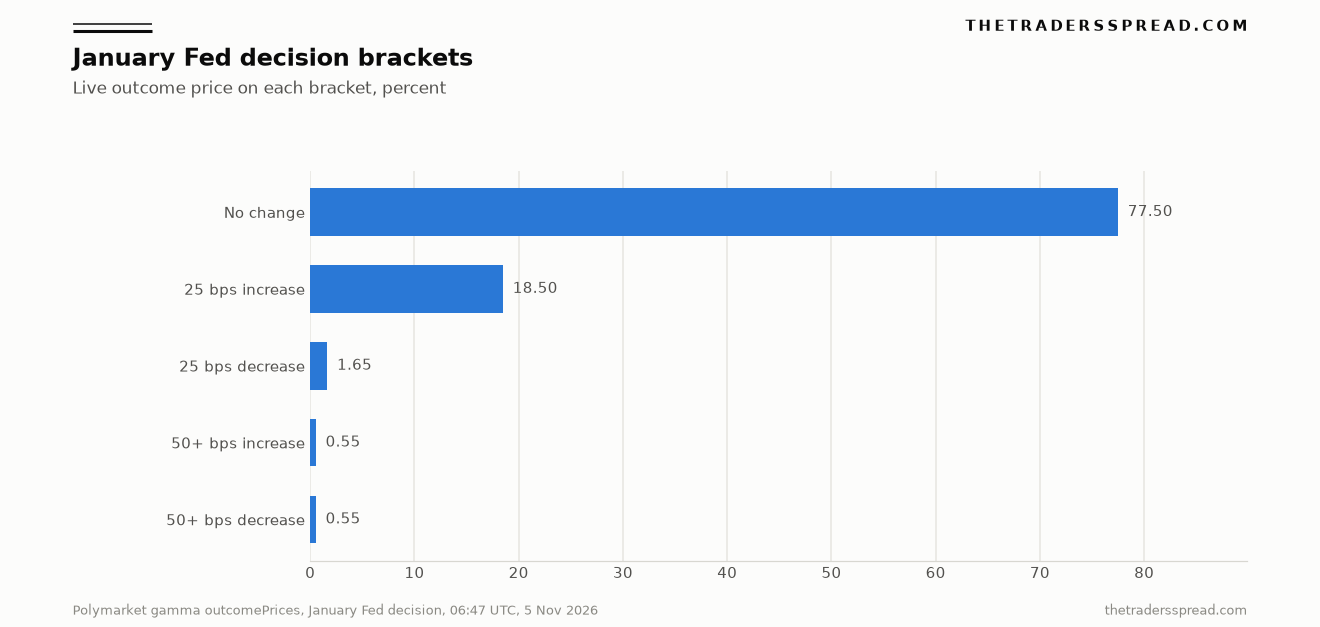
Inside the same book, No change is up 0.185 on the month and the 25 bps increase is down 0.180, against day changes of plus 0.05 and minus 0.06.
If the new rate sits off the displayed menu, the change is rounded up to the nearest 25 and resolves to the matching bracket. The parenthetical in the rules says a cut or an increase of 12.5 basis points is treated as 25, and the text stops there, so a 12.5 bp rise lands in the 25 bps increase bracket and a 12.5 bp decline lands in the 25 bps decrease bracket.
The menu has already changed between vintages. The closed January 2026 book has four labels, with the increase side as one leg marked 25+ bps increase. The 2027 book splits that side into 25 and 50+. How Bank of Canada and RBNZ contracts line up is the same habit applied to two other banks.
Step 6: The dissent sits beside the decision
A dissent is a sentence inside the statement. It records who preferred a different action. The range in the decision sentence is the range the upper-bound test uses.
On 28 January 2026 the statement lists Jerome Powell as Chair among the voters for maintaining the range at 3-1/2 to 3-3/4 percent, and two against. Stephen Miran and Christopher Waller preferred to lower the target range by 1/4 percentage point. The closed book for that meeting settled on the No change leg, the bracket the decision sentence produces.
RelatedDo Bank of Canada and RBNZ contracts resolve alike?
On 28 October 2026 the statement says the action carried 10-2. Lisa Cook and Beth Hammack preferred to raise the target range by 1/4 percentage point, while the decision sentence maintains 3-3/4 to 4 percent. The 16 September statement, the one that did move the range, was 12-0, and the dissent line is absent.
The press conference is a further document, posted later the same day. At 20:33 UTC on 28 October the Board's account said Chairman Warsh was reading an opening statement at the press conference, about two and a half hours after the statement link. The contract text names the policy statement and leaves the press conference off the source line.
Chairman Warsh reads opening statement at the #FOMC press conference on October 28, 2026: https://t.co/QjiMBx7Cgt
— Federal Reserve (@federalreserve) October 28, 2026
Under 27-28 October the calendar lists the statement, an implementation note and a press conference as separate items. The contract text leaves the implementation note unmentioned, and the bracket follows the upper bound in the decision sentence.
Step 7: A resolved book and a live book
The earlier January book, slug fed-decision-in-january, is a different object from the one in the chart. Gamma lists it closed, with closedTime 28 January 2026 at 23:04:04 UTC, open interest of zero and a recorded event volume of $659,499,549. Each leg has acceptingOrders set to false and umaResolutionStatus resolved. The No change leg is the settled winner, and the other three legs resolved the other way.
The closed event still has active set to true, and so does the open January 2027 event. The open book has closed set to false and acceptingOrders true on every leg. Open interest on the live book was $142,361 at the 06:47 read, against zero on the closed book. The sleeve name drifted as well: the closed event's seriesSlug reads fed-interest-rates, the open event's reads fomc, and both responses embed a series object whose own slug is fomc.
Once a statement is out, someone still has to propose the resolution on the book. Proposal, dispute and the bond posted against a bad proposal sit outside the FOMC text and inside the market's own rules. How a proposal and a dispute work is that layer, and it comes after the statement.
The closed January 2026 event is the settlement example. Its $659.5 million volume is a historical total, set beside $1.17 million on the open January 2027 book and $12.9 million on December.
| Document | What the page shows | Role in the January 2027 rules |
|---|---|---|
| FOMC statement | Range and the vote. The three we opened were timed at 2:00 pm Eastern | Named resolution source |
| Open-market table | One 2026 row, a 25 bp rise dated 17 September, level 3.75-4.00. Footer dated 16 September | Another place the level is published |
| Implementation note | Separate calendar link under the statement | Left unmentioned in the contract text |
| Press conference | Separate calendar link. Posted at 20:33 UTC on 28 October | Left unmentioned in the contract text |
| Minutes | Three weeks after the decision. January 2026 minutes dated 18 February, after that book closed | Left unmentioned in the contract text |
| Dissent sentence | Voters who preferred a different quarter-point move | The adopted range is the input |
FAQ
Which figure does a Fed decision market use?
The contract text defines the rate by the upper bound of the target federal funds range. The figure that selects the bracket is the change in that upper bound, in basis points, versus the level in place before the named meeting. A floor can move while the ceiling stays put, and the test still scores a zero on the upper bound. The statement is the resolution source, while the press conference and the minutes sit on separate calendar links.
What happens when the statement is late?
The January 2027 rules say the market may resolve as soon as that meeting's statement is issued. If the statement is still unpublished by the end of the next scheduled meeting, the text resolves the market to the No change bracket. The calendar puts 16-17 March 2027 after the January meeting, tentative until the prior meeting confirms it. The event endDate, 28 January 2027 at 04:59 UTC, is a different field from that fallback.
Can a dissent flip the bracket?
On 28 January 2026 the Committee maintained the range at 3-1/2 to 3-3/4 percent, while Stephen Miran and Christopher Waller preferred a cut of 1/4 percentage point. The closed book for that meeting settled on No change. On 28 October 2026 the Committee maintained 3-3/4 to 4 percent, while Lisa Cook and Beth Hammack preferred a rise of 1/4 percentage point. In both statements the adopted range is the decision, and the preference is written beside it.
Verdict
Before a Fed-decision price is treated as settled, four items have to agree: the event's closed flag and the orders flag, the statement the rules name, the upper bound printed in that statement, and the bracket that change maps onto, including the round-up the text actually gives. A price on an open book is a quote taken at a stated time. The January 2027 event was still accepting orders at 06:47 UTC on 5 November 2026, with No change at 77.5 cents, and with December's meeting still ahead of it. The closed January 2026 book, winner on No change after a statement that maintained the range, is what a settled vintage looks like.
The steps above are a reading of the contract text and of the Board pages opened on 5 November 2026, for information only, and they are not a recommendation to transact.