

What is this market actually asking? Not whether Nicolás Maduro walks out of the Metropolitan Detention Center in Brooklyn, where he has been held since a US operation flew him out of Caracas on 3 January 2026. The Polymarket contract on Venezuela's leadership asks something narrower and far more literal: whose name sits in the head-of-state field on 31 December 2026, and, decisively for the money, which document the resolver reads to find out. The rules answer that in a specific order. Official Venezuelan government information comes first. A list maintained by the United Nations Protocol and Liaison Service is only the tiebreak, used "if the Venezuelan government does not clearly state who is the head of state". At the time of writing the Maduro leg trades at 82.65 cents. We think the market has the two sources in the wrong order, and that the leg is expensive.
Here is the conflict, and as far as we can tell nobody has put the two documents side by side. On 9 September 2026 we pulled both. The UN Protocol list, dated 08/09/2026, records Venezuela's head of state as "Excelentísimo Señor Nicolás Maduro Moros", full title "Presidente de la República Bolivariana de Venezuela", date of appointment 05-Mar-13. One day earlier, on 07-09-2026, Venezuela's own Ministry of People's Power for Foreign Affairs published a communiqué that opens: "La Presidenta de la República Bolivariana de Venezuela, Delcy Rodríguez Gómez, extiende un afectuoso saludo a la República Federativa del Brasil." That is the full constitutional title, unqualified, applied to somebody else. In the text of the three ministry publications we checked there is no "encargada", no "(E)", and no reference to Maduro as the sitting president. The Venezuela leadership market on Polymarket is pricing the fallback document and ignoring the primary one. Links to Polymarket are affiliate links, from which The Traders Spread may earn a commission at no cost to you.
Key facts
- Maduro leg trades at 82.65% YES, best bid 0.826 against best ask 0.827 — Polymarket gamma-api, retrieved 9 September 2026
- Venezuelan foreign ministry communiqué dated 07-09-2026 names "La Presidenta de la República Bolivariana de Venezuela, Delcy Rodríguez Gómez" — mppre.gob.ve, retrieved 9 September 2026
- UN Protocol and Liaison Service public list dated 08/09/2026 still records Nicolás Maduro Moros, appointed 05-Mar-13
- Delcy Rodríguez prices second at 10.5%, against our fair value of 32% — Polymarket gamma-api, 9 September 2026
- Reported event volume $96.02m, but 92.1% of it sits on legs priced under 1% — The Traders Spread calculation from gamma-api leg data, 9 September 2026
- Resting liquidity on the Maduro leg itself: $62,895 — Polymarket gamma-api, 9 September 2026
- Rodríguez's 90-day term as acting president under Article 234 expired on 5 April 2026 — Latin America Reports, 24 April 2026
The rules have an order, and it matters
Most political contracts are bets on events. This one is a bet on which filing cabinet gets opened first.
The resolution text settles on the individual who "officially holds the position of the head of state of Venezuela on Dec 31, 2026 at 12 PM ET", where officially holding means formally appointed, confirmed where required, and sworn in, "or otherwise confirmed by official government information as being the head of state". Only after that does the fallback arrive: "If the Venezuelan government does not clearly state who is the head of state, the market will resolve to the individual who is listed as the Head of State by the UN."
Two conditions have to hold before the UN list is ever consulted. The Venezuelan government must be unclear, and it must stay unclear through 31 December. Neither looks true today. A foreign ministry communiqué is official government information by any ordinary reading, and the ministry is not hedging. We checked three of its publications. The communiqué of 7 September uses the full constitutional formula. A second item the same day, on a conservation agreement with India, calls her "la Jefa de Estado". A third, dated 2 September, does the same. None of the three carries "encargada", none carries an "(E)", and none mentions Maduro in its text.
Two honest limits on that. We checked the foreign ministry, not every organ of the Venezuelan state: the presidency's own site returned an empty page, and the Supreme Tribunal's refused our request. And the National Assembly still hosts, among its archived documents, the record of Maduro's swearing-in as "presidente constitucional", a retrospective filing rather than a current assertion, but a resolver hunting for contradiction would find it.
The UN document, by contrast, shows its age on its face. It dates Maduro's appointment to 05-Mar-13, and it has not been revised even though the same Venezuela block was updated on 13 July 2026 to record a new foreign minister, Félix Plasencia González. A protocol list is a courtesy register that moves when a member state notifies it. Caracas has evidently notified a change of foreign minister and not a change of president, which tells you something about Venezuelan bureaucratic priorities and very little about who holds the office.
How the market got to 82.65%
The price history explains the mistake, and it is an honest mistake rather than a stupid one.
When the market opened on 4 January 2026, one day after the capture, the Maduro leg printed 4.4%. Traders read the removal as terminal. Through February and March the leg drifted between 10% and 16% while the Rodríguez leg peaked near 67%. Then, between 14 and 18 April, the Maduro leg went from 17.6% to 57.7%, with hourly data putting the bulk of the move inside 17 April. It has ground higher ever since, touching 86.4%.
Nothing happened in Venezuela on 17 April. What had happened was an absence.
Under Article 234 of the Venezuelan constitution, a temporary presidential absence is covered by the vice president for up to 90 days, extendable once by the National Assembly. Rodríguez was sworn in on 5 January 2026 after the Supreme Tribunal ordered her to assume the office, as Reuters reported that day. Her 90 days ran out on 5 April. The National Assembly was expected to debate the expiry between 6 and 10 April and did not. On 12 April its president, Jorge Rodríguez, told El País: "The most important thing right now is the economy... I couldn't tell you exactly when, or even what the first election will be." Latin America Reports set out the sequence on 24 April 2026.
The market drew a reasonable inference: if nobody will declare the office vacant, the office stays formally occupied by its last elected holder. That inference was sound in April. What it missed is that the Venezuelan state resolved the ambiguity anyway, not through a constitutional act but through usage. Somewhere between April and September, Caracas simply started calling Delcy Rodríguez the president, and stopped qualifying it.
The legal architecture had been flagged as unstable from the start. Writing on 5 January 2026, José Ignacio Hernández, Visiting Scholar at Boston College Law School, argued that the Supreme Tribunal's Constitutional Chamber had invented a category of "forced absence" found nowhere in the text: "The Constitutional Chamber abused its judicial review power to avoid the constraints of the framework for presidential vacancies." A doctrine invented in an afternoon to avoid an election is not a doctrine anyone in Caracas is obliged to keep honouring in their press releases, and they have stopped.
The book is much thinner than the headline
The $96.02m volume figure attached to this market is close to meaningless, and it is the reason a documentary error can persist for months.
Of that total, $88.4m — 92.1% — has traded on legs currently priced below one cent on the dollar. Richard Grenell's leg carries $32.79m of volume at 0.05%. A leg for Frank Donovan shows $25.81m at 0.15%. Pete Hegseth's shows $9.19m at 0.15%. The four legs that carry any real probability mass account for $7.6m between them, or 7.9% of the reported figure. Volume on a multi-outcome market is not depth, and here it is not close.
Resting liquidity tells the honest story. The Maduro contract, the one doing all the work, shows $62,895 of book. The Rodríguez leg shows $51,037. Sixteen live legs price to a total of 97.95 cents, a 2.05-point underround across the complete set, which is wide for a question that has been open eight months. A market with sixty thousand dollars of resting depth is not a machine for aggregating expert legal opinion about Venezuelan protocol filings. It is a handful of people reading the same headline.
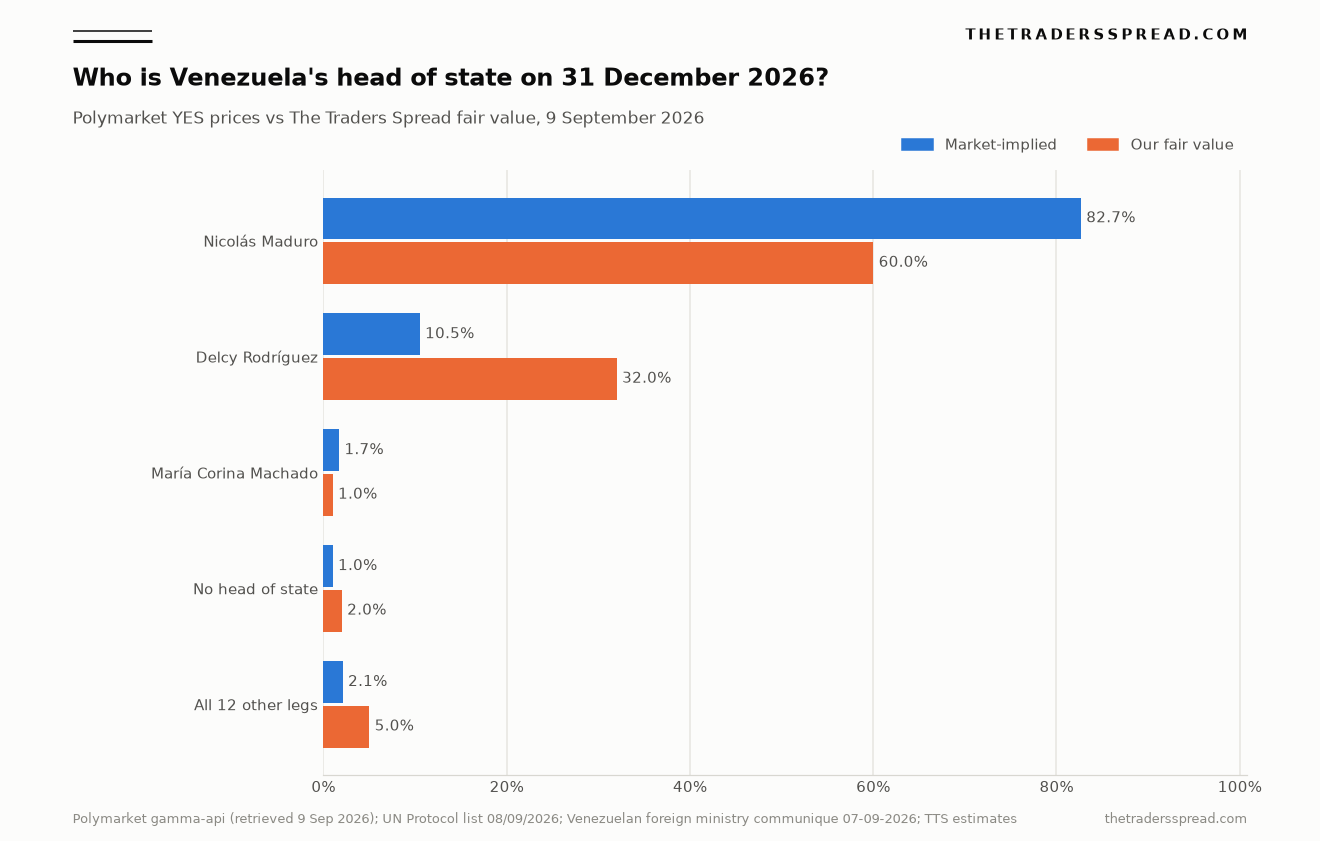
| Leg | Market-implied | Our fair value | Leg volume | Resting liquidity |
|---|---|---|---|---|
| Nicolás Maduro | 82.65% | 60.0% | $2.84m | $62,895 |
| Delcy Rodríguez | 10.50% | 32.0% | $1.78m | $51,037 |
| María Corina Machado | 1.70% | 1.0% | $1.46m | $74,066 |
| No head of state | 1.00% | 2.0% | $1.52m | $59,260 |
| All 12 other legs | 2.10% | 5.0% | $88.4m | — |
Source: Polymarket gamma-api, retrieved 9 September 2026. Fair values are The Traders Spread estimates.
The case for the 82.65%
We may be wrong, and the argument against us is specific rather than vague.
It rests on one sentence spoken by Rodríguez herself. In an interview with NBC News published on 12 February 2026, asked about her own standing, she said: "President Nicolás Maduro is the legitimate president. I will tell you this as a lawyer, that I am." Of her own position she offered only that she is "in charge of the presidency of Venezuela, as it's stated clearly in the constitution". If a resolver treats that as the government's considered position, the Venezuelan state has said Maduro is president out of its own head of state's mouth, and the case collapses.
Against that: February is seven months ago, it was an interview rather than an official act, and the ministry's current published usage contradicts it flatly and repeatedly. Markets price the present state of the evidence, not its most quotable moment.
The second argument for the leg is procedural inertia. No formal act has vacated the office. Maduro has not resigned, his six-year term running from January 2025 has not expired, and no body in Caracas has invoked Article 233. A resolver looking for a document that formally removed him will not find one. There is also the plain fact that the rules hyperlink the UN page directly, and resolvers follow links that are put in front of them. That is not a legal argument, but it is a real one about how these contracts actually settle.
We have seen the same gap between the political story and the settlement text before, in the Strait of Hormuz contract, where the definition of a closure did most of the pricing work, and in the Brazilian presidential market, where eligibility mattered more than polling. In both, the market eventually converged on the text rather than the narrative.
Why an oil desk should care
Venezuela sits on the largest proved crude reserves in the world, and the question of who legally speaks for the state is the question of who can sign a barrel away.
That is not abstract. The oil-opening law Rodríguez signed on 29 January 2026 invites private capital into fields nationalised in 2007, and Venezuela shipped its first crude cargo to Israel in years the following month, as Bloomberg reported on 10 February 2026. In August 2026 the BBC reported the US president hailing as historic an agreement for American access to 65 billion barrels of Venezuelan reserves. Every one of those instruments was executed by Delcy Rodríguez, and their durability depends on whether she was the head of state when she signed them.
Washington has already taken a view. On 10 March 2026 the State Department filed a statement of interest in a federal court in New York, authored by Michael Kozak of the Bureau of Western Hemisphere Affairs, formalising recognition of Rodríguez as the authority able to act for the Venezuelan state. She has governed accordingly, replacing Vladimir Padrino López, defence minister since 2014, with the head of the intelligence service in a move Reuters reported on 18 March 2026.
RelatedKharg Island: December Control at 7.5 Cents, Fair Lower
For anyone underwriting Venezuelan barrels, sovereign title is the risk, not the geology. None of this makes Venezuela a swing producer again in 2026 — its output is a rounding error against the OPEC+ balance, and the crude story this quarter has been elsewhere, as our coverage of the WTI move on renewed US strikes on Iran set out. The Venezuelan variable is legal, slow, and measured in reserve access over years.
The call
Our fair value on the Maduro leg is 60%, against a market at 82.65%. On that basis the leg trades above fair, by roughly twenty-three points, and the Rodríguez leg at 10.5% against our 32% is the mirror image of the same disagreement.
The reasoning is a probability over which document governs, not over what happens in Caracas. We put roughly 32% on a resolver applying the rules in their stated order, finding that the Venezuelan government does clearly state who its head of state is, and reading the September ministry communiqués as that statement. We put roughly 60% on the leg resolving to Maduro anyway — because the rules hyperlink the UN list, because no formal act ever vacated the office, because the February NBC interview gives a resolver cover to call the government's position unclear, and because incumbency in these disputes is a real force. The remaining 8% covers a formal transition, an election, a resignation as consideration in a US plea negotiation, death in custody, or the office being judged genuinely vacant.
What would change our mind, in order of how quickly we would notice it: a revised UN Protocol list naming Rodríguez, which would end the argument outright; the ministry reverting to "encargada" in its communiqués; any statement from the presidency or the National Assembly reaffirming Maduro as the sitting president; or a published clarification from the venue naming one source as controlling. The first two are checkable weekly and are what we watch. Live pricing across all sixteen legs sits on the event page.
The honest weakness in our number is that we are underwriting an interpretation, not an outcome, and we are doing it against a market that has had eight months to think about it. We think the thinness of the book is why it has not, and that the two documents dated one day apart are the whole trade. Readers who disagree should note that they only have to believe the resolver clicks the link in the rules.
FAQ
How can Maduro be Venezuela's leader if he is in a US jail?
Under this contract he can, because it resolves on who officially holds the office rather than who is at liberty. Venezuela has never passed a formal act vacating the presidency, and the UN Protocol list dated 8 September 2026 still records Nicolás Maduro Moros as head of state. Our argument is not that this is impossible, only that Venezuela's own ministry now says otherwise and the rules read that source first.
What exactly does the Venezuelan government say?
Its foreign ministry published a communiqué on 7 September 2026 beginning "La Presidenta de la República Bolivariana de Venezuela, Delcy Rodríguez Gómez", using the full constitutional title without qualification. A second ministry item published the same day, and a third dated 2 September, both call her "la Jefa de Estado". None of the three uses "encargada" or "(E)". We checked the foreign ministry only; the presidency's site returned an empty page and the Supreme Tribunal's refused the request.
Why did the price jump in April 2026?
Rodríguez's 90-day term under Article 234 expired on 5 April 2026 and the National Assembly did not convene the debate that would have converted a temporary absence into a permanent one. The market read that silence as confirmation that the office would stay formally occupied, and the leg repriced from roughly 18% to 58% between 14 and 18 April.
How liquid is this market really?
Much less than the headline implies. Reported event volume is $96.02m, but $88.4m of it has traded on legs priced under 1%, several of which name American officials. The Maduro leg carries $62,895 of resting liquidity and the Rodríguez leg $51,037, so the depth behind the two prices that matter is modest.
What is the connection to oil?
Venezuela holds the world's largest proved crude reserves, and whether concessions granted in 2026 survive a later government depends on who validly signed them. The January 2026 law opening production to private capital, the resumption of exports to new buyers, and the reserve-access agreement reported in August all rest on Rodríguez's authority. It is sovereign-title risk rather than a near-term supply story.
When does the contract settle?
It resolves on the position as it stands on 31 December 2026 at 12:00 ET. That gives 113 days from the date of this analysis, and the two documents worth re-reading each week are the UN Protocol list and the Venezuelan foreign ministry's communiqués.
Disclaimer
This article is analysis and information only. It is not financial advice, an offer, or a recommendation to buy or sell any contract or instrument. Prediction-market contracts can settle at zero and capital is at risk. Figures were retrieved on 9 September 2026 and prices move. Readers should do their own research and consider their own circumstances.