

Winning more Berlin constituencies than its vote share justifies will not give Die Linke a single seat of advantage in the Abgeordnetenhaus, because Berlin's electoral law matches every overhang mandate with compensation seats for the other parties. That matters for anyone reading the Polymarket Berlin State Election Winner market, which settles on seats rather than votes and priced Die Linke at 63.5% at 06:54 UTC on Tuesday 15 September, five days before Sunday's vote. Links to Polymarket are affiliate links, from which The Traders Spread may earn a commission at no cost to you. In Berlin the seat order follows the second-vote order almost exactly. The only place the two can part company is rounding, and the market's own rulebook decides who collects when rounding leaves two parties level. That rule points away from Die Linke, so our fair value for the Linke leg is 60%.
The market's rules state that a tie for the most seats resolves "in favor of the party or coalition whose listed abbreviation comes first in alphabetical order". CDU sorts ahead of Linke, and also ahead of "Die Linke", the abbreviation printed on the official ballot. Berlin has seen a dead heat recently. In the February 2023 repeat election, the SPD finished 53 second votes ahead of the Greens out of 1,527,899 cast, and each party received exactly 34 seats. With Die Linke's lead over the CDU averaging about 1.4 points across the latest polls, our simulation of Berlin's Hare-Niemeyer allocation puts the chance of a first-place seat tie near 9%. In roughly 4% of all simulated outcomes, Die Linke wins more votes than the CDU, draws level on seats and still loses the market. That tie tax accounts for most of the gap between 63.5% and our 60%.
Key facts
- Die Linke 63.5%, CDU 27.5%, AfD 7.75%, Grüne 1.7%, SPD 0.25% to win the most seats — Polymarket Gamma API, 06:54 UTC, 15 Sep 2026
- $3.76 million traded on the event, $2.49 million of it (66%) on the AfD leg — Polymarket Gamma API, 15 Sep 2026
- Last polls: Infratest dimap Linke 21%, CDU 20%; Forschungsgruppe Wahlen Linke 23%, CDU 21%; INSA 20% each — wahlrecht.de poll table, 10 to 14 Sep 2026
- 2023 repeat election: CDU 28.2%, SPD and Grüne 18.4% each, Linke 12.2%, AfD 9.1% of second votes — Landeswahlleiter für Berlin, official final result
- The CDU's 10 overhang mandates in 2023 pushed the house from 130 to 159 seats — Landeswahlleiter report on the 2023 repeat election, tables 4.3 to 4.5
- Seats go by Hare-Niemeyer across 130 base seats and 78 constituencies, with a 5% threshold — Landeswahlamt Berlin seat-allocation note, 7 Jan 2026
Why a constituency sweep adds no seat lead
Berlin elects 130 members in its base case, 78 of them in single-member constituencies on the first vote and the rest from party lists. According to the Landeswahlamt's seat-allocation note, the proportional split is calculated on second votes alone, using the largest-remainder method named after Hare and Niemeyer (section 17(2) of the state election law). Parties under 5% of second votes drop out of the calculation (section 18). Constituency winners are seated first. A party that wins more constituencies than its share entitles it to keeps them (section 19(1)), and section 19(2) then enlarges the house until the party with the most seats holds exactly its second-vote share, handing compensation seats to everyone else.
The 2023 repeat election shows the machine working. The CDU's second-vote quotient was worth 42 of 130 seats, but it won 48 constituencies. Because Berlin credits direct mandates district by district, 10 of those became overhang seats, taking the party to 52. The Landeswahlleiter's report then computed a new house size of 158.9769, rounded to 159. Re-running Hare-Niemeyer on 159 gave the SPD a quotient of 33.8861, the Greens 33.8797, Die Linke 22.4824 and the AfD 16.7442. The CDU's 52 seats came to 32.7% of the chamber, the same as its share of the 1,309,199 second votes cast for parties that cleared the threshold.
So a strong constituency map inflates the size of the chamber rather than the winner's margin.
The residual is rounding. If around 86% of second votes go to parties above 5%, as the September polls imply, one seat is worth between roughly 0.54 and 0.67 of a percentage point of the total vote, depending on whether the chamber ends at 160 or 130 seats. Two parties separated by less than that can land on the same seat count. Under a pure largest-remainder count, two separated by more cannot. Seat markets reward reading the allocation law before the polls, and our Duma seat-gain market analysis covered another contract that settles on seats rather than votes.
Fifty-three votes and the alphabet
The resolution text is short. The market pays the party that wins "the greatest number of seats" in the Abgeordnetenhaus, and it states that resolution "will be based solely on the number of seats won by the named party or coalition". It resolves on a consensus of credible reporting, and if that is ambiguous, on official results from the Landeswahlleiter für Berlin, currently Prof. Stephan Bröchler. A tie for first goes to whichever listed abbreviation comes first alphabetically.
Run the 2023 numbers through that rule and the effect is plain. The SPD beat the Greens by 53 votes, 279,017 to 278,964, and the seat count came out 34 each. Had those two been fighting for first place, a market written this way would have paid the Greens, because "Grüne" sorts before "SPD". The party with fewer votes would have won.
In 2026 the relevant pairing is CDU against Linke, and C comes before L. The Amtsblatt notice of 27 August 2026 lists 28 approved lists, with the CDU as list 1 and Die Linke as list 4 under the short name "Die Linke". Whether a resolver reads Polymarket's "Linke" or the ballot's "Die Linke", the CDU still sorts first. The AfD sorts ahead of everyone, so it wins any tie it is part of. The rule is neutral in wording and lopsided in effect: of the three plausible winners, Die Linke is the only one that loses a tie to both of the others.
Our Venezuela leader market analysis also turned on the source clause rather than the headline question. Here the clause is unambiguous. It simply costs the favourite something.
What 63.5 cents is pricing
The leg has travelled a long way. CLOB price history shows Die Linke at 7.5 cents on 28 June, the same week Infratest dimap was fielding an RBB survey, published on 1 July, that put the party first on 20%. The CDU leg fell to 10 cents on 12 July, two days after Governing Mayor Kai Wegner gave up the lead candidacy. The biggest single repricing came after Forsa's poll for t-online on 22 August put Die Linke four points clear: the Linke leg went from 39 cents on 20 August to 60.5 cents on 23 August. It sagged to 48.5 cents on 8 September, then climbed back through the Infratest dimap and Forschungsgruppe Wahlen releases of 10 and 11 September, peaking at 68.5 cents in the 13 September reading before settling at 63.5 (bid 63, ask 64) on Tuesday morning.
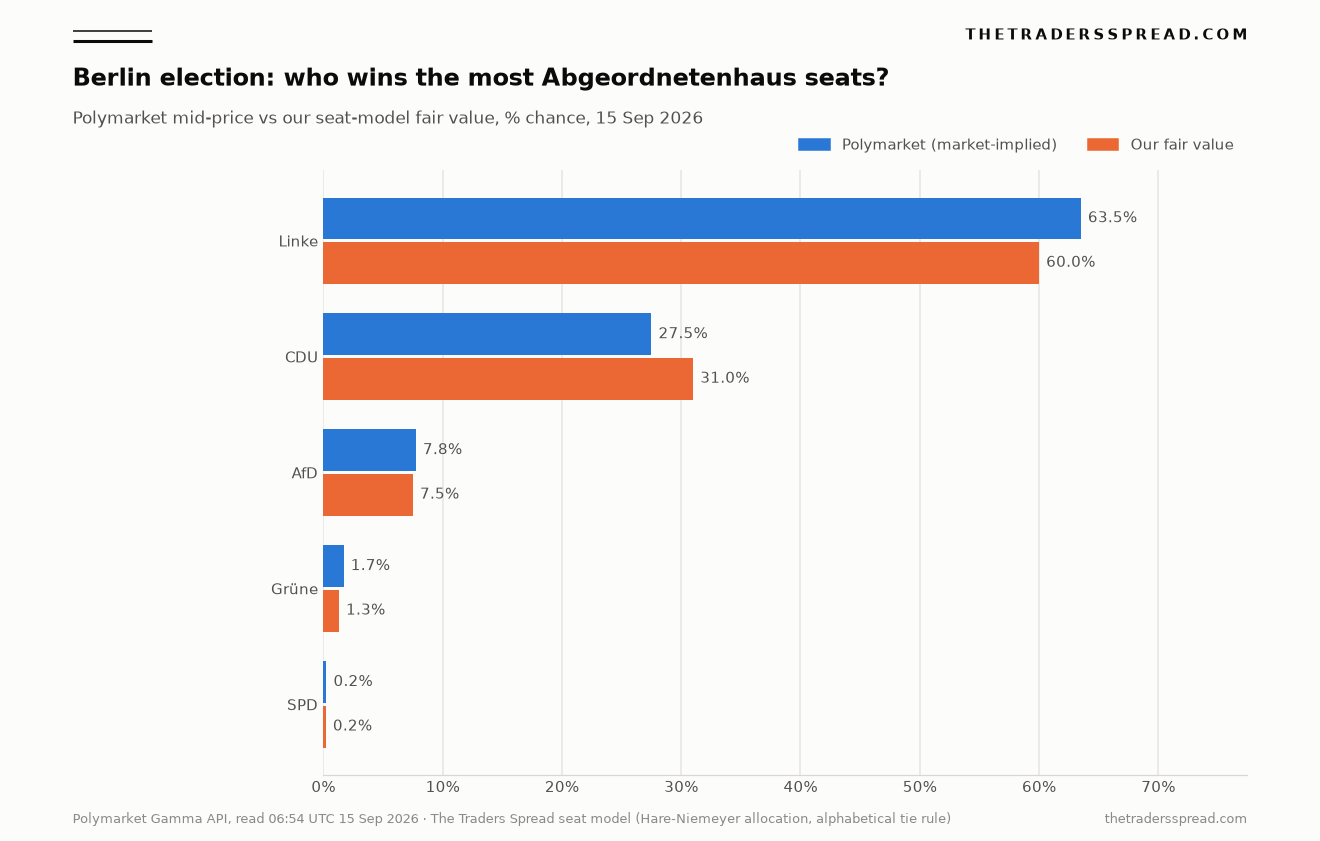
| Party leg | Polymarket | Our fair value | Fair minus market (pts) | Leg volume |
|---|---|---|---|---|
| Linke | 63.5% | 60.0% | -3.5 | $243,352 |
| CDU | 27.5% | 31.0% | +3.5 | $329,264 |
| AfD | 7.75% | 7.5% | -0.25 | $2,489,600 |
| Grüne | 1.7% | 1.3% | -0.4 | $205,103 |
| SPD | 0.25% | 0.2% | -0.05 | $409,792 |
Source: Polymarket Gamma API per-market volumeNum, read 06:54 UTC, 15 September 2026. Fair values are The Traders Spread's.
Two features of the book matter more than the headline number. The first is where the money went. Two-thirds of the $3.76 million traded sits on the AfD leg, which peaked at 28 cents in late May and has since bled to 7.75. The Linke and CDU legs, where the contest now sits, have traded only $243,352 and $329,264 respectively. The second is depth. At 06:55 UTC the Linke order book showed about $37,500 of offers within three cents of the best ask, while the CDU side had only about $3,400 within the same band, so the CDU price can move on small tickets. A thin spread on a thin book is not the same as efficient price discovery. You can check the live book on the Berlin market page before the vote.
Wegner's exit and a race between two unfamiliar names
This campaign changed shape in July. On 10 July, Kai Wegner, Governing Mayor of Berlin, told ZDF he was stepping back as CDU lead candidate after months of criticism over his communication during the January blackout that followed an arson attack on the power grid: "Yes, I made communication mistakes, and that was a mess too" (translated from German). He remains in office until a new coalition elects his successor. Three days later the CDU state executive unanimously chose finance senator Stefan Evers. "The situation we find ourselves in is not an easy one," Stefan Evers, CDU lead candidate and Berlin finance senator, said after the vote (translated from German).
Die Linke's candidate is pitching the election as a mayoral contest rather than a protest vote. Asked by t-online whether a Linke vote was a vote for opposition, Elif Eralp, Die Linke's lead candidate and deputy leader of its group in the Abgeordnetenhaus, answered: "No! A vote for Die Linke is a vote for me as Die Linke's first Governing Mayor" (translated from German, interview published 15 September).
Neither name is well known. The Infratest dimap BerlinTREND for ARD found that just over half of voters could not rate the CDU, Linke and SPD lead candidates, with satisfaction at 20% for Eralp and 18% for Evers. The institute described its 7 to 9 September survey as its last before the vote, and 16% of respondents said their preference could still change. The Forschungsgruppe Wahlen Politbarometer Extra for ZDF found 25% preferring Evers as Governing Mayor and 23% Eralp, while 28% did not yet know for certain whom, or whether, they would vote. A contest decided by late movers inside a 1.4-point average lead is exactly where a rounding rule bites.
How we reached 60%, and where it could break
We started from the latest poll by each institute, as listed on the wahlrecht.de Berlin table, giving the older Forsa survey half weight.
| Institute (client) | Fieldwork | Sample | Linke | CDU | AfD | Grüne | SPD | BSW |
|---|---|---|---|---|---|---|---|---|
| INSA (BILD) | 7 to 14 Sep | 1,000 | 20% | 20% | 18% | 16% | 12% | 5% |
| Forschungsgruppe Wahlen (ZDF) | 7 to 10 Sep | 1,100 | 23% | 21% | 17% | 16% | 10% | 3% |
| Infratest dimap (ARD) | 7 to 9 Sep | 1,527 | 21% | 20% | 18% | 16% | 12% | 4% |
| Forsa (t-online) | 4 to 18 Aug | 1,535 | 22% | 18% | 18% | 16% | 12% | 4% |
That average puts Die Linke on 21.4%, the CDU on 20.0% and the AfD on 17.7%. We drew 400,000 election outcomes around it with fat-tailed errors of about 2.3 points for a party near 20%, a width that fits Berlin's last contest: in their final 2023 surveys the four main institutes had the CDU on 25% or 26%, and it took 28.2%. Each draw dropped parties under 5%, sized the chamber between 130 and 160 seats, allocated seats by Hare-Niemeyer and applied the alphabetical tie rule. Die Linke topped the second vote in 64.7% of draws but won the market in 60.6%. The CDU won the vote in 28.6% and the market in 31.4%. We shade the Linke number to 60% because the model is only as good as four polls.
The sensitivity is real. Narrow the errors to 1.8 points and Die Linke rises to 67%; widen them to 2.8 and it falls to 57%. Drop Forsa and it is 56%. Take INSA's 20-20 tie at face value and the CDU becomes the favourite at 45% against 39%. The tie tax holds between 3.5 and 4.8 points in every version, which is why we treat it as the firmer half of the call.
There are also reasons to think the polls understate Die Linke. At the February 2025 federal election, the official Berlin result had Die Linke first on second votes with 19.9% against the CDU's 18.3%, so its current share is not a summer bubble. The CDU's 2023 overperformance came with a lead candidate who had fronted its campaign from the start, and this time the party changed candidate ten weeks out. A repeat of the 2023 polling miss in the CDU's favour would flip the result. A repeat in Die Linke's favour would make 63.5% look cheap. For another European contest we have priced against the polls, see our Sweden election odds analysis.
The call: Die Linke at 60%, CDU at 31%
Our fair value for the Linke leg is 60%, against a market price of 63.5%. On our numbers the market is 3.5 points above fair value, and nearly all of that gap is the tie clause rather than a disagreement about the polls.
Base case, 60%: Die Linke wins the most seats. It finishes first on second votes by more than about two-thirds of a point, which is enough to clear the rounding band on a chamber of 130 to 160 seats.
RelatedWill the Bank of Russia hold the key rate on 23 October?
CDU case, 31%. About 27 points of this come from the CDU simply outpolling Die Linke on Sunday, which needs a late swing no larger than the 2023 miss. The remaining 4 points are the tie tax: Die Linke ahead on votes, level on seats, market to the CDU.
AfD case, 7.5%. The AfD needs to finish top outright or tie for first, since it sorts first alphabetically. At 17.7% in the average, it needs a miss of roughly four points on the leader.
Everyone else, 1.5%. Grüne and SPD are both five points or more behind the leader, and the SPD is also carrying an investigation into its lead candidate, which Infratest noted its survey largely predated.
What would change my mind: a fresh poll from a major institute showing Die Linke three points or more clear would lift our fair value toward 70%, while one showing the CDU ahead would drop it below 50%. On election night the Landeswahlleiter's preliminary count will drive the reporting the market resolves on. The first number worth watching is the Linke-CDU gap on second votes. Above one point, the tie rule is irrelevant. Below two-thirds of a point, check the seat table before assuming anything, and follow the live Polymarket Berlin odds as the count comes in.
FAQ
Who wins the Polymarket Berlin market if Die Linke and the CDU win the same number of seats?
The CDU. The rules award a tie for most seats to the party whose listed abbreviation comes first alphabetically, and CDU precedes both "Linke" and the ballot's "Die Linke". The AfD would beat either of them in a tie. In 2023 the SPD and Greens tied on 34 seats despite a 53-vote gap, so a tie is a live possibility when two parties poll within a point of each other.
Do constituency wins give a party extra seats in Berlin?
Not relative to its rivals. Berlin seats constituency winners first, but if a party wins more than its second-vote share justifies, the chamber is enlarged and the other parties receive compensation seats until every party's seat share matches its second-vote share. In 2023 the CDU's 10 overhang seats pushed the house from 130 to 159 members, and its final 52 seats matched its 28.2% vote share among qualifying parties.
When is the Berlin election and when does the market resolve?
Voting is on Sunday 20 September 2026, a date the Berlin Senate set on 3 June 2025, and it elects the 20th Abgeordnetenhaus together with the twelve district assemblies. The market resolves on a consensus of credible reporting of the seat result. If that reporting is ambiguous, the official results of the Landeswahlleiter für Berlin decide. If no vote happens by 31 December 2026, it resolves to "Other".
Why has most of the money traded on the AfD leg?
Of the $3.76 million traded, $2.49 million is on the AfD, which peaked at 28 cents in late May, when spring polls had it within one to three points of the lead. The leg has since fallen to 7.75 cents. Our fair value is 7.5%, so we see no meaningful gap there. The Linke and CDU legs carry far less volume, and the CDU order book is thin enough to move on small orders.
Who are the lead candidates?
Elif Eralp leads Die Linke, Stefan Evers leads the CDU after Kai Wegner withdrew on 10 July, Kristin Brinker leads the AfD, Steffen Krach leads the SPD and Werner Graf is the Greens' mayoral candidate. Wegner remains Governing Mayor until a new coalition elects a successor. Pollsters report unusually low name recognition, with about half of voters unable to rate the main candidates.
Disclaimer
This article is analysis, not investment or betting advice. Prediction-market contracts can lose their entire value, and you can lose all the capital you commit. Prices quoted are from 15 September 2026 and move continuously. Check the market's full resolution rules before acting on any view, and only risk money you can afford to lose.