

A beat contract settles on the first EPS figure in the company's own release, which retires the idea that traders must wait for the earnings call, the 10-Q, or the next morning's analyst note. The family recurs every earnings season: a strike is written on the day the market is created, one earnings line is named, and that first official print decides Yes or No. A long call, a margin slide, or a wire consensus published an hour later leaves the strike where creation put it.
Two releases from late October 2026 show why the named line is the whole test. Amazon's third-quarter release on 29 October 2026 reported net income of $20.7 billion, or $1.89 per diluted share, beside operating income of $28.1 billion. The Amazon beat contract had frozen a GAAP strike of greater than $2.00 at creation, and gamma later recorded a resolution to No. Microsoft's release the day before printed GAAP diluted earnings of $4.92 and non-GAAP diluted earnings of $4.89, and its GAAP contract, struck above $4.82, resolved to Yes. The contract reads only the line its rules name. Links to Polymarket are affiliate links, from which The Traders Spread may earn a commission at no cost to you.
The order below is the one a reader can reuse on the next print: what beat means, which number on the release counts, a result that lands between two strikes, a later restatement, and the moment the contract pays. Prices below are reference readings from Polymarket's gamma API, retrieved at 07:16 UTC on 30 October 2026, unless a sentence names another time.
Updated 30 October 2026, with the contract readings and the company figures checked the same morning.
Key facts
- Amazon reported diluted GAAP earnings of $1.89 for the quarter ended 30 September 2026, against a creation strike of greater than $2.00. Source: Amazon company release, 29 October 2026.
- That beat contract resolved to No, with gamma showing Yes at 0, No at 1, volume of $8,832.10, and a close at 22:04:58 UTC on 29 October 2026. Source: Polymarket gamma, 30 October 2026.
- Microsoft reported GAAP diluted earnings of $4.92 and non-GAAP diluted earnings of $4.89. The contract tested GAAP earnings greater than $4.82 and resolved to Yes. Source: Microsoft Source, 28 October 2026, and gamma, 30 October 2026.
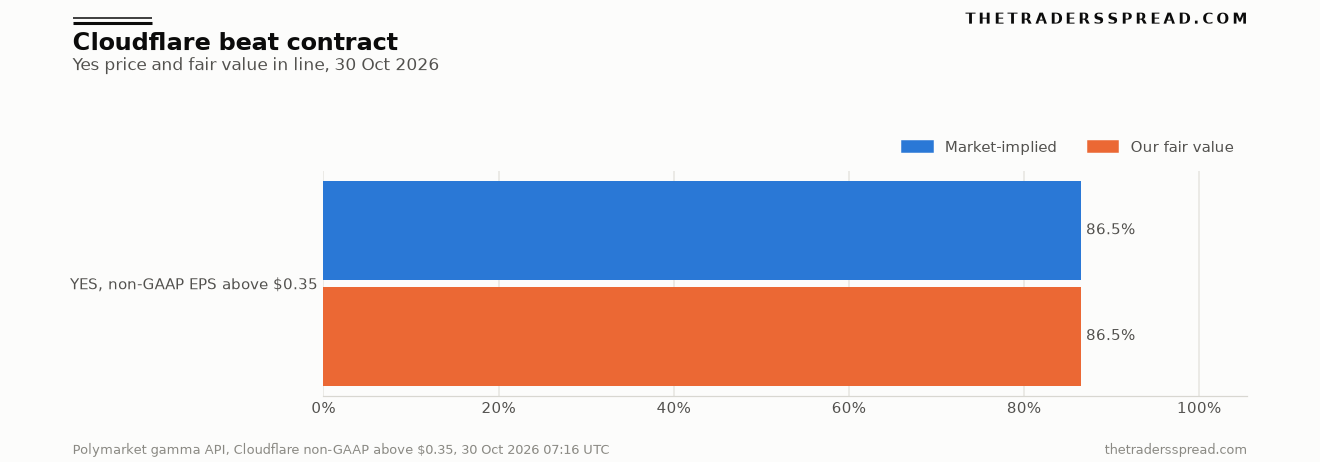
- The open Cloudflare beat contract priced Yes at 86.5% that non-GAAP earnings exceed $0.35, on volume of $3,776.52 and liquidity of $969.68, ending 5 November 2026. Source: Polymarket gamma, 07:16 UTC on 30 October 2026.
- Two open ExxonMobil strikes sat a cent apart: Yes at 70% above $4.11, and Yes at 61.5% above $4.12. Source: Polymarket gamma, 07:16 UTC on 30 October 2026.
- A later restatement of the first GAAP figure stays out of the Amazon score, aside from an obvious and immediate mistake, and every figure is rounded to the nearest cent. Source: contract rules, 30 October 2026.
- The fair probability beside the Cloudflare Yes price is 86.5%, in line with that gamma print. Source: gamma, 07:16 UTC on 30 October 2026.
1. Freeze the strike before the release exists
Read the first sentences of the rules before a headline. As of market creation on 16 October 2026, Amazon was estimated to release earnings on 29 October 2026, and the Street consensus for GAAP earnings per share was $2.00. The market resolves to Yes if Amazon reports GAAP earnings greater than $2.00 for that quarter in its next quarterly earnings release, and otherwise it resolves to No. The resolution source is the GAAP figure in the company's official earnings documents.
That opening dates the strike to creation, names GAAP, and sets the comparison as greater than, so a print that lands on $2.00 fails the test. A later note says GAAP means diluted GAAP earnings unless diluted is unpublished, in which case basic GAAP earnings qualify. People who search polymarket earnings are usually after exactly this family: one company, one quarter, one frozen number.
The strike is the selected street consensus at creation, so a consensus that drifts before the release is a different number and the contract keeps the earlier one. If the release omits GAAP earnings, the page names Seeking Alpha's GAAP figure, then a No if that figure is missing within 96 hours of the 16:00 ET close on announcement day. No release within 45 calendar days of the estimated date also resolves the market to No.
2. The first company release is the scorecard
Take the figure from the company's own document. Amazon's release, for the quarter ended 30 September 2026, states the diluted result in one sentence: net income decreased to $20.7 billion, or $1.89 per diluted share, compared with $21.2 billion, or $1.95 per diluted share, a year earlier. The company attributed the decrease primarily to pre-tax gains of $9.5 billion in the year-earlier quarter from its investment in Anthropic. The $1.89 is already expressed to the cent, which is the precision the rules require, and $1.89 is below the $2.00 strike.
Andy Jassy, President and CEO, Amazon, used the same release for a different line. "Our AWS investment in functionality and infrastructure is working, with over 39% year-over-year revenue growth in Q3 ($184 billion revenue run rate) and projected revenue growth rates of over 40% both in 2027 and in 2028," he said. AWS net sales were $46.0 billion. The GAAP diluted line of $1.89 against a strike of $2.00 is what settled the contract to No.
Amazon's own account posted on 29 October 2026 that the quarter's earnings were out and pointed readers to the investor-relations release, the same first document the rules use.
Amazon’s Q3 2026 earnings are in. More here.👇 https://t.co/QiV4kbXvTD
— Amazon (@amazon) October 29, 2026
Gamma records the Amazon market as closed at 22:04:58 UTC on 29 October 2026, with UMA status resolved, a Yes price of 0, a No price of 1, and volume of $8,832.10. Liquidity was no longer listed once the event had closed. The volume behind that settled 0 and 1 is why the print is usable as a record, and an open contract further down ties the same method to a book that was still trading.
Microsoft shows the other outcome, and why the adjective in front of EPS is the rule. The 28 October 2026 release says diluted earnings per share were $4.92 on a GAAP basis and $4.89 on a non-GAAP basis. Amy Hood, executive vice president and chief financial officer of Microsoft, said: "Results exceeded expectations across revenue, operating income, and earnings per share." The Microsoft beat contract asked whether GAAP earnings were greater than $4.82. Both printed lines cleared that strike, and gamma shows a close at 22:03:40 UTC on 28 October 2026, resolved, Yes at 1, No at 0, volume $5,323.14. Where the two lines sit on opposite sides of a strike, the GAAP figure named in the rules is the one that scores.
Which vintage of a public number counts is a cousin of this problem. A growth-bucket page on this site walks that question for an advance government print at the advance-print method piece. The earnings version stays with the issuer's own release, and treats the webcast as commentary that arrives after the number is already out.
3. Round to the cent, then test greater than
The Amazon rules say all figures are rounded to the nearest cent using standard rounding. Amazon had already printed $1.89 to the cent, so the remaining question is whether that cent is greater than the strike. It sits eleven cents under $2.00, so the result is No. A print that rounded to exactly $2.00 would also be No, because equality fails a greater-than test.
Round first, using the cent the release already states when it states one, then compare with the word the rules use, which on these events is greater than. A one-cent miss is a miss. A headline from a different data vendor is often measured against a consensus taken on the morning of the release, while the contract uses the consensus selected at creation.
Diluted versus basic is the other switch. GAAP earnings means diluted GAAP earnings unless diluted is unpublished, in which case basic qualifies. If both rows are printed, the diluted row scores even when the basic row sits closer to the strike. Figures are in US dollars unless the rules say otherwise, and a company listed mainly abroad is scored on the US-listed shares, or on the ADR or ADS.
4. A one-cent gap is two contracts
Some weeks the board lists two events for the same company, struck one cent apart, each with its own rules and its own Yes price. On the morning of 30 October 2026, gamma showed two open ExxonMobil contracts. The greater-than-$4.12 contract priced Yes at 61.5%, with volume of $4,513.02 and liquidity of $519.99. The greater-than-$4.11 contract priced Yes at 70%, with volume of $4,064.32 and liquidity of $315.30. Both were still open at 07:16 UTC, with end timestamps of 13:00 UTC that day, so the pair shows how a penny gap was quoted before a print.
Score a rounded print through each sentence alone. A non-GAAP figure that rounds to $4.12 is greater than $4.11, so the lower contract's test passes, and the same $4.12 equals the higher strike, so the higher contract's test fails. One print can produce two results. The gap between 70% and 61.5% on the retrieval morning is the market's own statement that a single cent of earnings is enough to split the two books.
The open contract used for the fair-value comparison is Cloudflare, estimated to release on 5 November 2026, with an end timestamp of 22:00 UTC that day. The Cloudflare beat contract resolves to Yes if the company reports non-GAAP earnings greater than $0.35. At 07:16 UTC on 30 October 2026 the Yes price was 86.5% and the No price was 13.5%, on volume of $3,776.52 and liquidity of $969.68. The fair probability plotted against that price is also 86.5%, so the contract sits in line with the gamma print.
If the Cloudflare release has no non-GAAP line, the market uses Seeking Alpha's non-GAAP figure, then official GAAP, then Seeking Alpha's GAAP figure, and a No if none appears within 96 hours of the 16:00 ET close on announcement day. Several non-GAAP versions mean the primary headline number counts, typically diluted. No release within 45 calendar days of the estimated date resolves the market to No.
5. What a later filing can still change
Subsequent restatements, corrections, or revisions of the initially announced GAAP figure stay out of the Amazon resolution, except an obvious and immediate mistake. The rules give their own example of a fat-finger error, citing Lyft's earnings release in February 2024, the sort of typo a company corrects in the same news cycle. A restatement in a 10-Q weeks later stays outside the score.
Archive the sentence that contains the diluted figure and compare any later document with it. A revision of an investment gain, of the kind Amazon described for the year-earlier Anthropic item, changes a comparison, which is a different subject from an immediate correction of the cent just printed. The same restatement note appears on the Microsoft, Cloudflare, and ExxonMobil contracts in this set.
RelatedThree different readings sit under one US PPI bucket
Hood's comment that results exceeded expectations, and Jassy's comment on AWS growth, are management judgements about the quarter. A beat contract has already chosen its sentence. If the call introduces an adjusted figure the release omitted, the fallback chain applies only when the named line was actually missing. When the release contained that line, the chain stops.
6. Payout waits for the proposal
The headline minute and the payout minute are different hours. Amazon's release is dated 29 October 2026 and describes a conference call for later that day, while gamma closed the contract at 22:04:58 UTC with UMA status resolved. Microsoft's market closed at 22:03:40 UTC on 28 October 2026, also resolved. A beat contract pays when that resolution is final, after the figure has been proposed against the rules and the dispute window has run. A price of 86.5% the week before a release is a trading price, and a price of 0 and 1 after the close is a settled record.
Gamma lists a proposal bond of 500 and a reward of 5 on the Amazon, Microsoft, and Cloudflare markets, which is the oracle charge attached to putting a result up. The dispute path, including a challenge to the proposed cent, is walked in the proposal-versus-dispute explainer. On an earnings contract the proposal should cite the first company document and the cent in it.
Cloudflare at 86.5% had volume and liquidity on the retrieval morning and had not closed. A high displayed percentage can sit unresolved on other books too, which is the subject of a separate page on a price that had not settled. Read closed, the UMA status, outcome prices, and volume together. Liquidity still posted between 0 and 1 means the market is open.
The clocks can force a No without a print that clears the strike. The 96-hour window runs from 16:00 ET on the announcement day and governs the fallback sources when the preferred line is missing. The 45-day window runs from the estimated date in the rules, and an empty window resolves the market to No. A delay is itself a result under those sentences.
Frequently asked questions
Does a beat contract settle when the earnings call ends?
The call discusses a figure the release has already stated. Amazon's 29 October 2026 release scheduled the webcast for later that day, and the rules point at the GAAP line in the official documents. Gamma closed that market at 22:04:58 UTC, resolved to No on the $1.89 diluted print against a $2.00 strike. The document is the scorecard, and the call is commentary around a number already on the page.
Which EPS line counts when a release prints both GAAP and non-GAAP?
Count the line the rules name, to the cent, and use diluted earnings when the rules say diluted and the release prints it. Microsoft reported GAAP diluted earnings of $4.92 and non-GAAP diluted earnings of $4.89 on 28 October 2026. The contract tested GAAP earnings greater than $4.82 and resolved to Yes. Where the two lines diverge around a strike, the named line is the one that scores.
What if the rounded print equals the strike?
Equality fails these contracts, because the rules say greater than, after rounding to the nearest cent. A diluted GAAP print of exactly $2.00 would have resolved the Amazon contract to No, just as the actual $1.89 print did. The same logic splits a one-cent pair: a rounded non-GAAP figure of $4.12 would pass a greater-than-$4.11 test and fail a greater-than-$4.12 test. Each event is scored on its own sentence.
Can a restatement in a later filing flip the result?
Ordinary restatements stay out of the score. The Amazon rules say subsequent restatements, corrections, or revisions of the first announced GAAP figure stay outside the resolution, except an obvious and immediate mistake, and they point at a fat-finger case in their own text. Archive the first release and the cent in it. A 10-Q that revises the figure weeks later is outside that exception. The narrow crack is an error corrected in the same news cycle as the print.
What if the company never publishes the named EPS figure?
Follow that event's fallback in order, then the clocks. On a GAAP contract such as Amazon's, a release without GAAP earnings uses Seeking Alpha's GAAP figure, and an empty 96 hours after 16:00 ET resolves it to No. On a non-GAAP contract such as Cloudflare's, the chain runs through Seeking Alpha non-GAAP, official GAAP, Seeking Alpha GAAP, and then No. No release within 45 calendar days of the estimated date also resolves the market to No.
A checklist for the next earnings contract
- Copy the strike, the named line, diluted unless the rules switch to basic, and the greater-than test.
- Note the creation date, because a morning-of consensus is a different number from the one frozen in the rules.
- Take the named cent from the company's own release, and leave the margin headline and the webcast out of the score.
- Use the cent the release states, then ask whether it is greater than the strike. Equality fails.
- Score each one-cent strike on its own event, so one print can pass the lower test and fail the higher one.
- Save the first release. A later restatement stays out unless the immediate-error exception matches.
- If the named line is missing, walk the fallback and the 96-hour clock from 16:00 ET, and if there is no release, the 45-day clock. Either can resolve to No.
- On gamma, read closed, UMA status, outcome prices, volume, and liquidity together. A mid price with liquidity is open. A 0 and a 1 with volume is settled.
- Record the Yes price, a fair probability, and the end date. Cloudflare was 86.5% Yes at 07:16 UTC on 30 October 2026, in line with an 86.5% fair value, ending 5 November 2026.
This page is analysis of how a published beat contract resolves, using company releases and gamma readings dated above. It is not a recommendation to take either side of any contract. Prediction-market positions can lose money, and a price retrieved on one morning will differ from the price on the morning of the print.