

71.5% is the price on the US-Iran ceasefire market for a hold through 31 October, and it sits 17 points under the same question dated 15 October. At 07:05 UTC on 5 October 2026 the YES side of that leg was 71.5 cents, bid at 71 and offered at 72, with Polymarket's own one-week change at plus 18 cents and the one-day change at plus 7. The print does not mean the war is three-quarters finished. It is what traders will pay to be right if the United States has not, by 11:59 pm Iran Standard Time on 31 October, hit Iranian land with a qualifying air or missile strike. The 15 October leg, on that same definition, is 88.5 cents. Those two numbers, and the path between them, are the call. Prices below are from the US-Iran ceasefire market on Polymarket. Links to Polymarket are affiliate links, from which The Traders Spread may earn a commission at no cost to you.
Glance at 88.5 against 71.5 and confidence seems to break after mid-October. Divide by the days and the break disappears. From the 5 October leg at 99% to 15 October at 88.5% is 10.5 points of priced strike risk in ten days. From 15 October to 31 October is 17 points in sixteen days. Same pace, about a point a day. The liquid book holds that line through 30 November, at 41.5 cents, and only then flattens: 31 December YES is 33.5%, about a quarter of a point a day. The cliff is an optical trick. Our gap to 71.5 cents is smaller, and it has a cause. A straight line smears in headlines the rules exclude, and the US midterms on 3 November, a date that falls after this leg has settled. AFP, on 4 October, said the United States had not struck Iran since 1 September. A point a day forward says the next month will not look like that one.
The book, as pulled
- 31 October YES at 71.5%, bid 71 cents and offered at 72, with a one-week change of plus 18 cents and a one-day change of plus 7 (Polymarket gamma-api, 07:05 UTC, 5 October 2026).
- Event volume of $6.12 million, 24-hour volume of $246,255, liquidity of $529,875 and open interest of $629,890 (Polymarket, 5 October 2026).
- The 31 October leg alone has traded $1.22 million, with $131,595 of liquidity and $60,915 in the past day (Polymarket, 5 October 2026).
- 15 October YES is 88.5%, 30 November YES is 41.5%, and 31 December YES is 33.5% (Polymarket, 5 October 2026).
- The 20, 25 and 30 September legs resolved YES at $1. The 30 September leg alone had traded $2.45 million (Polymarket resolutions, September 2026).
- The United States has not struck Iran since 1 September, AFP reported (The Hindu, 4 October 2026).
Open interest is still above $600,000. The event is active, not closed.
What "continues through" actually counts
The contract's own first sentence is the whole definition. It resolves to "No" if the United States takes a qualifying military action against Iran by the specified date, 11:59 pm Iran Standard Time. Otherwise it resolves to "Yes." Qualifying means an air strike or a surface-to-surface missile strike, started by the United States, that directly hits Iran. Air strikes, in the text, include bombs, air-to-surface missiles and air-launched drones. Surface-to-surface strikes include one-way attack drones and cruise or ballistic missiles.
The exclusions are longer than the definition, and they are where a headline reader goes wrong. Munitions destroyed or intercepted before impact do not count, and neither does debris that then falls on Iran. Surface-to-air fire, small arms, ground incursions, cyber operations, naval gunfire and artillery do not count. Nor do howitzers, mortars, rocket artillery, or what the rules call minor surface-to-surface strikes: short-range loitering munitions, first-person-view drones, anti-tank missiles. A threat, an authorisation, or an announcement that is not carried out does not count.
"Iran", here, is land plus internal waters. Maritime territory and airspace are outside the line. If sources disagree on whether a strike happened, who fired it, or when, the market can stay open until a consensus forms, or for three full Iranian calendar days from the first credible report. That window may run past the end date. A single denial does not decide it. The named sources are official US and Iranian government and military information, plus a consensus of credible reporting.
Read that list against the war as it is being fought and most of the violence in a morning brief does not flip this YES to NO. A tanker incident in the Strait, an Israeli strike in Lebanon, a cyber operation, a tighter naval blockade, a presidential threat: none of those is the event. They can change the politics that produce a qualifying strike. They are not themselves the strike. Our earlier note on Iran blockade odds at 23.5% was a different contract, written on a different question, and this piece does not reopen it.
September is the clean demonstration. The legs through 20, 25 and 30 September all resolved YES, at a dollar, after a combined $3.74 million of volume. Under the written rule, that is an adjudication that no qualifying US strike on Iranian land had occurred by those dates. It is not a claim that the month was peaceful. AFP's report that Washington had not struck Iran since 1 September is broader than the contract and points the same way. The same account says military operations have been dialled back, in recent weeks, towards economic pressure, and that a June memorandum aimed at a settlement collapsed largely over Hormuz.
A point a day, not a cliff
The curve is a stack of the same question with different end dates. Because a later YES implies every earlier YES, the prices have to fall as the date moves out, or the book is broken. They do fall. The useful question is the slope.
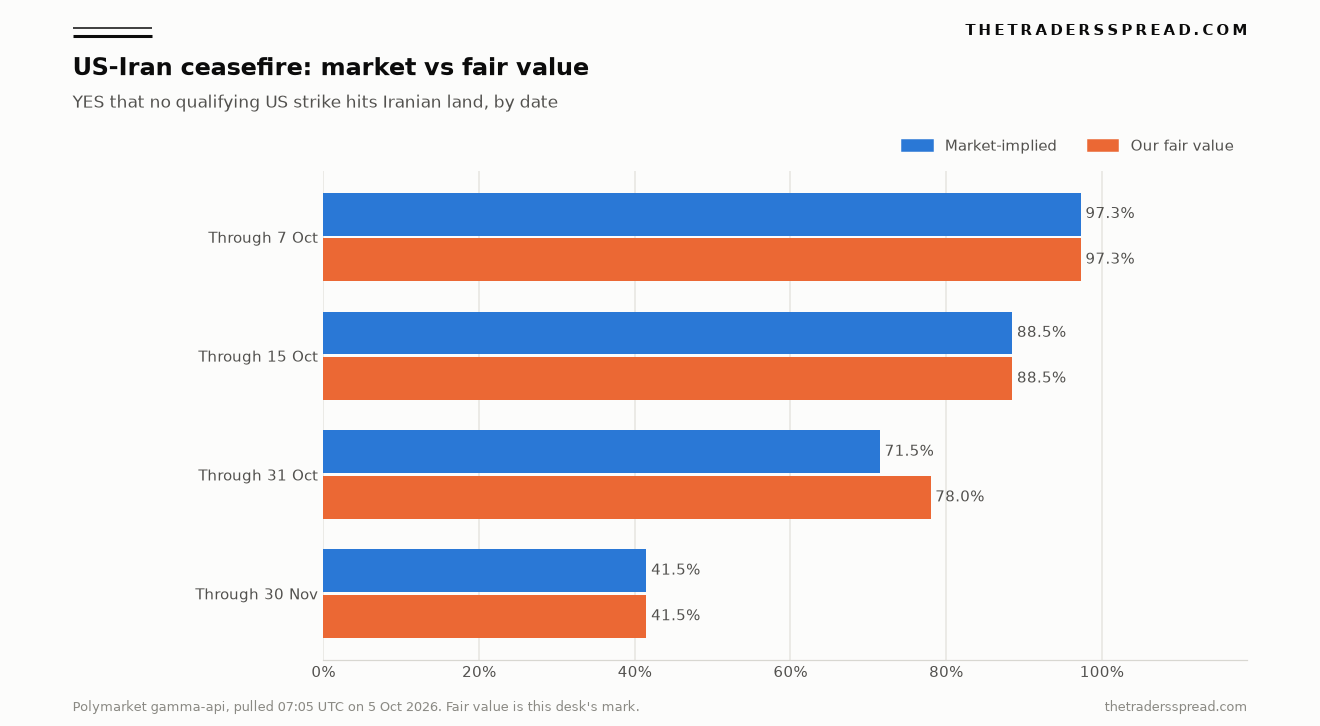
On the 31 October ceasefire leg the book is a cent wide. Last trade was 72 cents. The leg has taken $1,221,747 in total and $60,915 in the past day, against $131,595 of liquidity. The 15 October anchor was just as alive this session: $62,820 of 24-hour volume, 88 bid and 89 offered.
| Leg | YES | Bid / ask | Volume | Past 24h | Liquidity |
|---|---|---|---|---|---|
| 5 October | 99.0% | 98.7 / 99.3 | $25,093 | $18,120 | $38,355 |
| 7 October | 97.3% | 97.2 / 97.4 | $274,285 | $48,273 | $64,175 |
| 15 October | 88.5% | 88 / 89 | $178,830 | $62,820 | $62,592 |
| 31 October | 71.5% | 71 / 72 | $1,221,747 | $60,915 | $131,595 |
| 30 November | 41.5% | 41 / 42 | $317,405 | $2,844 | $66,171 |
| 31 December | 33.5% | 33 / 34 | $338,529 | $41,768 | $63,002 |
Two thinner prints fill the gaps: 9 October at 95.5% on $7,486, and 12 October at 92% on $4,136. The front is smooth. We do not lean on either for the call. The table is the size we trust.
Turn the levels into a rate and October stops looking special.
| Window | Days | Added strike risk | Per day |
|---|---|---|---|
| 5 to 15 October | 10 | 10.5 points | 1.05 |
| 15 to 31 October | 16 | 17.0 points | 1.06 |
| 31 October to 30 November | 30 | 30.0 points | 1.00 |
| 30 November to 31 December | 31 | 8.0 points | 0.26 |
A 15 November leg at 51.5 cents would make early November look faster, if you trusted it. We do not. The bid is 50, the offer is 53, and it has traded $6,172. That is a suggestion, not a clearing price. The liquid path from 31 October to 30 November is the point-a-day line. November's past-day volume was only $2,844, so 41.5 cents is a stock of earlier trades. December did $41,768 in the past day. The far month is not asleep.
One more cut of the same prices. Conditional on no qualifying strike by 15 October, the market's 31 October price implies an 80.8% chance the hold survives the next sixteen days: 71.5 divided by 88.5. That is a 19.2% chance of a qualifying hit inside a window that contains no announced political date. The date people keep naming, the US midterms, is Tuesday 3 November. A strike on Sunday 1 November does not hit this leg. A strike on Saturday 31 October does. One weekend day is inside. The election itself is not.
Araghchi on Sunday, Trump to Axios
The past ten days explain why late October is even in argument. They do not, by themselves, set 71.5 cents.
Abbas Araghchi, Iran's foreign minister, told a gathering of foreign ambassadors on Sunday 4 October that Tehran still wanted talks and was ready if they failed. "If our enemies again choose the path of military confrontation, our response will be stronger than before, and we will defend ourselves with even more force," he said. He went on: "There is no military solution, nor any solution based on new sanctions," adding that "only negotiations based on justice and fairness" could end the conflict. The account is AFP's, published by The Hindu the same day. That copy also records the negative fact already in the key list: no US strike on Iran since 1 September.
The American line, a week earlier, was a rejection with the door left open. Donald Trump, the US president, told Axios on Sunday 27 September: "They want to make a deal, but it is not the deal that I want to make." He added: "It is what we would have maybe agreed to a year ago." And: "They overplayed their hand." CNA's report of that interview says he dismissed Tehran's seven-day plan to reopen the Strait of Hormuz and has mused about resuming full-scale air strikes. "Mused" is the newsroom's verb, not a quoted order. We are not going to promote it into one.
Between those Sundays, Axios reported a cabinet meeting on Friday 2 October about the war in Iran and the fighting in Yemen. We have that at second hand, through the AFP account, and we treat it as a meeting, not a decision. The same report has indirect talks at the UN General Assembly and seven Iranian conditions for reopening the strait. The sequence the contract can use is shorter: a plan rejected, a meeting held, talks offered and a harder answer if they fail.
None of that is a qualifying strike. It is why a point a day is not an absurd prior. September says the lump risk did not arrive as a qualifying hit. It does not say it cannot.
Why 71.5 cents might already be enough
The case for leaving the price alone is straightforward, and it is the case we almost took.
A constant point a day, from a 99 cent front to 41.5 cents at the end of November, is a coherent description of a strike with uncertain timing. You do not need a cliff on 31 October to get to 71.5. You need sixteen ordinary days. If that hazard is smooth, the honest mark is "in line". The 18 cent rally of the past week may already be the market separating a quiet September from a still-open autumn.
Lump risk cuts the other way. Strikes are not dripped out in one-point doses. They arrive as an order, or they do not. A linear fit can understate a binary choice that Trump has kept in view since he rejected the seven-day plan. Twenty-six days is a long time to treat 1 September as the new normal. The 7 October leg at 97.3 cents, on $274,285 of volume, says the next two days are very likely quiet. It says little about the last week of the month.
There is a proxy problem the tape will not split. This leg is the deep one, a cent wide with $1.22 million traded. Exposure to "something before the election" can sit here because the 15 November book is four cents wide and thin. Some of the 28.5% NO price may be November risk in an October label. On 1 September this desk wrote up Strait of Hormuz odds at 28.5%, with transits then reported at five ships a day. That was a shipping contract on that date, not a live count, and not an input to the mark below. When US strikes resumed earlier in the war, WTI climbed 21% to $91, a 3 September report here. Crude can move on a Hormuz incident these rules ignore, and leave the ceasefire YES untouched.
Related97.8% Bank of Japan No-Change Odds Sit Above Fair Value
Fair value through 31 October
We mark fair value on the 31 October YES at 0.78. The mid is 0.715 and the offer is 0.72, so the gap is about six cents through the touch. On this site the market sits below our fair value. That describes the gap. It does not tell anyone to take an outcome.
We accept 15 October at 0.885 as the anchor. Conditional on no qualifying strike by then, survival through 31 October is 88% in our mark, against the market's implied 80.8%. Then 0.885 times 0.88 is 0.779, rounded to 0.78. The seven points removed are excluded headlines and the 3 November election, which this leg cannot settle. A 12% chance of a qualifying hit over those sixteen days is still nothing like September. October is not marked safe.
The base case is that 0.78: no qualifying US strike on Iranian land through 11:59 pm Iran time on 31 October. No deal is required, only the absence of one act. The bull case, a higher fair value rather than a trade, is about 0.86 if the anchor holds and conditional survival rises to 97% on a talks date covering the rest of the month. We do not have that date. Expecting talks, which is what Trump told Axios, is not a calendar. The bear case is near 0.58. If 15 October falls to about 80 cents and conditional survival drops to about 72%, the product is 0.58, and 0.78 dies with the anchor we borrowed. A confirmed impact on Iranian land does that faster.
Four prints would change the view: that confirmed impact; 15 October under about 80 cents; a talks date for the rest of the month; or real size in the thin 15 November book. Until one of them, 0.78 stands. We are not marking 30 November. The 30 November ceasefire leg at 41.5 cents can be right even if 31 October is a few cents cheap, because the midterms sit later. Every other row on the chart is left in line on purpose.
Questions the curve raises
What settles the US-Iran ceasefire market as NO?
A qualifying US strike that hits Iranian land, including internal waters, by 11:59 pm Iran Standard Time on the date of that leg. The text counts air strikes and surface-to-surface missiles, including cruise and ballistic missiles and one-way attack drones. It does not count intercepted weapons, debris, cyber, ground raids, naval gunfire, artillery, or a threat that is never carried out. Maritime territory and airspace are outside the definition.
Why not call the 5 October contract, priced at 99 cents?
Because it is almost a settlement, not a forecast. At the same 07:05 UTC pull the 5 October YES was 99 cents, bid 98.7 and offered at 99.3, with under a day left. A contract the book has already decided carries no dispute. The leg worth a fair value is 31 October, where $1.22 million has changed hands and the spread is still one cent.
Does a closed Strait, or fighting in Lebanon, flip this YES?
Not by themselves. The rules need a US air or surface-to-surface strike on Iranian land. A blockade, a shipping incident, or a war next door can raise the chance of that strike and still leave the contract paying YES if the strike never comes. That is why this note and the older blockade note can disagree in tone without contradicting each other. They are pricing different events.
Where does the 0.78 fair value come from?
From the 15 October market price of 0.885, which we accept, times an 88% chance that no qualifying strike lands between 16 and 31 October. The market's own ratio implies 80.8% for that conditional. The difference is our judgement that a straight line pulls in excluded headlines and the 3 November election, which this leg cannot settle. If the 15 October price moves, the 0.78 moves with it. It is not an independent target.
Is 71.5 cents an instruction to take a side?
No. It is a mid, 71 bid and 72 offered, on a defined contract with a six-cent gap to our fair value. Six cents clears a one-cent spread, and it is not a wide margin of safety. A break in the 15 October anchor gets the bear case to the high 50s quickly. Read 0.78 as this morning's curve. It expires when the curve changes.
Disclaimer
This is analysis, not a recommendation, and capital is at risk. A prediction-market price can be wrong, and a contract can settle at zero. The words that pay are the resolution rules, not a headline that sounds like them. Nothing here tells you to take a side.