

Polymarket's rules for the Reserve Bank of Australia book say the market resolves on the change, in basis points, in the RBA cash rate target that comes out of the Monetary Policy Board meeting, measured against the level in place before that meeting. The resolution source is official information from the Bank, including the statement or release from the meeting on the board meeting schedule. For the edition used as the worked example, that meeting is listed for 2-3 November 2026, and the Bank times the media release at 2.30 pm Sydney time on 3 November.
The buckets name a gap between two printings of the cash rate target. The destination rate is whatever arithmetic that gap produces. On the afternoon of 1 November 2026 the Bank's cash rate target overview showed the target at 4.60 percent, effective 30 September 2026, with the next update set for 2.30 pm on 3 November 2026. A later meeting starts from whatever number sits in that box on the morning of the decision.
Two pages, read together, stop a mix-up the bucket labels do nothing to prevent. The overview defines the cash rate as the rate banks pay to borrow from each other overnight, and the cash rate target as the level the Board sets. Banks earn a little below the target on overnight deposits at the Reserve Bank, and pay a little above it to borrow, so a print of 4.58 or 4.63 on a hold day leaves the target, and the contract, where they were. Where a central bank publishes a band, the rules count the change in the upper bound. Australia publishes one target, so that clause stays idle unless the instrument is rebuilt.
Updated 1 November 2026
The wording above is the description on the November Reserve Bank of Australia decision book. Links to Polymarket are affiliate links, from which The Traders Spread may earn a commission at no cost to you. Later meetings in the same family reuse the buckets. A page built around one Tuesday still describes the next one, because the prior level updates every time the cash-rate table does.
Two rates share one everyday name
The cash rate statistics page separates the operations from the decision. Monetary policy sets a target for the cash rate. A media release goes out at 2.30 pm after each Monetary Policy Board meeting, and any change in the target takes effect the following day. The cash rate itself is the interest rate on unsecured overnight loans between banks, which markets also call AONIA.
The contract follows the target, and its gamma description, read on 1 November 2026, resolves on the basis-point change in the cash rate target from the level prior to the meeting. With 4.60 percent as that prior level, a repeat is no change, 4.85 percent is a 25 basis point increase, 4.35 percent is a 25 basis point decrease, and 5.10 percent or a larger rise that rounds into the wide bin is an increase of 50 basis points or more.
The statistics page puts the new target into effect the day after the meeting, so a 3 November change would take effect on 4 November. The rules allow the market to resolve as soon as the statement carrying the figure is issued. Settlement can land on the afternoon of the announcement, with the new target still a day away from being the rate the system is implementing.
A basis point is the unit the buckets speak
A basis point is one hundredth of a percentage point, so 25 basis points are 0.25 of a percentage point and 100 basis points are a full point. The cash-rate table, opened on 1 November 2026, runs from 3.60 percent at the December 2025 meeting to 4.60 percent after September 2026: 3.85 in February, 4.10 in March, 4.35 in May, holds at 4.35 in June and August, then a rise of 0.25 at the meeting of 28-29 September. Four increases, two holds, a net rise of 100 basis points.
That run is why the live book looks like a hold against another 25 basis point rise, and why the label "25 bps" is a bin rather than a demand for that exact size. The same table shows a change of 0.15 of a percentage point, down to a 0.10 percent target, beside minutes dated 3 November 2020, and a run of 0.50 point increases in 2022. The bins have to catch those sizes.
Five steps from the release to a bucket
Each step drops a number that looks related and is the wrong input if it is used in place of the target.
The prior target comes from the cash-rate table on the morning of the meeting. Every other Australian rate sitting nearby stays out of the subtraction. For this edition the prior target is 4.60 percent, effective 30 September 2026, after the 29 September monetary policy decision. The release's opening line is the line the table later stores: the Board increased the cash rate target by 25 basis points to 4.60 percent.
The Reserve Bank posted the September decision in the words the contract treats as the prior target for the following meeting.
At its meeting today, the Board decided to increase the cash rate target by 25 basis points to 4.60 per cent.
— Reserve Bank of Australia (@RBAInfo) September 29, 2026
Read the full statement here: https://t.co/wXEMA1bRdH pic.twitter.com/JuxdSPrjPK
The new target comes from the monetary policy decision media release, which the homepage schedules for 2.30 pm on 3 November 2026, alongside the Statement on Monetary Policy. A media conference follows at 3.30 pm, and a chart pack at 11.30 am the next day. The rules name the statement or the release. The press conference is colour around a number that belongs in the PDF. If another official RBA page states the target first, the rules still point at official Bank information.
The prior target is subtracted from the new target and the gap is turned into basis points, which means multiplying a percentage-point difference by 100. From 4.60 percent, 4.85 is 25 basis points up, a repeated 4.60 is zero, and 4.35 is 25 basis points down. The sign is the direction, and the absolute size is what the next step rounds.
A labelled step, or a gap of zero, needs no rounding, and anything else uses the description. A move under 25 basis points counts as 25 in that direction, and the description's own case is a 10 basis point move. A larger move rounds to the nearest 25, and a tie rounds away from zero, so 37.5 basis points counts as 50. A 30 basis point rise stays in the 25 basis point bucket, and a 40 basis point rise goes to the wide bucket.
A postponed meeting that still decides before the next scheduled meeting begins is scored on that decision. The 2026 schedule lists the next Monetary Policy Board meeting for 7-8 December, so a November sitting that slips into early December, and still announces before 7 December, remains this contract. A cancellation, or a delay that leaves no decision announced when the December meeting starts, resolves to the no-change bracket. An emergency move from outside the specified meeting stays out of the score. A target published as a range would be read from its upper bound, which is idle while the Bank publishes one number.
The fourth step looks redundant only while the Board's habit matches the labels. The 15 basis point cut beside the November 2020 minutes would score, under today's wording, as a 25 basis point decrease. The 50 basis point rises of 2022 would score in the wide increase bin. The bins are wider than the labels read on their own.
What the November book is quoting
The worked example is the live November book. Gamma's record for reserve-bank-of-australia-decision-in-november, updated at 08:18 UTC on 1 November 2026, showed about $270,896 of volume and $28,738 of liquidity, rounded to the nearest dollar. Five yes-or-no legs are open, and a leg at 100 percent with an empty tape would already be resolved, and the cut legs, each at 0.0005, have traded about $15,413 and $27,336.
The leg that carries the price is the 25 basis point increase, outcome price 0.9345. On that pull the last trade was 0.929, the bid 0.923 and the ask 0.946, with about $99,296 of volume and $2,577 of liquidity. The no-change leg was 0.061, last 0.067, bid 0.05 and ask 0.072. The wide increase was 0.001, and each decrease was 0.0005.
| Bucket | Target if the prior level is 4.60% | Outcome price | Volume | Liquidity |
|---|---|---|---|---|
| 50 bp or larger decrease | 4.10% or lower | 0.05% | $15,413 | $5,791 |
| 25 bp decrease | 4.35%, or a smaller cut that rounds here | 0.05% | $27,336 | $10,957 |
| No change | 4.60% exactly | 6.1% | $96,828 | $3,772 |
| 25 bp increase | 4.85%, or a smaller rise that rounds here | 93.45% | $99,296 | $2,577 |
| 50 bp or larger increase | 5.10% or higher | 0.1% | $32,023 | $5,076 |
Prices, volume and liquidity are from the gamma-api event payload at 08:18 UTC on 1 November 2026. Dollar figures are rounded to the nearest dollar. Each outcome price is the yes side of that bucket.
The five yes prices sum to 0.9975, a quarter of a point short of a closed pie, which is ordinary when each leg has its own bid and ask. Over the prior month the no-change price fell 65.4 percentage points and the 25 basis point increase rose 64.8. Over the prior week the pair moved about 24.4 points and 25.35 points, and over the prior day about 2.75 and 3.05.
Liquidity and price part company, since the 25 basis point cut, at 0.05 percent, had the deepest book, about $10,957, while the 25 basis point rise had the thinnest, about $2,577. The 93.45 percent figure sits inside a market bid at 92.3 and offered at 94.6.
A fair value that still leaves room for a hold
A fair value has to show its working. The six 2026 decisions on the cash-rate table are the base: four increases of 25 basis points, and holds at 4.35 percent in June and August, with no cut and no 50 basis point step in that run. A raw count puts about 67 percent on another 25 basis point rise and about 33 percent on a hold, and it treats June like a meeting that follows a unanimous hike.
Media release 2026-27 said inflation was still too high, that a further tightening was warranted, and that the Board would raise the cash rate target further if needed. The decision was unanimous, and the minutes of 28-29 September record the case for waiting, including a larger spending hit from falling housing prices and the chance that earlier hikes would bite harder than forecast, and record that members judged the increase stronger. Market pricing in those minutes was one more rise at that meeting, about 15 basis points more by year-end, and about 30 in the first half of 2027.
RelatedBeat contracts settle only on the first company print
The inflation overview, opened with the gamma pull, showed consumer prices up 4.3 percent on the annual change for September 2026, against a target band of 2 to 3 percent. The next inflation update on the homepage is 25 November, after this decision. The September minutes already had unemployment at 4.6 percent in August. Labour figures can move a policy-rate book before the Board sits, which is a different question from how a monthly unemployment bucket is priced, the subject of what moves the monthly US unemployment rate market. The Australian contract still pays on the cash rate target.
That 67/33 split moves toward the hike and stops short of 93.45 percent, because the last vote was unanimous, a further increase stayed in view, and 4.3 percent inflation sits well clear of the band. The same Board has already held twice in this sequence, and the minutes' market snapshot into September was only about 15 basis points of extra tightening by year-end. The figures used here are 88 percent on a 25 basis point rise and 10 percent on a hold. The other 2 percent is a tail, 1.5 percent on a larger rise and 0.5 percent across the two cut bins, because 2020 and 2022 show sizes other than 25.
| Bucket | Gamma outcome price | Fair value |
|---|---|---|
| 50 bp or larger decrease | 0.05% | 0.2% |
| 25 bp decrease | 0.05% | 0.3% |
| No change | 6.1% | 10% |
| 25 bp increase | 93.45% | 88% |
| 50 bp or larger increase | 0.1% | 1.5% |
Gamma outcome prices at 08:18 UTC on 1 November 2026. Fair values are this desk's judgement and sum to 100 percent. The outcome prices sum to 99.75 percent.
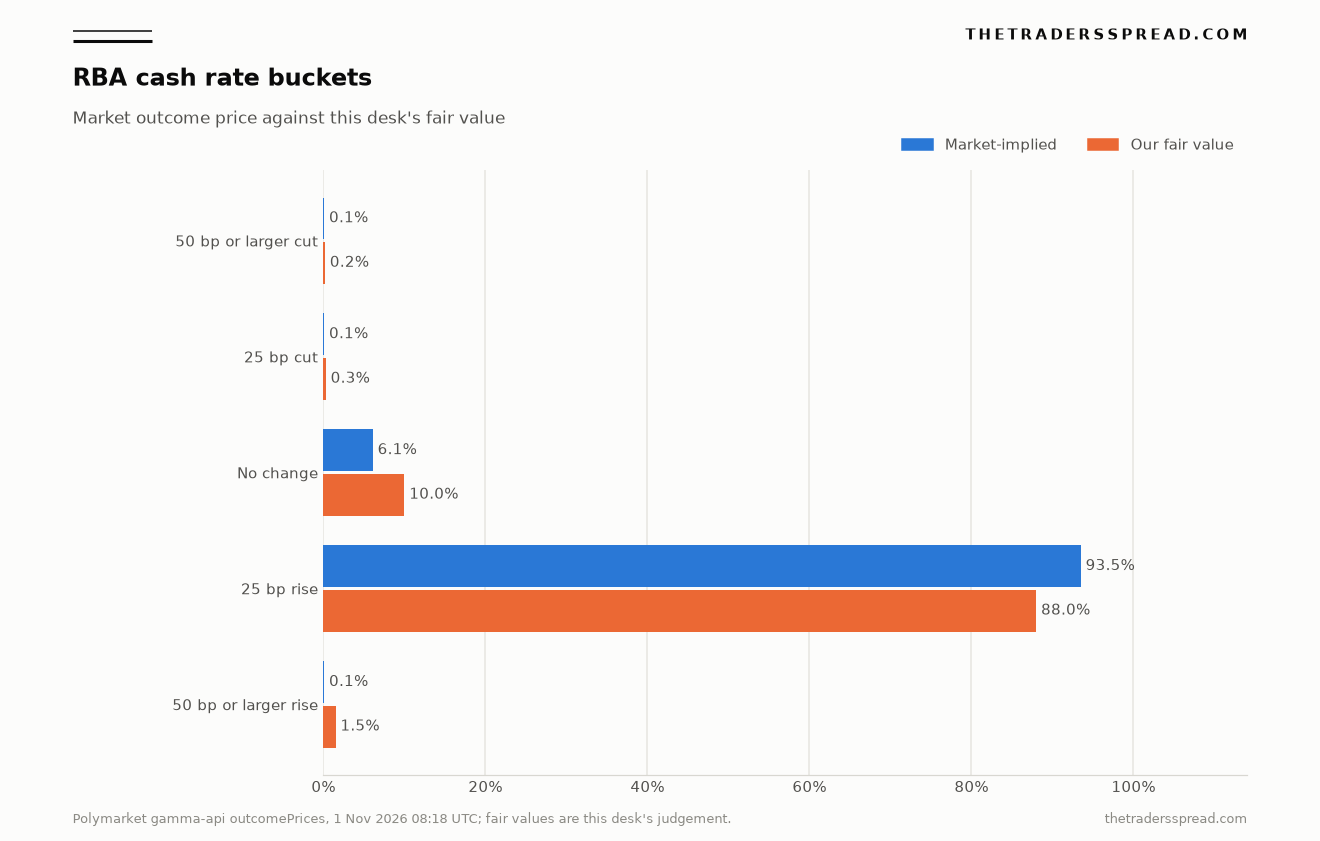
On the 25 basis point increase, 93.45 percent sits above an 88 percent fair value, and so does the 92.3 percent bid, with the offer at 94.6. The comparison against the book is that the market price is above this fair value. The no-change leg mirrors it, 6.1 percent against a 10 percent fair value. A yield ladder such as the five-year Treasury ladders settles on a market yield from a price feed. This contract settles on a figure in a media release.
Where an off-grid move lands
The rounding rule is easier to audit as a table. Each row assumes the prior target is the one in force on the morning of the meeting. For November that number is 4.60 percent. At a later meeting the same rows apply to a different starting point, and the bucket names stay where they are.
| Change in the cash rate target | Bucket | Why |
|---|---|---|
| 0 bp | No change | The target is repeated |
| A rise under 25 bp, such as 10 bp | 25 bp increase | Under 25 rounds to 25 |
| +25 bp | 25 bp increase | Exact labelled step |
| +30 bp | 25 bp increase | Nearer to 25 than to 50 |
| +37.5 bp | 50 bp or larger increase | A tie rounds away from zero |
| +40 bp, or +50 bp and beyond | 50 bp or larger increase | Nearest step is 50, or the move is already there |
| A cut under 25 bp | 25 bp decrease | Same rounding, opposite sign |
| Meeting dropped, and no decision before the next meeting starts | No change | The cancellation clause |
The boundaries follow the contract description on the November event, read from gamma-api on 1 November 2026. A postponed meeting that still decides before the next scheduled meeting begins is scored on that decision, so it has no separate row.
A 10 basis point rise sounds close to a hold and scores as a 25 basis point increase, so the no-change leg loses. A 37.5 basis point rise sounds like a modest overshoot of 25, and the tie-break sends it to the wide increase. The 25 basis point leg includes the small tweak and leaves out that tie.
A late release, and the hour after the PDF
The no-change leg is where a missing decision lands, and it is also what a genuine hold pays. A Board that repeats 4.60 percent, and a meeting cancelled with no decision announced before 7 December, both resolve that leg to yes. At 6.1 percent the weight that can be justified is mostly the ordinary hold. The cancellation path is the remnant that gives the book a defined result when the calendar breaks.
Gamma's end time is 04:59 UTC on 4 November 2026, which is 3.59 pm that day in Sydney on Australian eastern daylight time. The release is scheduled for 2.30 pm on 3 November, and a changed target takes effect the next day, so the market clock runs past both. The rules still allow resolution once the statement carries the figure, and the gap leaves room for a late release and for a dispute on the path set out in how Polymarket resolution works. The release and the cash-rate table are the documents to set beside that process.
How the contract is settled
Settlement sets the pre-meeting cash rate target against the target in the decision release and reads the gap in basis points. A gap of zero lands in the no-change bucket, and a smaller move, or one that rounds to 25, is the 25 basis point bucket in that direction. A move that rounds to 50 or beyond is the wide bucket. A postponement that still produces a decision in time is scored on that decision, and a cancellation or a silence through to the next meeting settles on no change. An emergency move from outside the specified meeting stays out of the score. A band would be read from its upper bound, and a single published number is read as itself.
For November the prior number is 4.60 percent, effective 30 September 2026, and the release is timed for 2.30 pm Sydney time on 3 November. At 08:18 UTC on 1 November the 25 basis point increase was 93.45 percent, against an 88 percent fair value drawn from the year's decisions, the September wording, and a 4.3 percent inflation print. Those steps, with a fresh prior target, are the contract again at the following meeting. The Australian dollar has its own market. Settlement here is the cash rate target.
The fair-value figures are a judgement about how the published rules map onto the live buckets. They are not a recommendation to trade, and they are not personal advice.