

The Bank of Canada and the Reserve Bank of New Zealand both have a 9 December 2026 decision listed on Polymarket, yet the two contracts watch different interest rates. One settles on Canada's target for the overnight rate. The other settles on New Zealand's official cash rate, the OCR. A hold in Ottawa is a claim about one published number. A hold in Wellington is a claim about another.
The split is already on the record from 28 October 2026. The Bank of Canada raised its target by 25 basis points, to 2.5 percent, and that October bracket resolved yes. The same day the Reserve Bank's monetary policy committee voted four to three to hold the OCR at 2.75 percent, and the October no-change bracket resolved yes. A basis point is one hundredth of a percentage point, so 25 basis points equal a quarter of a percentage point.
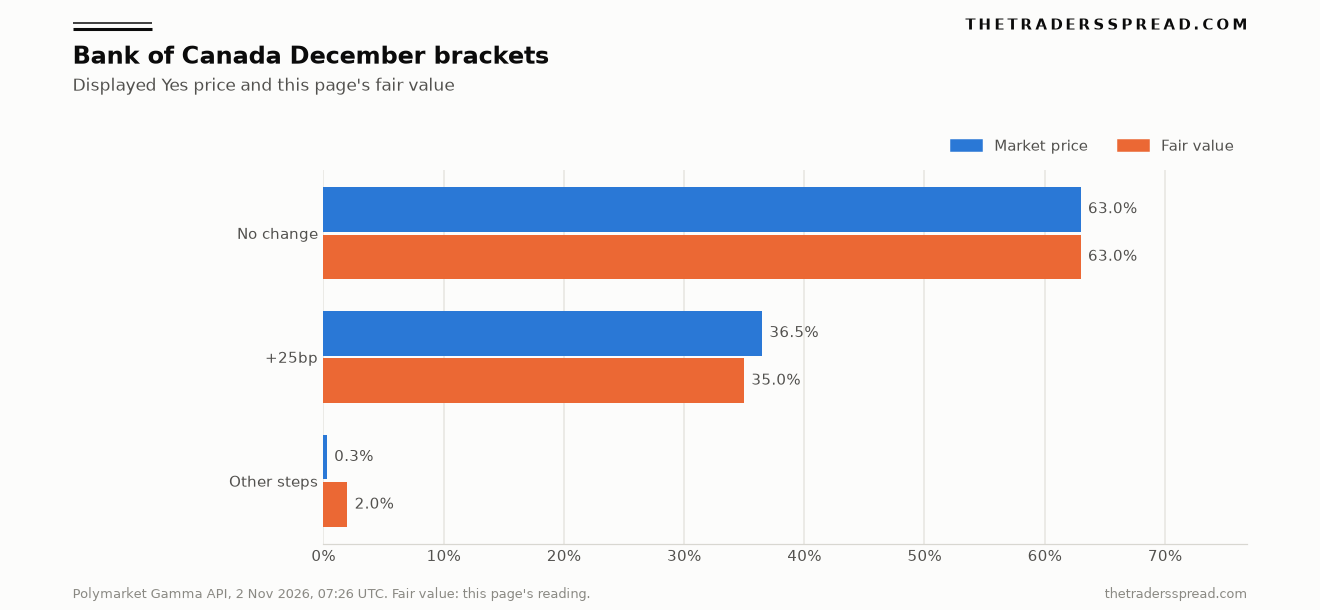
A Bank of Canada rate decision contract is a set of brackets around the change in that target. What follows lines the December wording up against the Reserve Bank contract for the same date: the resolution source, the size of each step, and the sentence that fires if the statement is late. Prices are reference prints from the Polymarket Gamma API at 07:26 UTC on 2 November 2026. The Bank of Canada December decision market is the book with a fair value below. Links to Polymarket are affiliate links, from which The Traders Spread may earn a commission at no cost to you.
Updated 2 November 2026
Same date on the calendar, two rates in the rules
A resolution source is the document a contract treats as final. The Bank of Canada rule points at the Bank's statement for the 9 December 2026 announcement and at the calendar of fixed announcement dates. The Reserve Bank rule points at that Bank's statement for the meeting on the same day and at the RBNZ events calendar.
After those names, the mechanical sentences match. A move under 25 basis points rounds to 25. A larger move goes to the nearest 25, and a tie rounds away from zero, so 37.5 basis points becomes 50. A postponement that still falls before the next scheduled decision is the decision that counts. A cancellation, or silence when that next decision starts, resolves to the no-change bracket. An emergency change from another announcement is left out. If the rate is ever published as a range, the change that counts is the change in the upper bound.
The shared block is why the markets look alike in a list. The nouns are what separate them: "target for the overnight rate" against "official cash rate (OCR)". Swap those nouns and a real statement gets scored against the wrong number.
| What the rule fixes | Bank of Canada | Reserve Bank of New Zealand |
|---|---|---|
| Decision | December 2026 announcement | December 2026 meeting |
| Date in the text | 9 December 2026 | 9 December 2026 |
| Rate | Target for the overnight rate | Official cash rate (OCR) |
| Where to look | Bank statement and key-rate calendar | RBNZ statement and events calendar |
| Standard step | 25 basis points | 25 basis points |
| Move under 25 basis points | Rounds to 25 | Rounds to 25 |
| Move of 37.5 basis points | Rounds away from zero, to 50 | Rounds away from zero, to 50 |
| Postponed, still before the next decision | Postponed announcement counts | Postponed meeting counts |
| Cancelled, or silent at the next start | No-change bracket | No-change bracket |
| Emergency move on another day | Left out | Left out |
| Rate later published as a range | Change in the upper bound | Change in the upper bound |
The Canadian row is titled "No Change" and the New Zealand row is titled "No change". Both cancellation sentences use "No Change", and both brackets mean a zero change in the named rate.
The number on the statement, and the number in the market
The Bank's policy-rate explainer says the target is the overnight rate it wants institutions to charge each other for one night. They can also deposit at the deposit rate or borrow at the Bank Rate. That gap is the operating band, currently 30 basis points wide, with the deposit rate 5 basis points under the target. The 28 October release matches it: target 2.5 percent, deposit rate 2.45 percent, Bank Rate 2.75 percent.
The CORRA page describes the Canadian Overnight Repo Rate Average as the cost of overnight general-collateral funding against Government of Canada treasury bills and bonds. CORRA is a traded average, not the target the December contract names. The contract moves when the December announcement changes the target.
The upper-bound sentence applies if the specified rate is defined by an upper and lower bound. Here the specified rate is the target, a single figure, with the deposit rate under it and the Bank Rate over it. The explainer says the band's width can change, so a wider band could move the Bank Rate while the target stayed put. The bracket would follow the target. The range sentence would matter if a later contract's named rate were itself a bound.
The Reserve Bank contract names the OCR. On 28 October the committee held it at 2.75 percent by four votes to three. The release, carried by Scoop after the Reserve Bank site refused a direct fetch, says tighter policy is likely to be required but remains conditional on the outlook. The December bracket compares the OCR set at that meeting with the OCR in force just before it.
The Reserve Bank posted the hold itself. The 2.75 percent in the post is the OCR the December rule tracks, and the vote was split on a step the same width as one bracket.
Official Cash Rate held at 2.75% - The Monetary Policy Committee today voted 4 - 3 to hold the OCR at 2.75%
— Reserve Bank of NZ (@ReserveBankofNZ) October 28, 2026
· Inflation is above our target range, largely due to high global fuel costs and their effects on other prices.
· The economy is recovering gradually, but conditions are… pic.twitter.com/dY65NhH0Os
The Reserve Bank of New Zealand December decision market uses that OCR and that date. The Yes prices from the same Gamma print sit beside the Canadian book in the table below.
Twenty-five basis points is the smallest box
Neither December contract has a 10-basis-point row. The rule's own example treats a 10-basis-point move as 25, and it treats 37.5 basis points as 50 because a tie rounds away from zero. On 28 October that sentence had nothing to re-label: Canada moved by a full 25, and New Zealand moved by zero. A later 10-basis-point tweak would still land in the 25-basis-point bracket. The unchanged row is reserved for a zero change in the named rate.
The ECB decision page prices another no-change bracket off a central-bank statement, with its own source and its own date. A familiar grid can still answer a different question.
A late statement already has an ending
Either December contract may resolve as soon as the statement carrying the decision is public. A later speech counts only if it is the first document that actually carries the rate. There is also a backstop for a missing statement.
On the Bank of Canada calendar, opened on 2 November 2026, the announcement after 9 December is 27 January 2027, which is also the next Monetary Policy Report. A December announcement moved to a day still ahead of 27 January is the one the December contract follows. A cancellation, or a statement still unpublished when the 27 January announcement starts, resolves the December contract to the no-change bracket.
The Reserve Bank rule has the same shape and a different calendar link. A postponed December meeting that still falls before the next scheduled meeting is the one that counts. A cancellation, or a delay that runs into that next meeting, resolves to the no-change bracket. Release hour is absent from both texts. The Reserve Bank events page returned an access error on 2 November, so that next meeting's clock time stays on the calendar the contract names.
An emergency move on another day sits outside both contracts. It changes the December result only by changing the level in force on the morning of the named decision. The same habit, settling on the first official document that contains the figure, shows up in beat contracts, which use the first company print. A later interview can explain the vote. The named statement is what settles the bracket.
The Bank of Canada January 2027 decision market points at 27 January with the same target, the same grid, and the same postponement sentence. December has no new Monetary Policy Report on the calendar, and January arrives with one. The fair value below is for December only.
What the two books showed on 2 November
Each bracket is its own yes-or-no market, so the Yes column can total a little over 100 percent or a little under. The five Canadian Yes prices added to 99.75 percent. The five New Zealand Yes prices added to 103.7 percent. Read a row on its own.
| Bracket | Bank of Canada Yes | RBNZ Yes |
|---|---|---|
| Cut of 50 basis points or more | 0.05 percent | 0.25 percent |
| Cut of 25 basis points | 0.15 percent | 2.4 percent |
| No change | 63 percent | 24.5 percent |
| Increase of 25 basis points | 36.5 percent | 71 percent |
| Increase of 50 basis points or more | 0.05 percent | 5.55 percent |
| Event volume | $193,964 | $51,091 |
| Liquidity | $61,692 | $12,402 |
Source: Polymarket Gamma API, records updated 2 November 2026 at 07:26 UTC. The Canadian no-change row showed a 62 cent bid and a 64 cent ask, last trade 64, around the displayed 63 percent. The Reserve Bank no-change row showed 24 bid and 25 ask, while its 25-basis-point increase showed 70 bid and 72 ask. Leg volume was about $73,131 on the Canadian no-change row and about $24,690 on that Reserve Bank increase.
The fair value used here for the Canadian no-change bracket is 63 percent, the same figure as the displayed Yes price, so the stored reading sits in line with the book. The 28 October press release says there could be a need to increase the policy rate further, and that Governing Council agreed to proceed carefully. The next Monetary Policy Report is 27 January 2027, after a 9 December announcement on its own. A council that has just hiked, and that leaves a further increase possible while saying it will proceed carefully, lines up with a hold as the central case and a second 25-basis-point step still carrying a large share. The screen already had that shape.
The only difference at the edges: the 25-basis-point increase is marked at 35 percent, against 36.5 on the screen, and the other three brackets together are marked at 2 percent, against about 0.3 percent displayed. An odd-sized step would be pushed into a 25-point row or a 50-point row. The shift leaves the no-change bracket on the displayed price.
RelatedFive-year Treasury ladders sit apart from the ten-year book
October already closed on opposite rows
The October contracts are finished, so those prices are results. In the Gamma search on 2 November 2026, the Bank of Canada October event had about $617,028 of volume and the 25-basis-point increase leg, about $232,653, stood at yes. The Reserve Bank October event had about $145,878 of volume and the no-change leg, about $55,599, stood at yes.
The Bank of Canada posted the new target the same day. That figure is the starting level the December contract now uses.
We have increased our interest rate to 2.50%. https://t.co/BjYoo4p2vY#MonetaryPolicy #InterestRates #cdnecon #economy pic.twitter.com/g1nb1GIohu
— Bank of Canada (@bankofcanada) October 28, 2026
The two October books used the same grid and the same style of rule, and they closed on different rows because the named rates did different things.
Frequently asked questions
Does the Bank of Canada contract follow CORRA?
CORRA measures what overnight secured funding costs in the market. The December contract follows the target for the overnight rate, the policy figure in the statement. On 28 October 2026 that target was 2.5 percent, with the deposit rate at 2.45 percent and the Bank Rate at 2.75 percent. A CORRA print away from the target leaves the brackets where they were. The bracket changes when the announcement changes the target.
What happens to a 10-basis-point move?
The rule folds a move smaller than 25 basis points into the 25-basis-point bracket. A 10-basis-point cut is scored as a cut of 25, and a 10-basis-point hike is scored as an increase of 25. Both books start at that step. The same paragraph sends 37.5 basis points to 50, because an equal distance is rounded away from zero. The example is written into both December texts.
What if the statement is published late?
A postponed decision that still falls before the next scheduled decision is the one the contract follows. A cancellation, or a statement still unpublished when the next decision begins, settles on the no-change bracket. For the Bank of Canada, the next date after 9 December 2026 is 27 January 2027. The Reserve Bank rule uses the same structure and points at that bank's events list for the meeting after December.
Do the two no-change brackets describe the same economy?
They describe the same shape of outcome on different rates. No change in the Canadian contract means the overnight target is the same after the December announcement as before it. No change in the New Zealand contract means the OCR is the same after the December meeting as before it. After 28 October those levels were 2.5 percent and 2.75 percent. A hold in one country leaves the other rate where its own committee set it.
Who decides if the statement is ambiguous?
The economic fact is the central bank's statement. The market fact is whether that statement fits the bracket someone proposes. Polymarket handles a challenged result through a proposal and, if a participant objects, a dispute. How a proposal and a dispute work is set out separately. Follow that process if the argument is about the oracle. The comparison here stops at the sentence that names the rate.
What would change this comparison
The reading uses the two rule texts and the two calendars as they stood on 2 November 2026. It would move if either text changed the named rate, the grid, or the calendar link. A Bank of Canada contract aimed at CORRA, or at the Bank Rate, would be a different market. An RBNZ contract that scored a range by its upper bound, after a single OCR was dropped, would wake up a sentence that now sits idle.
A step thinner than 25 basis points would retire the rounding example. If one calendar moved 9 December past the other bank's next meeting, the postponement clauses would describe different delays. Any of those would be a new document, not a new opinion about this one.
Prices and wording here are a reference for reading the contracts. They are not a recommendation to take either side.