

Is EUR/RON pricing a freely floating leu, or the National Bank of Romania's managed float against the euro, with USD/RON left to carry the dollar?
We pulled the ECB reference series through Frankfurter at 06:58 UTC on 30 October 2026, and it answers with the second reading. On 29 October 2025 the euro reference was 5.0841 lei and the dollar reference was 4.3693 lei. On 29 October 2026 those prints were 5.3441 and 4.8015. That is a 5.11 percent rise in EUR/RON and a 9.89 percent rise in USD/RON. Over the same two dates EUR/USD fell from 1.1636 to 1.113, a 4.35 percent decline. Divide the later euro-leu print by the later euro-dollar print and the dollar-leu print comes back: 5.3441 divided by 1.113 equals 4.8015 at four decimal places. The extra distance in USD/RON is the dollar's own move, sitting on top of the leu's move against the euro.
The National Bank's fixing for the same day, in the XML cube whose publishing date is 29 October 2026, was 5.3449 lei per euro and 4.7943 lei per dollar. The euro prints differ by 0.0008 and the dollar prints differ by 0.0072. What follows is how the operating rule is built, and which of the two leu crosses carries it.
Updated 30 October 2026
Key facts
- ECB reference EUR/RON was 5.3441 on 29 October 2026, up from 5.0841 on 29 October 2025, a rise of 5.11 percent. Source: Frankfurter ECB reference series, retrieved 30 October 2026.
- ECB reference USD/RON was 4.8015 on 29 October 2026, up from 4.3693 a year earlier, a rise of 9.89 percent, while EUR/USD fell from 1.1636 to 1.113. Source: Frankfurter, retrieved 30 October 2026.
- The NBR reference fixing dated 29 October 2026 was 5.3449 lei per euro and 4.7943 lei per dollar. Source: National Bank of Romania XML cube, publishing date 29 October 2026.
- The monetary policy rate is 6.50 percent, the lending facility 7.50 percent and the deposit facility 5.50 percent, shown as valid from 8 August 2024, and the board kept all three on 8 October 2026. Source: NBR homepage and the 8 October 2026 board decision.
- The inflation rate displayed for September 2026 is 6.61 percent, against a target of 2.5 percent plus or minus 1 percentage point. Source: NBR homepage, read 30 October 2026.
- Foreign-exchange reserves were EUR 60,060 million on 30 September 2026, compared with EUR 64,865 million on 31 August 2026. Source: NBR international reserves release, 1 October 2026.
- The current-account deficit for January to August 2026 was EUR 19,925 million, compared with EUR 18,983 million a year earlier. Source: NBR balance of payments release, 15 October 2026.
1. A managed float with the euro as the operating cross
Under Article 2 of Law 312/2004 the National Bank defines monetary policy and exchange-rate policy. The regime page states a managed float for the leu, lined up with inflation targeting as the nominal anchor, so an unexpected shock can be met with some flexibility in the currency. The homepage's primary objective is price stability, which is why the float is managed, and the decision text conducts that management against the euro.
A harder cousin is the Danish krone's euro band. The desk page on GBP/DKK and the euro peg that sets that cross keeps meeting the same fact: a quote against sterling or the dollar is mostly the euro cross plus the outside pair. Romania's rule is looser than a band, and the past year of ECB references shows that looseness as a quiet stretch followed by two steps.
From the October 2025 month-end through the March 2026 month-end, EUR/RON on the ECB tape sat between 5.0858 and 5.0991. Six month-ends, a range of 0.0133 lei. Across that same window the dollar cross was already elsewhere. The low ECB print for USD/RON in the year file is 4.2563 on 28 January 2026, with EUR/USD at 1.1974 that day and EUR/RON still at 5.0965. The leu against the euro had barely left the autumn range. The leu against the dollar had moved, because the euro had strengthened against the dollar.
The reserve-management page gives the reason a stock of reserves sits behind the regime: price stability, financial stability, and resources for mitigating foreign-exchange volatility where necessary. When the October decision turns to the currency, it names EUR/RON.
2. Inflation still above the band the corridor was built around
The homepage target is 2.5 percent plus or minus 1 percentage point, so the band runs from 1.5 to 3.5. September 2026 is displayed at 6.61 percent, which is 3.11 percentage points above the top of the band and 0.11 percentage points above the 6.50 percent policy rate. The key rate and that monthly reading sit near each other, and both sit far above the target.
The corridor is a full percentage point wide on either side, with the deposit facility at 5.50 percent and the lending facility at 7.50 percent, dated on the homepage as valid from 8 August 2024. The board meeting of 8 October 2026 kept the policy rate at 6.50 percent per annum and maintained the existing minimum-reserve ratios on leu and foreign-currency liabilities. The October text keeps those ratios at their existing levels, and the percentages sit in the earlier framework.
On the assessments then in hand, the decision says annual inflation would follow an upward path through the end of 2026. It names higher fuel, energy and other commodity prices, agri-food included, the Middle East conflict, the year's severe drought, and the leu's exchange rate. More lei per euro means euro-invoiced imports cost more lei at the border, which is the channel from EUR/RON back into the price index. Dollar-invoiced goods take the USD/RON route into the same index.
Leu credit is still most of private credit, which is how the 6.50 percent rate reaches the economy being targeted. The decision records private-sector credit growth at 8.2 percent in August 2026, from 8.4 percent in June, with the leu share of that stock steady at 66.8 percent. Broad money at end-September was RON 816,213.4 million, up 8.4 percent on the year, or 1.7 percent in the real terms quoted on the homepage beside that nominal rate.
3. Four percentage points between the leu rate and the ECB deposit rate
On 29 October 2026 the ECB Governing Council left its key rates unchanged: deposit facility 2.50 percent, main refinancing 2.65 percent, marginal lending 2.90 percent, aimed at 2 percent inflation over the medium term. The NBR policy rate of 6.50 percent sits 4.00 percentage points above that deposit rate, and the two deposit facilities, 5.50 against 2.50, sit 3.00 percentage points apart. Those posted gaps are the price of leu funding relative to euro funding.
The ECB's own post that day is the euro-area half of the gap, and it matters here because EUR/RON is a cross against the currency that decision steers.
The Governing Council decided to keep interest rates unchanged.
— European Central Bank (@ecb) October 29, 2026
We are committed to ensuring that inflation stabilises at 2% says President @Lagarde.
Watch here https://t.co/GaO1SUSKBo pic.twitter.com/oZSfYnRHj5
The Romanian decision, three weeks earlier, had already pointed at that euro-area choice, and at the Fed and at central banks in the region. The paragraphs give the Fed's name and leave the funds rate unstated, so the funds rate stays out of the comparison. A dollar loan prices the Fed's rate plus a spread, a euro loan prices the ECB's rate plus a spread, and a leu loan prices the NBR corridor. EUR/RON is where the leu-euro gap shows up in the currency. USD/RON folds the euro-dollar rate in on top.
The clean contrast on this desk is GBP/SEK, a European cross with its own rate path. Sterling and the krona each carry a policy rate, and that pair's path is the gap between those two rates plus whatever else the market is charging for risk. Romania's euro cross has a manager. Treating the leu like that Scandinavian pair is how the two trades get blurred.
4. The external deficit the reserve stock has to face
The balance-of-payments release dated 15 October 2026 covers January to August, marked provisional. The current account posted a deficit of EUR 19,925 million, against EUR 18,983 million in the same months of 2025. The widening is EUR 942 million. The release splits the deficit the way a managed float actually feels it, into goods, services, and the two income lines.
| Component | January-August 2025 | January-August 2026 |
|---|---|---|
| Current account | -18,983 | -19,925 |
| Goods | -21,567 | -22,385 |
| Services | 8,632 | 9,344 |
| Primary income | -6,370 | -6,665 |
| Secondary income | 322 | -219 |
Goods widened by EUR 818 million and the services surplus by EUR 712 million, so goods and services together explain EUR 106 million of the EUR 942 million deterioration. Primary income widened by EUR 295 million, and secondary income swung by EUR 541 million, from a 322 million surplus to a 219 million deficit. Income explains EUR 836 million of the wider deficit. The change is an income story, while the level is still a goods story: the goods deficit of EUR 22,385 million exceeds the whole current account because services run a surplus of EUR 9,344 million.
External debt at end-August was EUR 238,078 million, up EUR 7,450 million. Long-term debt was EUR 184,784 million, or 77.6 percent of the total, up 1.8 percent from end-2025. Short-term debt was EUR 53,294 million, or 22.4 percent, up 8.5 percent. The addition tilted short, and a refinancing date pulls on the euro cross through a flow of euros, while a dollar move can show up as a valuation change on its own.
The reserve release dated 1 October 2026 puts the stock beside those flows. Foreign-exchange reserves were EUR 60,060 million on 30 September, against EUR 64,865 million on 31 August. Inflows of EUR 3,302 million and outflows of EUR 8,107 million net to the same EUR 4,805 million drop, and about EUR 2,684 million of the outflow was public-debt interest and principal. Gold stayed at 103.6 tonnes, valued at EUR 12,280 million. Total reserves were EUR 72,340 million, against EUR 77,627 million, and October's due public foreign-currency payments were about EUR 350 million.
5. USD/RON is EUR/RON divided by EUR/USD
Across 256 overlapping business days, EUR/RON divided by EUR/USD reproduces USD/RON, and the largest gap was under 0.00005 lei. On the latest day, 5.3441 divided by 1.113 prints 4.8015. The NBR fixings come from licensed banks' average quotations, so 5.3449 divided by 4.7943 implies about 1.1148 dollars per euro, against the ECB print of 1.113. The euro fixings sit 0.0008 apart. The dollar fixings, 4.7943 against 4.8015, are where the two methods part company.
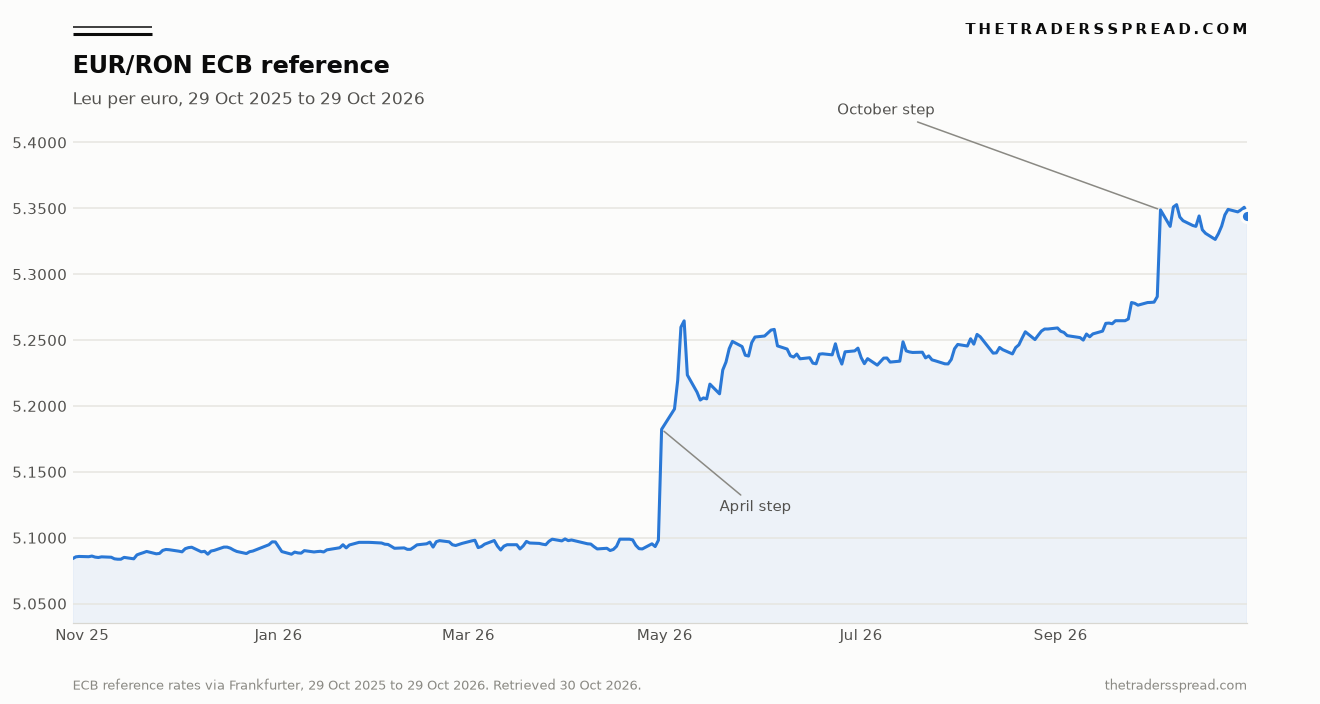
The high-low spans are the simplest comparison of the two leu crosses. EUR/RON travelled from 5.0837 on 12 November 2025 to 5.3528 on 7 October 2026, a span of 0.2691 lei. USD/RON travelled from 4.2563 on 28 January 2026 to 4.8063 on 28 October 2026, a span of 0.5500 lei, which is 2.04 times the euro span. A managed euro cross can drift higher in steps and still look calm next to a dollar cross that also absorbs a 4.35 percent fall in EUR/USD.
RelatedEUR/CZK Price Prediction: 24.55 Bull Case vs 24.10 Bear Case
| Date | EUR/RON | USD/RON | EUR/USD |
|---|---|---|---|
| 29 Oct 2025 | 5.0841 | 4.3693 | 1.1636 |
| 28 Jan 2026 | 5.0965 | 4.2563 | 1.1974 |
| 31 Mar 2026 | 5.0991 | 4.4348 | 1.1498 |
| 30 Apr 2026 | 5.1823 | 4.4286 | 1.1702 |
| 29 May 2026 | 5.2523 | 4.5107 | 1.1644 |
| 30 Sep 2026 | 5.2788 | 4.6489 | 1.1355 |
| 2 Oct 2026 | 5.3488 | 4.7651 | 1.1225 |
| 7 Oct 2026 | 5.3528 | 4.7891 | 1.1177 |
| 28 Oct 2026 | 5.3508 | 4.8063 | 1.1133 |
| 29 Oct 2026 | 5.3441 | 4.8015 | 1.113 |
Two steps dominate the euro column. EUR/RON rose 0.0842 lei on 30 April 2026, from 5.0981 to 5.1823, the largest daily rise in the file, and then 0.0658 lei on 2 October, from 5.2830 to 5.3488. The high, 5.3528, printed on 7 October, and 29 October was back at 5.3441. Over those same late-October days USD/RON was still near its high of 4.8063 on 28 October. The euro cross had levelled off while the dollar cross was still taking the weaker euro.
USD/DKK, the dollar cross against a euro-anchored krone, sits in the same drawer. Anchor the European leg to the euro, by Denmark's band or by the managed float that spent six month-ends inside 0.0133 lei and then stepped twice, and the dollar quote becomes a conversion.
6. The October path the board described for EUR/RON
The 8 October decision says EUR/RON steepened in the first ten-day stretches of September, soared at the end of September and the onset of October, and then stuck. ECB references go from 5.2567 on 1 September to 5.2788 on 30 September, a rise of 0.0221 lei. The large ECB move is the 2 October step. The meeting day printed 5.3434 and 29 October printed 5.3441, so the board's verb fits the ECB reference tape, while the NBR is describing the market it watches.
Medium- and long-term government yields fluctuated in early September, rose sharply with the Middle East conflict and the domestic political situation, and the rise was largely corrected in the first days of October. The opened paragraphs give that sequence and skip a basis-point tally, so the sequence stands on its own. Yields moved, the euro cross jumped as the month turned, and the policy rate stayed at 6.50 percent. The instrument that moved, among those the board discusses, was EUR/RON.
The April step of 0.0842 lei had already carried the cross out of the 5.09 area it occupied from the previous autumn, and the October step carried it off the summer plateau near 5.25 to 5.28. Between the two jumps the other trade shows itself plainly. On 18 June 2026 USD/RON rose 0.0576 lei while EUR/RON rose 0.0073. That session belongs to the dollar, and folding it into a leu-policy story would blur the two crosses.
FAQ
Why does the National Bank's constraint show up in EUR/RON rather than in USD/RON?
The regime page calls the leu a managed float tied to the inflation target. The 8 October 2026 decision then describes EUR/RON by name and spends the exchange-rate detail on that cross. On ECB references, USD/RON is the euro cross divided by EUR/USD, so the dollar's move arrives after the euro rate is printed. The constraint the bank describes sits on the euro cross.
Why do the ECB reference and the NBR fixing differ on the same date?
On 29 October 2026 Frankfurter's ECB reference was 5.3441 lei per euro and 4.8015 lei per dollar, while the NBR XML cube printed 5.3449 and 4.7943. The NBR builds its list from average quotations of banks licensed for foreign exchange, and the ECB publishes its own euro reference, which Frankfurter redistributes. The euro gap that day was 0.0008 lei and the dollar gap was 0.0072 lei, so the two methods disagreed by more on the dollar.
How wide was the gap between the euro cross and the dollar cross over the year?
From 29 October 2025 to 29 October 2026, the ECB high-low span for EUR/RON was 0.2691 lei, from 5.0837 on 12 November 2025 to 5.3528 on 7 October 2026. The USD/RON span was 0.5500 lei, from 4.2563 on 28 January 2026 to 4.8063 on 28 October 2026, or 2.04 times the euro span. Over the matched year EUR/RON rose 5.11 percent and USD/RON rose 9.89 percent, with EUR/USD down 4.35 percent.
Verdict
We read EUR/RON as the cross that carries the National Bank's constraint. The statute pairs exchange-rate policy with an inflation target, the October text narrates EUR/RON by name, and the 6.50 percent corridor stayed in place. Foreign-exchange reserves of EUR 60,060 million at end-September are the stock available when the bank damps volatility. USD/RON carries that euro cross and then the dollar: over the ECB year the euro cross rose 5.11 percent, the dollar cross rose 9.89 percent, and 5.3441 divided by 1.113 holds at the fourth decimal.
Reference prints above come from the ECB series redistributed by Frankfurter and from National Bank of Romania releases and the 29 October 2026 XML cube, each with its date. They describe how the two crosses are set, and they stand apart from any instruction to take a side in either cross.