

EUR/ZAR was 18.5339 on the European Central Bank reference rate for 28 October 2026, the rand price of one euro in the ECB's daily XML that morning and the same figure Frankfurter returned for the date. The page open beside the print was the South African Reserve Bank's September Monetary Policy Committee statement, still showing a policy rate of 7.25%, effective from 25 September, with the next decision dated 19 November 2026.
Lesetja Kganyago, Governor of the South African Reserve Bank, used that statement to describe a rand that has been "notably resilient throughout the year," with import prices contained and food inflation at its lowest since 2010. The usual reading of that resilience is a carry story: the policy rate sits well above the euro area's deposit facility, capital prefers rand assets, and EUR/ZAR should keep grinding lower. The gap is wide, and it is the same width it was in early April.
On 1 April 2026 the ECB deposit facility was still 2.00%, the setting in force since 11 June 2025. The October Monetary Policy Review records a cumulative 50 basis point rise in the SARB policy rate, to 7.25%, over April to October, which puts the rate at the opening of that window at 6.75%. Against a 2.00% deposit rate the gap was 4.75 percentage points. On the morning of 29 October the key-rate table still showed 2.50%, with effect from 16 September, and the SARB rate was 7.25%. The gap is 4.75 percentage points again, because both central banks hiked by half a point. The South African policy rate and the ECB deposit rate do not have to move together, and the base case below uses the SARB policy rate, not an ECB deposit-rate move.
Over those months EUR/ZAR fell from 19.4745 on 1 April to 18.5339, a decline of 4.83%, and now sits 0.141 rand above the 18.393 low of 21 October, about 8% of the way up from that low to the 20.0745 high of 4 November 2025. From 19.9043 a year earlier the cross is down 6.88%. The decline arrived while the euro gap stood still, and about four points of the 4.83% came from a weaker euro against the dollar.
Key facts
- EUR/ZAR 18.5339 on 28 October 2026, down 6.88% from 19.9043 on 29 October 2025. High 20.0745 on 4 November 2025, low 18.393 on 21 October 2026. ECB reference rates via the daily XML and Frankfurter, retrieved 29 October 2026.
- SARB policy rate 7.25% from 25 September 2026, unanimous. Next meetings 19 November 2026, 28 January 2027, 18 March 2027. SARB September MPC statement, opened 29 October 2026.
- ECB deposit facility 2.50% from 16 September 2026, after 2.25% from 17 June and 2.00% from 11 June 2025. Main refinancing 2.65%, marginal lending 2.90%. ECB key-rate table, opened 29 October 2026.
- Nominal gap 4.75 percentage points at both ends of April to October. The 6.75% start is 7.25% minus the review's cumulative 50 basis points. SARB Monetary Policy Review, 6 October 2026.
- Inflation 3.2% in the first quarter, 4.5% in the second, and 4.5% in September, up 0.4% on the month. Projected above 5% until the second quarter of 2027. SARB MPR, 6 October 2026, and Stats SA P0141, 21 October 2026.
- Second-quarter GDP minus 0.2%, with 2026 growth projected at 1.2%, from 1.4%. Petrol under-recovery was R2.83 a litre in the September statement, opened on the SARB site on 29 October 2026.
Section 1: The euro gap, unchanged
Kganyago's line is that policy is restrictive relative to a 3% inflation target, with rates "above longer-term levels." Restrictive against that target can sit beside a euro gap that finished the review window where it began, the same 4.75 points as when EUR/ZAR fixed at 19.4745.
The ECB table dates the euro hikes as 2.00% to 2.25% from 17 June 2026 and 2.25% to 2.50% from 16 September. The SARB review records the South African side as a cumulative 50 basis point rise to 7.25% over April to October, and the September statement identifies the last 25 basis points, unanimous, effective 25 September. The full-window change on each side was half a point. The 6.75% cell is that subtraction, the rate the review's own 50 basis points rise from.
| Setting | Start of the review window | 29 October 2026 |
|---|---|---|
| SARB policy rate | 6.75%, implied by a cumulative 50bp rise to 7.25% | 7.25%, effective 25 September |
| ECB deposit facility | 2.00%, in force since 11 June 2025 | 2.50%, effective 16 September |
| Gap | 4.75 percentage points | 4.75 percentage points |
| EUR/ZAR | 19.4745 on 1 April 2026 | 18.5339 on 28 October 2026 |
Sources: ECB key interest rates, opened 29 October 2026; the SARB Monetary Policy Review of 6 October 2026 and the September MPC statement; ECB reference rates via Frankfurter for 1 April and the ECB daily XML for 28 October, both retrieved 29 October 2026.
Section 2: Where the cross actually travelled
By 29 January 2026 the fix was already 18.7584, down from the 4 November 2025 high of 20.0745, and March then ran back up to 19.7984 on 27 March. A large slice of the decline from that high was on the tape before the review window opened, while the policy rate was still the 6.75% the later hikes rose from. Inside the window, July is the analogue for the bear case. The fix on 6 July was 18.5318, two-tenths of a cent from 18.5339 on 28 October, and by 24 July it was 19.1704, a rise of 0.639 rand, or 3.45%, in three weeks. From there it faded to the 18.393 low on 21 October, and the next six sessions only took it back to 18.5339.
On 25 September, the day 7.25% took effect, EUR/ZAR was 18.5798, and by 28 October it was 18.5339, a change of 0.25%. Six weeks after a unanimous hike, against a deposit rate just lifted to 2.50%, the cross moved less than it moves in a quiet week.
Section 3: The cushion inside the gap
What moved is the inflation rate under that unchanged nominal gap. The October review has headline inflation up from 3.2% in the first quarter to 4.5% in the second, above 5% until the second quarter of 2027, and back toward target only from the fourth quarter of that year. The policy rate rose 0.5 percentage point over the review while inflation rose 1.3 points from the first quarter to the second, so the ex-post cushion thinned by about 0.8 point, from 6.75 minus 3.2 (3.55) to 7.25 minus 4.5 (2.75).
The September landing page, opened on 29 October, still showed inflation at 4.4% with a next-due date of 21 October, a date that had already passed. Stats SA's P0141, embargoed until that day, put September at 4.5%, from 4.4% in August and 4.3% in July, up 0.4% on the month, with transport at 10.8% contributing 1.5 points. The above-5% stretch is still a forecast. Longer-run expectations, as the governor reported the Bureau for Economic Research survey, were around 4% rather than the 3% target, so a real policy rate near 2.75% is a thinner cushion than the euro gap suggests. The Reserve Bank's 16 October post puts the consensus in one sentence.
[ICYMI] Governor Lesetja Kganyago told Bloomberg’s Avril Hong that monetary policy remains restrictive as the MPC works to return inflation to target. With global uncertainty and tighter financial conditions shaping the outlook, the MPC will continue to assess incoming data on a…
— SA Reserve Bank (@SAReserveBank) October 16, 2026
The Quarterly Projection Model has the policy rate "broadly stable through the remainder of this year," with cuts only later. The review dates a return toward 3% to late 2027. The meetings between now and 31 March 2027 are 19 November, 28 January and 18 March, and the base case leaves the policy rate at 7.25% through all three.
Section 4: Scenarios the statement already ran
The September statement also ran two alternatives, and they are the parents of the bull and bear cases below. Double the baseline foreign hike, to a full percentage point between this year and next, and the Bank's model has the rand depreciating, with about one extra domestic hike in response. Higher inflation expectations and wages produce between one and two hikes above the baseline peak. The baseline foreign hike itself is the piece the EUR/ZAR base case leaves unspent. The key-rate table opened on 29 October, ahead of the Governing Council decision at 13:15 UTC, still ended on the 16 September row. A separate desk piece follows the October ECB decision. The base case is fully specified with the deposit facility left at 2.50% and EUR/USD held at 1.1133.
The desk's AUD/NZD forecast runs the same kind of test on a different pair. Here the variable the base case uses is the SARB rate, held at 7.25% while inflation stays near 4.5% and the review's path points above 5% into the first half of 2027. The ECB's 8 October post points at the account of the 9-10 September meeting, the session that set the deposit rate still on the table.
Account of the monetary policy meeting of the Governing Council of the ECB on 9-10 September 2026 https://t.co/ynR4GvkOlt pic.twitter.com/UyGk2lu1Et
— European Central Bank (@ecb) October 8, 2026
Section 5: The euro-dollar did the heavy lifting
On 28 October the daily XML showed EUR/USD at 1.1133 beside EUR/ZAR at 18.5339, so the implied dollar-rand rate is 16.6474, against Frankfurter's direct print of 16.6477. On 1 April, EUR/USD was 1.1605 and EUR/ZAR 19.4745, an implied dollar-rand rate of 16.7816. Across that span EUR/USD fell 4.07% and the dollar-rand rate 0.80%, and the product is the 4.83% fall in the cross. A carry bid funded in euros would have shown up as a much stronger rand against the dollar. On 21 October the same division, 18.393 over 1.1234, was 16.3724, so the bounce to 28 October was a weaker rand partly offset by a weaker euro. The desk's USD/ZAR forecast is a different pair. Holding EUR/USD at 1.1133, the base, bull and bear cases below line up with dollar-rand rates of 17.07, 17.47 and 16.08.
Section 6: The call, through 31 March 2027
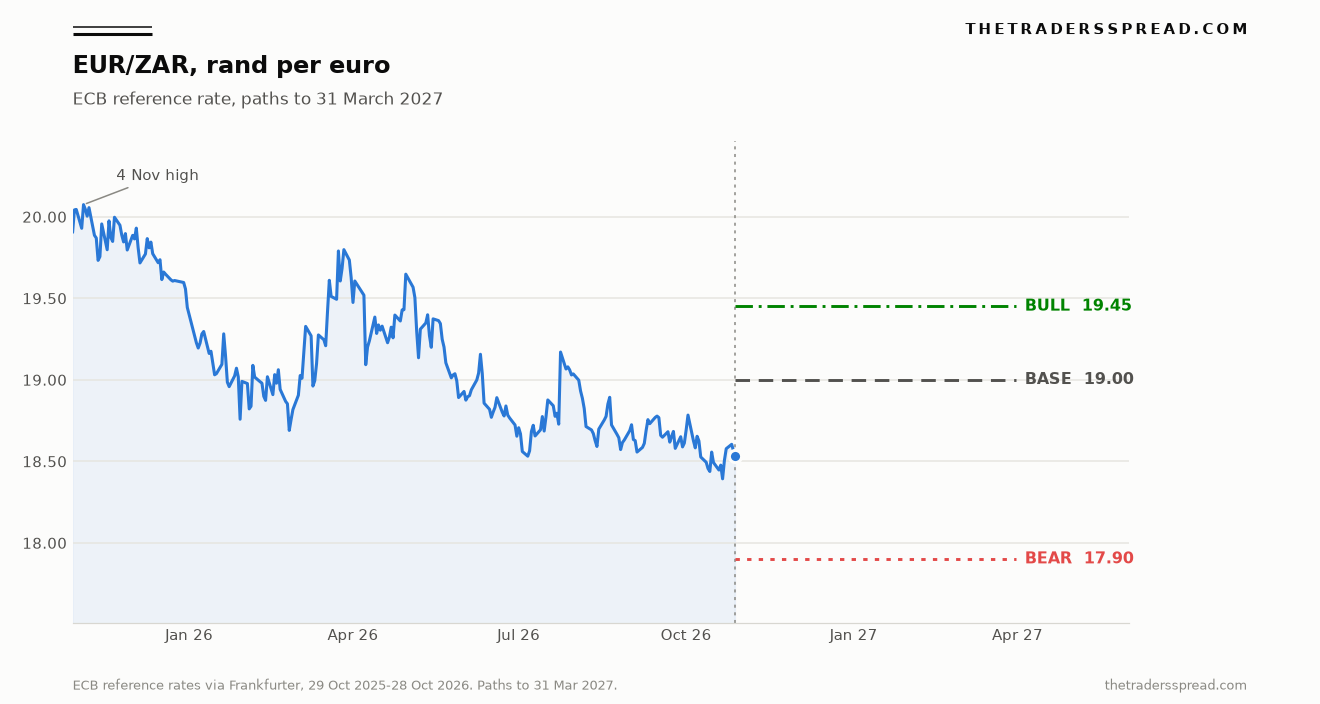
All three paths hold EUR/USD at 1.1133 through 31 March 2027, so a higher EUR/ZAR is a weaker rand, and the differences turn on the SARB rate.
| Path to 31 March 2027 | EUR/ZAR | Versus 18.5339 | Implied USD/ZAR if EUR/USD stays 1.1133 | Probability |
|---|---|---|---|---|
| Bull | 19.45 | +4.94% | 17.47 | 25% |
| Base | 19.00 | +2.51% | 17.07 | 50% |
| Bear | 17.90 | -3.42% | 16.08 | 25% |
| Fix, 28 October 2026 | 18.5339 | reference | 16.6474 |
The base case is 19.00, probability 50%. The SARB holds on 19 November, 28 January and 18 March, the deposit facility stays at 2.50%, and EUR/USD stays at 1.1133. Half of the 0.941 rand fall from 1 April, added back to 18.5339, is 19.004, so 19.00 is that halfway mark, a 2.51% rise. The weight sits here because the euro gap is unchanged from April, the July floor failed within three weeks, and the review still has inflation above 5% into the first half of 2027.
RelatedGBP/DKK versus the euro peg that actually sets the cross
The bull case is 19.45, probability 25%, a couple of cents short of the 1 April fix at 19.4745. Inflation above 5% with the policy rate still at 7.25% would slip the ex-post real rate toward 2.25%. The statement's doubled foreign-hike scenario, which the Bank says causes rand depreciation, is the other route, and the model's extra hike is why the case stops near April rather than the 20.0745 high.
The bear case is 17.90, probability 25%, 0.49 rand under the 21 October low and, within a cent, 18.5339 minus the 0.639 rand July swing. It needs the expectations scenario of one or two extra hikes, inflation rolling toward 3% faster than the review, and further rand resilience against the dollar. About four-fifths of the recent decline was the euro, which is why this path carries a quarter of the weight rather than the centre.
The probability-weighted level is 18.84, about 1.6% above the fix, so the recorded bias is bull, the target is 19.00 and invalidation is 17.90. A fix under 17.90 retires the base, and a fix over 19.45 means the bull case was the small one. Conviction is 3, because a 2.5% dollar-rand move sits inside a normal few months while the governor's resilience point still leaves room for 17.90.
Section 7: What would change the call
The bear case takes the plurality if the 19 November committee hikes and the next inflation prints are back under 4%, which widens the ex-post real rate and matches the statement's one-or-two-hike scenario. The bull case becomes too low if inflation prints above 5% while the committee holds through 18 March and EUR/USD is still near 1.1133, because 19.45 would then be only the April neighbourhood. A deposit-rate decision that shifts EUR/USD away from 1.1133 drops the unchanged-euro assumption first. The base case was built for a deposit rate left at 2.50%, and a large euro-dollar move would have to be rebuilt from the new euro reference.
Frequently asked questions
What is the EUR/ZAR base case from here?
The base case is 19.00 on 31 March 2027, from 18.5339 on the 28 October ECB reference, a rise of about 2.5%. It assumes the SARB policy rate is still 7.25% after the November, January and March meetings, and that the ECB deposit facility is left at 2.50% with EUR/USD held at 1.1133. The bull case is 19.45 and the bear case is 17.90, at 25% each, against 50% on the base.
Did a wider rate gap against the euro lift the rand?
The gap between the SARB policy rate and the ECB deposit facility was 4.75 percentage points at the start of the April-to-October review, using the 6.75% rate implied by the cumulative hike, and it was 4.75 percentage points again on 29 October. EUR/ZAR fell 4.83% over that window anyway. About four percentage points of the decline came from EUR/USD, which went from 1.1605 to 1.1133, and about 0.8 of a point from the rand against the dollar.
How does this differ from the USD/ZAR forecast?
Dividing the two ECB references for 28 October, 18.5339 by 1.1133, puts the dollar-rand rate at 16.6474, against Frankfurter's direct print of 16.6477 the same day. The desk's USD/ZAR forecast is a separate pair with its own cases. Holding EUR/USD at 1.1133, the 19.00 base case lines up with a dollar-rand rate near 17.07. That implied rate is arithmetic for this cross, not a figure taken from the USD/ZAR note.
Figures are reference rates and published policy settings as of the morning of 29 October 2026, ahead of that day's ECB decision. They are scenarios for the cross, and they are not an instruction to take a position.