

Is €69.81 a megawatt-hour the Dutch TTF price that gets Europe through winter 2026-27, or does the contract still have to rise until storage and LNG say the shortage is finished? The forward curve has already answered. On 29 September the ICE Endex October 2026 contract settled at €69.805. The November 2026 to March 2027 strip was €68.77. The third quarter of 2027 settled at €49.95, and Calendar 2028 at €36.61. That is not the shape of a market waiting for a 2022-style squeeze. It is the shape of a market that will pay for the heating season and then expects the premium to end. Two republishers of the exchange, checked the same morning, agree on the October print once rounding is allowed. The argument worth having is whether a winter priced like October is enough when German storage sits nineteen points under last year.
October, the fourth quarter and the first quarter of 2027 all settled within about €1.50 of one another. January is not priced richer than October, even though German storage on gas day 28 September was 57.74 percent full, against 76.73 percent a year earlier. Dutch TTF is treating the missing gas as volume that Norwegian pipes and LNG berths can cover. It is not treating it as a shortage that gets more expensive as the cold arrives.
That bet can be wrong. It is the bet.
The marks that matter
- October 2026 settled at €69.805 on 29 September 2026, against €82.566 on 14 September and €40.688 on 25 June. ICE Endex via Luminus MDM, export timed 30 September 2026 at 04:51 UTC.
- Same session: Q1 2027 €68.346, Q3 2027 €49.954, Calendar 2027 €55.14, Calendar 2028 €36.608. The November 2026 to March 2027 strip was €68.77 on Elexys, stamped 29 September.
- EU storage, gas day 28 September: 71.33 percent full, 807.1 TWh, against 82.5 percent and 940.0 TWh a year earlier. AGSI, Gas Infrastructure Europe, updated 30 September 2026.
- Germany 57.74 percent versus 76.73 percent a year earlier. The Netherlands 58.15 percent versus 70.11 percent. Same AGSI gas day.
- From gas day 30 August to 28 September, German fullness rose 4.71 points. Extended flat, that pace reaches about 63 percent on 1 November, not 80.
- INES, on 8 September, still saw a technical path to about 77 percent by 1 November, and said extreme cold could leave January shortfalls above 25 percent even from there.
Four prices, one answer
Dutch TTF is the virtual point where gas in the Dutch network changes hands, and the benchmark most continental contracts use when the unit is euros per megawatt-hour. It is not a US screen and it is not a fund. The October 2026 contract is the front month as of the 29 September settlement. The dollar hub is a different market: the Henry Hub note on this site is priced in dollars, and those figures do not belong on a TTF chart.
Luminus stores the ICE Endex settlements and was exported on 30 September with a last trade date of 29 September. Elexys prints the same board and shows October at €69.81, which is €69.805 rounded. Where the pages overlap, they agree. The November-to-March strip is on Elexys only. Luminus's monthly window, as pulled, holds October, November and December, not January and February.
| Contract | 29 Sep 2026 | 14 Sep 2026 | 25 Jun 2026 |
|---|---|---|---|
| October 2026 | €69.805 | €82.566 | €40.688 |
| Q4 2026 | €69.525 | €82.415 | €40.512 |
| Q1 2027 | €68.346 | €81.023 | €39.375 |
| Q2 2027 | €53.496 | €58.018 | €32.701 |
| Q3 2027 | €49.954 | €52.544 | €31.876 |
| Calendar 2027 | €55.14 | €60.685 | €33.853 on 26 Jun |
| Calendar 2028 | €36.608 | €36.664 | €27.202 on 26 Jun |
Read down the 29 September column. Q1 2027 at €68.346 is €1.46 under October, not above it. Q2 2027 is €16.03 under Q4 2026. Q3 2027 is €18.39 under Q1 2027, or 36.8 percent cheaper. Calendar 2027, blending the expensive winter with the cheaper summer, is €55.14. Calendar 2028 is €36.61. Elexys's November 2026 to March 2027 strip was €68.77, down from €72.41 the session before. The winter package is October, carried forward, then abandoned once April arrives.
On 1 September 2025, Q1 2027 was €32.128 and Calendar 2028 was €26.679. By 29 September 2026 the winter quarter had risen 113 percent. Calendar 2028 had risen 37 percent, to €36.608. A year of trading marked up the winter people are about to burn. It did not mark up 2028 the same way.
The path in between was not a grind. October was €45.699 on 1 May, the first day it sits in the dashboard's three-month window. The low was 25 June, €40.688. The high was 14 September, €82.566. Low to high, the contract rose 103 percent. Fifteen days after the high it settled at €69.805, a fall of 15.5 percent. The 28 September settlement was €73.437, so 29 September alone was a 4.9 percent drop. A 25 September print of €72.071 was still circulating early on 30 September as a previous close. It is not the latest settlement.
Counting the tanks
AGSI is the primary storage series. For the EU aggregate the row used here is gas day 28 September 2026, updated 30 September at 03:20 UTC. Fullness was 71.33 percent. Gas in storage was 807.1409 TWh. Working volume was 1,131.5982 TWh. The one-day change on that row was plus 0.16 points, and injection still dwarfed withdrawal. The system was filling.
Gas day 28 September 2025 was 82.5 percent full, with 940.0407 TWh against a working volume of 1,139.469 TWh. The Union holds 11.2 percentage points less fullness and 132.9 TWh less gas than on the comparable day of 2025. Working capacity is not identical across the two years, so both the percentage and the terawatt-hours belong in the comparison.
Germany and the Netherlands are not one tank. TTF delivers in the Netherlands. Germany is the largest store.
On gas day 28 September 2026 Germany was 57.74 percent full, 142.9145 TWh of 247.5263, row updated 29 September at 17:20 UTC. A year earlier it was 76.73 percent, 191.8201 TWh: 19.0 points and 48.9 TWh given back. The Netherlands, updated 29 September at 10:20 UTC, was 58.15 percent, 83.7593 TWh of 144.0428, against 70.11 percent and 101.1268 TWh. The Dutch gap is 12.0 points and 17.4 TWh. Smaller than Germany's, and still real.
The pace since late August is the part that will not sit quietly inside those levels. From gas day 30 August to 28 September, 29 days:
- The EU went from 65.10 percent, 735.8 TWh, to 71.33 percent, a pace of 0.215 points a day.
- Germany went from 53.03 percent, 130.7 TWh, to 57.74 percent, a pace of 0.162 points a day.
- The Netherlands went from 46.86 percent, 67.4 TWh, to 58.15 percent, a pace of 0.389 points a day.
Run those paces, unchanged, across the 34 days to 1 November and the arithmetic is about 78.6 percent for the EU, 63.3 percent for Germany and 71.4 percent for the Netherlands. That is not an operator forecast. It is the last month repeated. Germany's version is the awkward one. At 0.162 points a day, 80 percent is about 137 days away, which is February, not 1 November.
From gas day 1 September the split is sharper. The Netherlands went from 47.64 percent to 58.15, plus 10.5 points. Germany went from 53.55 percent to 57.74, plus 4.2. The delivery hub has been filling more than twice as fast as the market next door. A price that clears in the Netherlands can look calmer than a German policy target and still be describing the same week.
Two warnings, and they are not the same warning
On 16 September, Klaus Müller, president of the Bundesnetzagentur, told phoenix that Germany's statutory 80 percent fill before winter was no longer realistic. The phoenix press release that day quotes him: "Inzwischen sind sich alle Expertinnen und Experten einig, diese 80 Prozent sind schon technisch fast nicht mehr zu schaffen und auch nicht realistisch." By now, he said, the experts agree this 80 percent is already technically almost impossible, and not realistic either. The release put storage near 56 percent. AGSI for gas day 16 September is 56.02 percent in Germany.
He did not stop at the missed mark. The same release has him saying stocks already exceeded last winter's withdrawals, that facilities could still take gas through October, and that four LNG terminals plus Norway, Belgium, the Netherlands and France sit beside storage. That is a supply argument, not a price call. A missed 80 percent is not, on its own, a reason to reprint the September high.
Eight days earlier the operators' association had published the companion piece. INES, on 8 September, said German facilities were only around 53 percent full at the start of the month, the lowest for that point in the year since its records began 15 years ago. AGSI on gas day 1 September is 53.55 percent. INES put early September 2025 near 71 percent. Its model, run off 1 September stocks, still showed a technical path to about 77 percent by 1 November, beside booked capacity it put near 83 percent. Technical means the wells can take the gas. It does not mean anyone has a reason to send it.
Sebastian Heinermann, managing director of INES, said in that statement: "German gas storage facilities are at historically low levels for this time of year. While it is still technically possible to reach a storage level of around 77%, simply having storage capacities booked is not enough. Filling storage facilities must be economically viable if market participants are to actually carry it out."
The same update is blunt about weather. A normal winter, on the 8 September runs, could be covered from about 77 percent on 1 November, with storage near 38 percent by 1 April 2027. Extreme cold could not. On individual January days the scenarios have supply shortfalls above 25 percent. Those lines are not a 30 September rerun. The next INES update is dated 10 November, and the stress case was drawn when Germany was four points emptier than it is on the latest AGSI row.
INES named the drag on injections: higher prices after the closure of the Strait of Hormuz, and a summer-winter spread that was at times even negative. The oil-side record of that disruption is already on this site, in the note on WTI when US strikes on Iran resumed, and in the Strait of Hormuz contract. What can be checked here is the gas spread.
In the ICE quarterlies, Q1 2027 minus Q3 2027 was positive on every 2026 session in the file: €3.17 on 5 January, about €24 on 8 September, €28.48 on 14 September, €18.39 on 29 September. If INES measured a negative spread, it was another pair, or a spread after storage and financing costs. The gap was already wide on 8 September, and German injections still added only 4.2 points by 28 September. That is not the acceleration INES said the 77 percent path required.
What the chart is, and what it is not
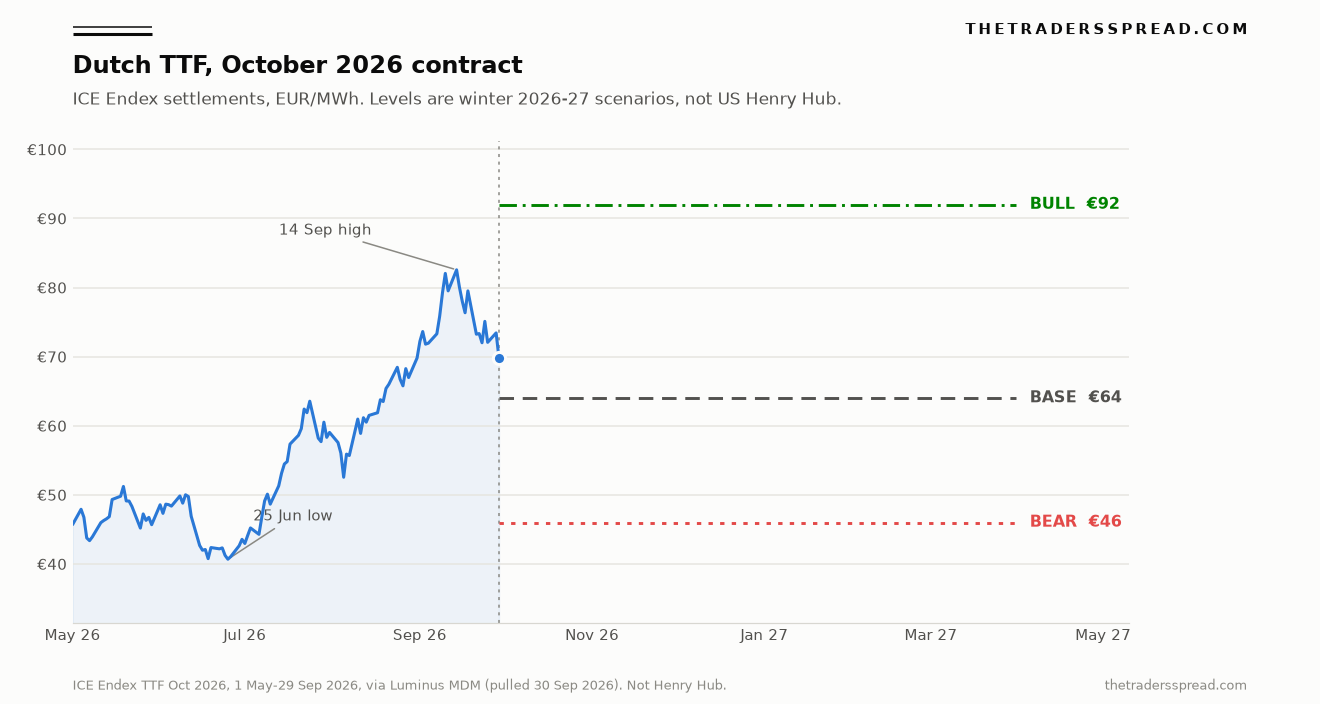 The line is October 2026 only, daily, from 1 May to 29 September. It starts in May because that is where this contract enters the three-month window, not because the contract was unlisted before then. The levels run to 31 March 2027. They are not a claim that October will still be the front month in March. By then the prompt is a spring contract, and the curve says spring is cheaper.
The 25 June low, €40.688, is the last time this contract traded near the summer-2027 board it now sits about €20 above. The 14 September high, €82.566, is the print a bull case has to beat rather than remember. A fade from €82 to €70 is not a return to June. It is also not the US hub, and it is not oil. The Brent prediction is a dollar call with its own bull and bear. It does not set Dutch TTF.
Who has to hold the winter
A strip at €68.77, flat to October, exists only if someone will offer the cold months at roughly October's price. That party includes producers and LNG cargo owners who would rather lock €68 than bet on a reprint of €82, and storage customers who have decided that even €18 over next summer does not pay them to inject. Heinermann's line about booked capacity left empty is a description of the second group. They are why Germany is at 57.74 percent.
Opposite them is whoever must serve January load anyway: utilities, industrial offtakers, and any ministry that has turned a missed fill into a political problem. Müller urging more gas into store through October is that side of the market, speaking through a regulator. If the gas shows up as flow, it props the price up. If it shows up only as a speech, the €68.77 strip was a coherent place for the other side to stand. Calendar 2028 at €36.61 refuses the idea that €70 is the new centre of Dutch TTF. A cold January can reprice Q1 2027 without repricing 2028.
RelatedCheddar Rises 21.5% to $1.68 in the Week to Friday
The call for winter 2026-27
The central case is €64, under the 29 September settlement and well above Q3 2027 at €49.95. The September premium keeps leaking, German storage still misses 80 percent, and a normal winter plus LNG and Norway stops a rout. The weights are an editorial judgement, not an options model.
Base, €64, weight 50. A winter of the kind INES called sufficient on 8 September, from a German tank thinner than the 77 percent they wanted. Injections stay near the recent pace. Hormuz neither shuts again nor fully clears. The prompt gives back about €6 from €69.81 and holds above the summer contracts. Above €83, through the 14 September high, this case is dead.
Bull, €92, weight 30. A cold January of the kind INES sketched, or a fresh break in LNG flows. €92 is 32 percent above the 29 September settlement and about €9 clear of the €82.57 high, without borrowing 2022. A Germany near 63 percent in November is a larger version of the thin-tank problem INES already flagged at 77 percent. The case needs one bad month in Q1 2027. It does not need 2028 to move.
Bear, €46, weight 20. A mild winter, LNG arriving in size, and the Hormuz premium leaving the front month. The prompt falls through the summer-2027 cluster near €50 to €53, toward the 25 June low of €40.688, and stops at €46, 34 percent under €69.81. It is not the late-2025 trough. Calendar 2027 was €24.47 on 16 December 2025. This case only gives back the doubling since June.
Bias is lower. Conviction is 3 out of 5: the winter strip at €68.77 has not agreed to €64, and a contract that doubled from June to September can jump again. The fade dies above €83.
A mild October, with Q1 2027 still under €70 in November, retires the bull. The INES update on 10 November is the next dated test. If it drops the extreme-cold shortfall, the 30 weight on €92 is too heavy. If the ceiling itself falls, the 30 is too light.
Questions the strip actually gets
What is Dutch TTF, in one paragraph?
Dutch TTF, the Title Transfer Facility, is the virtual hub where gas in the Dutch network changes hands. ICE Endex lists the futures in euros per megawatt-hour, and those futures are the benchmark most European wholesale contracts point at. This note uses the October 2026 contract and the seasonal contracts around it. It is not a retail tariff, not a US futures price, and not a producer's share price.
Why is January not priced above October if the tanks are this low?
Because the holders of Q1 2027 have decided the shortage is a volume problem with a pipe attached, not a January panic. On 29 September, Q1 2027 settled €1.46 under October. The scarcity premium is already in the whole winter. It is not being saved for the coldest contract. That is rational if LNG and Norway can meet a cold week. It is expensive if they cannot.
How can Germany miss 80 percent and the curve still fall into 2027?
The curve is not falling into this winter. Q4 2026 and Q1 2027 are both near €69. The fall is into summer 2027 and into 2028: a bet that one tight heating season does not reset the rest of the decade. Müller argued on 16 September that last winter's withdrawals are already covered, and that terminals and neighbouring pipes exist. The curve is pricing a version of that. It is not pricing the cold-January case.
Is €69.81 the number on a household bill?
No. €69.805 per megawatt-hour is a wholesale settlement for October 2026. A household tariff stacks network charges and tax on a wholesale price, often averaged across months rather than taken from one session. This note does not convert the print into cents per cubic metre. A table that does is using a factor that has not been re-measured here.
What retires €64, €92 or €46?
€64 fails if the winter strip settles back through €83, above the 14 September high of €82.57. €92 fails if November arrives with Q1 2027 still under €70 and German storage still rising, even slowly. €46 fails if the front month cannot get down to the summer-2027 contracts near €50, the first rung on the way down. The next fundamental check is the INES update on 10 November 2026.
This is analysis, not a recommendation to trade. Dutch TTF can move several euros in a session, as the 4.9 percent drop on 29 September showed, and a winter that looks manageable in late September can look different in January. Levels and weights state a view. They are not instructions. Capital put to work in this market can be lost.