

Is the CAC 40 being marked down because France cannot pass a budget, or because the world has stopped paying up for handbags and sunglasses? The two stories arrive in the same headlines, and they lead to very different year-end numbers. Paris's benchmark closed at 8,140.59 on Wednesday 16 September, according to CNBC's index data. That is 0.11% below where it finished 2025, and 6.7% under the 8,726.03 closing high of 10 August. Over the same stretch of 2026 the STOXX Europe 600 has gained 7.58%. Meanwhile the French 10-year government bond closed 96.0 basis points above the German Bund, within a basis point of the widest close in CNBC's daily series back to May 2024, while France's 10-year yield sat 9.1 points above Italy's. A trader holding a France 40 CFD into the fourth quarter needs to know which of those two problems the price is actually carrying.
Our answer, from the daily data, is mostly the handbags. We regressed the CAC 40's daily return over the STOXX 600 against the daily change in the OAT-Bund spread. In 2025 the link was visible: a correlation of -0.19 across 254 sessions, with the French index lagging on days the spread widened. In 2026 it has all but vanished, at -0.04 across 178 sessions, and it has stayed near zero since June. Meanwhile three stocks, LVMH, Hermès and EssilorLuxottica, have shed roughly €252 billion of market value this year. French sovereign risk is priced into French bonds and French bank shares. So far it has barely been priced into the index as a whole, and that gap is what the 30 September draft budget will test.
Key facts
- The CAC 40 closed at 8,140.59 on 16 September, down 0.11% year to date, against a 7.58% gain for the STOXX Europe 600 — CNBC index data, 16 Sep 2026
- France's 10-year yield closed at 4.47% and Germany's at 3.51%, a spread of 96.0 basis points, up from 69.8 at the end of 2025 — CNBC bond data, 16 Sep 2026
- A second feed put the same spread at 95.6 basis points on 16 September, the top of its one-year range of 59.0 to 95.6 — Idéal Investisseur, 16 Sep 2026
- The ECB deposit facility rate rose from 2.25% to 2.50%, effective 16 September — ECB series via FRED, 16 Sep 2026
- LVMH is down 36.3% this year, Hermès 34.8% and EssilorLuxottica 46.2%, all three closing at or near 52-week lows — CNBC equity data, 16 Sep 2026
- French public debt stands at €3.54 trillion, or 118% of GDP, with the 2025 deficit at 5.1% of GDP and a draft 2027 finance bill expected on 30 September — Amundi Investment Institute, 1 Sep 2026
- 60-day realised volatility on the CAC 40 is 11.5% annualised, below its 250-day figure of 13.9% — The Traders Spread calculation from CNBC daily closes, 16 Sep 2026
Where €252 billion went
The CAC 40 is a free-float, capitalisation-weighted index of 40 Paris-listed companies, and a handful of very large ones do most of the work. LVMH and L'Oréal each carry a market value of about €203 billion on CNBC's figures, TotalEnergies €183 billion, Schneider Electric €162 billion, Airbus €156 billion and Hermès €146 billion. Anything that hits the luxury group as a block hits the index hard.
That is what 2026 has done. The table below multiplies each company's current market value by its share-price change since the 31 December 2025 close, which gives an approximate figure for the value added or lost this year. Share counts move with buybacks, so treat the numbers as rounded estimates, not accounting entries.
| Company | Close 16 Sep (€) | 2026 change | Since 7 Aug | Approx. value change in 2026 |
|---|---|---|---|---|
| LVMH | 410.95 | -36.3% | -14.4% | -€115.8bn |
| Hermès | 1,383.00 | -34.8% | -15.4% | -€78.0bn |
| EssilorLuxottica | 145.10 | -46.2% | -15.8% | -€57.9bn |
| TotalEnergies | 80.03 | +44.0% | +8.0% | +€55.8bn |
| Schneider Electric | 279.40 | +18.9% | -8.0% | +€25.7bn |
| BNP Paribas | 102.32 | +26.6% | -9.0% | +€23.7bn |
| Société Générale | 73.67 | +7.2% | -12.2% | +€3.7bn |
| Crédit Agricole | 18.39 | +4.8% | -6.2% | +€2.6bn |
Source: CNBC daily closes and market values for each listing, retrieved 17 September 2026; value change is The Traders Spread's estimate.
Read the first three rows together. Around a quarter of a trillion euros has left luxury and eyewear, and roughly €105 billion has come back through an oil major, an electrical-equipment maker and France's largest bank. None of that has much to do with the French Treasury. TotalEnergies is up because oil is up (our Brent crude forecast covers that trade). LVMH is at a 52-week low of €403.15 intraday because its customers are in Shanghai, New York and Dubai, not in the Assemblée nationale.
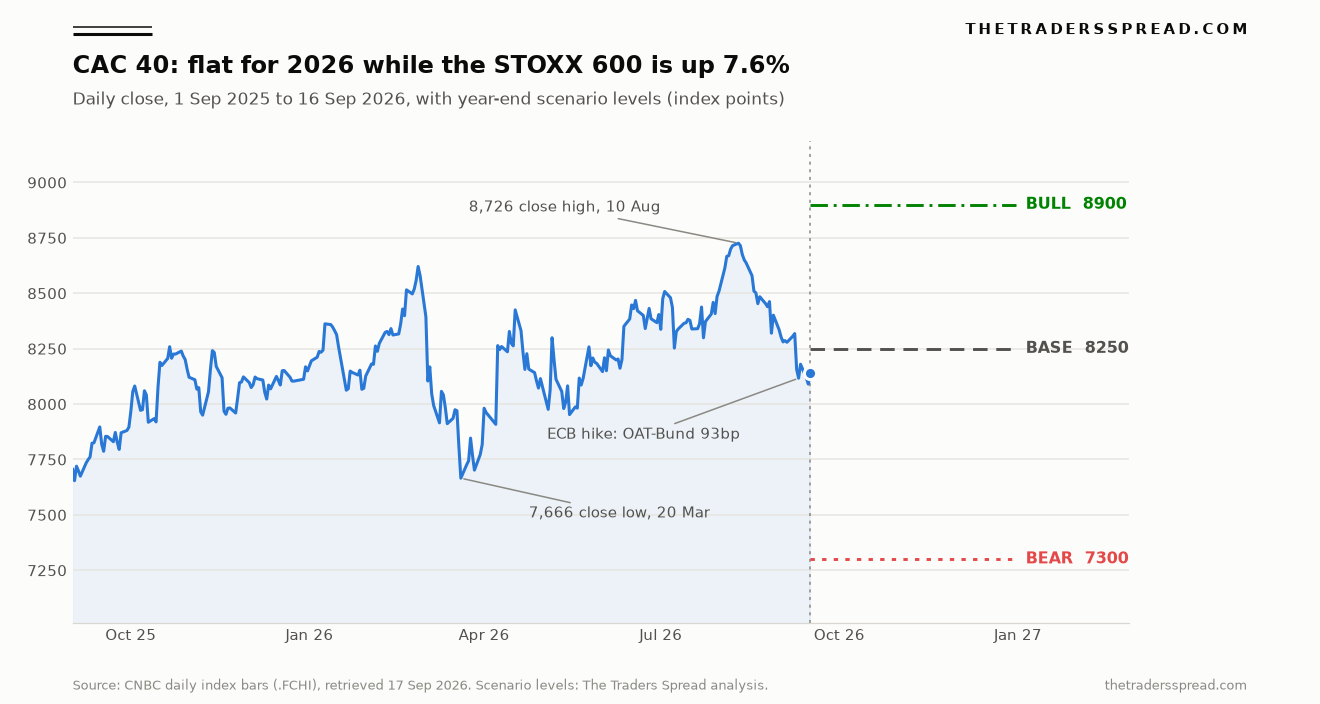
The chart makes the shape plain. An 11% slide from the 26 February close of 8,620.93 to the 20 March closing low of 7,665.62, a steady climb to 8,726.03 on 10 August, and a 6.7% give-back since. The year-end levels sit to the right. Note how far the bear line is below anything the index has closed at this year.
France now pays more to borrow than Italy
The bond market is where French politics shows up without disguise. On CNBC's closing data, France's 10-year yield ended 16 September at 4.47%, Germany's at 3.51% and Italy's at 4.38%. French paper has yielded more than Italian paper on every session since 4 August. The OAT-Bund spread was 54.9 basis points on 25 February, its low for the past year. It reached 78.4 on 7 August, 85.0 at the end of the month and 96.7 on 15 September.
Look at when the last leg happened. The spread closed at 88.9 on 9 September and 93.0 on 10 September, the day the European Central Bank raised rates by a quarter point. The deposit rate went to 2.50% from 2.25%, with effect from 16 September, as the ECB's series on FRED shows. A tightening central bank raises the cost of rolling over a deficit, and markets charged France first. Amundi counts it, with Belgium, among the euro-zone countries with the largest cyclically adjusted primary deficit in 2025.
The fiscal numbers explain why. The Amundi Investment Institute's 1 September note puts public debt at €3.54 trillion, or 118% of GDP, and the 2025 deficit at 5.1%. Citing the government-commissioned Jaravel-Ragot-Tavernier-Valla task force, it says debt could pass 130% of GDP by 2030 without deficit-reduction measures, and it puts the effort needed to stabilise the ratio at about €126 billion over 2027 to 2031. The same note expects the draft budget on 30 September and says it must be adopted by the end of 2026, with presidential elections set for 18 April and 2 May 2027. The note's authors, Vincent Mortier, Group Chief Investment Officer at Amundi, and Monica Defend, Head of Amundi Investment Institute at Amundi, put the warning bluntly: "Delaying action may increase the premium investors demand to hold French debt and lead to greater market volatility."
Ratings add a second clock. Amundi lists Fitch at A+ with a stable outlook and Moody's at Aa3 with a negative one, and writes that a downgrade is likely if the 2027 budget carries no significant consolidation.
The central bank in Paris is saying something similar, in plainer words. Emmanuel Moulin, Governor at Banque de France, told RTL radio on 11 September, the day after the ECB decision: "Je pense qu'effectivement, il y a une inquiétude aujourd'hui, parce qu'il y a des choses qu'il faut traiter, en particulier la question des finances publiques et du déficit budgétaire." In English: there is concern today because there are things that must be dealt with, above all public finances and the budget deficit. He added, "Il faut réduire le déficit budgétaire" (the budget deficit has to be cut), while arguing the economy was not in a catastrophic state, according to the interview report published by Boursorama. The same report says the government is looking for €30 billion of savings and that INSEE cut its 2026 growth forecast for France to 0.4% from 0.7%.
So the bond market has a clear view. The equity question is whether that view spreads.
June 2024 is the template, December 2024 the counterexample
France has run this experiment twice in the past 27 months, and the two results point in opposite directions.
The first came after President Emmanuel Macron dissolved the National Assembly following the European Parliament vote in June 2024. On CNBC's closes, the CAC 40 went from 8,001.80 on Friday 7 June to 7,503.27 on Friday 14 June, a fall of 6.2% in one week. The STOXX 600 lost 2.4% over the same days. The OAT-Bund spread jumped from 49.4 to 81.8 basis points. That is the version of events in which sovereign stress flows straight into the equity index: roughly 3.8 points of underperformance for 32 basis points of spread, or about 0.12 percentage points per basis point.
The second came when the Barnier government lost a no-confidence vote and became a caretaker administration on 5 December 2024. The spread had already moved. It closed at 83.9 basis points on 4 December and 77.8 on 5 December, and the CAC 40 rose 0.4% on the day, to 7,330.54. Markets had priced the fall before it happened, and the event itself was a relief.
Which one looks more like September 2026? The spread is already higher than at either point: 96.0 basis points against 81.8 and 83.9. Yet the part of the index most exposed to domestic funding costs has only begun to react. Since 7 August, BNP Paribas is down 9.0%, Société Générale 12.2% and Crédit Agricole 6.2%, against a 6.6% fall for the CAC 40 itself. Luxury names fell further over the same days. The June 2024 mechanism, in which the whole index is marked down as a French asset, is not what the tape shows. Instead the index is being dragged by global consumer stocks while the banks do the sovereign repricing on their own.
What the consensus misses about the 30 September budget
The common reading treats the draft finance bill as a binary event for French equities: pass and rally, stall and sell. The daily data argue for something narrower.
If the budget lands with a credible path, say the 4.9% of GDP deficit target for 2027 that Amundi cites from media reports, the spread has room to narrow and the banks have room to recover their August losses. BNP Paribas alone is worth €112.7 billion. A retracement toward its 13 August 52-week high of €113.82 would add about €13 billion of value, which is useful for the index but small next to one bad week for LVMH. A good budget helps the CAC 40 at the margin; it does not repair the luxury trade.
A failed budget is asymmetric. Here the June 2024 channel can reopen: foreign holders sell France as a country rather than stock by stock, and the correlation that has been near zero all year snaps back. At the June 2024 ratio, a further 25 basis points of spread would be worth around 3 percentage points of underperformance against Europe. Add that to an index already carrying the luxury drag, and 7,300 stops looking remote.
There is a quieter point too. French sovereign risk touches the euro. EUR/USD closed at 1.1465 on CNBC's data, 2.39% lower this year, which flatters the euro earnings of exporters such as Airbus and Safran. Our EUR/USD forecast and the DAX forecast cover the currency and the German comparison. Germany's index is up 4.28% in 2026 on the same CNBC data, so the French gap is not a Europe-wide story; our FTSE 100 forecast covers the London side.
Politics beyond the budget is a slower factor. On Polymarket's next French presidential election market, Marine Le Pen was priced at 36.05% at 06:07 UTC on 17 September, per the Gamma API. We covered that market in our French presidential election analysis. It matters more for 2027 than for this quarter's close.
The call: 8,250 base, 8,900 bull, 7,300 bear by 31 December
We start from 8,140.59, the 16 September close. The bias is neutral, conviction 2 out of 5.
Base case, 8,250 (+1.3%), 55% probability. The draft budget arrives on 30 September with enough consolidation to calm, not cure, the bond market. The spread drifts back into the 80s, bank shares recover part of their August losses, and luxury stabilises without a real rebound. The index holds between the March low and the August high and ends near its 200-day average of 8,240.65.
RelatedEUR/CAD Forecast: 1.64 Bull Case vs 1.56 Bear Case
Bull case, 8,900 (+9.3%), 20% probability. This needs two things at once: a budget the rating agencies can live with, pulling the spread below 80 basis points, and evidence of a bottom in luxury demand that takes LVMH back toward €470, where it traded in late July. That would put the CAC 40 above its 8,755.03 intraday high of 7 August.
Bear case, 7,300 (-10.3%), 25% probability. The budget stalls or a government falls, the spread pushes through 110 basis points, and the June 2024 pattern returns on top of the luxury drag. The index would then be back near its December 2024 levels.
How do those odds compare with plain volatility? Using 250-day realised volatility of 13.9% over the 76 trading days to year-end, a simple lognormal model gives the index roughly a 24% chance of trading at 8,900 at some point and about 15% of trading at 7,300. We keep the bull case a little lower than that and push the bear case higher, because the budget is a scheduled event with a fat left tail and a known precedent.
What would change my mind. Three closes with the OAT-Bund spread above 110 basis points would move the bias to bearish, and a daily close below 7,650, under the March closing low, invalidates the base case. On the other side, a spread back under 80 basis points and a CAC 40 daily excess return that starts tracking luxury names up rather than down would move the call toward the bull case.
FAQ
What is the CAC 40 forecast for the end of 2026?
Our base case is 8,250 by 31 December, a gain of about 1.3% from the 8,140.59 close on 16 September. The bull case is 8,900 and the bear case 7,300, with probabilities of 20% and 25%. The range reflects a luxury-sector drag that is already priced and a French budget risk that mostly is not.
Why has the CAC 40 lagged the STOXX 600 in 2026?
Mainly because of its heavy weighting in luxury and eyewear. LVMH, Hermès and EssilorLuxottica have lost roughly €252 billion of market value this year on CNBC data. The index is down 0.11% in 2026 while the STOXX 600 is up 7.58%, and daily moves show almost no link to French bond spreads this year.
What is the OAT-Bund spread and why does it matter for the CAC 40?
It is the gap between France's and Germany's 10-year government bond yields, a gauge of sovereign risk. It closed at 96.0 basis points on 16 September. A wider spread raises funding costs for French banks first. In June 2024 it also dragged the whole index, which fell 6.2% in a week.
When is the French 2027 budget due?
The Amundi Investment Institute expects the draft finance bill on 30 September 2026, and notes it must be adopted by the end of the year. It is the main scheduled event for French assets this quarter, with ratings reviews and the April 2027 presidential election behind it.
What level would invalidate the base case?
A daily close below 7,650, under the 20 March closing low of 7,665.62, would end the range view. Three consecutive closes with the OAT-Bund spread above 110 basis points would shift the bias to bearish even before that level breaks, because it would signal the June 2024 pattern returning.
Is a France 40 CFD the same as the CAC 40 index?
No. A contract for difference tracks the index or its futures price, with financing charges, spreads and leverage set by the provider. Index levels in this article refer to the cash CAC 40 as published by Euronext and reported by CNBC.
Disclaimer
This article is analysis, not investment advice. Index levels, probabilities and scenarios are the author's views based on data available on 17 September 2026 and may change. Trading CFDs and other leveraged products carries a high risk of losing money rapidly, and your capital is at risk.