

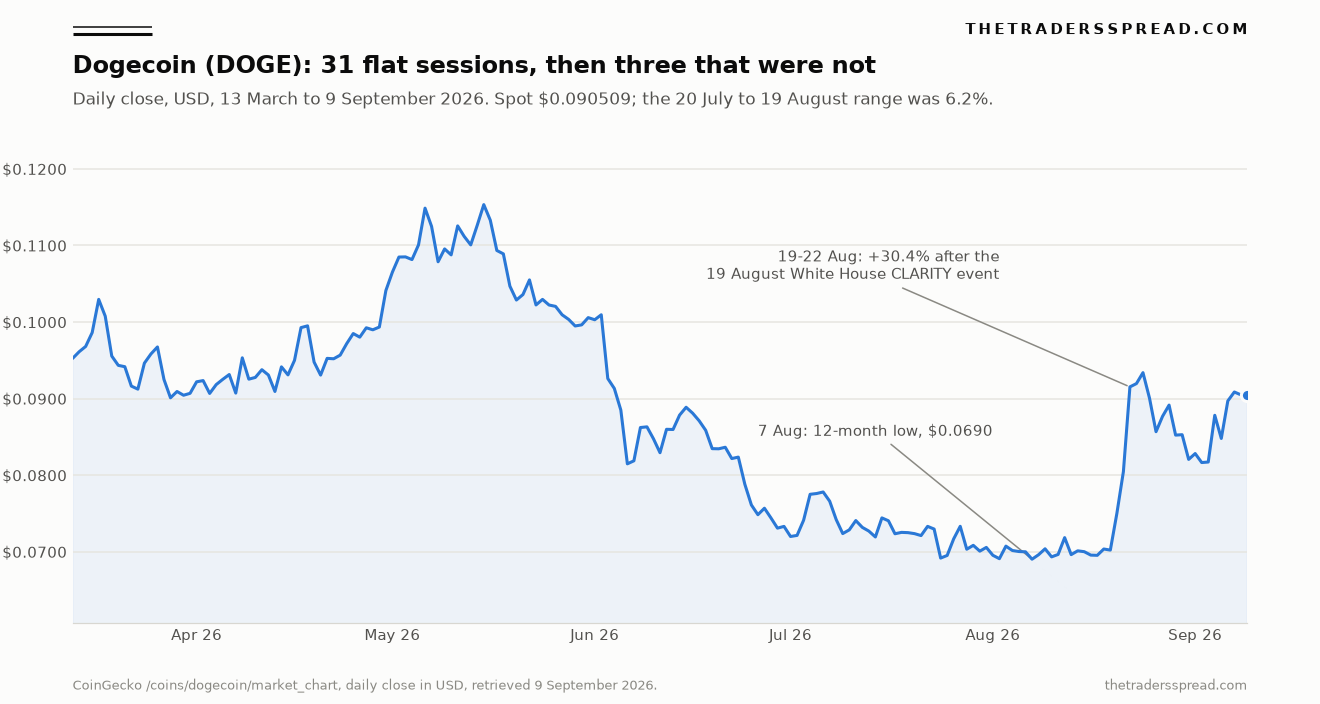
Having marked Dogecoin's daily closes on this desk every morning since the 2024 cycle, I have never watched the tape go as quiet as it did between 20 July and 19 August 2026. Thirty-one consecutive daily closes, and the whole range was 6.2%: a low of $0.069020 on 7 August, a high of $0.073315. For an asset whose reputation rests on 40% afternoons, that is a coma. Then the month arrived all at once. Dogecoin closed 19 August at $0.070211 and 22 August at $0.091521, a 30.4% move across three sessions, and it has held nearly all of it. DOGE changes hands at $0.090509 as I write, up 29.4% over thirty days, capitalised at $14.10bn on 155.84bn circulating tokens. Every figure there comes from CoinGecko daily closes pulled this morning, 9 September 2026.
Nothing Dogecoin did caused any of it. The three sessions that made the month began the day President Donald Trump gathered digital-asset executives at the White House on 19 August and pressed Congress to pass the Digital Asset Market Clarity Act. That is the entire mechanism, and the proof is in what did not move alongside the price. Open interest in the deepest DOGE perpetual book fell in token terms while the price rose. The four American funds that hold Dogecoin for you control $23.49m between them, roughly one six-hundredth of the token's market capitalisation. The only Dogecoin-specific corporate disclosure inside the window was a seller: a Nasdaq-listed treasury company confirming to the SEC that it had liquidated 463 million DOGE. A token with no issuer, no roadmap and no lobbyist in the room captured a policy repricing anyway, because that is what a high-beta instrument does.
Key facts
- DOGE spot $0.090509, up 29.4% over 30 days and down 61.9% year on year, market capitalisation $14.10bn, 24-hour volume $831.6m — CoinGecko, retrieved 9 September 2026.
- Thirty-one daily closes from 20 July to 19 August spanned just 6.2%, from $0.069020 to $0.073315 — CoinGecko daily series, retrieved 9 September 2026.
- 19 to 22 August: +30.4%, from $0.070211 to $0.091521, immediately after the 19 August White House event on the CLARITY Act — CoinGecko; event date per the Latham & Watkins US Crypto Policy Tracker.
- Binance DOGEUSDT perpetual open interest fell from 3.055bn tokens on 20 August to 2.629bn on 29 August, a 13.9% reduction, even as the dollar notional rose — Binance futures open-interest history, retrieved 9 September 2026.
- Combined assets of the four US Dogecoin funds: $23.49m at the 8 September close, equal to 0.17% of DOGE market capitalisation and 2.8% of a single day's spot volume — stockanalysis.com fund pages, retrieved 9 September 2026.
- CleanCore Solutions sold "substantially all 463 million Dogecoin for aggregate proceeds of approximately $33.4 million" on 20 July 2026 — Form 424B5 prospectus supplement filed 12 August 2026.
- The Senate cloture vote on the motion to proceed to the CLARITY Act is set for 15 September 2026 and needs 60 votes — Latham & Watkins US Crypto Policy Tracker, retrieved 9 September 2026.
Three sessions, and the rest of the month was filler
The 19 August meeting was not a signing ceremony and it was not a rule change. Trump hosted crypto executives alongside SEC Chairman Paul Atkins and CFTC Chairman Michael Selig, and asked the Senate to move a bill that had already passed the House 294 to 134 on 17 July 2025 and cleared the Senate Banking Committee 15 to 9 on 14 May 2026. Nothing was enacted. The market treated the political signal as if something had been.
What the CLARITY Act would actually do is draw the boundary between a security and a digital commodity, and hand the resulting categories to the SEC and the CFTC without the overlapping claims that have defined American digital-asset supervision since 2017. Senate Banking Committee Chairman Tim Scott said on 14 May that the bill "does not take sides between traditional finance and new technology, or Republicans and Democrats. It takes the side of everyday Americans. It brings digital assets out of the shadows and into a system that is safer, fairer and more transparent."
For Dogecoin the classification question is close to trivial. There is no issuer, no pre-mine sitting on a corporate balance sheet, no foundation selling tokens to fund development. If any asset in the top twenty was always going to land on the commodity side of a statutory line, it is this one. The trade, then, is not about Dogecoin's odds of being reclassified. It is about the size of the pool of American institutional money that becomes permitted to touch digital commodities at all once a statute exists, and DOGE is simply the highest-beta way to express that.
Beta is the right word, and the cross-market numbers make it uncomfortable rather than flattering.
| Asset | 19–22 Aug 2026 | 30 days to 9 Sep 2026 |
|---|---|---|
| Dogecoin (DOGE) | +30.4% | +29.4% |
| Bitcoin (BTC) | +21.1% | +22.5% |
| Ethereum (ETH) | +31.2% | +31.1% |
| XRP | +45.3% | +35.1% |
| Solana (SOL) | +21.7% | +41.3% |
CoinGecko daily closes in USD, retrieved 9 September 2026.
Read that table twice. Over the three sessions Dogecoin was beaten by XRP and matched by Ethereum. Over the full thirty days it finished fourth of five, behind Solana, XRP and Ethereum, ahead only of Bitcoin. The asset with the loosest fundamental anchor in the group did not lead the policy rally. It rode it, mid-pack, which is precisely what you would expect if the bid came from index-shaped and basket-shaped buying rather than from anyone forming a view about Dogecoin.
Our own coverage of the same window makes the point from the other direction. Ethereum's August was carried by a named corporate accumulator taking 4.9% of supply, and Solana's move came with $1.06bn of ETF assets standing behind it. Each of those has an identifiable marginal buyer. Dogecoin's rally has no such name attached to it.
The leverage never showed up
The reflexive explanation for a three-day 30% move in a memecoin is that leveraged money piled in. It did not, and the data is public.
Binance runs the deepest DOGE perpetual book, and its open-interest history is denominated in tokens as well as dollars, which is what makes it useful. On 19 August, the day of the White House event, open interest stood at 2.997bn DOGE worth $210.5m. It peaked in token terms the very next day at 3.055bn, then fell every week after that: 2.946bn on 22 August, 2.777bn on 26 August, 2.629bn on 29 August. That is a 13.9% reduction in position size from the 20 August peak. Over the same stretch the dollar notional rose from $229.3m to $269.8m before settling at $224.1m, which is the trap. Notional grew because the price grew. The book shrank.
Positioning was reduced into strength. That is the signature of spot demand meeting an inventory that wanted out, not of a leveraged squeeze, and it is why the move stuck instead of retracing the way a funding-driven spike does. Funding on the same contract sat at 0.009265% per eight hours when I checked this morning, an annualised rate near 10%, which is unremarkable for a rallying perpetual and nowhere near the 40% to 80% readings that mark a crowded long.
Open interest today is 2.875bn DOGE, $258.7m of notional. Below the 20 August peak in tokens, four weeks after the price moved 30%. Whoever bought Dogecoin in the third week of August did not borrow to do it.
A $23m wrapper on a $14bn asset
The second reflexive explanation is exchange-traded funds, and it is the one worth killing properly, because the "spot DOGE ETF era" has been written about for a year and the numbers have never been checked in public.
Four American funds give a brokerage account exposure to Dogecoin. Here is what they are actually worth, taken from their fund pages at the 8 September close.
| Fund | Issuer | Listed | Inception | Assets |
|---|---|---|---|---|
| DOJE | REX-Osprey | Cboe BZX | 18 Sep 2025 | $11.54m |
| GDOG | Grayscale | NYSE Arca | 24 Nov 2025 | $8.70m |
| TDOG | 21Shares | Nasdaq | 22 Jan 2026 | $2.56m |
| BWOW | Bitwise | NYSE Arca | 25 Nov 2025 | $0.69m |
stockanalysis.com fund pages, 8 September 2026 close, retrieved 9 September 2026.
Twenty-three and a half million dollars. Against a $14.10bn market capitalisation that is 0.17%. Against a single day's spot volume of $831.6m it is 2.8%. The entire American regulated wrapper for Dogecoin could be liquidated into the tape on a quiet Tuesday and the print would barely notice. And DOJE, the largest of the four, is not even a pure spot vehicle: its published holdings are 37.43% Dogecoin, 25.09% a 21Shares Dogecoin exchange-traded product listed in Switzerland, and the balance in cash-equivalents and other assets, at an expense ratio of 1.50%.
The ETF news inside the rally window was plumbing, not demand. 21Shares told the SEC in an 8-K filed on 26 August that it had signed a benchmark licence with FTSE International on 20 August, and that from 27 August TDOG would value its shares against the FTSE Dogecoin Index instead of the CF Dogecoin-Dollar US Settlement Price Index. The same filing moved the sponsor's fee from weekly to quarterly in arrears, payable in Dogecoin. Useful housekeeping for a $2.56m fund. Not a flow event.
Compare that with what a real institutional bid looks like. Solana's ETF complex passed $1.06bn in August, and that showed up in the tape as sustained outperformance across thirty days rather than a three-day step. Dogecoin has the wrapper without the money in it.
The only Dogecoin news in the window was a seller
Here is the fact that ought to end the debate about whether anything Dogecoin-specific drove this.
CleanCore Solutions, a Nevada-incorporated company listed on NYSE American as ZONE, adopted a Dogecoin treasury strategy on 5 September 2025 under an asset-management agreement with Dogecoin Ventures and 21Shares US. It terminated that agreement on 6 March 2026. In a prospectus supplement filed with the SEC on 12 August 2026, the company states plainly: "On July 20, 2026, we sold substantially all 463 million Dogecoin for aggregate proceeds of approximately $33.4 million dollars." The proceeds went into data centres. Its risk factors now discuss "the Company's transition away from its Dogecoin treasury strategy."
Do the arithmetic. Four hundred and sixty-three million tokens for $33.4m is an average realised price of $0.0721, sold on the exact day the 31-session flat band began. At this morning's $0.090509 the same stack would fetch $41.9m. The largest listed corporate holder of Dogecoin exited its entire position four weeks before the token repriced, and left roughly $8.5m on the table doing it.
Which means the Dogecoin-specific news flow across the rally window was, on net, supply. A corporate treasury liquidating, a fund complex changing index providers, and no new issuance narrative of any kind. The price still rose 29%. That is not a coincidence to be explained away. It is the clearest available evidence that the marginal buyer was not buying Dogecoin. It was buying American digital-asset policy risk, and Dogecoin is what that exposure looks like at the speculative end of the curve.
What this changes
Three things, and none of them is a target.
RelatedToncoin (TON) Price Prediction: $2.15 Bull vs $1.15 Bear
First, Dogecoin's beta profile has been re-established in public. From late 2024 through mid-2026 the token was widely treated as a retail-sentiment instrument that traded on personalities and social volume. The August repricing was none of that. It was a legislative headline transmitted through the whole complex, and DOGE captured 30 points of it in three days without leading. Anyone modelling Dogecoin as an idiosyncratic asset now has a dated counter-example.
Second, the date that matters is 15 September 2026. The Senate delayed a floor vote before the August recess over ethics provisions and banking-sector opposition, and Majority Leader John Thune filed cloture on the motion to proceed for 15 September. Sixty votes are needed to open debate. Our prediction-markets desk put the probability of the bill becoming law this year at 12.5% with 36 Senate working days left, and the calendar is the binding constraint rather than the politics: the House and a third of the Senate face voters in November. A token that gained 30% on a presidential request for a vote is exposed in both directions to how that vote goes.
Third, the absence of leverage changes what a disappointment would look like. When a rally is built on borrowed money, a failed catalyst produces a liquidation cascade and a violent round trip. This one was not. Open interest is below its August peak and funding is ordinary, so the more likely path on a failed cloture vote is a grind rather than a gap, with the $0.0700 shelf that held for thirty-one sessions as the obvious reference point traders will watch. Cody Carbone, chief executive of The Digital Chamber, framed the meeting's message to Fox Business as a signal that "the U.S. is not going to slow down in its objective of becoming the crypto capital of the world." The market bought the signal. It has not yet been asked to pay for the statute.
What has not changed is the longer arithmetic, and it deserves saying flatly. Dogecoin is down 61.9% over twelve months and sits 87.6% below its record close of $0.731578 on 7 May 2021. A 29% month restores a fraction of that. The same policy channel runs through the rest of the complex, which is why the Bitcoin scenarios we published last week and the brokerage equities that trade off crypto volumes are all pointed at the same September calendar.
Frequently asked questions
Why did Dogecoin rise 29% in 30 days?
Almost all of the move happened in three sessions, from $0.070211 on 19 August to $0.091521 on 22 August, immediately after President Trump hosted digital-asset executives at the White House on 19 August and asked Congress to pass the CLARITY Act. Bitcoin, Ethereum, XRP and Solana all rose sharply over the same three days, so the driver was market-wide policy repricing rather than anything specific to Dogecoin.
Did spot Dogecoin ETFs drive the rally?
No. The four American funds holding Dogecoin (DOJE, GDOG, TDOG and BWOW) had combined assets of $23.49m at the 8 September close, equal to 0.17% of the token's $14.10bn market capitalisation and 2.8% of one day's spot volume. A complex that size cannot move a price by 30%. The only ETF development in the window was 21Shares switching TDOG's benchmark to the FTSE Dogecoin Index from 27 August.
Was the move driven by leverage?
The evidence says the opposite. Binance DOGEUSDT perpetual open interest peaked at 3.055bn tokens on 20 August and fell 13.9% to 2.629bn by 29 August, while funding stayed near 10% annualised. Dollar notional rose only because the price did. Positioning was cut into the rally rather than added to it.
What is the CLARITY Act and when does the Senate vote?
The Digital Asset Market Clarity Act, H.R. 3633, would set statutory definitions separating securities from digital commodities and divide supervision between the SEC and the CFTC. It passed the House 294 to 134 on 17 July 2025 and cleared the Senate Banking Committee 15 to 9 on 14 May 2026. A cloture vote on the motion to proceed is scheduled for 15 September 2026 and requires 60 votes.
Who sold Dogecoin during the rally window?
CleanCore Solutions (NYSE American: ZONE) disclosed in a 12 August 2026 SEC filing that it had sold substantially all 463 million Dogecoin on 20 July 2026 for approximately $33.4m, an average of about $0.0721 per token, and redeployed the proceeds into data-centre projects. At $0.090509 that stack would now be worth $41.9m.
How far is Dogecoin from its record high?
Dogecoin's record close was $0.731578 on 7 May 2021. At $0.090509 it trades 87.6% below that level, and it is down 61.9% over the past twelve months even after the August repricing. Terms used here, including spot market and liquidation, are defined in our glossary.
Disclaimer
This article is analysis and information, not investment advice, and it is not a recommendation to buy, sell or hold any asset. Digital assets are highly volatile and your capital is at risk. Every figure is sourced and dated as shown and was accurate at the time of retrieval on 9 September 2026; prices move continuously and any of them may be stale by the time you read this. Do your own research and consider taking regulated professional advice before making any financial decision.