

Having tracked Stellar (XLM) through enough foundation posts to stop reading one as a bid, I opened the 14 October note and then the price file, in that order. Chainlink Data Feeds and Data Streams are live on the network. The lumen did not pay up for the switch. From the midnight print on 10 October to the midnight print on 17 October, XLM fell from $0.1946 to $0.1813, which is 6.8%. Bitcoin, taken off the same CoinGecko stamps, fell from $82,564 to $81,524, or 1.3%. The gap is about 5.6 percentage points of underperformance. There is no level in this piece at which the token "works", and there is no forecast attached to the week. The file supports a narrower claim: in the seven days to the last daily close, Stellar lagged Bitcoin while a data layer the foundation described in October 2025 actually switched on.
The path inside the week will not sit still for a one-line cause. XLM's highest midnight print in the window was $0.2029 on 12 October, 4.3% above the 10th. On 13 October, before the Stellar Development Foundation published, the print fell 6.2%. On the 14th, the day of the post, it was off 0.06%, while Bitcoin rose 1.6%. The 15th then took 4.1%. Run the same midnight method from 17 September and the change is only about 1.3% lower, so the seven-day headline mostly records a bounce that was handed back. From 18 October 2025 the daily print is still down 41.3%, to $0.1813 from $0.3087. Three windows, one file, three different stories. The useful reading is the disagreement between them.
Key facts
- Stellar (XLM) fell 6.8% from $0.1946 to $0.1813 between the midnight prints on 10 October and 17 October 2026 — CoinGecko market chart, retrieved 17 October 2026
- Bitcoin fell 1.3% on the same stamps, from $82,564 to $81,524, so XLM lagged by about 5.6 percentage points — CoinGecko, 17 October 2026
- The live print at 07:24 UTC on 17 October was $0.1793, with a market cap of $6.31 billion, trailing 24-hour turnover of $108.8 million and a rank of 21 — CoinGecko, 17 October 2026
- Chainlink Data Feeds and Data Streams went live on Stellar; the foundation put real-world assets on the network above $4 billion — Stellar Development Foundation, 14 October 2026
- The plan to adopt those feeds, plus the Cross-Chain Interoperability Protocol, was published on 31 October 2025 and is not the same event as this week's switch-on — Stellar Development Foundation, 31 October 2025
- Circulating supply was 35.20 billion XLM against a total near 50.00 billion, about 70.4% of the coins the cap is counting — CoinGecko, 17 October 2026
- Meridian 2026 is listed for 28–29 October at Convento do Beato in Lisbon, with general admission at $299 — Meridian site, retrieved 17 October 2026
Data feeds, not a new chain
On 14 October the Stellar Development Foundation said Chainlink Data Feeds and Data Streams were live, and that builders now had market data for lending markets, prediction markets, perpetual futures and other applications tied to the network's real-world assets. The post is specific about the job. Assets, it says, need to be priced, traded, borrowed against and used as collateral. It names collateral processing, loan-to-value calculations, automated liquidations and stablecoin reference rates as functions "leading ecosystem applications" are adopting at launch. It does not name those applications.
The dollar figure on the asset book is the foundation's. The post says the network already supports more than $4 billion in real-world assets and points at a Dune page. Opened on 17 October, that page did not return a stable total, so the figure here stays theirs: above $4 billion, as written on the 14th. It is their description of the book, not a fresh census.
Johann Eid, chief business officer at Chainlink Labs, said on that page: "The Stellar network's adoption of Chainlink as its data infrastructure unlocks a new generation of DeFi and tokenized asset applications across its ecosystem. With Data Feeds and Data Streams now available natively, developers have the high-quality, reliable market data needed to build secure lending markets, stablecoins, and tokenized assets and scale them for widespread adoption." That is a launch description, not a volume report.
The note says the launch delivers on an earlier announcement. That post, dated 31 October 2025, said Stellar would join the Chainlink Scale programme and adopt Data Feeds, Data Streams and the Cross-Chain Interoperability Protocol. On that date the foundation also cited $5.4 billion in quarterly real-world-asset payment volume. I am leaving the $5.4 billion where it was written. It is eleven months old, and I do not have a current replacement. CCIP was part of the 2025 plan. The 2026 note that declares the data products live does not declare CCIP live.
Fees are the part of the design that actually touches XLM. Stellar's developer docs say every transaction that reaches the ledger pays a fee, and that fees are paid in the native token. A reference price for someone else's tokenised Treasury does not, by itself, create a new use for the lumen. The fee does. A lower dollar price of XLM makes the dollar cost of a given fee smaller. That is arithmetic, not a reason the week had to fall. The docs do not hand me a single dollar cost I will quote without a worked example from this session.
Two names, then a conference list
Raja Chakravorti, chief business officer of the Stellar Development Foundation, is the other signature on the 14 October post. His line is about sequence, not about this week's print: "Tokenization is only the beginning. For onchain financial markets to operate at institutional scale, assets need reliable infrastructure for pricing, execution, and movement. Chainlink's oracle infrastructure strengthens that foundation by giving developers access to the data and connectivity required to build next-gen financial applications on Stellar. As these layers mature together, the opportunity shifts from simply issuing assets onchain to putting them to work."
Read against the tape, that is a build order. Issuance first, pricing and use after. The token market did not wait for step two, and did not rally when step two was announced as done. A network can add a pricing layer in the same week the token gives back a bounce.
The next dated gathering is Meridian, not the Chainlink post. The event site, read on 17 October, lists 28–29 October 2026 at Convento do Beato in Lisbon. HackMeridian is listed for 25–26 October. General admission is $299, a government and public-policy ticket is $99, and a developer ticket is $49. The page says Meridian 2025 drew more than 1,000 attendees from 65 countries, across more than 60 sessions and more than 115 speakers, and that past speakers have included people from DTCC, Chainlink, PayPal and Circle. Featured names this year include Anthony Scaramucci, founder and managing partner at SkyBridge Capital; Jamie Walker, head of digital assets and money movement at U.S. Bank; Nadine Chakar, global head of DTCC Digital Assets; Michael Shaulov, chief executive and co-founder of Fireblocks; and Ginger Baker, vice president of product management at Meta.
None of that is a CoinGecko print. A room eleven days out can concentrate attention. It does not explain a 6.2% down day before the Chainlink note, or a flat day on the note itself.
The photograph is that convent, not a Stellar stage. Sam Barnes took it for Web Summit on 13 November 2023, inside Convento do Beato, and Wikimedia Commons carries it under CC BY 2.0. The booking for 28–29 October is Meridian's. The signs in the cloister belong to a different conference.
Seven prints, set beside Bitcoin
The chart is history only. It runs from the CoinGecko midnight print on 17 January 2026, at $0.2261, to the midnight print on 17 October, at $0.1813. No scenario lines. The right-hand edge is the week in the headline, a give-back after a push toward $0.23 in early October. On this plot the highest midnight print is $0.2600 on 1 June, and the lowest is $0.1433 on 23 May. The 17 October close sits between them, and 19.8% under the 17 January print.
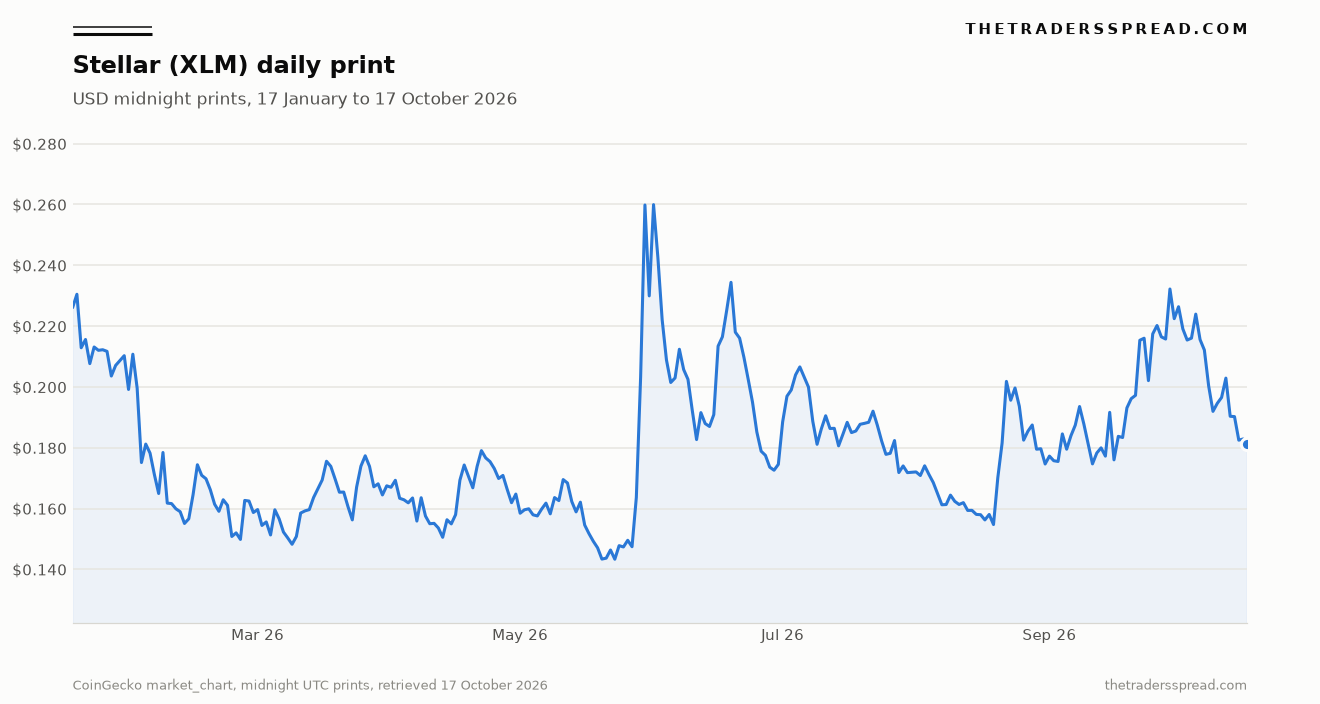
Day by day, against Bitcoin, the week looks like this. Changes are computed from the unrounded prints and then rounded. The dollar levels in the table are rounded, so dividing the rounded cells will be a tenth off in places.
| Midnight, UTC | XLM | XLM day | Bitcoin | Bitcoin day |
|---|---|---|---|---|
| 10 October | $0.1946 | $82,564 | ||
| 11 October | $0.1965 | +1.0% | $82,918 | +0.4% |
| 12 October | $0.2029 | +3.2% | $83,691 | +0.9% |
| 13 October | $0.1903 | −6.2% | $81,795 | −2.3% |
| 14 October | $0.1902 | −0.1% | $83,115 | +1.6% |
| 15 October | $0.1825 | −4.1% | $81,604 | −1.8% |
| 16 October | $0.1829 | +0.2% | $82,156 | +0.7% |
| 17 October | $0.1813 | −0.9% | $81,524 | −0.8% |
Two rows do the work. On 13 October both fell, and XLM fell harder: 6.2% against Bitcoin's 2.3%. On 14 October they diverged. Bitcoin rose 1.6%. XLM was effectively unchanged. From the 12 October high of $0.2029 to the 17 October close, XLM was down 10.7%. That figure sits inside the window. It is not the headline, because the headline starts on the 10th, when the print was already off that high.
Market cap moved with the price, which is what you expect if supply did not jump. The cap was $6.82 billion at midnight on 10 October and $6.38 billion at midnight on 17 October, down 6.5%, close to the 6.8% price decline. At 07:24 UTC the cap was $6.31 billion, on 35.20 billion coins circulating out of about 50.00 billion, rank 21. The live price, $0.1793, sat 79.5% under the $0.8756 high dated 2 January 2018. That snapshot's high and low were $0.1856 and $0.1788, and the rolling 24-hour change was about 2.3% lower. I am not promoting the session into the title.
Turnover did not vanish on the down days. The trailing 24-hour volume print was $137.0 million at midnight on 13 October, $143.5 million on the 14th, $152.5 million on the 15th, $171.6 million on the 16th and $121.5 million on the 17th. At 07:24 UTC it was $108.8 million. Not a climax, and not a drought. A tape that was still trading while the price gave back the early-week rise.
A weekly decline in a large altcoin is not, on this desk, a Stellar exclusive. Algorand fell 9.0% across a week in an earlier note, a larger percentage than XLM's 6.8%, on different days and a different story. The comparison only checks the habit of treating one integration as the whole altcoin tape.
What the week does not prove
The file does not name a seller.
CoinGecko will tell you the print and the turnover. It will not tell you whether the 13 October drop was a fund, a market-maker shifting inventory, or a cluster of small holders on an exchange I did not open. Inventing that name would be worse than the hole. Net, over seven midnights, the bid lost more than it gained. That is all the price file is allowed to say about the other side.
The tidy story, that XLM fell because Chainlink went live, does not survive the calendar. The largest down day in the window was 13 October. The "now live" post is dated the 14th. On the 14th the lumen was flat and Bitcoin was up. If the post had been the cause, the flat day is an awkward place to put it. A softer version, that the post failed to stop a selloff already underway, fits the rows better and still does not explain the 13th. Bitcoin was down 2.3% that day too. The extra, between 6.2% and Bitcoin's 2.3%, is a residual this note cannot assign.
Stretch the denominator and the residual does not disappear. From midnight on 18 September to midnight on 17 October, Bitcoin rose 6.7%, from $76,371 to $81,524. XLM over that same pair of stamps fell 1.1%, from $0.1834 to $0.1813. The headline week is not a one-off sulk inside a month when Stellar was keeping up. For that month, it was not. This site already has a Bitcoin page with its own numbers and its own horizon. Bitcoin is here only as the thing XLM failed to match.
Another miss is to treat "above $4 billion" of real-world assets as a claim on the token. Those assets are issued onto the ledger by other parties. XLM is the fee token, the thing an account needs in order to exist and to send. Holding the lumen is not holding a slice of the tokenised book. When the book is described as large and the token falls, the honest sentence is that the two did not move together, not that one of them is mispriced against the other by a figure I could defend.
Monero's seven days into 15 October were a smaller decline, 2.9% in that note. Different asset, different window end, same habit of measuring a week and saying so. XLM's 6.8% is larger than that Monero week and smaller than the Algorand week already linked. Magnitude, not a shared cause.
What this changes
What changed on 14 October is the menu a builder sees, not a required direction for XLM. Someone who wants a reference price for collateral, a loan-to-value check, a liquidation or a stablecoin rate can call Chainlink data on Stellar, if the foundation is right, rather than wait on a plan dated 31 October 2025. Eid and Chakravorti are describing that menu. It did not lift the print. The feeds went live and the seven-day close fell 6.8%.
What I watch from here is a short list, not a target.
RelatedPyth (PYTH) Price Prediction: $0.11 Bull vs $0.05 Bear
Names, first. The post says leading applications are adopting the feeds, and names none of them. Until the names are public, "adopting at launch" is a sentence in a launch post.
Second, what stayed on last year's list. CCIP was in the 31 October 2025 plan and is missing from the sentence that declares this launch done. A later note that marks the interoperability protocol live would be a new event, read against the print on that date.
Third, Lisbon. HackMeridian falls on 25–26 October and Meridian on 28–29 October, tickets at $299, $99 and $49. If the week after that room looks like the week after the Chainlink note, the pattern is the part to keep: news on the network, a lumen trading on something else.
The gap against Bitcoin stays a measurement. About 5.6 percentage points this week, and wider from 18 September, when Bitcoin rose 6.7% and XLM fell 1.1%. The next week closes some of that or it does not.
A 30-day change of about 1.3% down, from 17 September, argues against calling this week a fresh slide. A 41.3% decline from 18 October 2025 argues against calling the month quiet. Internet Computer rose 11.97% in a single day in another note on this desk. These sessions are not one weather system. Nothing in the list is an instruction. The opening claim changes only if the seven-day arithmetic is wrong, or a primary page says the feeds were not live on the 14th.
Questions the tape actually answers
How far did Stellar fall, and which days count?
Stellar (XLM) fell 6.8% between CoinGecko's midnight prints on 10 and 17 October 2026, from $0.1946 to $0.1813. That is the headline window, ending at the last daily close. A later snapshot, $0.1793 at 07:24 UTC on the 17th, was about 1.1% under the close, and the rolling 24-hour change then was about 2.3%. The session was too small for the title. The week was not.
Did XLM fall on the day Chainlink went live?
Not in a way that matters. The post declaring the feeds live is dated 14 October. From the 13 October midnight print to the 14th, XLM went from $0.1903 to $0.1902, off 0.06%, while Bitcoin rose 1.6%. The hard down days were the 13th, at 6.2%, before the post, and the 15th, at 4.1%, after it.
How did Bitcoin do over the same seven days?
Bitcoin fell 1.3% on the same stamps, from $82,564 on 10 October to $81,524 on 17 October. Stellar's 6.8% was about 5.6 percentage points worse. On the 13th both fell. On the 14th only Bitcoin rose. The comparison is a denominator for this week, not a view on where Bitcoin goes next.
Are Data Feeds the same thing as CCIP?
No. The 31 October 2025 post said Stellar would adopt Data Feeds, Data Streams and the Cross-Chain Interoperability Protocol. The 14 October 2026 post says the two data products are live. It does not say the interoperability protocol is live. Pricing data and cross-chain movement are different jobs, and only one of them was marked done this week.
Where is Meridian, and what is on the ticket page?
The event site, read on 17 October, puts Meridian at Convento do Beato in Lisbon on 28–29 October, with HackMeridian on 25–26 October. General admission is $299, a government ticket is $99, and a developer ticket is $49. The page says the 2025 edition had more than 1,000 people from 65 countries. None of that is a statement about the XLM print.
Does the real-world-asset figure mean the token is backed?
No. The 14 October post says the network supports more than $4 billion of real-world assets, and the October 2025 post cited $5.4 billion of quarterly payment volume in that book. Those are assets other parties issued on the ledger. XLM is the fee token. A large book and a lower price sat side by side this week. The token is not a claim on the book.
Disclaimer
This is analysis, not advice. It does not tell you to transact in Stellar, Bitcoin or any other asset. Crypto assets can fall hard and can go to zero. Capital is at risk. Every figure is tied to the named source and the date given, and those figures will move after publication. Do your own work.