

Ethereum (ETH) closed the August 2026 calendar month up 26.01%, from $1,917.57 on 31 July to $2,416.24 on 31 August, on CoinGecko daily closes pulled on 1 September. Over the trailing seven days to 1 September, the same asset is down 1.1%. Both statements are true, and neither is comfortable next to the other. The month that Bitmine Immersion Technologies (NYSE American: BMNR) crossed 4.89% of Ethereum's circulating supply was also the month in which ETH stopped going up, roughly a week before the buying was disclosed. Spot sits at $2,449.49 as this is written, 50.5% below the $4,946.05 all-time high set on 24 August 2025.
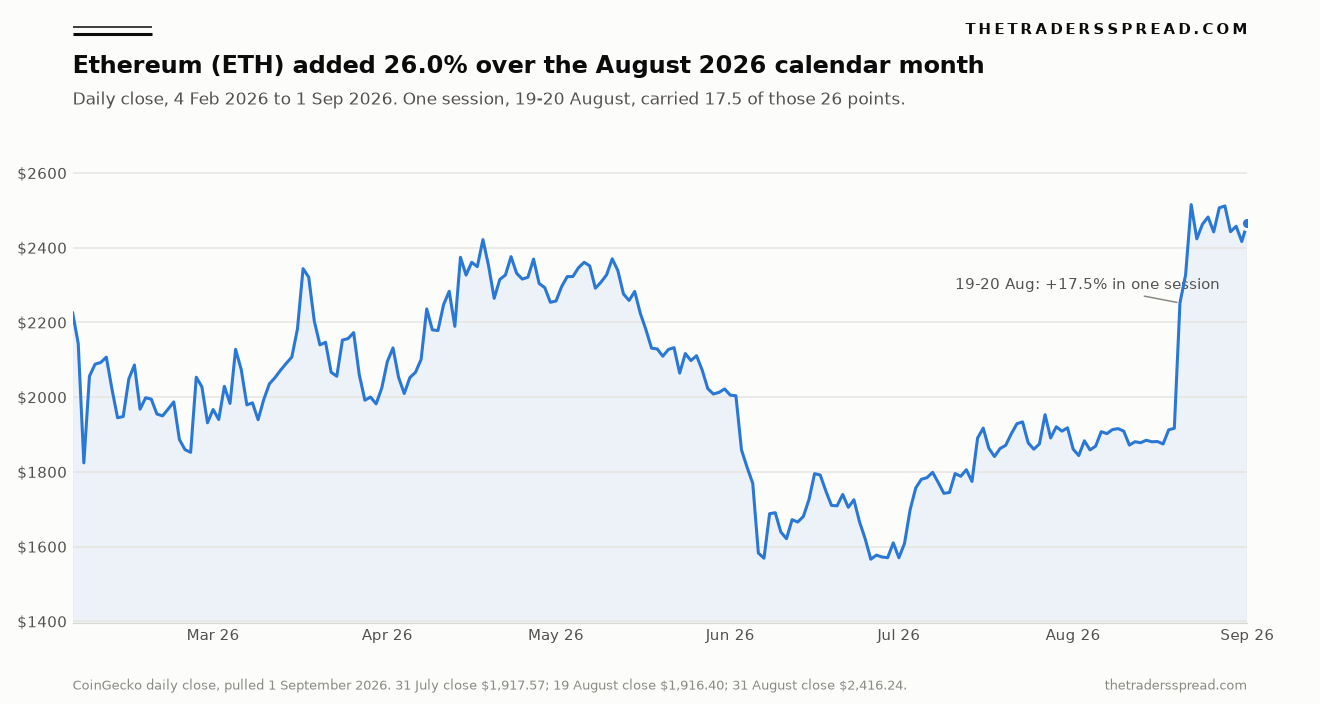
Here is the part almost nobody paired with the 4.89% headline. That 26% was not a month of accumulation; it was a single session. Ethereum closed 31 July at $1,917.57 and closed 19 August at $1,916.40, a nineteen-day round trip of minus 0.06%. The following session, 19 to 20 August, took ETH from $1,916.40 to $2,251.73, a gain of 17.50% in one day. The remaining eight trading days of the month added 7.31%. Bitmine bought 53,501 ETH into that repricing across the week to 30 August. It did not cause it, and its own disclosure does not claim it did.
Key facts
- Ethereum (ETH) rose 26.01% over the August 2026 calendar month: $1,917.57 close on 31 July to $2,416.24 close on 31 August — CoinGecko daily series, pulled 1 September 2026.
- The 19–20 August session alone delivered +17.50% ($1,916.40 to $2,251.73). The first nineteen days of August produced −0.06% — CoinGecko, 1 September 2026.
- Bitmine held 5,901,112 ETH at 30 August, equal to 4.89% of the 120,681,093 ETH circulating supply — Bitmine press release and CoinGecko, 31 August 2026.
- 5,067,309 ETH (85.9%) of that stack is staked at a 2.63% seven-day annualised yield, which the company projects at $335 million of annual staking revenue — Bitmine, 31 August 2026.
- Bitmine carries roughly $5.1 billion of unrealised losses on the position — Cointelegraph, 31 August 2026.
- BMNR shares closed 31 August at $25.32, up 6.39% on the day and up 46.53% across August from $17.28 — StockAnalysis, 31 August 2026.
- ETH remains 50.5% below its $4,946.05 record of 24 August 2025 — CoinGecko, 1 September 2026.
The month was one session wearing a month's clothing
Window choice is doing enormous work in every account of this rally, so it is worth setting the windows down side by side and leaving them there.
| Window | Ethereum (ETH) change |
|---|---|
| 24 hours to 1 September | +0.54% |
| 7 days to 1 September | −1.10% |
| 14 days to 1 September | +30.0% |
| 30 days to 1 September | +31.7% |
| August calendar month (31 Jul – 31 Aug close) | +26.01% |
| From the 24 August 2025 record of $4,946.05 | −50.48% |
Source: CoinGecko, pulled 1 September 2026.
The fourteen-day and thirty-day numbers straddle the gap and look spectacular. The seven-day number sits entirely on the far side of it and is negative. The calendar month is the honest frame for the event, because it is the frame the event actually occupied, and it is the frame this article uses throughout.
Decomposed, August looks like this.
| Leg | Window | Start close | End close | Change |
|---|---|---|---|---|
| 1 | 31 Jul – 19 Aug | $1,917.57 | $1,916.40 | −0.06% |
| 2 | 19 Aug – 20 Aug | $1,916.40 | $2,251.73 | +17.50% |
| 3 | 20 Aug – 31 Aug | $2,251.73 | $2,416.24 | +7.31% |
| Full month | +26.01% |
Source: CoinGecko daily closes, pulled 1 September 2026.
What caused the gap is where the reporting gets loose, and where we part company with it. The attribution most widely repeated is that an expanded US Treasury bond buyback programme, coupled with a legislative push on digital asset market structure, reset risk appetite on 19 and 20 August. Tom Lee, Chairman of Bitmine Immersion Technologies, put a version of it on the record on 24 August: "the fact that the White House signaled support for crypto and the Treasury buying long-term bonds supported improved risk appetite."
We went to the primary source rather than the summaries. The US Treasury press-release feed carries three items dated 20 August 2026: two sanctions actions, on Hizballah and on an Ecuador-based cocaine network, and a proposal on investment rules for Trump Accounts. There is no buyback announcement on 19, 20 or 21 August. That does not prove nothing happened in the bond market on those days; buyback operations are announced through the New York Fed's desk schedule rather than a Treasury press release. It does mean the causal chain circulating under this rally rests on interpretation by a large ETH holder, not on a document. Traders sizing a view off "the Treasury did X" are sizing off a claim, and the claim's most prominent author owns 4.89% of the asset.
Who is on the other side of 4.89%
Bitmine's disclosure on 31 August was its sixty-fifth consecutive week of buying ether. That streak, more than the size of any single purchase, is the fact worth holding.
The company reported 5,901,112 ETH at 30 August against total crypto, cash, marketable securities and early-stage investments of $15.6 billion. At the $2,449.49 spot used here the ether alone marks at $14.46 billion. Against the roughly $2,511 reference price in circulation when the $5.1 billion unrealised loss was reported, the arithmetic implies an average entry near $3,375 per ETH. At today's spot that position is about 27% underwater, and the mark-to-market hole widens to roughly $5.5 billion.
Sixty-five weeks of buying at a rising average cost, into a token that has halved from its record, is a specific kind of exposure. It is also familiar. MicroStrategy's bitcoin stack sat barely 3% above cost when its shares fell 7.3%, and the mechanism there is the mechanism here: a listed vehicle whose equity trades as a leveraged claim on one token, funded by issuing more equity to buy more of that token. When the premium to net asset value compresses, the funding channel narrows at exactly the moment the token is weak.
Lee's framing on 31 August was comparative rather than defensive. "As we enter the final month of 3Q26, ETH is the best performing macro asset, outperforming the S&P 500 by 5,430bp through last Friday," he said, adding that the top three performing assets since 30 June were ETH, BTC and SOL, and that this "sets the stage for institutions to add to their crypto holdings." Since 30 June, ETH is indeed up 50.1% on closes, from $1,609.75 to $2,416.24. The claim checks out on the window he chose. On the seven-day window it does not, which is the whole tension in this piece.
BMNR shareholders had the better August of the two. The stock ran 46.53% over the calendar month against ether's 26.01%, closing 31 August at $25.32. It also sits 61.4% below its 52-week high of $65.60. The leverage cuts in the direction of travel, and it has been cutting downward for most of a year.
What $335 million of staking revenue actually depends on
The most durable number in the disclosure is the staking line, and it is the one most likely to be quoted without its assumptions.
Bitmine has 5,067,309 ETH staked, 85.9% of the stack, at a 2.63% seven-day annualised yield. Multiply those and the position throws off about 133,270 ETH a year. Everything after that is a price assumption. At $2,513.69 per ETH, 133,270 ETH is worth $335 million, which is where the headline figure comes from. At the 31 August close of $2,416.24 the same stake produces $322.0 million. At the $2,449.49 spot used here it produces $326.4 million.
| ETH price | Annual staking revenue on 5,067,309 ETH at 2.63% |
|---|---|
| $2,000 | $266.5m |
| $2,416.24 (31 Aug close) | $322.0m |
| $2,449.49 (spot, 1 Sep) | $326.4m |
| $2,513.69 (implied by the $335m headline) | $335.0m |
| $3,000 | $399.8m |
Source: Bitmine holdings and yield, 31 August 2026; prices from CoinGecko, 1 September 2026. Author's calculation.
A $13 million gap between the headline and the month-end close is not a scandal. It is a reminder that the revenue line is a price line wearing an income label, and that it moves with the same thing the balance sheet moves with. Alvin Kan, Chief Operating Officer at Bitget Wallet, made the point plainly to Cointelegraph on 13 August: "The revenue is annualized, depends on ETH price and staking yield, and comes with operational, liquidity, validator and regulatory considerations."
The yield itself is the softer variable. A 2.63% seven-day annualised rate is a function of how much ETH is staked network-wide, and Bitmine has added to that denominator every week for sixty-five weeks. An entity that stakes more ether than anyone else on the network is, by construction, part of the reason the rate it earns keeps falling.
The issuance fight nobody priced into August
Which brings up a governance argument that has been running in parallel to the price action, largely unnoticed by anyone trading the tape.
EIP-8363, a tapered issuance burn, would progressively cut validator rewards as staked ETH approaches 60.25 million tokens, around half of current supply, phasing the change in over eighteen months and eventually taking rewards to zero at that threshold. The proposal has drawn hard opposition. Stani Kulechov, founder of Aave, told Cointelegraph on 5 August that "this will self evidently push out solo stakers who aren't subsidized by the EF or others," while Mike Silagadze, chief executive of Ether.Fi, argued it would leave the field to "only large centralized entities with zero cost of capital."
Read that critique from Bitmine's chair. A rule change that squeezes small validators and consolidates staking among large, cheaply funded institutions describes the company's competitive position almost exactly. A rule change that taps the brakes on aggregate staking rewards describes a direct cut to its $335 million line. Both readings sit inside the same proposal, and neither was in the price on 20 August.
What this changes
Nothing about 31 August altered Ethereum's supply, its issuance schedule or its throughput. What it altered is the concentration of who holds it, and the visibility of that concentration.
Ownership of 4.89% of circulating supply by a single listed company, 85.9% of it locked in validators, removes a meaningful block of ether from the tradeable float. Thinner float amplifies moves in both directions, and August supplied the demonstration: a market that could gap 17.5% in one session on a macro impulse is a market where the marginal seller is scarce. The same scarcity works in reverse if a treasury vehicle is ever forced to unwind, which is the tail risk that sits under every one of these structures.
RelatedCosmos (ATOM) Price Prediction: $2.44 Bull vs $1.40 Bear
Three things are worth watching from here, and none of them is the ether price.
The first is the streak. Sixty-five consecutive weeks is now the company's most-quoted statistic, which makes the first missed week a headline in its own right, regardless of the reason behind it. The second is BMNR's premium to net asset value: with $14.46 billion of ether inside a company carrying $15.6 billion of total assets, the equity is close to a pass-through, and the buying programme depends on issuing stock above that mark. The third is EIP-8363 and the wider issuance debate, which is the only live mechanism that could change the economics of a 5.07 million ETH staked position without the price moving at all.
For the seven-day tape itself, the record is what it is. Ethereum went up 26.01% in August and has gone nowhere since 25 August, and the largest single owner of the asset added to its position in the week between those two facts. Anyone reconciling them should start by naming the window. Our live pricing for the pair of assets in this story sits on the Ethereum market hub, alongside the rest of the markets board.
Frequently asked questions
How much did Ethereum rise in August 2026?
Ethereum rose 26.01% over the August calendar month, from a 31 July close of $1,917.57 to a 31 August close of $2,416.24, on CoinGecko daily data pulled 1 September 2026. The window matters: over the seven days to 1 September, ETH is down 1.1%, so a weekly frame reverses the direction of the headline entirely.
Did Bitmine's buying cause Ethereum's August rally?
The sequence argues against it. ETH was flat for the first nineteen days of August, at minus 0.06%, then gained 17.50% in the single 19–20 August session. Bitmine's 53,501 ETH purchase covered the week to 30 August, after the repricing. The company's own disclosure describes the move as a macro outperformance rather than a consequence of its buying.
How much of Ethereum's supply does Bitmine own?
Bitmine reported 5,901,112 ETH at 30 August 2026 against a circulating supply of 120,681,093 ETH, which is 4.89%. Of that holding, 5,067,309 ETH, or 85.9%, is staked. It was the company's sixty-fifth consecutive week of buying ether.
Is Bitmine profitable on its Ethereum position?
No. The company carries roughly $5.1 billion of unrealised losses on the stack as reported on 31 August 2026. Measured against the reference price used in that reporting, the implied average entry is near $3,375 per ETH, against spot of $2,449.49 on 1 September, leaving the position about 27% below cost.
What does Bitmine's $335 million staking figure assume?
It assumes an ETH price of roughly $2,514. The 5,067,309 staked ETH earning a 2.63% seven-day annualised yield generates about 133,270 ETH a year; converting that at the 31 August close of $2,416.24 gives $322.0 million instead. The projection is denominated in ether and therefore moves with the token.
How far is Ethereum from its all-time high?
ETH traded at $2,449.49 on 1 September 2026, which is 50.5% below the record close of $4,946.05 set on 24 August 2025. The August 2026 gain of 26.01% recovered a fraction of a drawdown that has now run for over a year.
Related analysis
- Solana (SOL) jumps 13% to $109 as ETF assets hit $1.06bn
- Morpho (MORPHO) jumps 27% in 30 days as Base deposits top $5bn
- Hyperliquid (HYPE) climbs 52% in 30 days on the CFTC onshoring push
Featured image: "Close-up of a physical Ethereum coin" by Ivan Radic, CC BY 2.0, via Wikimedia Commons.
.jpg)
Disclaimer: this article is analysis and information, not financial advice, and no part of it is a recommendation to buy or sell any asset. Prices and holdings are as at the dates stated and change without notice. Trading and investing carry risk, including the total loss of capital.