

Algorand (ALGO) fell 9.0% over seven days and rose 2.94% over the last 24 hours. Both figures are CoinGecko's, last updated at 14:06 UTC on 11 October 2026, with the token at $0.1188 and a session range of $0.1163 to $0.1207. Rank on that snapshot was 78. The two moves cannot both be the comfortable reading of a feed that pairs "plenty of Algorand news" with "the price keeps falling" and treats the pair as one fact. The week supports the falling verb. The day rejects it. Eight minutes earlier, CoinGecko's aggregate crypto market cap was down 2.59% over 24 hours, so the bounce was not Algorand riding a broad rise. A busy feed and a down week can be true together. An up session makes the falling claim stale the moment it is written in the present tense with no window attached.
Put a date on the path and the week stops looking like a breakdown. CoinGecko's daily file prints $0.135966 on 29 September and $0.077299 on 30 July. From that September print to the 11 October spot of $0.11877, the change is −12.6%. From the July print, the same spot is 53.7% higher. The all-time low on CoinGecko is a different kind of mark, an intraday print of $0.075732 on 29 July 2026, and spot sits 56.8% above it. The rolling seven-day field and the slide since 29 September point the same way. The path since the July low does not. Folding the windows into one verb is how a timeline turns a giveback into a collapse.
Key facts
- Algorand last updated at $0.11877, a seven-day change of −9.003% and a 24-hour change of +2.936% — CoinGecko, 11 October 2026, 14:06 UTC
- Market cap was $1,077,168,084 and 24-hour volume was $54,563,464, rank 78 — CoinGecko, same timestamp
- The daily history prints $0.135966 on 29 September and $0.077299 on 30 July — CoinGecko market_chart, daily, retrieved 11 October 2026
- The recorded all-time low is $0.075732 on 29 July 2026, and the all-time high is $3.56 on 20 June 2019 — CoinGecko, retrieved 11 October 2026
- The newest Algorand Foundation blog item on the sitemap is dated 17 September 2026 — algorand.co sitemap and RSS, checked 11 October 2026
- August stake was above 2.02 billion ALGO, with the community at 80.6% of that stake — Algorand Foundation Algo Insights, published 10 September 2026
The posts are real. The dates are not this week.
Checked on 11 October, the Algorand Foundation blog sitemap and its RSS agree on a newest item: Pera Wallet's note of 17 September 2026. Nothing on that sitemap carries a last-modified date on or after 20 September. On the foundation's own blog, October is empty.
That is narrower than "nothing happened anywhere." A company this desk did not open could have announced a partnership. What the check rules out is the comfortable version of the feed, the one in which a fresh foundation release is supposed to be sitting under the posts. The material still being passed around is older than the down week.
On 9 September the foundation's note says CoinDesk was first to cover William Herkelrath's appointment as chief executive. The same note, published on algorand.co, describes him as a former Chainlink executive and a cofounder of K3 Labs. The note records CoinDesk's characterisation that he will lead a push into institutional finance and quantum-resistant security. It is not Herkelrath speaking. The date is 9 September, outside the rolling week anchored near 4 October.
Joseph Cecala's byline, dated 17 September, said Pera had helped the chain cross one million post-quantum resilient transactions, a few days after native quantum accounts arrived with v5.0.0. A significant share, the Pera note says, came from commemorative NFTs signed with FALCON, a NIST-selected scheme, in tiers at 1, 100 and 1,000 transactions.
The document that contains quotations is older. On 18 June 2026, datelined Dover, the foundation published a post-quantum roadmap and committed to broad quantum resilience by the end of 2027. The release places that horizon ahead of NIST's deprecation of legacy RSA key sizes. Milestones were to begin in the third quarter of 2026: native post-quantum accounts, including inside Pera, then multi-signatures and a migration of the foundation treasury.
"Post-quantum security cannot be retrofitted after Q-Day," said Bruno Martins, chief technology officer of the Algorand Foundation, in that 18 June release. The sentence the feed tends to keep is the next one. Institutions, developers and users "need to know their assets will remain secure should the quantum threat materialize," and the roadmap was offered as that assurance, with deployments meant to start in 2026.
The deployments are not a June rumour. The August insights, published 10 September, say quantum-resilient accounts went live on 20 August. Through 7 September the network had 1,800 such accounts and 1.24 million such transactions. Pera's 17 September headline is a wallet count crossing one million, not a reprint of that network figure. Both numbers sit in September.
The photograph above is Silvio Micali, Algorand's founder, from a 2018 portrait. He is not the byline on these posts.
A product that lands inside the price window looks different from one the feed is still discussing. Sui's 24.4% gain over 24-25 September sat next to DeepBook's app going live. That is a dated shipping event overlapping the move. Algorand's identifiable shipping, on the record checked here, was August and the first half of September. The daily high came afterwards, on 29 September. The headline decline is the giveback since.
Seven days, set against the other windows
The headline figure is CoinGecko's rolling seven-day percentage: −9.003% at 14:06 UTC, which is −9.0% to one decimal place. It is not the gap between two midnight prints. From the 4 October daily print of $0.131293 to the 11 October spot, the arithmetic decline is 9.54%. Same direction, a slightly wider gap, a different anchor. "About 9% on the week" covers both. An unrounded figure does not, unless the anchor is named.
Inside that week the path kinked. The daily print rose from $0.131293 on 4 October to $0.132524 on 5 October, then fell on each of the next four daily points, to $0.114568 on 10 October. "Keeps falling" fits 6 October through 10 October. It does not fit 11 October.
Spot at $0.11877 is 3.67% above the 10 October daily print. The rolling 24-hour change was +2.94% because a rolling day is not yesterday's daily point. High $0.12065, low $0.116316. The session never left a band of half a cent. That is the bounce a falling-week sentence deletes when the window is left off.
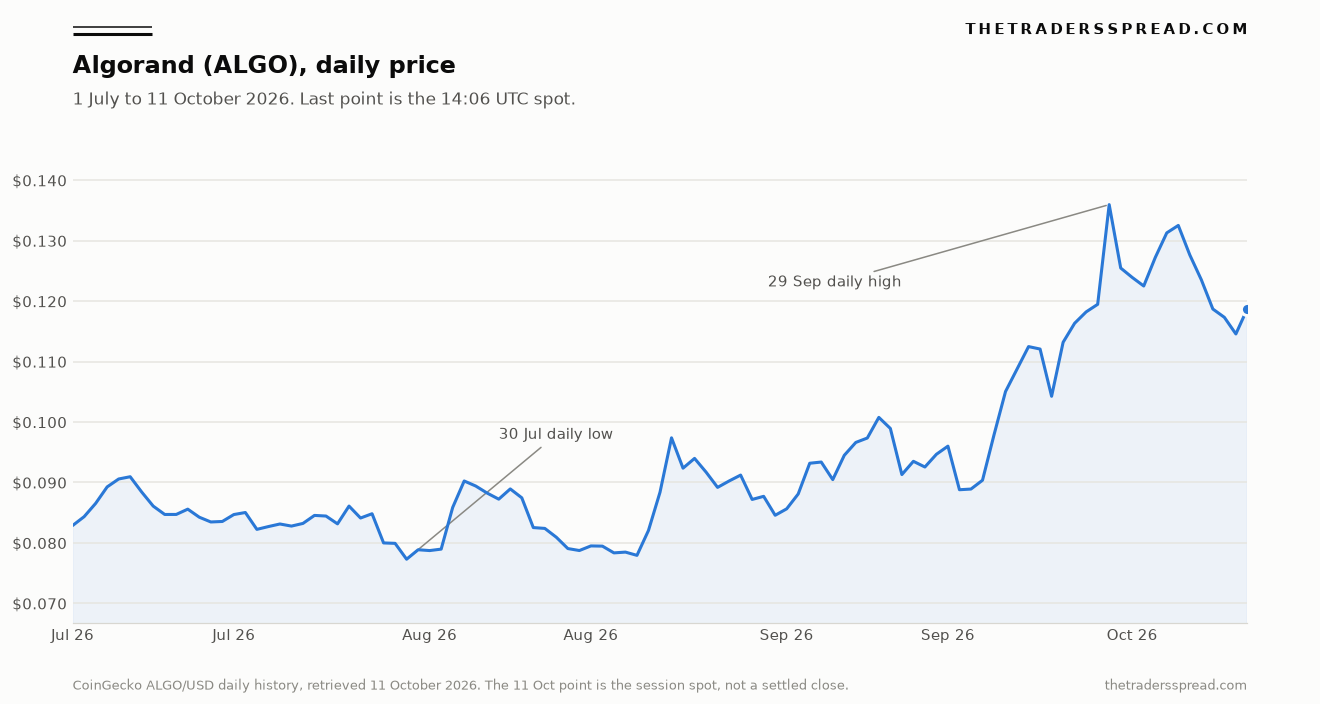
From the start of July the series climbs off the summer floor, spikes into 29 September, and gives back part of the climb. The last point is the 14:06 UTC spot, not a settled close. No forward lines are drawn.
| Window on the 14:06 UTC snapshot | Change | What that window is actually saying |
|---|---|---|
| 24 hours | +2.94% | The session bounced, inside $0.1163 to $0.1207 |
| Seven days | −9.00% | The headline window: a rolling field, not a pair of midnights |
| 14 days | +1.42% | Two weeks is not a decline on this snapshot |
| 30 days | +26.88% | Still a recovery month off the summer |
| 60 days | +49.01% | The larger climb out of the July-August base |
| 200 days | −9.94% | Almost the week's percentage, and a different story |
| One year | −37.08% | Twelve months is still a large decline |
All seven rows are CoinGecko fields from one response at 14:06 UTC on 11 October 2026. The 200-day row is the trap. −9.94% and −9.00% look alike. One is a week of giveback after a September high. The other runs through the summer low and the climb off it.
Volume was $54,563,464 against a market cap of $1,077,168,084, about 5.1% of the cap in a day. Active, not a scramble. Numeraire's 38.7% rise to $16.59 is the contrast, a day when the turnover jump was the story. Algorand's volume does not rewrite the week.
Jupiter's 6.38% drop on the 8 October close is the nearer parallel on this desk: a morning gain that did not survive the session. Daily sign and weekly sign come apart, so a headline has to pick a window. This one picks seven days, the decline the posts are gesturing at, because the day has already stopped agreeing.
August's book, and why it does not price this week
The August Algo Insights report, published 10 September 2026 and signed by Simon Bonanno, head of analytics at the Algorand Foundation, is the last full operating picture the foundation has numbered. It describes August. Using it as the cause of this week's price is a category error. Using it as backdrop is fair, because the figures were already public before the 29 September high.
Dollar total value locked rose 4.7% on the month, from $64 million to $67 million. In ALGO, TVL fell 1.7%, from 804 million to 790 million. Stablecoin market cap on the chain fell 2.3%, from $44 million to $43 million. Dollar TVL up, token TVL and stablecoins slightly down. The report is not a one-way inflow story, and it does not pretend to be.
Usage moved more than liquidity. Monthly active wallets rose 29.6%, from 522,000 to 677,000. Cumulative wallets went from 52.02 million to 52.55 million, with about 534,000 new wallets in the month. August transactions were 32.9 million, taking the cumulative count from 3.672 billion to 3.705 billion.
Contracts deployed were roughly flat, 606,000 to 603,000. New assets created rose 40.3%, from 217,000 to 305,000. Issuance is not a bid.
Agentic payments through x402 had their first full month after a late-July launch. Cumulative settled volume through August was $277,000 across 654,000 transfers. August was about 94% of cumulative transfers and 63% of cumulative settled volume, an average ticket near $0.28 on the report's reading. Wrong scale for the price: $277,000 in a month does not explain a $1.077 billion token moving 9% in a week while $54.6 million turned over in a day.
Staking was the large steady figure. Total ALGO staked sat above 2.02 billion, 80.6% of it from the community and 19.4% from the foundation's share. Circulating supply at the end of August was 9.04 billion, 90.4% of the 10 billion maximum, up 0.76% from July. Validators earned 6.74 million ALGO of staking rewards in August, and 53.63 million across 2026 up to the report.
On 11 October, circulating supply was 9,070,896,658 against that same 10 billion maximum, about 90.7%. The unissued gap, marked at $0.11877, is about $110 million of notional value. Desk arithmetic on CoinGecko's supply and price, not cash under the bid, and not a second official market cap. It does not fund the week's volume, and it does not pick the week's sign.
The Global x402 Challenge, posted 15 September, offers $100,000 plus 500,000 ALGO and a path to Devcon 8. Real, and outside both the seven-day window and the last fortnight. Half a million ALGO against 9.07 billion circulating is not a supply event, and the post does not call it one.
Where "still falling" stops being true
"Still falling" is present tense. It described the path from 29 September into 10 October, daily prints stepping from $0.135966 through $0.131293 on 4 October to $0.114568 on 10 October, with only 5 October higher along the way. It does not describe the 24 hours into 14:06 UTC on 11 October, which were up 2.94%. A true sentence about the week became incomplete inside one session. That is why the window belongs in the headline.
Lengthen the window slightly and the verb fails again. Fourteen days: +1.42%. Thirty days: +26.88%. Sixty days: +49.01%. A one-month look is a gain of more than a quarter. A one-week look is a loss of 9.0%. Same token, same hour. The feed's habit is to publish only the sentence that sounds like the posts.
RelatedKaspa Price Prediction for KAS: $0.055 Bull, $0.025 Bear
Stretch further and the picture sours, which a bounce story would skip. One year: −37.08%. Two hundred days: −9.94%. The all-time high remains $3.56 from 20 June 2019. Spot near twelve cents is a small fraction of that print. The July-to-October climb is a bounce off a 2026 low, not a return to the 2019 extreme. Calling the up day a new regime repeats the week's error in the other direction.
A cross-check that names no bellwether coin: at 13:58 UTC, CoinGecko's global market cap was $2.813 trillion, down 2.59% over 24 hours. Algorand's own 24-hour change, eight minutes later, was positive. The bounce did not simply shadow the aggregate. That makes it Algorand's session, not a more important one. A 2.94% up-day does not retire a −9.0% week.
What this changes
The feed can stay loud without a new document. September produced a chief executive, an insights pack, a prize challenge and a wallet crossing a million post-quantum transactions. Under them sits a June roadmap whose first accounts went live in August. Repetition is not a fresh cause, and this account assigns no level at which the token ought to trade.
The useful test is the date. If a post cites Algorand news as the reason the token should have risen this week, the next sentence needs a calendar day. The newest foundation blog date verified here is 17 September. The down week is early October. Miss that gap and the item is background, not an explanation of a seven-day sign.
"Fell 9.0% in a week" matches the 14:06 snapshot. "Continues to decline" matches neither the 24-hour field nor the 14-day, 30-day or 60-day fields. The other down windows are the 200-day change and the year. They are real. They are not this week's news. A percentage without a clock is decoration.
Chris Peikert, chief scientific officer of the Algorand Foundation, put the quantum work on another clock in the 18 June release. "Migrating a live protocol takes years, and the probability of a quantum attack on legacy cryptography grows meaningfully as the end of this decade approaches," he said. A seven-day price does not grade that sentence. The roadmap runs to the end of 2027, and a quiet October on the blog is not a failed test of it.
What would age this account is already on the chart. A daily point under the 30 July low of $0.077299 would make the week more than a giveback. A daily point back through the 29 September high of $0.135966 would make the giveback look finished. A foundation URL dated in October would fill the sitemap hole. None of that is an instruction. Until one of those prints, the week is down 9.0%, the day is up 2.94%, and the July low is intact.
FAQ
What is the Algorand price on 11 October 2026?
CoinGecko at 14:06 UTC put Algorand (ALGO) at $0.11877, with a 24-hour range from $0.116316 to $0.12065. Market cap was $1,077,168,084, rank 78, and volume was $54,563,464. The seven-day change on that same response was −9.003%, or −9.0% to one decimal. The algorand price in this piece is that timestamp. It will not still be the live tape when the next session opens.
Why did the Algorand price fall this week if posts still look busy?
The dated posts are real, and they are not from the week that fell. The newest foundation blog item is 17 September, on Pera and post-quantum transactions. The chief-executive note is 9 September. The roadmap quotation is from 18 June, with accounts reported live on 20 August. The seven-day change at 14:06 UTC on 11 October was −9.0%. A loud feed can recycle September. Recycling is not a new announcement, and it need not share a sign with the token.
How does the seven-day move compare with 30 days?
On the same CoinGecko response, seven days were −9.00% and 30 days were +26.88%. Fourteen days were +1.42%. Sixty days were +49.01%. The year was −37.08%, and the 200-day change was −9.94%, close to the week and unrelated to it. A 30-day look is still a recovery off the summer low. "Algorand is falling," with no window, mixes those answers into one false sentence. The headline uses the week and names it.
When did Algorand print its 2026 low?
CoinGecko's all-time low is $0.075732 on 29 July 2026, an intraday mark. The daily series used in the chart troughs at $0.077299 on 30 July. Spot at $0.11877 is about 56.8% above the intraday low and about 53.7% above the daily trough. The low is the reference for whether the summer floor has broken. On this snapshot it has not. A −9.0% week does not, by itself, reopen that question.
Did the foundation publish a blog post in October 2026?
Not on the record checked on 11 October. The sitemap's newest blog date was 17 September 2026, and the RSS led with the same Pera note. No October URL appeared in that crawl. A wire or a partner's own post could still exist off algorand.co. A claim of fresh foundation news needs a link carrying an October date. This desk does not have one, and the piece does not invent a partnership to fill the space.
Does a 9% week change the quantum roadmap?
The 18 June 2026 roadmap aims at broad quantum resilience by the end of 2027. Chris Peikert, the foundation's chief scientific officer, said then that migrating a live protocol takes years. Accounts were reported live on 20 August, with 1,800 of them and 1.24 million transactions by 7 September. A one-week price does not confirm that calendar and does not retire it. The seven-day percentage and the 2027 horizon measure different things.
This article is market analysis for information only. It is not a recommendation to transact in Algorand or any other asset, and it does not set a price objective. Cryptoassets can lose a large share of their value quickly. Capital is at risk. Figures are tied to the CoinGecko timestamps above and to the foundation pages linked in the text.