

Toncoin (TON) changed hands at $1.39 at 06:56 UTC on 16 October 2026, on CoinGecko. The question the market is actually pricing is not the name. The page already lists the coin as Gram, ticker gram, after a rebrand TON Strategy says took effect on 8 June 2026: a new label, not a new chain. The chain is still The Open Network. The question is whether a wallet inside Telegram is worth more than the tape has paid for a coin still 83% under its 14 June 2024 high of $8.25. Pavel Durov, founder and chief executive of Telegram, wrote on 21 July that zero-fee transfers were coming for more than a billion users. TokenPost reported on 9 October that Money, that wallet, had been rolled out across the messenger. The close that day was $1.38. On 16 October it was $1.39. A doorway that large and a one-cent week are not the same event.
Turnover will not sit beside the user count. On 17 October 2025 the same daily series showed a price near $2.18 and about $208 million of volume. A year later the price is $1.39 and volume is $36.6 million: about 82% less money changing hands, against a 37.5% price fall on the one-year field. The audience claim got louder. The market that warehouses the coin got quieter. Set that next to Aave's 50% climb as deposits topped $31 billion, a move that arrived with a stock of money the protocol could count. Toncoin's on-chain pool is a different size. DefiLlama put total value locked on the TON chain at $49.7 million on 16 October 2026, 1.3% of a $3.93 billion market cap. A button in a messenger is distribution. Until balances show up in a feed like that, it is not a bid.
Key facts
- Toncoin, listed as Gram (prev. Toncoin) under the id the-open-network, traded at $1.39 at 06:56 UTC on 16 October 2026, up 4.1% on the day and down 10.4% over 14 days — CoinGecko, 16 October 2026.
- Market cap was $3.93 billion, 24-hour volume $36.6 million, rank 31, and the day's range was $1.33 to $1.39 — CoinGecko, 16 October 2026.
- From 17 October 2025 the daily high was $2.72 on 8 May 2026 and the low was $1.22 on 28 March 2026. The all-time high on the coin page is $8.25 on 14 June 2024 — CoinGecko, 16 October 2026.
- TON Strategy held about 230.5 million Gram at 30 June 2026, about 229.9 million of it staked, and reported $15.0 million of staking revenue for the quarter — TON Strategy Company, Exhibit 99.1, 11 August 2026.
- DefiLlama recorded $49.7 million of total value locked on the TON chain on 16 October 2026 — DefiLlama, 16 October 2026.
- The SEC's 2020 settlement ordered disgorgement of $1,224,000,000 and an $18.5 million penalty over the original Gram offering — US Securities and Exchange Commission, 26 June 2020.
A year of closes, and three lines
The chart is one CoinGecko print a day, from 17 October 2025 to 16 October 2026, with three levels drawn out to 31 December 2026. They are scenarios, not a trade.
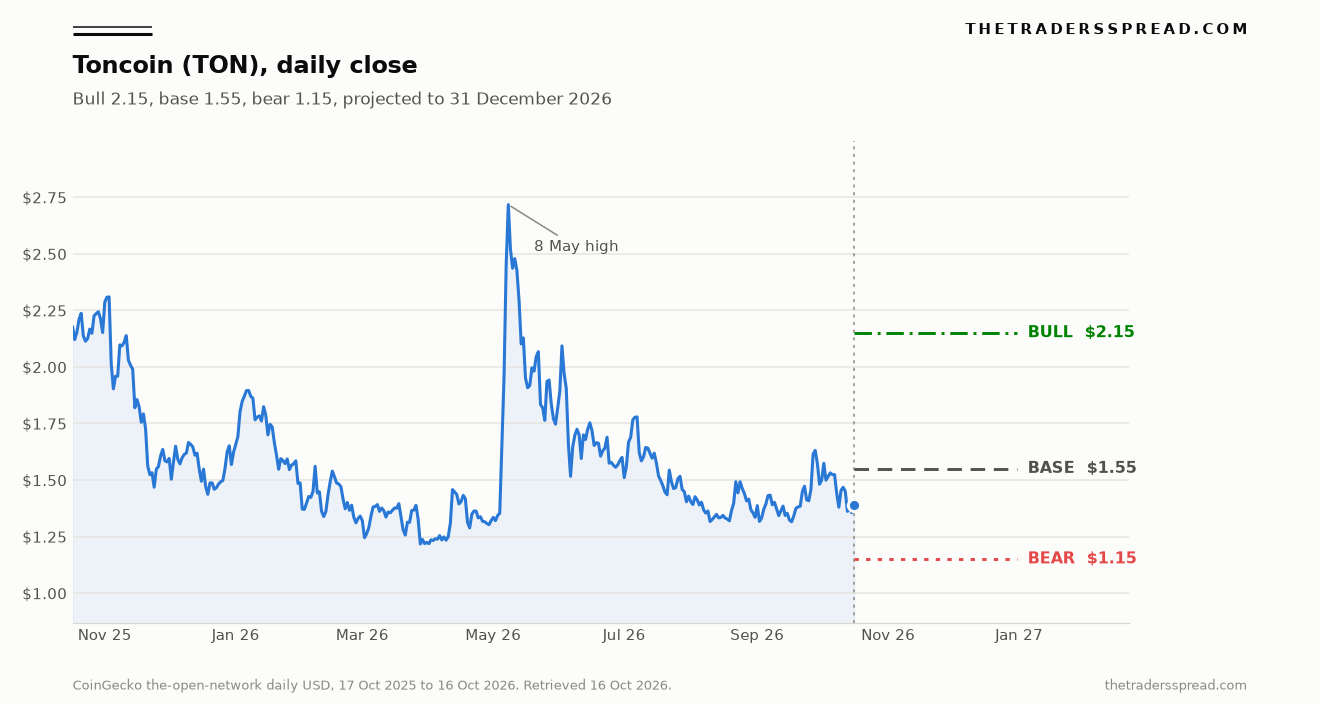
October 2025 ended at $2.15. November ended at $1.58. January closed at $1.49, March made the low at $1.217 on the 28th, and May broke the pattern: $2.72 on the 8th, then a monthly close of $1.82. The spike is on the chart. So is the give-back.
No month after October 2025 has closed above $2.
June did not install a new range. The close on 8 June, the rebrand date on the company's account, was $1.70, and the month ended at $1.60. July ended at $1.43, August at $1.34. September touched $1.63 on the 28th, on about $144 million of volume, and still closed at $1.48. October's high on this series was $1.57. The 16th closed at $1.39. A bull case of $2.15 asks for the first monthly close back at the October 2025 level, inside ten weeks.
| Date | Close | What sits on that date |
|---|---|---|
| 17 Oct 2025 | $2.18 | Series start. Volume about $208 million. |
| 31 Oct 2025 | $2.15 | Last monthly close above $2. The bull case. |
| 28 Mar 2026 | $1.22 | Low of the series, $1.217. |
| 8 May 2026 | $2.72 | High of the series. The 31 May close was $1.82. |
| 8 Jun 2026 | $1.70 | Rebrand effective, on TON Strategy's account. |
| 21 Jul 2026 | $1.43 | Durov's wallet post. The next close was $1.54. |
| 28 Sep 2026 | $1.63 | Autumn spike, about $144 million of volume. |
| 9 Oct 2026 | $1.38 | TokenPost's Money report. Prior close $1.44. |
| 16 Oct 2026 | $1.39 | Spot in this piece. Volume $36.6 million. |
Hold two volume days together. On 28 September the coin traded about $144 million and closed at $1.63. On 29 September it traded about $136 million and closed at $1.57. Two and a half weeks later the close was $1.39. Busy sessions have not installed a higher range. The bull case asks for something more persistent than a pair of them.
| Case | Level | Versus $1.39 | Weight | What has to be true by 31 December |
|---|---|---|---|---|
| Bull | $2.15 | about 55% higher | 20% | Turnover back toward $150 million to $200 million days, and a close through $1.63. |
| Base | $1.55 | about 12% higher | 50% | The March floor holds and the early-October shelf near $1.50 to $1.57 is reclaimed. |
| Bear | $1.15 | about 17% lower | 30% | A daily close under $1.20, through the 28 March low. |
A treasury larger than the DeFi book
Someone already holds a lot of the coin. TON Strategy Company said in its 11 August 2026 earnings release that it held about 230.5 million Gram on 30 June, including about 229.9 million staked. On TonStat figures it cited as of 4 August, that was about 4.4% of total supply, and the staked portion was about 35% of Gram staked on the network. Fair value of the digital assets was about $369.5 million. Cash and restricted cash were about $29.0 million. The company said it had no debt.
Revenue was $15.0 million, against $3.0 million in the first quarter. The company said it earned about 9.4 million Gram, up from about 2.2 million, at an annualised gross staking yield of about 17%. It tied the jump to Catchain 2.0, which it said cut block time from about 2.5 seconds to 400 milliseconds. Faster blocks are a real change. They are already behind us, and $2.72 did not stick.
Kevin Wilson, chief executive, put the hope in one sentence. "TON is becoming faster, less expensive, and easier to use, as blockchain functionality is integrated into Telegram's global platform of more than one billion users." An $82.8 million gain from the change in Gram's fair value sat inside the quarter's pre-tax result. When the coin rises, the income statement rises with it. Wilson is a holder talking about his holding, which is useful, and not the same thing as an outside census of demand.
At the June mark, 230.5 million units and $369.5 million imply a price near $1.60, matching the 30 June close. The same unit count at $1.39 is about $320 million. That sketch assumes the inventory is unchanged. October's holding is not in the release. Even as a sketch, it is several times DefiLlama's $49.7 million of chain TVL. The known holder is larger than the decentralised book the dashboards show.
Liquidity runs the other way. A $36.6 million day at $1.39 is about 26 million coins. The June inventory is roughly nine such days, if it is still there. Nothing in the August release says the company intends to sell. The narrower point is that daily turnover is small next to the known inventory, so a change in that holder's behaviour would show up on the chart long before a billion chat accounts did.
The name the SEC already litigated
Gram is not a fresh word. On 11 October 2019 the SEC sued Telegram Group Inc. and TON Issuer Inc., alleging sales of about 2.9 billion Grams to 171 initial purchasers. On 24 March 2020 a New York court issued a preliminary injunction barring delivery. On 26 June 2020 the Commission said a settlement had court approval. The defendants did not admit or deny the allegations. Disgorgement was $1,224,000,000, with credit for amounts returned to initial purchasers. Telegram Group Inc. was to pay an $18.5 million penalty, and for three years it was to notify SEC staff before taking part in a digital-asset issuance.
Kristina Littman, then chief of the SEC Enforcement Division's Cyber Unit, said it plainly in that 26 June 2020 release. "New and innovative businesses are welcome to participate in our capital markets but they cannot do so in violation of the registration requirements of the federal securities laws." The three-year notice clock in the release has run out. That is a deadline, not a comfort letter, and it says nothing about the coin trading now.
Keep the defendants and the coin apart. The 2020 case was Telegram's offering. The asset here is the coin that carried The Open Network afterwards, still filed under the-open-network. TON Strategy said holders did not have to swap or claim anything, and that the rebrand "restores the asset's original identity." Original identity includes the court file. A bull case that treats the rename as a clean start leaves out the reason the name was famous.
The file is not a hidden injunction on today's holders. This piece found no 2026 SEC order, in the sources opened, that restrains the current coin, the treasury company or the wallet. The useful residue is historical. Gram was a securities case before it was a messenger feature, and the market has had six years to decide what that history is worth.
What a billion users have not done
Durov's 21 July post is brief enough to quote. "This summer will see the largest rollout of a non-custodial crypto wallet in human history. Instant zero-fee crypto transactions for over a billion users are about to become reality." The close that day was $1.43, on about $32 million. The next close was $1.54, on about $67 million. On 11 August, the morning of the earnings release, the close was $1.33, on about $18 million. The post produced one lively session.
October's version is thinner. TokenPost, in John Kim's 9 October report, said Telegram had rolled Money out across the app. On that account Money stores and sends Gram and handles gifts and collectible usernames. Users can fund it from Walt, with transfers described as instant and free of a network fee, while trading stays in Walt, which the piece said covers more than 300 assets. A chat wallet and a brokerage are different objects. Splitting them is sensible. It is not, by itself, a reason for a higher coin.
The close did not applaud. CoinGecko printed $1.44 on 8 October and $1.38 on 9 October. Into the morning of 16 October the 14-day change was minus 10.4%, and the day's 4.1% rise only lifted the coin off a $1.33 low. If the market were paying up for "available across the messenger," the series would show a step. It shows a wiggle.
Where new demand can be counted, the price story looks different. Solana's jump to $109 as ETF assets hit $1.06 billion was tied to a stock of assets, not to a count of people who might open an app. Toncoin has no equivalent stock in the documents used here. Claims on social media about how many wallets switched on in a week were left out. They were not in a filing, a CoinGecko series, or a release this desk could stand behind.
Supply is not filling the gap either. Filecoin's rise ahead of a dated cut in new supply was a schedule story. CoinGecko's page for this coin shows about 2.83 billion circulating, about 5.27 billion in total supply, and no maximum. About 54% of that total is the float. The treasury company was still receiving new units as staking rewards, 9.4 million in a quarter. A bull case built on coins running out is not available on these figures.
Faster blocks can be real at a price of $1.39. A hop the user does not pay a network fee for is a reason for the token to move, not a reason for it to be scarce. Movement without a sink is turnover, and turnover fell from about $208 million to $37 million.
Base, bull and bear into 31 December
The horizon is 31 December 2026. Weights are a reading of that path, not a market-implied probability and not a prompt to take a position.
RelatedRender (RENDER) Price Prediction: $3.10 Bull vs $1.40 Bear
The base case is $1.55, weight 50%. It sits on the early-October shelf, closes mostly $1.50 to $1.57 between the 1st and the 7th, about 12% above spot. It asks for the March floor to hold and for a price from a fortnight ago to be reclaimed. That is the path which needs the least new information.
The bull case is $2.15, weight 20%, the 31 October 2025 close and the last month to finish above $2, about 55% above spot. May printed $2.72 and still ended at $1.82. Getting back there in ten weeks needs turnover toward the $150 million to $200 million days, not another $37 million session.
The bear case is $1.15, weight 30%, about 17% under spot and through the 28 March low of $1.217. The weight sits above the bull's because the news flattered the story and not the price: $1.43 the day Durov posted, $1.33 on the earnings morning, $1.39 now. A daily close under $1.20 retires the base. This is not a path down to the 2021 low of $0.52.
A close above $1.63 on volume above $150 million would lift the bull weight. A DefiLlama total an order of magnitude above $50 million would mean the wallet was showing up as balances. Neither print is here. The bias is neutral: reference $1.39, base $1.55, invalid under $1.20. Conviction is 2 out of 5. The catalyst has been published, and the answer was a one-cent week.
Questions the tape keeps raising
Is Gram a different coin from Toncoin?
No. CoinGecko still uses the id the-open-network and labels the page Gram (prev. Toncoin), symbol gram. TON Strategy said the 8 June 2026 rebrand changed the name and the ticker, not the chain, balances or staking positions. A wallet that held Toncoin beforehand held the same units after. This piece says Toncoin because that is the name in the search, and Gram when the live listing does.
Why is the bull case $2.15 rather than $8.25?
The June 2024 high is 83% above the current price, and the last year does not look like a trip back there. Since October 2025 the daily range tops out at $2.72, for one day in May that the month did not keep. $2.15 was a monthly close on 31 October 2025 and has not been one since. It keeps the bull case inside a range the chart already shows.
What does a close under $1.20 decide?
$1.20 sits just under the lowest daily close of the CoinGecko year, $1.217 on 28 March 2026. The base case at $1.55 assumes that floor is still the floor. A daily close beneath $1.20 retires the base and makes $1.15 the working bear case into 31 December. It says nothing, by itself, about 2027 or about the 2021 low.
Does the 2020 SEC settlement still bind this token?
It bound Telegram Group Inc. and TON Issuer Inc. over the original Gram offering: $1,224,000,000 of disgorgement, an $18.5 million penalty, and three years of notice before further digital-asset issuance. Measured from 26 June 2020, that notice window has expired. Expiry is not a blessing of the 2026 coin. This piece found no order that pastes the old judgment onto today's holders. The name was picked because it is the old name.
Why does volume matter more than a billion users?
A user count is an audience that could trade. Volume is the audience that did. The sources opened here put the first number above a billion, in Durov's July post and in TON Strategy's August release, and the second at $36.6 million on 16 October. Until volume moves with the wallet, the user count is a distribution claim. It can become a bid later. The closes since July do not show that it has.
How should the treasury holding be read?
As a dated concentration fact, not a promise of support. About 230.5 million units on 30 June, worth $369.5 million then, is a large known holder. At $1.39 that count is roughly nine days of 16 October's turnover, if the inventory is unchanged. The company has not published an October count in the documents used here.
Disclaimer
This is market analysis, not a recommendation to transact and not a personal recommendation. Scenarios, weights and levels describe a range. They are not instructions. Crypto prices move sharply, a treasury company is exposed to the coin it holds, and you can lose money. Do your own research.