

Basic Attention Token (BAT) rose 26.7% in the week to 18 October and fell 9.0% on the last day of that week. Both numbers come from the same CoinGecko daily file, and both were printed before anyone had a chance to pick a favourite. The 11 October stamp, taken at 00:00 UTC, was $0.141479. The 18 October stamp was $0.179268. Divide the second by the first and the token is higher by 26.7%. The 17 October stamp was $0.197005, so the step into 18 October is a fall of 9.0%. A screen that shows only the week is not wrong. A screen that shows only the day is not wrong. They become wrong when either one is asked to stand in for the other. Spot at 07:12 UTC was $0.17911, within a fraction of a cent of the 18 October stamp, so the split is not a wick that printed after midnight.
Bitcoin did not share the week. On those same two stamps CoinGecko had bitcoin at $82,917.90 on 11 October and $81,408.35 on 18 October, a fall of 1.8%. BAT's rise is not a shadow of the large coin. It is a move of its own, laid over a bitcoin tape that slipped. The last daily step makes the split sharper: bitcoin went from $81,523.66 to $81,408.35, about a tenth of one percent, while BAT gave back 9.0%. Brave's own site, opened the same morning, does not name a cause for either leg. The newest post on the blog index was a 15 October note about encrypted chats in the Leo assistant. The last post that actually sets out BAT product plans is still the 9 July roadmap.
Key facts
- Basic Attention Token rose 26.7% from the 11 October daily stamp of $0.141479 to the 18 October stamp of $0.179268 — CoinGecko market chart, pulled 18 October 2026
- The same series fell 9.0% from the 17 October stamp of $0.197005 to that 18 October stamp — CoinGecko, 18 October 2026
- Bitcoin fell 1.8% on the same 11-to-18 October daily stamps, from $82,917.90 to $81,408.35 — CoinGecko bitcoin market chart, 18 October 2026
- The highest daily stamp in the 90-day file is 16 October at $0.215791, and the 18 October stamp sits 16.9% under it — CoinGecko, 18 October 2026
- Circulating supply was 1.496 billion BAT against a maximum of 1.5 billion, and market cap on the 18 October stamp was $268.1 million — CoinGecko, 18 October 2026
- Brave's BAT Roadmap 4.0, dated 9 July 2026, says the browser is used by over 120 million people and describes planned BAT buybacks without dating an October transaction — Brave blog, opened 18 October 2026
Two clocks on one series
The title uses the midnight stamps on purpose. CoinGecko also publishes rolling changes, and those are a different clock. At 07:12 UTC on 18 October the coin endpoint put spot at $0.17911, the rolling 24-hour change at −13.4%, and the rolling seven-day change at +22.4%. Copying those tiles into a headline would describe another window. The rolling week looks back from 07:12, not from midnight on 11 October to midnight on 18 October. The rolling day includes a stretch of 17 October that the step from $0.197005 to $0.179268 does not isolate in the same way.
The rolling 24-hour range on that pull ran from $0.1722 to $0.2029. The token traded both below and above the midnight print inside that window. The $0.2029 high is still under the 16 October daily stamp of $0.215791. Nothing in the range rewrote the week's high.
Several honest percentages can be hung on this token before breakfast, and they do not match. +26.7% for the named week. −9.0% for the last daily step. −13.4% and +22.4% on the rolling tiles. The point of naming the stamps is so a reader can recompute the title without guessing which button produced it.
Market cap moved with the price because almost all the supply is already out. CoinGecko put circulating supply at 1,495,724,657 BAT and the maximum at 1,500,000,000, which is 99.7% of the cap. Market cap on the 11 October stamp was $211.6 million. On the 18 October stamp it was $268.1 million, the same 26.7% as the price. Fully diluted value at 07:12 was $268.9 million against a spot market cap of $268.1 million. Rank on that pull was 150.
Where the week actually moved
The 26.7% is not seven rising days. Read the stamps and the week argues with itself.
On 9 October the daily stamp was $0.102536. On 10 October it was $0.135236, a one-step rise of 31.9%, and the volume reading jumped from $13.5 million to $76.1 million. The measured week begins the next midnight, at $0.141479, so the 26.7% starts after that jump. From 9 October to the 18 October stamp the rise is 74.8%. From 9 October to the 16 October high of $0.215791 it is 110.5%. Those figures are true. They are not the title. The title stops where the up-week and the down-day share an endpoint.
Inside the named week the path was a staircase with landings that gave way. The 12 October stamp was $0.159889. The 13 October stamp fell to $0.153653. The 14 October stamp jumped to $0.197103, and the volume reading on that stamp was $179.0 million, the heaviest in the file for this run, about 13 times the 9 October reading. The 15 October stamp fell back to $0.172254. The 16 October stamp made the high of the entire 90-day daily series, $0.215791, on a volume reading of $78.3 million, less than half the 14 October reading. The high and the heaviest volume reading were not the same day.
Then the giveback. 17 October printed $0.197005. 18 October printed $0.179268. From the high, two daily steps took off 16.9%. A mark on 16 October is a loss of 16.9%. A mark on 11 October is a gain of 26.7%. Volume on the 18 October stamp had cooled to $37.6 million, and the 07:12 record showed 24-hour turnover of $38.0 million. Activity had not vanished. It was no longer the $179 million reading on 14 October.
Stretch the file back and the week looks smaller than the recovery under it. The daily low in the 90-day chart is 15 August, at $0.056694. The 18 October stamp is 216% above that low. CoinGecko's all-time-low field, an intraday print rather than a midnight stamp, is $0.055241 on 14 August 2026, and the 07:12 spot was 224% above it. The all-time high on the same record is $1.90 on 27 November 2021. Spot was 90.6% below it. Off a summer low, and still far under a 2021 high: the percentage depends on the stamp left out.
From the 18 September stamp of $0.073891 to 18 October the rise is 142.6%. A 9.0% down day does not erase that, and that rise does not make the down day imaginary. Anyone quoting one BAT percentage this week owes the reader the two dates.
The chart, set against bitcoin
The daily series from 21 July to 18 October is below. History only: no projected level, because this piece has no target. The August trough, the September climb, the October acceleration and the last two lower stamps are on the line. The 16 October high is marked because the last two days are measured against it.
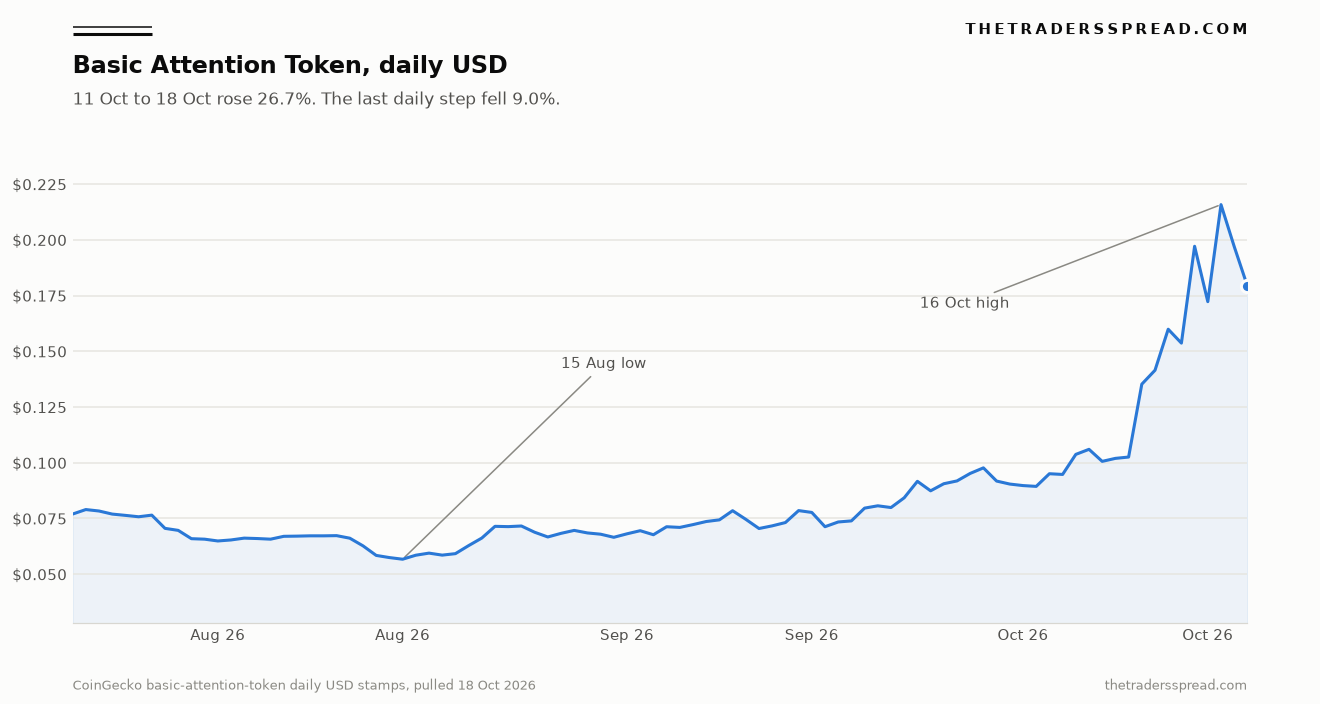
The table puts the windows that matter in one place. Every BAT and bitcoin figure is a CoinGecko daily stamp at 00:00 UTC, except the two rolling rows, which are fields on the coin record at 07:12 UTC on 18 October and are labelled as such so they are not mistaken for the title.
| Window | Start | End | Move |
|---|---|---|---|
| Title week, BAT | 11 Oct, $0.141479 | 18 Oct, $0.179268 | +26.7% |
| Last daily step, BAT | 17 Oct, $0.197005 | 18 Oct, $0.179268 | −9.0% |
| High to latest stamp, BAT | 16 Oct, $0.215791 | 18 Oct, $0.179268 | −16.9% |
| 9 Oct to 18 Oct, BAT | $0.102536 | $0.179268 | +74.8% |
| 9 Oct to the 16 Oct high, BAT | $0.102536 | $0.215791 | +110.5% |
| Rolling 7 days, BAT, 07:12 UTC | CoinGecko coin field | Spot $0.17911 | +22.4% |
| Rolling 24 hours, BAT, 07:12 UTC | CoinGecko coin field | Spot $0.17911 | −13.4% |
| Same week, bitcoin | 11 Oct, $82,917.90 | 18 Oct, $81,408.35 | −1.8% |
Bitcoin's last daily step, from $81,523.66 to $81,408.35, was a fall of about 0.1%. BAT's was 9.0%. The week and the day diverge more here than they do for bitcoin, which barely moved on either clock. That does not mean BAT had to follow bitcoin. It means a reader who files the week under a general crypto bounce has the wrong drawer. On these stamps the large coin was down.
Other notes on this desk have hung a single number on a named window, and the shape is not shared. Stellar's week was a fall. Internet Computer's note used one day rather than seven. Numeraire's rise was measured through to a price. The method is the same: name the stamps, then stop. BAT's complication is that a week and a day, ending on the same print, point opposite ways.
The pages that do not explain the print
A price move of this size invites a cause. This desk went looking on pages Brave actually publishes, and did not find an October event that can be tied to the candles without invention.
The Brave blog index, opened on 18 October 2026, led with a 15 October post on encrypted Leo chats. Fetched the same morning, that page is about the assistant's privacy design. The "BAT" strings on it sit in site navigation, not in an account of the week. Under it were a 3 September hackathon note and a 2 September speed-test note. Roadmap 4.0, on the same index, is dated 9 July. Nothing between those dates, on the first page, is a BAT market announcement.
The roadmap post is still the document that says what Brave intends. It says the browser is used by over 120 million people, and that Rewards has grown to tens of millions of users and over 2 million verified websites and creators. It sets out a unified wallet, a stablecoin layer called BravePay, a Rewards card, agent payments, and a creator protocol for AI uses of content. On buybacks the tense is future. A percentage of net revenue from the new products will fund BAT buybacks for rewards, creators and a growth reserve. Separate opportunistic buybacks are planned, with timing and size left open, and Brave says it will disclose them on its transparency pages and the BAT Ecosystem Growth page. Further mechanics, the post says, will come in a later piece still inside 2026. That is a plan dated July. It is not a fill dated October.
The growth page, opened 18 October, has headings for lifetime purchases, year-to-date purchases and a last purchase, and it says purchased BAT pays users who view ads. The figures under those headings did not render in the text retrieved. This piece cites no purchase amount, and it does not treat a buyback as the cause. A disclosure with a date and a size would change the reading. It was not on the page this desk could read.
The Basic Attention Token account posted a community-call summary on 15 October. It covers the week of 29 September and says the calls are hosted by Luke Mulks, vice president of business operations at Brave. The Rewards Card waitlist is put at more than 163,000 sign-ups by 28 September, from users in more than 200 countries. The summary does not mention the October price, a completed buyback, or an exchange notice. Mid-October's public note from that account was a late-September product recap, not an explanation of a 26.7% week.
Brendan Eich, co-founder and chief executive of Brave Software, posted on X at 04:37 UTC on 18 October. The text was "Use @brave.", attached to another person's note about advertising systems and surveillance. It does not mention a price, a repurchase or a listing. Reading it as the cause would be a mistake. Reading it as the chief executive's public line that morning, and noticing that the line is not a market explanation, is fair. The source is the post itself.
The cause stays unsourced. No Brave post, exchange notice or filing opened for this piece dates an action to the candles. What the tape shows is enough: a week that rose, a last day that fell, a 16 October high the next two stamps did not hold, and a volume reading that peaked on 14 October, two days before the price did.
RelatedMonero (XMR) Falls 2.9% Over Seven Days to 15 October
What this changes
A single percentage on Basic Attention Token is now a choice. The week to 18 October, midnight to midnight, is +26.7%. The last midnight step is −9.0%. The rolling tiles at 07:12 UTC were +22.4% and −13.4%. From the 16 October high back to the 18 October stamp the file shows −16.9%. One pull produces all of them. None of them licences the others. A note that keeps only the flattering figure is editing the series.
The path changes what kind of rise this was. Stamps fell on 13 October and on 15 October, before the high. The high printed on a lighter volume reading than 14 October, and the next two stamps gave back 16.9%. By the morning of 18 October the retreat was already two stamps old, and the volume reading had faded from $179.0 million to $37.6 million. Cooling is not a forecast. It is the last line in the file.
Bitcoin changes the category. A 26.7% week beside a 1.8% decline in bitcoin is not "the market." The down day is not the market either: bitcoin's last step was about 0.1%, and BAT's was 9.0%. On both horizons this desk measured, the token was not mirroring the large coin.
The missing cause changes what to ask for next, not what to do with a holding. Brave's July post contemplates buybacks and says opportunistic ones will be disclosed. The growth page did not yield a number on 18 October, and the newest blog post is about Leo. Until a page carries an amount and a date inside this window, the roadmap stays a July document. A disclosure, an exchange notice, or a checked quote from a named executive would rewrite the account. None of those would delete the 9.0% last step. With 99.7% of the cap already out, price and market cap told the same week. Two dates, one division, and the other date kept in view.
Questions readers actually ask
What is Basic Attention Token?
Basic Attention Token is the unit Brave uses in Brave Rewards. The 9 July 2026 roadmap says the browser is used by over 120 million people, with tens of millions of Rewards users and over 2 million verified sites and creators. CoinGecko showed 1.496 billion BAT circulating on 18 October against a 1.5 billion maximum. It is a rewards token, not a claim on Brave Software equity.
Which number is the 26.7% in the headline?
It is the change between two CoinGecko daily stamps at 00:00 UTC: $0.141479 on 11 October 2026 and $0.179268 on 18 October 2026. The division is 26.7% to one decimal place. It is not CoinGecko's rolling seven-day tile, which read +22.4% at 07:12 UTC on 18 October, and it is not the rise from 9 October, which was 74.8% through to the same 18 October stamp. The headline picks one window and names it.
Did the token also fall?
Yes, on a shorter window that ends at the same stamp. From $0.197005 on 17 October to $0.179268 on 18 October the daily step is a fall of 9.0%. From the 16 October high of $0.215791 the two-step fall is 16.9%. CoinGecko's rolling 24-hour field at 07:12 UTC was −13.4%, which is a third day-length measure and not a substitute for either stamp-to-stamp figure. All three can be true because the start points differ.
Did Brave announce a reason this week?
Not on the pages opened for this piece. The 18 October blog index led with a 15 October Leo privacy post, and the BAT roadmap was still dated 9 July. The growth page describes purchases for ad rewards but did not render a last-purchase figure. A 15 October call summary covered late September, including a waitlist above 163,000, and did not tie a figure to these candles. No cause is stated because none was sourced.
How far is BAT from its high and from the August low?
CoinGecko's all-time high is $1.90 on 27 November 2021. Spot at 07:12 UTC on 18 October 2026 was $0.17911, which is 90.6% below that high. The all-time-low field on the same record is $0.055241 on 14 August 2026, and spot was 224% above it. On the daily chart, the low stamp is 15 August at $0.056694, and the 18 October stamp of $0.179268 is 216% above that. The week, the summer low and the 2021 high are three different stories.
Does a higher week mean the last day does not matter?
No. The week is real, and so is the giveback from 16 October. A position marked to the 11 October stamp is higher. A position marked to the 16 October stamp is 16.9% lower by 18 October. Volume readings had already faded from $179.0 million on 14 October to $37.6 million on the 18 October stamp. None of that is an instruction. It is the reason a one-line percentage is a poor description of this particular week.
This is analysis, not advice. Markets move, stamps get revised by later data feeds, and capital is at risk. The figures above are CoinGecko pulls and Brave pages opened on 18 October 2026. They are not a solicitation to take either side of the token.