

Internet Computer (ICP) rose 11.97% in the 24 hours to 06:57 UTC on 12 October 2026, to $3.46. The same CoinGecko record puts the all-time high at $700.65 on 10 May 2021, and the price at that timestamp sits 99.5% below it. A session that added $0.37, and a gap of about $697 open since the week the network launched, cannot both be a recovery. One figure is a day. The other is the position. The addition is thirty-seven cents. The distance back to the high is still measured in hundreds of dollars. CoinGecko's own percentage field on that pull read 11.98%, a hundredth of a point from the arithmetic on its absolute change: $0.369959 on a prior level of $3.090. The 24-hour range ran from $3.05 to $3.52. Nothing in those bounds gets near 2021.
Nor was the day the rest of the tape. A CoinGecko markets pull two minutes later, at 06:59 UTC, had bitcoin up 1.3% over 24 hours and ether up 2.7%, with both down across seven days, by 1.9% and 5.2%. ICP's seven-day change on the coin record was up 5.3%, its 30-day change up 25.2%, and its one-year change only 7.7%. Those last two cannot sit together unless the eleven months before this one were lower: divide the year's factor by the month's and that earlier stretch comes out about 14% down. The token is having a loud month inside a quiet year, and a loud day inside the month. The specific account of what comes next, from Dominic Williams on 9 October, is not a customer invoice. It is a coupon.
- Internet Computer printed at $3.46, up $0.370 or 11.97% in the 24 hours to 06:57 UTC, inside a $3.05 to $3.52 range — CoinGecko coin record, 12 October 2026
- Market capitalisation about $1.93 billion, rank 54, with $116 million of volume over 24 hours — CoinGecko, 12 October 2026
- The $3.46 print is 99.5% below the $700.65 high of 10 May 2021 and 72.7% above the $2.00 low of 1 August 2026 — CoinGecko, 12 October 2026
- Ledger total supply and the circulating endpoint both read 557,362,263 ICP at 06:00 UTC; the coin record lists no maximum supply — Internet Computer ledger API and CoinGecko, 12 October 2026
- The public subnet list returned 42 subnets and 618 nodes, 604 of them up, with 1,165,990 canisters running — Internet Computer dashboard API, 12 October 2026
- NNS motion 140888, executed on 24 March 2026, gives engine nodes 80% of revenue and uses 20% to burn ICP — Internet Computer dashboard, proposal 140888
A Sunday ramp, already over
The 11.97% did not arrive as a straight line through Monday. On CoinGecko's hourly market chart, pulled at 06:58 UTC, ICP sat at $3.06 at 11:00 UTC on Sunday 11 October. By 23:00 UTC the same series printed $3.50. That is a rise of 14.4% across twelve hours, almost all of it after 13:00 UTC, when the price left $3.12. The 23:00 print was the high of that hourly path.
Monday did not extend it.
At 06:58 UTC on 12 October the same chart was at $3.45, about 1.4% under the Sunday evening high. The coin record's $3.46 spot, a minute earlier, is the same neighbourhood, not a new leg. A rolling 24-hour percentage still looks like a rally in progress. The path says the rally was a Sunday evening event that had stopped advancing before London sat down to Monday. Hourly interpolation between the 06:00 and 07:00 UTC prints on 11 October, against the chart's latest price of $3.45, comes out at 11.8%. Close to 11.97%, and not the same endpoint. This piece uses the coin-record arithmetic and treats the other prints as a check.
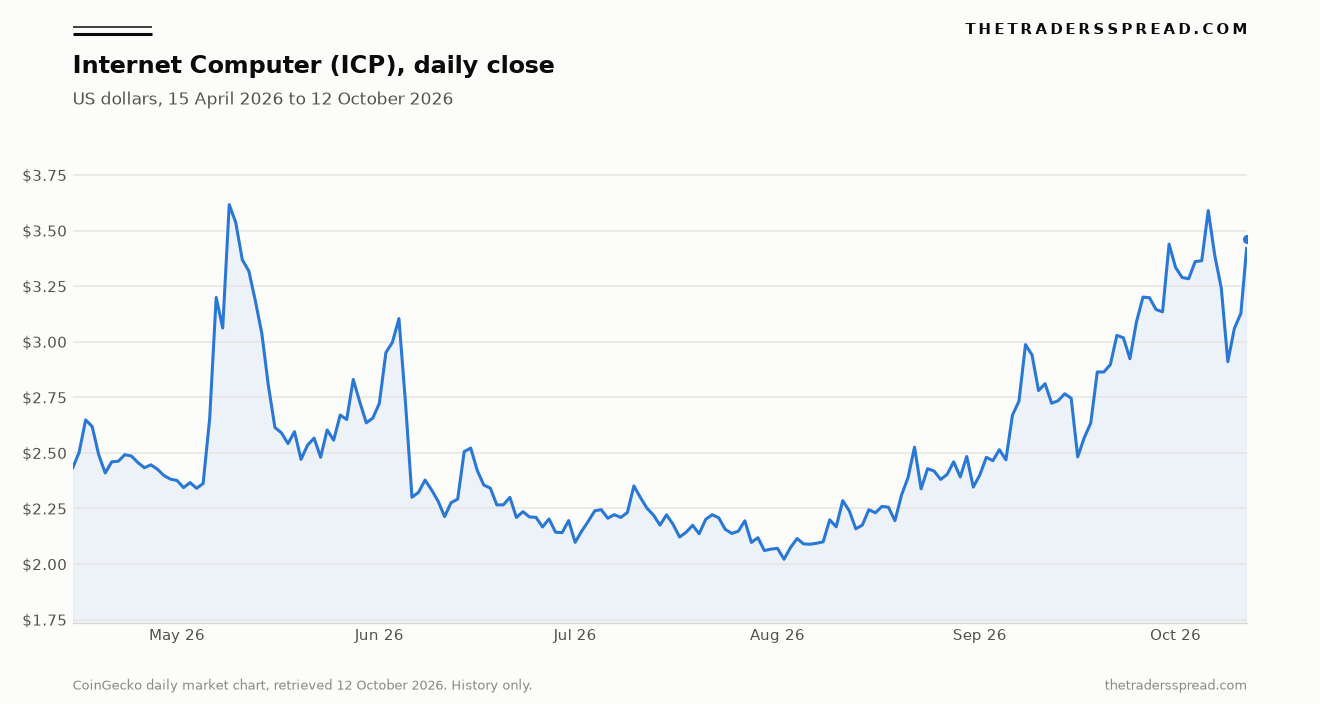
Across that daily series the highest close is not this week's. It is $3.62 on 9 May 2026. Sunday's hourly high of $3.50, and the coin record's 24-hour high of $3.52, both sit under a close the chart already printed five months ago. The lowest close in the window is $2.02 on 2 August 2026, a day after the all-time low of $2.00 on 1 August. From that August low to $3.46 is a climb of about 71% in ten weeks. Sunday is a loud step inside a recovery that has not cleared May.
Set against the majors, the day is ICP's own.
| Asset | Price | 24 hours | 7 days | 30 days |
|---|---|---|---|---|
| Internet Computer (ICP) | $3.46 | up 11.97% | up 5.3% | up 25.2% |
| Bitcoin | $84,156 | up 1.3% | down 1.9% | up 8.7% |
| Ether | $2,570 | up 2.7% | down 5.2% | up 2.0% |
ICP's row is the coin record at 06:57 UTC, with the 24-hour figure computed as above. Bitcoin and ether are the markets endpoint at 06:59 UTC. That same call also printed ICP at $3.45, up 11.9% on the day, up 6.5% on the week and up 25.0% on the month. The week disagrees by about a point between endpoints. The day does not. Either reading leaves ICP several times the majors' 24-hour move, and up on the week while both of them are down.
A single loud session is a record this desk already keeps, and it ages fast. LayerZero rose 10.88% in the 24 hours covered on 6 October. The chart that mattered afterwards was not that session.
The 20% applies to revenue, and a coupon is not revenue
On 9 October, Dominic Williams, founder of the DFINITY Foundation, posted the sequence he wants read as the launch path for cloud engines. The line that matters for the token is the first. "DFINITY will soon begin disbursing coupons with enough cycles to create and power an engine for 1 month+," he wrote, with general release still ahead of that disbursement. He also wrote that, in advance of general release, engines are already being used by governments and NGOs. He did not name them.
A cloud engine, in NNS motion 140888, is a private subnet. The owner can set a replication factor and place nodes in one region. The motion, flagged on the dashboard as a DFINITY proposal, was executed on 24 March 2026. It is not a document from this week. The sentence on money is specific: nodes in an engine receive 80% of the revenues generated, while 20% are used to burn ICP. Nodes on that track do not receive fixed payments from the network.
The vote was not a chorus. On the dashboard tally, yes took 51.0% of the yes-and-no total. The motion passed, and it passed narrowly. What it binds is a split of revenue. What Williams said on 9 October he would hand out soon is a coupon denominated in cycles, enough to run an engine for a month or more, before a general release.
Cycles are the unit of computation. The project's documentation states the conversion as a protocol constant: 1 trillion cycles equal 1 XDR, and minting them means sending ICP to the cycles minting canister. A canister then spends cycles as it runs. That spend is what the cycle-burn rate measures. It is not, by itself, ICP leaving supply in the same hour. ICP leaves supply when it is converted, or when a fee burns it. A coupon that arrives as cycles was minted by somebody. Whether that somebody burned ICP to do it is not in the 9 October post. Whether a customer paid is the part the post does settle. A coupon is not revenue, and the 20% term applies to revenue.
The March motion links a paying enterprise to ICP removed from supply. The step Williams says comes next does not. A coupon can fill a subnet with compute. It does not put 20% of a customer payment into a burn. Pricing Sunday's ramp as that term means pricing a cashflow the announcement does not produce.
The live consumption figures are small beside a $1.93 billion token, and the two public readings do not match. The IC API's latest cycle-burn point on the morning of 12 October was 32.29 billion cycles a second. The metrics API's average, pulled in the same session, was 49.67 billion. This piece does not blend them into a third number. At 1 trillion cycles to the XDR, the instant reading is 0.032 XDR a second, about 2,790 XDR a day, and the average is about 4,290 XDR a day. No dollar conversion is attached. A live XDR rate was not on the Frankfurter feed this morning, and a guessed one would be worse than the unit the protocol uses.
The same APIs showed ordinary work beside those rates: 21.1 billion instructions a second, and blocks finalising at 188.5 a second. None of that is a coupon. None of it is a new high in the price. Running canisters stood at 1,165,990, with another 106,178 stopped, across 42 subnets and 618 nodes.
May already printed this price
The all-time high is not a rhetorical comparison. CoinGecko dates it to 10 May 2021, at $700.65, and the Monday spot is 99.5% below that print. The all-time low is much closer in calendar time than the stories told about this token. It is $2.00 on 1 August 2026, ten weeks before this session. The change-from-low field on the Monday pull was 72.7%. A token that far off its low can look like a comeback in a headline and still be a token that printed its worst price in August of this year.
The supply record does not add a cap. At 06:00 UTC both ledger endpoints returned 557,362,263 ICP, and CoinGecko showed the same equality with the maximum left empty. That match is not proof neurons hold nothing. It does mean the Internet Computer price is not sitting on a published hard cap, while rewards still mint ICP. Inflation rates from the Mission 70 paper stay out: the paper was not opened. The demand-side term on the record is the 20% already quoted.
The 30-day gain of 25.2% is real, and it is why the one-year gain is only 7.7%. Most of what those two fields show arrived in the last month. A visible slice of that month is the Sunday run from $3.06 to $3.50. Monday's $3.46 sits back in the spring band, under the 9 May close, after the summer low.
Turnover of $116 million on a $1.93 billion capitalisation is busy for this token and small next to bitcoin, which changed hands in the tens of billions on the same pull. Rank 54 is the size of the room, not a thesis.
The other way a week can go is already on this desk. Algorand fell 9.0% across the week into 12 October. A single sector bid would have had a harder time lifting one of these and leaning on the other. ICP's week was its own.
ICANN's sentence does not mention the token
The same week produced a second set of headlines, and they do not survive the primary document. On 7 October 2026 ICANN published the applications in its 2026 round for new generic top-level domains: 1,615 of them. Applicants who filed an alternate string have until 23:59 UTC on 21 October to switch. String Confirmation Day is 17 November 2026. Kurtis Lindqvist, President and Chief Executive Officer of ICANN, said: "These applications demonstrate how organizations around the world are innovating new ways to build trusted online identities, serve their communities, and connect with Internet users."
The sentence is about the round. It is not about Internet Computer. The announcement, fetched in full, does not contain DFINITY, the string .icp, or the token. A page on the application publication site returned a script shell rather than a record. Until a record is in hand, a claim that someone applied for .icp stays a claim, and it is not a fact this desk will price. Delegation, if it ever happens, sits past confirmation day, objections and evaluation. None of that is a Sunday fill from $3.06 to $3.50.
One statement describes coupons that have not gone out. The other describes a domain round that does not name the asset. The price moved anyway. That is not evidence either statement had started producing the cashflow, or the name, that commentary reached for.
Fetch.ai rose 14.67% in 24 hours, to $0.2556, in a session this desk logged on 5 October, with a story attached and a chart that still had to be read on its own. Attaching a narrative is cheap. The chart either clears a prior high or it does not. ICP, on the daily series above, does not.
RelatedJupiter (JUP) price fell 6.38% on the 8 October close
What this changes
The useful change is in what has to be shown next, not in a level. A day near 12% that bitcoin and ether did not share needs an ICP-specific account. The only primary account from the founder in the prior three days is operational: coupons soon, general release later, and some unnamed governments and NGOs already on engines. The next observable is whether those coupons are actually disbursed, and in what size. A post that says soon is not a disbursement. Cycles handed out that way are still not the revenue the March motion assigns at 20%.
The burn that would count is ICP destroyed, not cycles spent. The morning's two readings, 32.29 billion cycles a second and 49.67 billion, are consumption. A real engine business would eventually show up there, and the current run-rate is a few thousand XDR a day against a token capitalised at $1.93 billion. That is not a receipt for Sunday. If ICP converted at the cycles minting canister rises with named engine revenue, the March term will have started to operate. If that ledger stays quiet while the price does not, the session was a session.
The chart already cuts against the headline. The high daily close since mid-April is $3.62 on 9 May, still above Monday's $3.46. The all-time low is ten weeks old. The one-year change is 7.7% only because the last month was 25.2%. None of that flipped because Sunday ran from $3.06 to $3.50 and Monday added nothing. The stall is part of the record.
What does not change is May 2021. Being 99.5% under $700.65 is not repaired by $0.37, and an undisbursed coupon does not make it less so. The March vote was narrow. By 1 August the token had made its low anyway. Three dated numbers are enough: $3.46 at 06:57 UTC on 12 October, $3.62 on 9 May 2026, and $700.65 on 10 May 2021. Only one is from this session.
Questions the tape actually raises
Why did the Internet Computer price rise on 12 October?
CoinGecko shows a computed rise of 11.97% in the 24 hours to 06:57 UTC, from $3.09 to $3.46. The hourly path puts almost all of that on Sunday, from $3.06 at 11:00 UTC to $3.50 at 23:00, with Monday morning a little under the evening high. Bitcoin was up 1.3% and ether 2.7% two minutes later, so the day was not a broad bid. No primary document in this session shows a new customer payment landing on Sunday.
What does the ICP price today mean next to the 2021 high?
At $3.46 the token is 99.5% below the $700.65 high CoinGecko records for 10 May 2021, a gap of about $697. It is also 72.7% above the $2.00 low of 1 August 2026. Both distances are from the same Monday pull. A double-digit day moves the first distance by a few tenths of a point and leaves the shape intact. The ICP price today is a 2026 price under a 2021 spike.
What is a cloud engine, in the document that defines the split?
Motion 140888, executed on 24 March 2026, describes a cloud engine as a private subnet whose owner can set replication and choose where nodes sit. Nodes on that track take 80% of revenue generated. The other 20% is used to burn ICP. They do not, on that text, get a fixed network payment. Yes took 51.0% of the yes-and-no tally. It is a March fact, not a filing from this week.
Do the coupons Williams described remove ICP from supply?
His 9 October post says coupons with enough cycles to power an engine for a month or more will be disbursed soon, ahead of general release. A coupon is not the revenue the 20% term refers to. Cycles are minted by sending ICP to the cycles minting canister, at 1 trillion per XDR, but the post does not say these coupons were funded that way. It does say the disbursement had not happened yet.
Is there a maximum supply of ICP?
Not on the feeds used here. At 06:00 UTC the ledger reported 557,362,263 ICP on both the total and the circulating endpoints. CoinGecko showed the same equality, about 557.36 million, and an empty maximum. That does not disclose neuron balances. It does mean the Monday price is not sitting on a published hard cap. Rewards still mint new ICP.
How did this session compare with other single-day moves?
LayerZero rose 10.88% in a 24-hour window reported on 6 October, and Fetch.ai rose 14.67% in one reported on 5 October. ICP's computed 11.97% sits between those session-sizes and, like them, has to be read against the longer chart. The high daily close since 15 April is $3.62 on 9 May, still above $3.46. Algorand, over the week into 12 October, went the other way.
Disclaimer
This is reporting and analysis, not a recommendation. It is not an instruction to trade Internet Computer or any other asset. Digital assets move sharply and can lose most of their value. Figures are tied to the sources and timestamps named above and will be stale by the time you read them. Capital is at risk.