

The idea that Monero has just led a privacy-coin collapse does not match the tape. Over the seven days to 15 October the coin fell 2.9%, from a CoinGecko daily print of $553.58 at 00:00 UTC on 8 October to $537.78 at 06:48 UTC on 15 October. The unrounded change is 2.85%. A red week is not a broken market, and the privacy label is doing too much work here. Zcash fell 12.4% on CoinGecko's rolling seven-day measure and 13.2% in the 24 hours to 06:56 UTC that same morning, with the spot at $1,089.72. Monero's own rolling seven-day print was down 3.5%, beside Bitcoin at down 2.3% on the same style of measure. The session range on the coins endpoint ran from $534.18 to $558.88. Spot there was $538.32 at 06:47 UTC, 54 cents above the chart's last print.
The split that matters is which coin you put in the privacy bucket. On the rolling windows CoinGecko published the same morning, Monero was up 30.86% over 60 days and Bitcoin was up 28.15%. Monero sat 32.52% under its $797.73 high of 14 January 2026. Bitcoin sat 35.95% under its $126,080 high of 6 October 2025. A coin that has tracked Bitcoin for two months, and that sits closer to its own peak, is a poor poster for a privacy reversal. The book is thin enough that the week's 2.9% did not need a shock: $108.2 million of Monero volume against a $10.13 billion market cap is 1.07% of capitalisation turned over in a day. Zcash turned over $1.16 billion on an $18.51 billion cap. Same label, different market.
Prints, clocks, sources
- Monero fell 2.85% from $553.58 at 00:00 UTC on 8 October to $537.78 at 06:48 UTC on 15 October, which rounds to 2.9% — CoinGecko market_chart, 15 October 2026
- The coins endpoint, stamped 06:47:50 UTC, showed $538.32, a 24-hour change of -2.23% ($12.29), a rolling seven-day change of -3.46%, and a day range of $534.18 to $558.88 — CoinGecko /coins/monero, 15 October 2026
- Rolling 60-day change +30.86%, rolling 30-day change +5.31%, rolling one-year change +68.93%; market cap $10.13 billion, rank 14, 24-hour volume $108.2 million, circulating supply 18.82 million — CoinGecko, 15 October 2026
- All-time high $797.73 on 14 January 2026, with the coins endpoint 32.52% under that print; the daily file's highest midnight observation in the year was $705.59 on 15 January — CoinGecko, 15 October 2026
- Bitcoin $80,751, rolling seven-day change -2.28%, 24-hour change -3.14%, 35.95% under the $126,080 high of 6 October 2025 — CoinGecko /coins/bitcoin, 15 October 2026
- Zcash $1,089.72 at 06:56:50 UTC, rolling seven-day change -12.40%, 24-hour change -13.15%, market cap $18.51 billion, rank 10, 24-hour volume $1.16 billion — CoinGecko markets endpoint, 15 October 2026
- FinCEN withdrew two proposed rules on convertible virtual currencies on 5 October 2026, and Monero 0.18.5.3 shipped on 6 October with a RandomX update to v1.2.3 — FinCEN.gov and getmonero.org, 5 and 6 October 2026
A seven-day fall, counted off the daily file
Two clocks are easy to mash together, and the mash is how a 2.9% week becomes a story about something else. The headline uses one cut only. Take the CoinGecko daily observation dated 8 October, $553.5805, and the last observation in the same file, $537.7782 at 06:48 UTC on 15 October. Divide the difference by the earlier print. The result is -2.8546%. At one decimal place that is a fall of 2.9%. Anyone quoting a different percentage for "the week" is either rounding harder or starting the clock somewhere else.
CoinGecko's own rolling seven-day field, on the coins endpoint, read -3.46% at 06:47:50 UTC. The rolling 24-hour field read -2.23%, or $12.29, to a spot of $538.32. From the midnight observation on 15 October itself, $549.86, down to $537.78, the file shows a further -2.20% before breakfast UTC. Four down numbers. None of them is a collapse, and none of them is the others.
Inside the week the path is lumpier than the endpoints. The daily print fell from $562.24 on 6 October to $519.38 on 10 October, a drop of 7.62%. It then recovered through $548.85 on 14 October and gave some of that back on the morning of the 15th. The headline window starts on 8 October, after the local high, not on it.
From the 22 September daily print of $590.79 to the 15 October chart price, the file is down 8.97%. That larger fade still leaves the coin far above summer. On 16 August the daily print was $410.56. Against $537.78 that is +30.99% on a fixed calendar cut, next to the rolling 60-day field of +30.86%.
Call the week a reversal only if you throw the two months away.
Bitcoin moved with it. Zcash did not
Put the rolling windows side by side and the privacy basket comes apart. Bitcoin, on the desk's Bitcoin page, was at $80,751 with a rolling seven-day change of -2.28% and a 24-hour change of -3.14%. Monero's rolling week was -3.46% and its rolling day was -2.23%. For a run of headlines about a privacy bid, that is an ordinary gap: about one percentage point on the week, and a day on which Bitcoin fell harder.
Zcash is the awkward comparison. At 06:56 UTC on 15 October, CoinGecko had it at $1,089.72, down 12.40% over its rolling week and 13.15% over 24 hours. The 30-day field was -5.02%. Monero's 30-day field was +5.31%. Over a month the two coins do not share a sign. Zcash has its own page on this desk. Nothing in today's Monero tape revises that page, and Zcash's week should not be pasted onto Monero because both get filed under privacy.
Distance to the peak gives the same warning. Monero is 32.52% under the 14 January 2026 high of $797.73. Bitcoin is 35.95% under the 6 October 2025 high of $126,080. The daily file's richest midnight print is $705.59 on 15 January, and the chart marks that spike as a daily high, not the intraday record. A 2.9% week does not close either gap.
Turnover finishes the job of splitting the basket. Monero's 24-hour volume was $108.2 million. Bitcoin's was $41.18 billion. Zcash's was $1.16 billion, on a market cap of $18.51 billion against Monero's $10.13 billion, rank 10 against rank 14. A few percent in the thinner book can be a change of hands in the low hundreds of millions. The same label on Zcash, this week, came with a much larger percentage and a tape about ten times fatter.
The chart, and the table underneath
The drawing is the daily file and nothing else. No projected levels, no scenario lines, no path past the last print. It runs from $318.39 on 16 October 2025 to $537.78 on the morning of 15 October 2026: January's spike, a spring grind near $300 to $400, then the climb into September. The last fortnight is a bend at the right-hand edge, not the whole story.
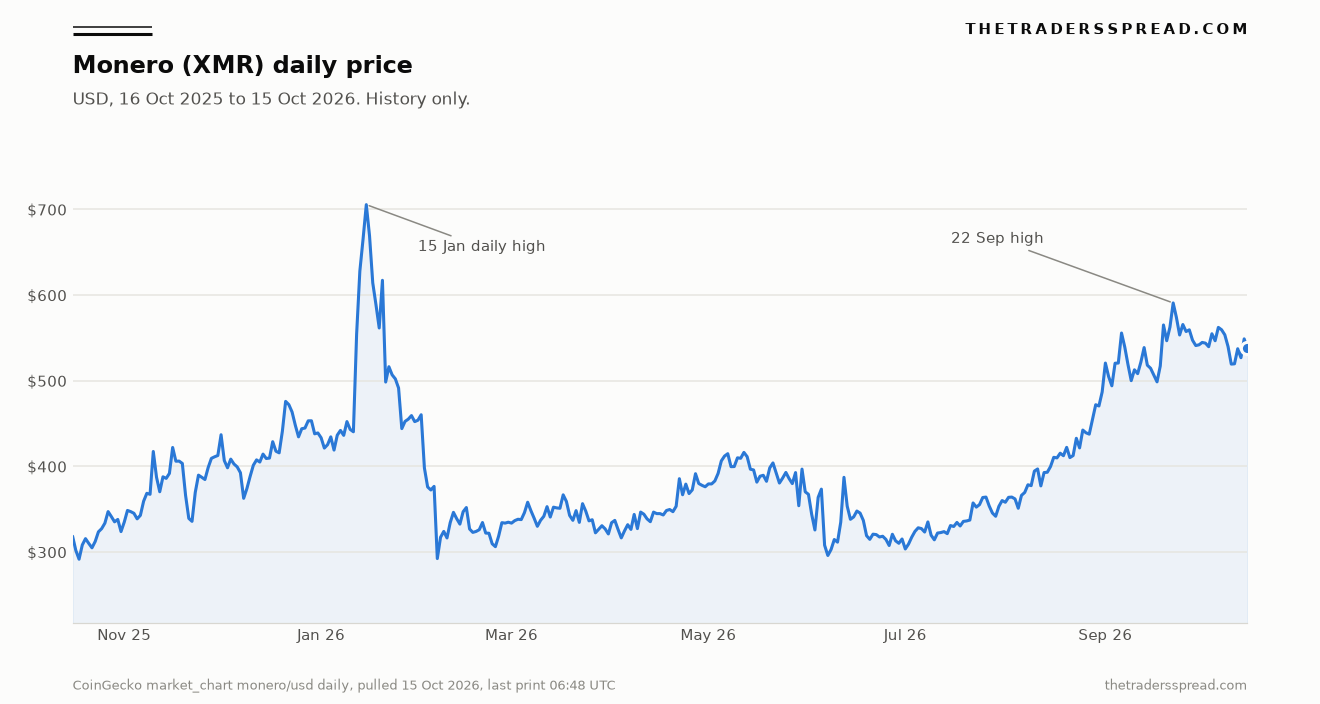
Read the table as clocks. The calendar row is the headline. The other rows are CoinGecko's rolling fields, pulled on 15 October 2026. Zcash's 60-day and one-year fields were not in the markets response used here, so those cells stay empty rather than being borrowed from a write-up.
| Window | Monero | Bitcoin | Zcash |
|---|---|---|---|
| Calendar, 8 Oct 00:00 UTC to 15 Oct 06:48 UTC | -2.85% ($553.58 to $537.78) | Not measured on this cut | Not measured on this cut |
| Rolling 24 hours | -2.23% to $538.32 | -3.14% to $80,751 | -13.15% to $1,089.72 |
| Rolling 7 days | -3.46% | -2.28% | -12.40% |
| Rolling 30 days | +5.31% | +4.04% | -5.02% |
| Rolling 60 days | +30.86% | +28.15% | |
| Rolling 1 year | +68.93% | -28.21% | |
| Distance to own recorded high | -32.52% vs $797.73 on 14 Jan 2026 | -35.95% vs $126,080 on 6 Oct 2025 | Not used |
| Market cap and 24-hour volume | $10.13bn, $108.2m, rank 14 | $1.623tn, $41.18bn, rank 1 | $18.51bn, $1.16bn, rank 10 |
Over the rolling year Monero is up 68.93% and Bitcoin is down 28.21%. The two-month lockstep is real, and so is that one-year gap. Picking only the red week is how the collapse version gets written.
Supply on that pull was 18,817,782 XMR. Market cap and fully diluted valuation were the same figure, $10,129,960,018. That does not make the coin tight in a trading sense. Tightness, for a desk, is how much of the cap changes hands. On this morning, 1.07% of it did.
Fluorine Fermi, and the machines it runs on
On 6 October the Monero project posted v0.18.5.3, codenamed Fluorine Fermi. The notes, on getmonero.org and posted by the maintainer selsta, call it a highly recommended release built from bug fixes. Seventeen people produced 182 commits and 4,162 new lines. The list is operational: peer-to-peer stalls, transaction relay after a restart, block relay, restricted RPC filtering, wallet refresh, multisig nonce handling, and an update of RandomX to v1.2.3. The notes do not quote a price.
RandomX, in Monero's own Moneropedia, is a proof-of-work design adopted from release 0.15, optimised for CPUs and built on random code plus memory-heavy work. The stated aim is to discourage specialised hardware, ASICs included, so block rewards stay spread across general-purpose machines. Moving from one RandomX version to the next, inside a bug-fix release, is maintenance of that choice. It is not, on this week's tape, a demand shock.
The photograph at the top is the CERN data centre, shot by Wikimedia Commons user Hugovanmeijeren on 12 March 2010 and released under CC BY-SA 3.0. It is not a Monero site. It is a room of ordinary server racks, the class of machine that description points at. Litecoin sits on its own page as a different proof-of-work coin this desk already follows. Whether RandomX still does what the Moneropedia says, after v1.2.3, is an engineering question. The price file from 6 to 15 October does not answer it.
Volume on the release day is the cleanest check against a "the code moved the coin" reading. The daily volume observation on 6 October was $147.0 million, the largest print in the first half of the month, and the midnight price was $562.24, a local high. By 10 October volume was still $137.8 million and the price print was $519.38. On 5 October volume had been $81.6 million, and on 1 October $103.1 million. The release sits inside an $80 million to $150 million band, not outside it.
FinCEN withdrew two proposals. Turnover barely noticed
The other dated event that week is American, and it is a withdrawal rather than a new rule. On 5 October 2026 FinCEN said it was pulling two proposed rules on convertible virtual currencies. One would have imposed recordkeeping, verification and reporting on certain transactions involving unhosted wallets. The other would have imposed a special measure on convertible virtual currency mixing. FinCEN said it had read the comments and was withdrawing both as part of a deregulatory agenda, so that digital-asset rules would be fit for purpose. The release does not name Monero.
That absence is the point. A privacy coin is the asset a mixing proposal gets waved at in commentary. The document that was issued is narrower. It retires two proposals. It does not set a new treatment for any ticker, and it does not restore a trading pair. A desk with the page open can say that two US proposals left the pending pile on 5 October. It cannot say, from that page, that any venue listed Monero again.
Nor did the book trade the withdrawal like a bid. The 5 October volume print, $81.6 million, was the quiet full day of the first ten days of October. The next midnight price was the local high, $562.24, and the four days after that gave back 7.6% on still-ordinary volume. A demand event would be a higher print and a fatter tape that stuck. The tape got busier for a day, then the price faded toward the print this article measures. Sharing a calendar with a press release is not a cause.
A proposal that never becomes a rule can sit for years as a line in a risk note. Removing it deletes a line, not a position. The rolling year is still +68.93%. The week after the withdrawal is down a few percent. Neither "regulation killed it" nor a deregulatory bid survives that order of events.
RelatedInternet Computer (ICP) Rises 11.97% in a Single Day
What this changes
The useful change is classification, not a target. For the seven days to 15 October, Monero does not belong in a sentence whose subject is "privacy coins fell". Zcash's rolling week of -12.40% can carry a sentence about a sharp decline in one privacy coin. Monero's calendar week of -2.85% and Bitcoin's rolling week of -2.28% can carry a sentence about a modest, broad fade. Using Monero as the example of the sharp version borrows Zcash's magnitude. The tape does not support that.
Two documents share the fortnight, and neither resets the book. FinCEN on 5 October withdrew an unhosted-wallet proposal and a mixing special measure. On 6 October the project shipped v0.18.5.3, with RandomX at v1.2.3. Daily volume stayed inside roughly $80 million to $150 million: $147 million on the release date, $81.6 million on the FinCEN date. An event that leaves turnover inside its recent band has not shown a demand shock. It can still matter for compliance staff and for people running a node.
The longer tape should not be retired on the back of this week. The 60-day rise is intact on both clocks, +30.99% from the 16 August print of $410.56 and +30.86% on the rolling field. The one-year rise of 68.93% is intact, as is the 32.52% gap to the January intraday high. The 10 October print of $519.38 and the 22 September print of $590.79 are nearby extremes already in the file. They are not destinations. A later week that pulled Monero's rolling change well away from Bitcoin's, with volume outside the $80 million to $150 million band, would weaken the beta reading. That week is not in the file pulled today.
Questions the tape actually answers
How much did the monero price fall in the week to 15 October?
The headline window runs from the CoinGecko daily print of $553.58 at 00:00 UTC on 8 October to $537.78 at 06:48 UTC on 15 October. The change is -2.85%, which rounds to a 2.9% fall at one decimal place. It is a completed move between two observations. It is not a forecast, and it is not the rolling seven-day field on the coins endpoint.
Why does a second seven-day figure, -3.46%, also appear?
The clocks start in different places. The 2.9% figure compares two daily observations seven calendar dates apart. CoinGecko's -3.46% is the rolling seven-day percentage on the coins endpoint, stamped 06:47:50 UTC on 15 October, measured against the price seven times 24 hours earlier. Both are down. Quoting either one without naming the clock is how a small week gets described as a different week.
Did Bitcoin and Zcash do the same thing?
Bitcoin did, roughly. Zcash did not. Bitcoin's rolling seven-day change was -2.28% and its 24-hour change was -3.14%, with the spot at $80,751 on the same morning's CoinGecko pull. Zcash was at $1,089.72 at 06:56 UTC, down 12.40% on its rolling week and 13.15% in 24 hours. Monero's week sat with Bitcoin. Zcash's week was several times larger, and its 30-day change was negative while Monero's was positive.
What did FinCEN withdraw on 5 October?
Two proposals covering convertible virtual currencies. One would have required recordkeeping, verification and reporting on certain transactions involving unhosted wallets. The other would have imposed a special measure on convertible virtual currency mixing. FinCEN's release, dated 5 October 2026, framed the withdrawals as part of a deregulatory review. The text does not name Monero, and it does not claim that any exchange changed a listing.
Did version 0.18.5.3 show up in volume?
Not as a break in the recent band. The project posted Fluorine Fermi on 6 October, including a RandomX update to v1.2.3. Daily volume that day was $147.0 million, the busiest print in the first half of October, and the midnight price was $562.24. By 10 October the price print was $519.38, down 7.6%, on volume of $137.8 million. A release and a fade shared a week. Turnover never left the band.
How far is Monero from its high?
CoinGecko records an all-time high of $797.73 on 14 January 2026. At the $538.32 spot of 06:47 UTC on 15 October, the coins endpoint put the coin 32.52% under that high. The daily file's highest midnight print in the past year was $705.59 on 15 January, lower because it is not the intraday extreme. Bitcoin, that same morning, was 35.95% under its own high of $126,080 from 6 October 2025.
Disclaimer
This article is analysis and a record of prints, not a recommendation and not an invitation to transact. Monero can rise or fall further, and money placed in it can be lost. The Traders Spread does not tell you to take a position in Monero, Bitcoin, Zcash or any other instrument. Figures come from the sources and timestamps named above. Check those sources before you rely on a number. Past prints, including the January high and the September high, are not predictions.