

Pyth (PYTH) was still the candle on the screen. Binance's PYTHUSDT session of 13 October reached $0.08827 and closed at $0.07819, with $10.45 million of quote turnover on that contract. From the high of the candle to the close, the print fell 11.4%. The low was $0.07745. A day earlier the same book had traded up to $0.09082 on $17.08 million of quote turnover, so the giveback arrived on a lighter print than the push that set the high. At 06:45 UTC on 14 October, CoinGecko had the spot at $0.07967, down 7.4% on the rolling day, inside a band of $0.077547 to $0.086743. Market value was $627.4 million. Rank 103. The screen looked like one of the session's losers. On the same CoinGecko page the sixty-day change was +99.7%. One contract, and one page, telling opposite stories.
The fortnight's paperwork does not agree with that candle, and it does not agree with itself. On 8 October Pyth said September recurring revenue had reached $11.5 million, 86% above the prior quarter, and that the DAO would now send every dollar it receives from Pyth products into open-market purchases of the token. Two days earlier the network's own report on real-world-asset perpetuals said Pyth had priced 90.29% of tracked September volume, down from 96.27% in August. Over the quarter, the same organisation still put the share above 94%, on more than $2 trillion of volume. A token 11.4% under one session's high is being asked to reflect a revenue line that grew and a monthly share that shrank. The candle does not choose. It does show that $0.088 was offered.
Key facts
- Spot $0.07967, down 7.4% over 24 hours, with a day range of $0.077547 to $0.086743 and $68.7 million of reported turnover — CoinGecko, 14 October 2026, 06:45 UTC
- Market cap $627.4 million, fully diluted value $796.7 million, rank 103 — CoinGecko, 14 October 2026
- Circulating supply 7.87 billion PYTH against a 10 billion maximum, 78.7% of the cap — CoinGecko, 14 October 2026
- All-time high $1.20 on 15 March 2024, now 93.3% below it; all-time low $0.02953 on 6 June 2026 — CoinGecko, 14 October 2026
- September recurring revenue stated at $11.5 million, up 86% on the quarter; the reserve stated at 42 million PYTH — Pyth Network, 8 October 2026
- Pyth priced 90.29% of tracked real-world-asset perpetual volume in September, down from 96.27% in August — Pyth Network, 6 October 2026
- Binance PYTHUSDT on 13 October: high $0.08827, close $0.07819, quote turnover $10.45 million — Binance daily kline, retrieved 14 October 2026
A year that does not fit on one candle
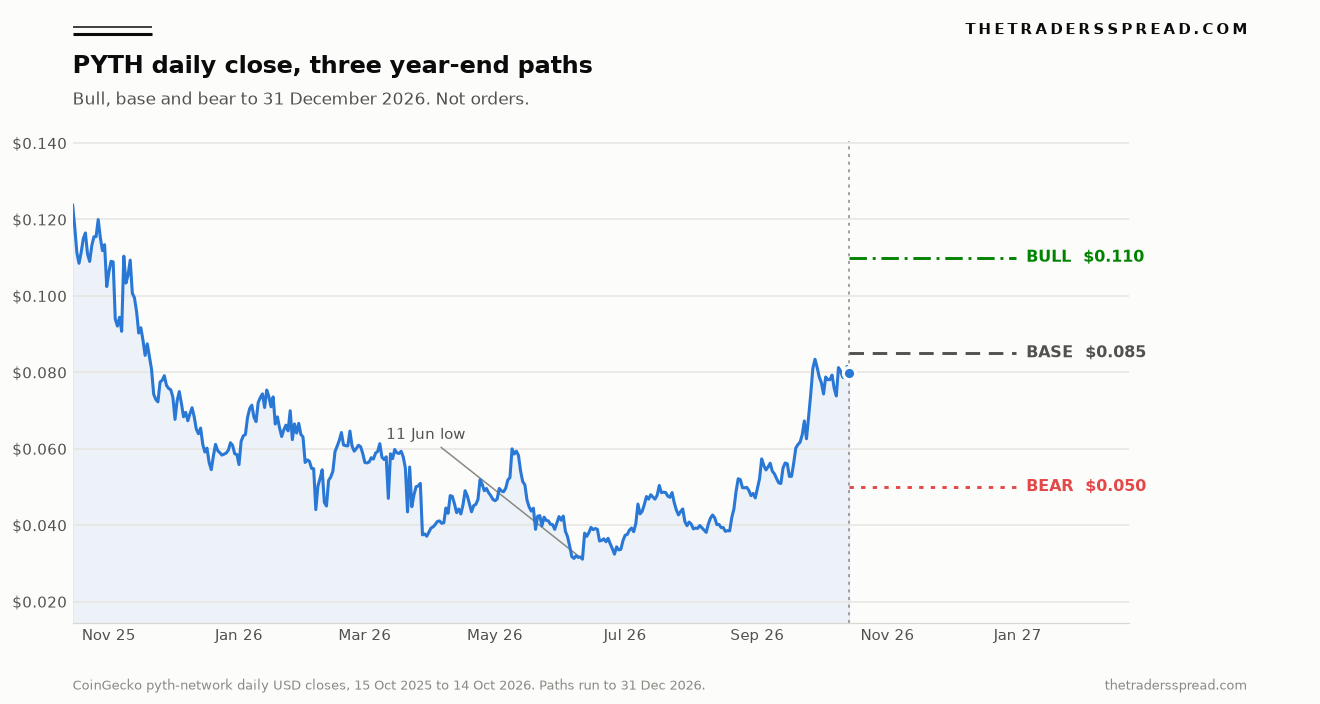
The one-year chart starts in a different market. CoinGecko's daily series, pulled the same morning, opens on 15 October 2025 at $0.1238. By 14 December 2025 the daily close was $0.0654. The 13 April 2026 close was $0.0433. The series bottoms on 11 June 2026 at $0.03107, just above the intraday all-time low of $0.02953 on 6 June. From that low to the 14 October spot, CoinGecko's own change is about 170%.
The recovery inside the sixty-day number is recent. On 11 August 2026 the daily close was still $0.0426. On 10 September it was $0.0521. On 10 October it was $0.0803. Most of the doubling happened inside six weeks, and it happened to a token already 93% under the March 2024 high of $1.20.
That shape matters more than the 13 October wick.
Spot at $0.07967 sits above the early-October shelf and below the 12 October high. On Binance the 7 October candle traded down to $0.07032 and closed at $0.07380. The one-year change is still down 34.8%. The 200-day change is +114.9%. Both are CoinGecko's, dated 14 October 2026. Quoting only one of them is choosing a story.
The primary mint, HZ1JovNiVvGrGNiiYvEozEVgZ58xaU3RKwX8eACQBCt3, sits on Solana, a chain this desk last covered when SOL jumped 13% in late August. PYTH can fall on a quiet Solana day, because the seller is a token holder, not a user of the feed.
Three paths, drawn past the last close
The chart below is the daily close from 15 October 2025 to 14 October 2026, then three lines into 31 December. Bull is $0.110. Base is $0.085. Bear is $0.050. Measured from the $0.07967 spot, those are +38.1%, +6.7% and −37.2%. The bull line sits under the left-hand side of the chart: $0.110 is 11% below the 15 October 2025 close of $0.1238. The bear line sits above the June trough.
| Path | Level | Versus the $0.07967 spot | What has to be true |
|---|---|---|---|
| Bull | $0.110 | +38.1% | A daily close above the 12 October Binance high of $0.09082, with September's revenue pace intact |
| Base | $0.085 | +6.7% | Spot holds the October band and the reserve bid absorbs ordinary selling into 31 December |
| Bear | $0.050 | −37.2% | The shelf near $0.070 gives way and price revisits the May 2026 closes, around $0.054 on 13 May |
On 13 May 2026 the daily close was $0.0541, so the bear level is a neighbourhood this chart has already visited. None of the three paths is an instruction. Divide the $627.4 million market cap by the $11.5 million of September recurring revenue stated on 8 October and the result is 54.6 times. The fully diluted value of $796.7 million is 69.3 times that same figure. A move from $0.080 to $0.110 would take the market-cap multiple from about 55 times to about 75 times if revenue stays put.
A price that is pulled, and a business that invoices
Pyth sells market data. The on-chain design is a pull: an application requests a signed price when it needs one, rather than waiting for a publisher to push an update into every block. The commercial catalogue around that design is now four products, as the 8 October note lists them: Pyth Pro subscriptions, listing as a service, the data marketplace, and Pyth Indices. Fifty indices were live across US equities, metals, oil, foreign exchange and thematic baskets. In September the network added indicative series for OpenAI and Anthropic, labelled as pre-IPO and indicative, not as exchange prints.
The September report is the cleaner window onto where the prices are actually used. Tracked real-world-asset perpetual volume was $637.85 billion, down from $753.7 billion in August. Open interest did the opposite. Average daily open interest rose from $10.45 billion to $11.71 billion, and the series hit a record $12.61 billion on 30 September. The market traded less and held more. Pyth's share of the volume that did trade was 90.29% for the month, 94.7% if swaps are stripped out and only perpetuals are counted. By class the split was uneven: 97.8% of equities, 91.5% of commodities, 77.1% of indices. The quarter-level claim, more than 94% and more than $2 trillion, can sit beside that weaker September.
Named users in that note include Trade[XYZ], Lighter, Kraken, Coinbase and Phoenix. Kalshi is described as the sole source agency in filings for gold and silver perpetuals on its CFTC-registered exchange. Coinbase is described as naming Pyth in an SEC filing for single-name equity perpetuals. Kalshi and Polymarket both use the prices on up-or-down markets. Nasdaq Basic is being distributed through the marketplace. Coinbase's share price is a different series, covered on the stocks desk in September. A filing that names an oracle is not a bid for the token.
A second distribution experiment is explicit about being a test. On 7 October Pyth said Exa was trying Pyth as a data layer for agentic search: current prices, history and candlesticks, through an MCP server, beside Exa's web results. Not a launched revenue line.
AI is changing how financial research is done, and that calls for a new approach to market data analysis. By combining Exa's search with Pyth's structured market data, we're exploring what that looks like in practice. We're excited to see where it leads.
Teo Gonzalez, head of partnerships at Exa, in Pyth's 7 October 2026 note. Useful as a description of a pilot. Not useful as a line in the $11.5 million.
The comparison people reach for is Chainlink, which this desk ranged separately in the Chainlink bull and bear paths. One network built its name on pushed updates. Pyth's price is one an application pulls. The tokens do not share a multiple.
Forty-two million tokens is a bid, not a vacuum
Read the 8 October announcement slowly and the headline shrinks. "Every dollar" is every dollar the DAO receives, not every dollar a customer pays. For the products the DAO owns, a 60% share reaches the DAO. The rest stays with the commercial operator. Under OP-PIP-136 the DAO then commits 100% of what it receives, plus non-PYTH assets already on the balance sheet, to reserve purchases of PYTH. Guardrails are unchanged from the old monthly vote: a 5% slippage cap, $25,000 per transaction, aggregator routing, public proofs, monthly reporting. The first purchases under the new authorisation were on 30 September.
The cash accounts are on the forum. On 5 October Douro Labs reported the eleventh distribution: gross $916,471, DAO share 553,693 USDC, Douro's keep $362,779. Since September 2025 the cumulative gross in that series is $4,135,517 and the cumulative DAO share is $2,506,630. The line items are below. The transfer itself is on Solana, 553,693 USDC, as cited in the 5 October forum post.
| September product | Gross | DAO share |
|---|---|---|
| Pyth Pro (60/40) | $768,084 | $460,850 |
| Listing as a service (90/10) | $12,700 | $11,430 |
| Indices (60/40) | $135,688 | $81,413 |
| Total | $916,471 | $553,693 |
Douro also noted that OP-PIP-136 told it to send the stablecoins straight to the Pythian Council wallet for purchases, and that this distribution did not go there. The rule and the first full month of cash were already out of step. That is an operating miss, not a thesis. It is still the sort of detail a headline about "100%" leaves out.
Put the cash against the float. At the $0.07967 spot, $553,693 takes in about 7.0 million PYTH. Repeat that month for a year and the purchases are about 83 million tokens, roughly 1.1% of the 7.87 billion in circulation. The reserve already holds 42 million PYTH, the figure in the tracking section of the 8 October post: about $3.35 million at the same spot, or 0.53% of circulating supply. At the $25,000 cap, that September sum is twenty-three transactions. It can lean against indifferent sellers. It cannot reprice the business on its own.
Market data has been sold the same way for forty years: expensive, fragmented, and out of reach for anyone without a procurement team. Pyth changed who can get it, and institutions are paying because the product is better. The DAO committing all of it to the Reserve is the strongest alignment this network has had: the people using Pyth, the people building it and the people governing it are now all pulling on the same rope.
Mike Cahill, chief executive of Douro Labs and a core contributor to Pyth, in the 8 October post. The rope in that sentence is the DAO's receipts, not the gross.
Indices add a second gap. The 8 October note calls them $1.81 million of fixed recurring revenue. The September index line in the table is $135,688 of gross, and the forum post says those bills run in arrears. A run-rate and a cash month are not the same dollar.
Where the upside stops being the base
The disconfirmation is the share table. A drop from 96.27% to 90.29% in one month is a venue choice, not noise, and the report does not name who took the points. Indices, the weakest class for Pyth at 77.1%, were a growing slice of the mix. If October's share prints at or under 90.29%, the bull path loses the claim that September was a one-month dip.
Supply should be stated narrowly. CoinGecko puts 7.87 billion PYTH in circulation out of a 10 billion maximum, so about 2.13 billion tokens sit outside the float under the $627.4 million market cap. This note does not date that stock. Secondary vesting calendars disagree, and the primary table was not the source used here, so no May cliff is assumed. The fully diluted value is the separate figure: $796.7 million.
RelatedAlgorand (ALGO) Falls 9.0% in a Week as the Feed Stays Loud
Price location does the rest. Spot sits between a shelf near $0.070 and a high at $0.09082. The 13 October candle then failed to hold $0.08827. A close under $0.070 hands the chart back to the spring, where $0.050 is a year-end print the path already allows. A close above $0.09082 does the opposite, and still leaves $0.110 under the $0.1238 close from October 2025, nowhere near $1.20. Between those two closes, $0.085 is the dull path. Dull is what the reserve bid is sized for.
Base, bull and bear into 31 December
The reference price is $0.07967, the CoinGecko spot at 06:45 UTC on 14 October 2026. The central path into 31 December is $0.085, 6.7% above that print and inside the band Binance has already traded this month. The upside path is $0.110, 38.1% higher, and it sits under the October 2025 shelf rather than through it. The downside path is $0.050, 37.2% lower, near the 13 May 2026 daily close of $0.054 and far above the June low. Weight sits on $0.085. The upside is a stretch. The downside is the chart if the $0.070 shelf fails.
Conviction is 2 out of 5. The revenue print is real: $11.5 million of stated September recurring revenue, 86% above the prior quarter, and a DAO that no longer votes the purchase through every month. The cash behind it is smaller. $553,693 reached the DAO in the September distribution, on the order of 1% of circulating supply across a year if that month repeats and every dollar is spent at this spot. September's share of tracked volume fell to 90.29%. The one-year token price is still down 34.8%. A higher conviction would need those facts to point the same way.
What would move the weight is observable. A Binance daily close above $0.09082 would shift weight from $0.085 toward $0.110. A daily close under $0.07032, the 7 October low, would shift weight toward $0.050 before year-end. A second monthly share figure at or below 90.29% would do the same to the upside even if price has not broken. An October share back near August's 96.27%, with the next distribution spent under the $25,000 clips and the fills published, would make $0.110 a claim about a larger bid.
The paths are distances from a published spot. Since June the token has already travelled from $0.031 to $0.091 and back inside $0.080. A year-end map that ignores that range is the mistake this note is written to avoid.
Questions the tape leaves open
What is the Pyth price prediction into 31 December 2026?
The central path is $0.085, about 6.7% above the $0.07967 CoinGecko spot at 06:45 UTC on 14 October 2026. The upside path is $0.110. The downside path is $0.050. Weight sits on $0.085 because that level is inside the October band. The upside needs a daily close above the 12 October Binance high of $0.09082 before it is more than a stretch. These are scenarios, not orders.
Why did PYTH fade on 13 October?
On Binance's PYTHUSDT daily candle the session reached $0.08827 and closed at $0.07819, an 11.4% drop from the high, on $10.45 million of quote turnover. The previous day had traded up to $0.09082 on $17.08 million. The fade was a failure to hold a high, on a lighter print, not a break of the early-October shelf near $0.070. CoinGecko's rolling 24-hour change by the next morning was a separate figure: down 7.4% at $0.07967.
Does the DAO reserve change the supply picture?
The 8 October post puts the reserve at 42 million PYTH, about 0.53% of the 7.87 billion circulating supply at the 14 October spot, or roughly $3.35 million. September's DAO cash of $553,693 comes to about 7 million tokens at that spot. Repeated for a year, that is near 1.1% of circulating supply, and the $25,000 transaction cap spreads it into many small prints. It is a bid. It is not a vacuum under the float.
How much revenue did Pyth actually distribute in September?
Douro Labs told the forum on 5 October that September gross was $916,471 and the DAO share was $553,693 USDC. Pyth Pro was most of it. The $11.5 million figure in the 8 October note is stated recurring revenue, a run-rate, not that month's cash. Indices add a further wrinkle: $1.81 million of fixed recurring revenue against $135,688 of index gross in the distribution, with bills running in arrears. Quote the one you mean.
What makes the $0.05 path the one that matters?
A daily close under the 7 October Binance low of $0.07032 would put the spring 2026 prices back in play, including the 13 May close at $0.0541 and, below it, $0.050. A second month of tracked-volume share at or under September's 90.29% would weaken the case for paying 55 times recurring revenue while the franchise slips. Neither has printed yet. Until one of them does, $0.05 is the downside path, not the base.
Disclaimer. This is analysis and information, not advice and not a solicitation to transact. Scenario levels describe distances from a published spot. They are not orders. Cryptocurrency prices are volatile and can fall to zero. Capital is at risk. Figures are tied to the named source and the date given; later revisions belong to those sources.