

The question the market is actually pricing in Chainlink (LINK) is not whether banks will end up using oracles. That argument was settled somewhere between Swift appearing on Chainlink's own institutional client list and the point where thousands of Chainlink feeds became load-bearing infrastructure for on-chain credit. The question is narrower, and far less comfortable for holders: can Chainlink convert that usage into LINK demand faster than its own treasury adds LINK to the float? At $11.7151 on 5 September 2026, up 43.0% over thirty days and still down 48.2% across twelve months, the tape's answer is no. Not yet, and not by a small margin. The 2026 rally is real, but it is a rally in a token whose supply grew by more than a tenth over the same period.
Here is the arithmetic almost nobody puts on one line. The Chainlink Reserve, the on-chain LINK sink launched on 7 August 2025 and funded by converting network revenue into LINK, held 5,770,818.04 LINK when we queried its Ethereum address at 06:55 UTC on 5 September 2026. That is real, verifiable, and worth $67.6m at spot. Over roughly the same window, circulating supply went from 678.08m LINK to 748.10m. The reserve absorbed about 8% of the LINK that entered the float alongside it.
Key facts
- LINK traded at $11.7151, up 43.0% over thirty days and down 48.2% over twelve months — CoinGecko, 06:43 UTC, 5 September 2026
- The Chainlink Reserve address held 5,770,818.04 LINK, worth $67.6m and equal to 0.771% of circulating supply — direct on-chain balance query of 0x9A709B7B69EA42D5eeb1ceBC48674C69E1569eC6, 5 September 2026
- The treasury released 70,000,000 LINK into circulation over twelve months, exactly 7.0% of total supply and 12.1 times what the reserve holds — Chainlink's supply endpoint and CoinGecko, 5 September 2026
- 42,604,947 LINK is staked, 5.70% of circulating supply, with the community pool exactly full at its 40,875,000 cap — Chainlink Staking v0.2 contracts read at block 25,909,458, 5 September 2026
- Cumulative Chainlink oracle rewards since 2019 total $410.2m, of which CCIP accounts for about $2.1m and price feeds for roughly $399.2m — Galaxy Research, 8 December 2025
- Two US spot LINK funds are already listed, Bitwise (CLNK) since January 2026 and Grayscale (GLNK) since April 2026, holding $92.1m of assets between them at 30 June 2026 — SEC Form 10-Q filings, 7 and 12 August 2026
- Coinbase named Chainlink the official oracle infrastructure for Coinbase Tokenized Stocks on 24 August 2026, two days after LINK's rally had already peaked at $11.99 — PR Newswire and CoinGecko, 24 August 2026
The supply arithmetic that decides everything else
Chainlink's revenue story is real. Its token-capture story is a rounding error against its own float, and the two get conflated constantly.
Start with what can be checked rather than argued. The Chainlink Reserve is a single Ethereum address, 0x9A709B7B69EA42D5eeb1ceBC48674C69E1569eC6, announced by Chainlink on 7 August 2025 as a strategic on-chain LINK reserve funded by converting off-chain enterprise revenue and on-chain service payments into LINK, plus half of the fees from Smart Value Recapture. We read its LINK balance against two independent Ethereum RPC endpoints at 06:55 UTC on 5 September 2026. Both returned the same figure: 5,770,818.04 LINK, worth $67.6m at the day's spot and equal to 0.771% of circulating supply. Across the 394 days since launch that averages roughly 446,000 LINK a month.
Now the other side of the ledger. Chainlink runs its own supply endpoint, and on 5 September 2026 it reported 748,099,970.4249 LINK circulating against a fixed 1bn total. A year earlier CoinGecko's data put the figure at 678.08m. The gap is 70m LINK, exactly 7.0% of total supply, and it did not trickle in: the implied supply series steps four times and is otherwise flat, by roughly 18.8m in October 2025, 11.3m that December, 19m in April 2026 and 21m in June. Thirty million in the second half of 2025 became forty million in the first half of 2026, a third faster, and then nothing: supply has sat at 748.1m for over ten weeks. At spot the year's new float is worth about $820m against the reserve's $67.6m, a ratio of 12.1 tokens released for every one the reserve holds.
There is a subtlety in the reserve that the announcement does not spell out. The same endpoint lists 33 non-circulating wallets holding 251,900,029.58 LINK, and total supply minus those balances equals the published circulating figure to the wei. The reserve address is not one of the 33. LINK bought into the reserve still counts as circulating, by Chainlink's own accounting and inside the $8.76bn market capitalisation. It takes tokens off the market in practice; it does not shrink the number anyone quotes. Those 251.9m held back are $2.95bn of latent supply at $11.7151, 44 times the reserve meant to offset them.
None of that makes Chainlink a bad business. It makes LINK a claim on a business part-financed by its own token, and a model that does not net the reserve against releases is not a model.
The staking sink is full, and it cannot get bigger without a decision
The second supply argument is staking. It is checkable too.
Chainlink Staking v0.2 runs two contracts. The community pool at 0xBc10f2E862ED4502144c7d632a3459F49DFCDB5e reports a typeAndVersion string of "CommunityStakingPool 1.0.0". At block 25,909,458 on 5 September 2026 its total principal returned exactly 40,875,000 LINK, and its maximum pool size returned exactly the same number. The community pool is full to the token. It has no room for another staker unless somebody withdraws or the cap is raised.
The operator pool at 0xa1d76A7cA72128541E9FCAcafBdA3a92EF94fDc5 tells a different story: 1,729,947.19 LINK staked against a 4,125,000 cap, 41.9% subscribed. Add the two and 42,604,947 LINK is staked across the network, about $499m, and 5.70% of circulating supply.
Set that against proof-of-stake networks where a quarter to a third of supply sits locked in consensus. LINK staking is not a consensus mechanism. It is an insurance bond on oracle services, deliberately sized at 45m tokens. That ceiling is a design choice, and investors who treat staking as an elastic sink that grows with adoption have it backwards: adoption can multiply and the sink stays 45m tokens wide until Chainlink Labs decides otherwise.
Who signed, and what the tape did about it
The 2026 announcement run has been genuinely dense. Six press releases since June, all naming real counterparties, none of them the vaporous kind, and in February the co-founder took a seat at the regulator: Sergey Nazarov was appointed to the CFTC's Innovation Advisory Committee on 12 February 2026 alongside executives from Nasdaq, CME Group, Intercontinental Exchange, Coinbase and Robinhood.
On 1 July 2026, Robinhood Chain launched and adopted Chainlink to connect its users to on-chain markets. On 18 August the Wyoming Stable Token Commission migrated the state's Frontier Stable Token to Chainlink CCIP. On 24 August, Coinbase named Chainlink the official oracle infrastructure for Coinbase Tokenized Stocks, giving Base builders continuous pricing for tokenised equities including NVDAc, METAc, AAPLc and GOOGLc so lending markets can take them as collateral. On 2 September, Wyoming went further and made Chainlink Proof of Reserve the exclusive on-chain asset verification infrastructure behind FRNT, a dollar and Treasury-backed token issued by a US state commission.
"By adopting Chainlink Proof of Reserve as Wyoming's exclusive onchain asset verification infrastructure, we're providing transparent, verifiable confirmation that the Frontier Stable Token is fully backed by high-quality reserve assets," said Anthony Apollo, Executive Director of the Wyoming Stable Token Commission, in that 2 September announcement.
Then there is Project Pangea, launched from Zurich on 23 June 2026, in which Chainlink, FairSquareLab, the UniKA alliance of Korean banks and Qivalis, a group of 37 European banks, are building a T+0 cross-border FX settlement framework on CCIP using atomic swaps of euro and won stablecoins. "Project Pangea upgrades the fragmented foreign exchange model of today with direct, atomic currency swaps using stablecoins," said Fernando Vazquez, President of Capital Markets at Chainlink Labs, in the launch release.
Put those dates against the price series and the argument gets uncomfortable for the bulls. LINK's 2026 low of $7.19 printed on 1 July, the same day as the Robinhood Chain launch. The rally that followed peaked at $11.99 on 22 August, two days before the Coinbase release. Since that peak, spanning both the Coinbase announcement and the Wyoming Proof of Reserve announcement, LINK has moved from $11.99 to $11.7151. Three of the strongest adoption headlines of the year landed either at a low or after the move had already happened.
The deals are not hollow. But not one of them discloses a LINK-denominated fee, a minimum spend, or a contract term. Coinbase's release names services, not economics. Wyoming's names infrastructure, not price. Project Pangea is a framework consortium, and the release does not say whether it is in production or what any participant pays. A reader hunting for the transmission line from these deals to token demand ends up back at the reserve address, which is adding roughly 446,000 LINK a month.
The ETF that already launched
One of the most common bull arguments for LINK is that a US spot exchange-traded fund would unlock institutional demand. Two of them are already trading.
The Bitwise Chainlink ETF went effective on 7 January 2026 and was certified for listing on NYSE Arca that 13 January as CLNK. Grayscale's Chainlink Trust ETF went effective on 16 April 2026 and trades as GLNK.
Bitwise reported total assets of $19,918,124 at 30 June 2026 in the 10-Q it filed on 12 August, up from $15,481,264 three months earlier. Grayscale reported $72,222,000 at 30 June 2026 against $73,816,000 at the end of 2025. Together the two funds held about $92.1m, roughly 1.05% of LINK's market capitalisation.
Dividing those balances by LINK's close on each reporting date puts the two funds at roughly 12.5m LINK between them at the end of June, against about 10.3m three months earlier. They accumulated tokens while their dollar balances stood still. That is the strongest bullish data point in this piece, and more than double what the reserve holds. It still did not stop LINK falling from $13.57 on CLNK's certification day to $7.19 on 1 July.
What the July low actually was
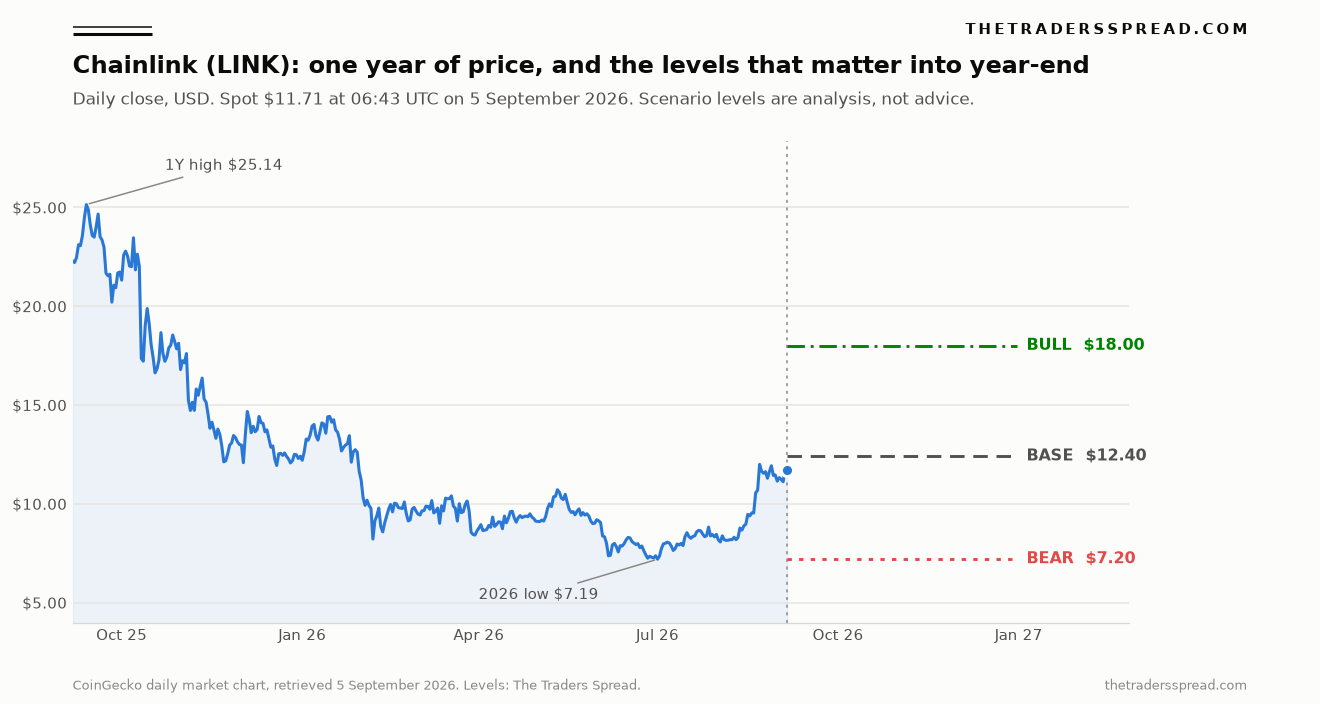
LINK spent nine months doing one thing: falling in steps. From the 13 September 2025 high of $25.14 it gave up ground through every rally attempt, bottoming at $7.19 on 1 July 2026. That is a 71.4% drawdown inside a single year, and it leaves spot 77.8% below the all-time high of $52.70 set on 9 May 2021.
Then the shape changed. Thirty-day realised volatility, annualised from daily log returns, ran at 67.9% into 5 September against 53.8% over ninety days. Volatility rising while price rises is the signature of a positioning unwind rather than a slow re-rating, and the 43.0% thirty-day gain came off a base where the ninety-day average price was $8.81. Spot now sits 33% above that average. The pattern rhymes with what we saw on Hyperliquid (HYPE) over the same weeks, and it tends to give back more than half of the move when the flow stops.
| Scenario | Level | From spot | Implied market cap | What it requires |
|---|---|---|---|---|
| Bull | $18.00 | +53.6% | $13.5bn | A visible step-change in reserve accumulation plus the listed US funds scaling several-fold |
| Base | $12.40 | +5.8% | $9.3bn | Adoption headlines continue, float keeps expanding, nothing breaks |
| Bear | $7.20 | -38.5% | $5.4bn | A full retrace to the 1 July low as the August bid exhausts |
Turnover is a check on how much of this is real. LINK traded $425.7m in the twenty-four hours to 06:43 UTC on 5 September against an $8.76bn market capitalisation, a rate of 4.86%. Active, not frenzied.
The counterparty view
Every price has a seller. Ours is not a sceptic about the technology.
The seller starts with revenue, because Chainlink does not publish any. Galaxy Research did the arithmetic instead. In Far Beyond Price Feeds: What Chainlink Actually Does Today, published 8 December 2025, Christopher Rosa, Vice President at Galaxy Research, decomposed cumulative recorded oracle rewards since 2019 and found $410.2m in total: roughly $399.2m from price feeds, $6.3m from VRF, $2.6m from Automation and $2.1m from CCIP. Ninety-seven per cent of everything the network has ever earned came from delivering price data. CCIP, the product carrying every institutional headline in this article, has produced about $2.1m across its entire life. Set that beside the $34,177,623,388,199 of cumulative transaction value Chainlink's front page claims to have enabled, retrieved 5 September 2026, and the difference between notional and revenue stops being a pedantic distinction.
RelatedRender (RENDER) Price Prediction: $3.10 Bull vs $1.40 Bear
The seller's second point is that the moat is self-measured, and Rosa is careful about where the argument thins. "The security story depends on fee growth and on staking that is meaningfully slashable and widely used," he wrote, and separately that "Chainlink does not lead the cross-chain sector today by headline metrics such as cumulative messages or cumulative transfer volume." Chainlink's own figures point elsewhere. The 7 August 2025 Reserve announcement put its share of oracle solutions at 67.77% and its Ethereum share at 83.67%, alongside more than $80bn in total value secured. Those are company numbers and thirteen months old. Its cross-chain page, retrieved 5 September 2026, claims 80-plus blockchains and more than 50m CCIP-enabled wallets, naming ANZ, Swift, UBS Asset Management, SBI Digital Markets and ADDX. Wallet counts are not fees, and on Galaxy's count those wallets have produced $2.1m.
What the seller does not have is a story about the technology failing. That is why the bear case resolves to $7.20 rather than something catastrophic: a valuation event, not a solvency event.
The call: base $12.40, bull $18.00, bear $7.20
Base case, $12.40 by 31 December 2026, 45%. The boring path, and the most likely one. Integrations keep arriving at the current cadence, the reserve keeps accumulating near its 446,000-a-month average, and the non-circulating balance keeps releasing tokens at a similar pace. LINK then holds the ground it took in August and grinds sideways in a $10 to $14 band, because the marginal buyer and the marginal seller are both about the size they are now.
Bull case, $18.00, 25%. Two things have to change together and neither alone is enough. The reserve's accumulation rate has to step up visibly, which means Chainlink converting materially more enterprise revenue into LINK each month than it managed in its first year. And the ETF channel has to scale by roughly an order of magnitude, from $92.1m across CLNK and GLNK towards the $1.06bn that Solana (SOL) vehicles had gathered. A licensing arrangement in which a major venue pays for Chainlink data in LINK rather than in dollars would do the same job. At $18 LINK carries a $13.5bn market capitalisation, still 28% below its September 2025 high of $25.14.
Bear case, $7.20, 30%. The August rally retraces in full to the 1 July low. The mechanism is unglamorous. A positioning unwind ends, the float keeps growing by roughly 70m tokens a year, and the reserve's $67.6m of accumulated LINK proves too small to matter against $820m of fresh supply at current prices.
What would change my mind. A raise in the 45m-token staking cap with visible take-up would break the capped-sink argument and pull the base case higher. So would a doubling of combined CLNK and GLNK assets in one quarterly filing. In the other direction, a fifth treasury release on the scale of June's 21m while the reserve adds under 1m LINK would tell me the capture problem is widening, and the bear probability should rise.
Frequently asked questions
What is the Chainlink Reserve and does it actually buy LINK?
It is a strategic on-chain reserve announced on 7 August 2025, funded by converting Chainlink's enterprise revenue and on-chain service payments into LINK through Payment Abstraction plus half of Smart Value Recapture fees. Its Ethereum address held 5,770,818.04 LINK on 5 September 2026. The reserve is not on Chainlink's published non-circulating wallet list, so those tokens still sit inside reported circulating supply.
Why is LINK down 48% over a year when adoption keeps growing?
Because adoption and token capture are separate variables. Galaxy Research puts cumulative Chainlink oracle rewards since 2019 at $410.2m, with about $2.1m of that from CCIP. Seven years of network revenue is a fraction of the token's $8.76bn market capitalisation, the reserve that converts revenue into LINK holds $67.6m, and circulating supply still grew 10.33% over the last twelve months.
How much LINK is staked, and can that number grow?
42,604,947 LINK, or 5.70% of circulating supply, split between a community pool completely full at its 40,875,000 cap and an operator pool 41.9% subscribed against a 4,125,000 cap. Total capacity is 45m tokens. The community pool cannot admit another staker until somebody exits or the cap is raised, so staking growth is a governance decision, not a market one.
What would make the $18 bull case real rather than hopeful?
A step-change in the pace at which network revenue converts into LINK, sustained for a quarter or more, plus the two listed US funds growing well beyond the $92.1m of combined assets they reported for 30 June 2026. Both are visible on-chain or in a quarterly filing rather than in a press release. Without that, $18 needs a general risk-on move across digital assets to do the work, which is a different proposition than a bet on Chainlink.
How does LINK compare with the other large-cap altcoins we cover?
It sits closer to Hedera (HBAR) than to Cardano (ADA): an enterprise-integration story whose token linkage stays indirect. It differs from Ethereum (ETH), where treasury buyers removed measurable supply, and from Bitcoin (BTC), where the supply schedule is fixed and public.
This article is analysis and information, not investment advice. Digital assets are volatile and your capital is at risk. Price levels, probabilities and scenarios are the author's assessment on the data available at the time of writing and may be wrong. Do your own research before making any financial decision.