

Being 87% below a price printed in a different cycle is not a thesis. Hedera (HBAR) changed hands at $0.074802 on 29 August 2026, some 86.9% under the $0.569229 it touched on 15 September 2021, and almost every HBAR price prediction published this year leans on that gap as though a five-year-old high were a gravitational field. It is not. The distance to 2021 tells you what a different set of buyers once paid; it says nothing about who is bidding now, what the network earns, or how many coins the treasury still has to sell. This piece throws the 2021 anchor away and rebuilds the case from three live sources: the Hedera public mirror node, the Canary HBAR ETF's own filings with the US Securities and Exchange Commission, and the CoinGecko price series pulled in this session.
Here is the thing nobody is saying. The only US spot HBAR fund, the Canary HBAR ETF (Nasdaq: HBR), increased its coin holdings by 40.1% in the first half of 2026 — from 473,456,805 HBAR at 31 December 2025 to 663,209,584 HBAR at 30 June 2026 — while posting a total return at net asset value of −35.21% over the same six months. Shares outstanding rose from 3,460,000 to 4,870,000. American investors were buying into the decline at scale. And on 9 June 2026 the trust quietly amended its governing document so that every staking reward those coins generate is paid to the sponsor as extra compensation and is excluded from net asset value entirely. Set that against a network that, on our own measurement of the mirror node this morning, collected roughly 2,310 HBAR — about $173 — in total transaction fees across a full day. A $3.28bn asset, a fund accumulating it hand over fist, and a fee base you could cover with a used car.
Key facts
- HBAR spot $0.074802, market cap $3.279bn, rank 28, 24-hour volume $78.9m — CoinGecko, pulled 10:38 UTC on 29 August 2026.
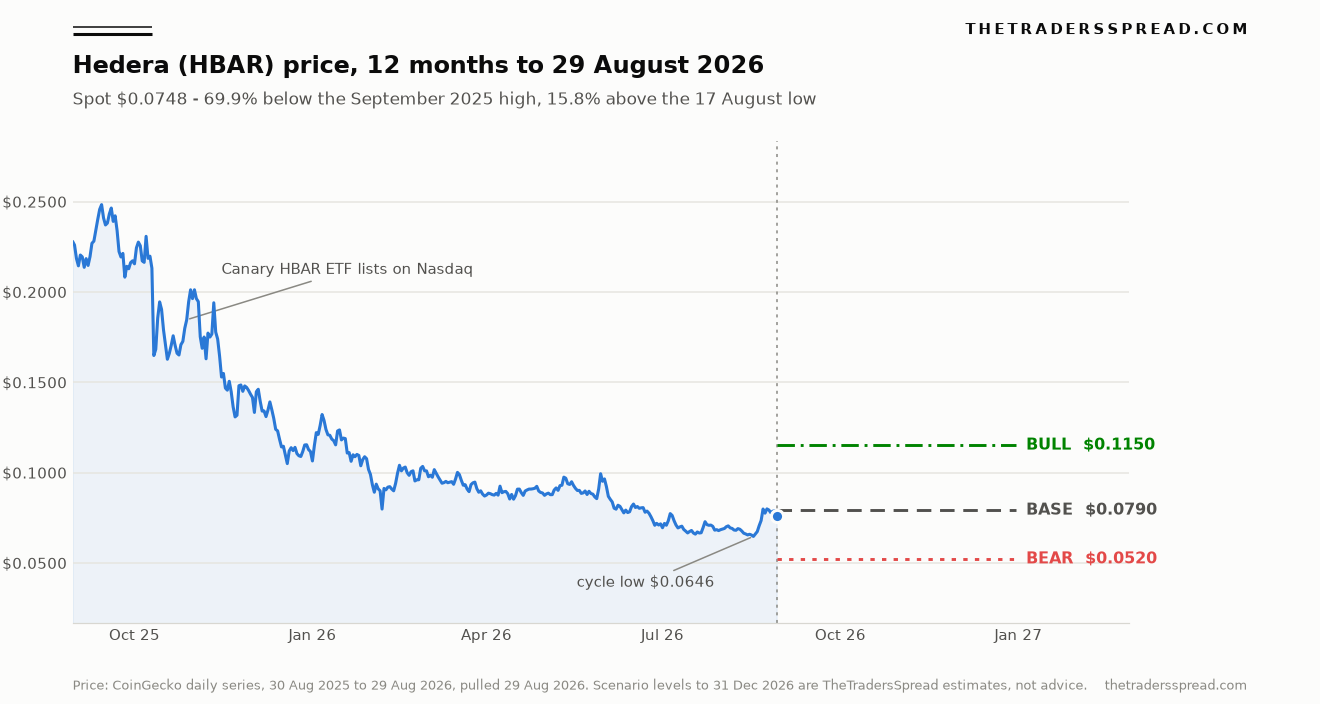
- Down 67.1% over 12 months and 29.7% year-to-date; 15.8% above the 17 August 2026 cycle low of $0.06461 and 69.9% below the 14 September 2025 high of $0.24828 — CoinGecko daily series, 29 August 2026.
- Canary HBAR ETF held 663,209,584 HBAR worth $46,157,486 at 30 June 2026 against a cost basis of $105,908,469 — an average of $0.1597 a coin, 53.2% above spot — SEC Form 10-Q filed 7 August 2026.
- Measured throughput on 29 August 2026: 2.5 to 2.6 transactions per second, roughly 217,000–228,000 a day, of which about 77% were plain transfers and 15% were consensus-service messages — TheTradersSpread measurement, Hedera public mirror node.
- Total DeFi value locked on Hedera: $26.50m, against a $3.279bn market capitalisation — a 124× ratio — DefiLlama, 29 August 2026.
- 6.17bn HBAR (12.3% of the 50bn maximum) has still not been released from the treasury; circulating supply grew 3.33% in the last 12 months — Hedera mirror node and CoinGecko, 29 August 2026.
- 34 organisations sit on the Hedera Governing Council, including Google, IBM, Dell, Deutsche Telekom, FedEx, LSE, Nomura and Standard Bank — hederacouncil.org, 29 August 2026.
The council is the product, and that cuts both ways
Hedera is not a permissionless chain in the way Ethereum or Solana are. Consensus nodes are run by members of the Hedera Governing Council, and as of 29 August 2026 that council listed 34 named organisations on hederacouncil.org: Aberdeen, Accenture, Arrow, Australian Payments Plus, Avery Dennison, BitGo, Blockchain For Energy, Chainlink Labs, Dell, Dentons, Deutsche Telekom, DLA Piper, EDF, FedEx, Google, Hitachi, IBM, IIT Madras, LG, LSE, Magalu, McLaren Racing, Mondelēz, NSE, Nomura, Repsol, ServiceNow, Shinhan Bank, Standard Bank, Swirlds, Tata Communications, Ubisoft, Wipro and Zain.
That roster is the single most-cited reason to own the token, and it is genuinely unusual. No other layer-1 can put two global law firms, a national stock exchange operator, a Japanese conglomerate and a Formula One team on the same governance sheet. The council's stated design is that "with equal voting rights and term limits for Council members, this structure ensures that no single entity can control the decision-making process."
The cost of that design is the mirror image of its benefit. A network governed by 34 corporations with legal departments is a network that will not host anonymous leverage, unlicensed perpetuals or the kind of reflexive on-chain casino that generated most of the fee revenue on competing chains between 2023 and 2026. That is a defensible strategic choice. It is also why Hedera's on-chain economics look nothing like those of the chains it is priced alongside, a divergence we flagged when looking at yield-bearing token models in our Ethena (ENA) analysis. Enterprise credibility does not convert into transaction fees, and transaction fees are what a token with a fixed 50bn supply has to monetise.
Hedera prices its services in dollars rather than in coin — the network's own documentation puts the floor at "$0.0001" per transaction, "automatically converted to HBAR at the time of each transaction, so your costs stay predictable regardless of HBAR's market price." Predictability for the enterprise customer is, mechanically, the removal of the fee-pressure channel that would otherwise transmit adoption into token value. If usage doubles, dollar fees double; the HBAR cost per transaction halves as the price rises. The design deliberately breaks the reflexive loop that other layer-1 valuations depend on.
The ETF bought 40% more coins and lost a third of its value
The Canary HBAR ETF listed on Nasdaq on 28 October 2025, when HBAR traded at $0.1846. The coin is 59.5% lower today. That alone should retire the idea that a spot listing is a catalyst rather than a distribution channel, and it echoes what we found tracking fund assets in the Solana ETF complex, where assets and price have moved on very different clocks.
The trust's Form 10-Q for the period ended 30 June 2026, filed on 7 August 2026, is unusually revealing. Net assets fell from $50,568,813 at 31 December 2025 to $46,117,098 at 30 June 2026. Net asset value per share ended the period at $9.47, with total return at NAV of −20.99% for the quarter and −35.21% for the six months. Sponsor fees of $253,789 were incurred over the half.
Yet the coin count went up. Holdings rose 40.1% to 663,209,584 HBAR and shares outstanding rose 40.8% to 4,870,000, then to 5,180,000 by 29 July 2026. Creations continued through a 35% drawdown. The cost base tells the story of who did that buying: $105,908,469 for coins worth $46,157,486 at period end, an average entry of $0.1597 against $0.074802 spot. The marginal US institutional holder of HBAR is 53.2% underwater on cost.
The structural detail matters more than the flow. In an 8-K filed on 12 June 2026, the trust disclosed a Second Amended and Restated Trust Agreement dated 9 June 2026. The 10-Q restates its effect plainly: "The Second A/R Trust Agreement authorizes the Trust to participate in a staking program. All staking rewards are paid to the Sponsor as additional compensation and are not included in the Trust's NAV." The sponsor also has "sole authority to direct and manage all aspects of any staking program."
Stack the drags. The Sponsor Fee is "an annual unified fee of 0.95% of the Trust's HBAR Holdings", accruing daily in HBAR — so the shareholder's claim on coins shrinks every day. On top of that, any staking yield the trust earns is assigned away. Hedera's mirror node caps the staking reward rate at 5,237 tinybars per HBAR per day, which annualises to 1.91%. A shareholder in HBR therefore gives up as much as 2.86 percentage points a year against holding the coin directly. HBR closed at $10.3799 on 28 August 2026 with a 52-week range of $8.851 to $28.92 and $57.23m in assets at a 0.95% expense ratio.
HBAR price prediction: what the on-chain data actually supports
We measured the network ourselves rather than quoting a dashboard. Two independent 600-transaction samples taken from the Hedera public mirror node on 29 August 2026 by walking consecutive consensus timestamps returned 2.52 and 2.51 transactions per second. A separate closed 60-second window, counted exhaustively, returned 158 transactions — 2.63 per second. Call it 217,000 to 228,000 transactions a day.
The composition is the surprise. Across 1,200 sampled transactions, roughly 77% were ordinary CRYPTOTRANSFER operations, about 15% were CONSENSUSSUBMITMESSAGE calls to the Hedera Consensus Service, 4% were Ethereum-compatible transactions and under 2% were smart-contract calls. The enterprise audit-trail workload that anchors the Hedera pitch is a sixth of throughput. The mean charged fee across those samples was 0.0106 HBAR, which implies network-wide fee revenue of roughly 2,310 HBAR a day — about $173 at spot, or $63,000 annualised.
Put the three independent datasets side by side and the picture sharpens. Hedera is capitalised at $3.279bn. DefiLlama records $26.50m of value locked across 24 protocols on the chain, the largest being SaucerSwap's two versions at a combined $18.35m and Bonzo Lend at $4.09m, plus $30.60m of dollar-pegged stablecoins. That is a market-cap-to-TVL ratio of about 124×.
| Metric | Value | Source and date |
|---|---|---|
| Market capitalisation | $3.279bn | CoinGecko, 29 Aug 2026 |
| DeFi value locked on chain | $26.50m | DefiLlama, 29 Aug 2026 |
| Stablecoins on chain (USD-pegged) | $30.60m | DefiLlama, 29 Aug 2026 |
| Measured transactions per day | ~217,000–228,000 | TheTradersSpread, mirror node, 29 Aug 2026 |
| Implied network fee revenue | ~2,310 HBAR/day (~$173) | TheTradersSpread, mirror node, 29 Aug 2026 |
| Coins held by the only US spot ETF | 663,209,584 HBAR | SEC Form 10-Q, 30 Jun 2026 |
| Coins staked | 11.35bn (25.9% of float) | Hedera mirror node, 29 Aug 2026 |
None of that makes HBAR uninvestable — plenty of large tokens have negligible fee revenue. It does mean the valuation is a claim on future enterprise adoption converting into on-chain settlement, not a multiple of anything the network currently earns. Anyone building an HBAR price prediction off "cheap versus 2021" is pricing a memory. The honest version prices an option on the council's pipeline, and options with no current cash flow are priced by sentiment and float — which is exactly what the chart shows.
Supply, staking and the regulatory frame
The float is the underrated risk. Circulating supply stands at 43,831,559,709 HBAR against a hard maximum of 50bn, leaving 6.17bn coins — 12.3% of the total — still undistributed. Deriving supply from CoinGecko's market-cap and price series shows the float grew by roughly 1.41bn coins over the past 12 months, an increase of 3.33%. At spot that is about $106m of new supply reaching the market annually, against $78.9m of daily volume. It is absorbable, but it is a persistent headwind that Bitcoin-style scarcity narratives simply do not apply here.
Staking adds a second, smaller stream. The mirror node's network stake endpoint reports 11,350,367,233 HBAR staked — 25.9% of the float — with rewarded stake capped at 6.5bn coins and a current reward rate of 44,516,742,006,833 tinybars per staking period, or 445,167 HBAR a day. Annualised, that is 162.5m new coins, 0.37% of circulating supply. Modest, but additive to treasury releases, and, per the filings above, entirely captured by the sponsor in the ETF wrapper rather than passed to fund holders.
On the regulatory side, the structure is already settled in a way that most altcoins' is not. The trust is registered with the SEC, its shares trade on the Nasdaq Stock Market LLC under file number 001-42918, and it files 10-Qs and 10-Ks like any other issuer. That removes the binary listing risk that hangs over tokens still waiting on an exchange rule filing. What it does not remove is the treatment question the trust itself flags: the 10-Q notes that "due to the uncertain treatment of digital assets, with respect to staking and including forks, airdrops and similar occurrences for U.S. federal income tax purposes, there can be no assurance" that the trust retains grantor-trust classification. A reclassification would change the tax character of every share.
The council's own governance is the other structural variable. Term limits mean membership rotates by design; a high-profile departure would read as a verdict on the enterprise thesis in a way that a departure from a permissionless chain's ecosystem never could. That asymmetry — where the strongest bull argument is also the most concentrated headline risk — is unique to Hedera among the top thirty tokens. Traders tracking the wider desk view can follow it on our markets hub.
The call: base $0.079, bull $0.115, bear $0.052
Spot is $0.074802. The 30-day mean is $0.07104, the 90-day mean $0.07322 and the 200-day mean $0.08398, so price is sitting just above its short-term averages and below its longer one — a market that has stopped falling without yet establishing that it has turned. Our horizon for these levels is 31 December 2026.
Base case — $0.079, 5.6% above spot. Probability roughly 45%. HBAR holds the shelf it built between 22 and 28 August, when it closed between $0.0788 and $0.0798, and drifts sideways into year end. This is what happens if ETF creations continue at the H1 pace, treasury releases stay near 3% a year, and the council announces nothing that changes the enterprise pipeline. The 90-day mean sits 2.2% below this level, which is why it is the path of least resistance rather than a target requiring a catalyst.
RelatedCosmos (ATOM) Price Prediction: $2.44 Bull vs $1.40 Bear
Bull case — $0.115, 53.7% above spot. Probability roughly 25%. This is a full round trip through the 5 March 2026 high of $0.1016 and then some, while still finishing 13% below the 6 January 2026 high of $0.1321. It requires the fee and TVL base to start moving — the DefiLlama TVL series going from $26.5m towards the $75m–$100m range would do it — or a council announcement that converts a named member's production workload onto the Hedera Consensus Service at volume. Watch the CONSENSUSSUBMITMESSAGE share of throughput: if it climbs from 15% towards 40% or more, the enterprise story is finally showing up in the mempool.
Bear case — $0.052, 30.5% below spot. Probability roughly 30%. A clean break of the 17 August low at $0.06461 and a further 20% flush. The mechanism is straightforward: ETF creations stop or reverse, the average holder sitting 53% below a $0.1597 cost base capitulates, and 6.17bn treasury coins overhang a market clearing $78.9m a day. At $0.052 the market capitalisation would be about $2.28bn — still 86× the current on-chain TVL, which is the uncomfortable point about downside in an asset with no earnings floor.
What would change our mind. On the upside: a sustained move in measured network fee revenue from roughly $173 a day into the thousands, or a Canary HBAR ETF 10-Q showing coin holdings above 1bn HBAR. On the downside: a council departure among the top-tier names, a treasury release schedule that accelerates beyond 5% annual float growth, or DefiLlama TVL falling below $15m. Each is observable, dated and public, and each can be checked without a subscription — the definitions we use for these terms are set out in our trading glossary.
FAQ
What is the HBAR price prediction for the end of 2026?
Our base case is $0.079 by 31 December 2026, 5.6% above the $0.074802 spot recorded on 29 August 2026, with a $0.115 bull case and a $0.052 bear case. The distribution is skewed: the bull requires a visible change in network usage, while the bear requires only that current flows stop.
Why is HBAR still 87% below its 2021 all-time high?
The $0.569229 high of 15 September 2021 was set in a cycle with different buyers and a much smaller float. Circulating supply has since grown to 43.83bn coins and the network's measured fee revenue is roughly $173 a day. The gap to 2021 reflects a change in who is bidding, not a discount waiting to be closed.
Does the Canary HBAR ETF pay staking rewards to shareholders?
No. Under the Second Amended and Restated Trust Agreement dated 9 June 2026, all staking rewards are paid to the sponsor as additional compensation and are excluded from the trust's net asset value. That sits on top of the 0.95% annual Sponsor Fee, which accrues daily in HBAR.
How many members does the Hedera Governing Council have?
Thirty-four organisations were listed on hederacouncil.org on 29 August 2026, among them Google, IBM, Dell, Deutsche Telekom, FedEx, LSE, Nomura, Standard Bank, Chainlink Labs and Ubisoft. Members hold equal voting rights and serve under term limits, so the roster rotates by design.
How much HBAR is still held by the treasury?
The mirror node reported 43,831,559,709 HBAR released of a 50bn maximum on 29 August 2026, leaving about 6.17bn coins — 12.3% of the total — undistributed. Float grew 3.33% over the preceding 12 months.
Is Hedera's transaction throughput really 10,000 per second?
That is a capacity figure, not a usage figure. Measuring consecutive transactions on the public mirror node on 29 August 2026 returned 2.5 to 2.6 transactions per second, or roughly 217,000 to 228,000 a day. Capacity headroom is real; current demand is not using it.
Disclaimer
This article is analysis and information only. It is not investment advice, a recommendation, or an offer to buy or sell any asset, and it does not take account of any reader's circumstances. Cryptocurrency prices are volatile and capital is at risk. Every figure is sourced and dated at the time of writing on 29 August 2026; prices and on-chain metrics change continuously. Readers should carry out their own research and consider taking independent professional advice.