

Jupiter (JUP) price did not close 8 October up 16.7%. Crypto Times reported at about 10:30 UTC that the token had risen 16.7% in 24 hours to $0.3775, with Solana down. Binance's JUPUSDT candle opened at $0.3589, hit $0.3881 in the 07:00 UTC hour, fell to $0.3286 in the 18:00 hour, and closed at $0.3361. That is 6.38% below the 7 October close of $0.3590. The $0.3775 print is only 5.15% above that prior close, so a 16.7% change was not measured from it. The base that produces 16.7% is about $0.3235, inside the prior day's range, whose low was $0.3125. The closing price gave the spike back.
The same candle took $18.10 million of Binance spot quote volume, the heaviest since 6 September, while the fee mix left the spot aggregator. DefiLlama recorded aggregator fees of $78,423, down from $110,916, and perpetual-exchange fees of $611,597, up from $291,899. Solana's own close fell 5.74% to $109.62. The token finished slightly weaker than the chain, not above it.
Key facts
- JUPUSDT closed 8 October at $0.3361, down 6.38% from the 7 October close of $0.3590. Source: Binance daily kline, 8 October 2026.
- Session high $0.3881, low $0.3286. The close finished 13.40% under the high. Source: Binance JUPUSDT daily kline, 8 October 2026.
- Spot quote volume was $18,097,976 across 172,152 trades, versus $9,286,358 and 76,738 trades on 7 October. Source: Binance daily klines, 7 and 8 October 2026.
- In the 24 hours to 06:42 UTC on 9 October, price went from $0.3752 to $0.3607, down 3.87%. Source: Binance 24-hour ticker, 9 October 2026.
- SOLUSDT closed at $109.62, down 5.74%. BTCUSDT closed at $81,754.45, down 1.88%. Source: Binance daily klines, 8 October 2026.
- DefiLlama Jupiter fees were $825,851 on 8 October versus $552,362 on 7 October. Aggregator fees were $78,423 of the later day. Source: DefiLlama fees API, retrieved 9 October 2026.
- The last posted Jupiter Aggregator volume day was 7 October, at $510.6 million. No 8 October bar was in the series. Source: DefiLlama aggregator API, retrieved 9 October 2026.
The session, hour by hour
The daily candlestick is a round trip. From the $0.3589 open to the $0.3881 high the tape gained 8.14%. From that high to the $0.3361 close it gave back 13.40%. From the high to the $0.3286 low the drop was 15.33%. The close finished 2.28% off the low. Marking the day off the morning print meant marking the spike.
The high did not stick inside its own hour. The 07:00 UTC hour opened at $0.3792, tagged $0.3881, and closed at $0.3797. The air came out in the afternoon. The 15:00 UTC hour traded about 4.93 million JUP and closed at $0.3476. The 16:00 hour traded about 4.12 million JUP and closed at $0.3422. The low printed in the 18:00 hour, which closed back at $0.3452. The 23:00 hour closed at $0.3361, the daily close. Four hours of selling, not a one-minute wick.
Daily closes only. The $0.3881 high is not on this line.
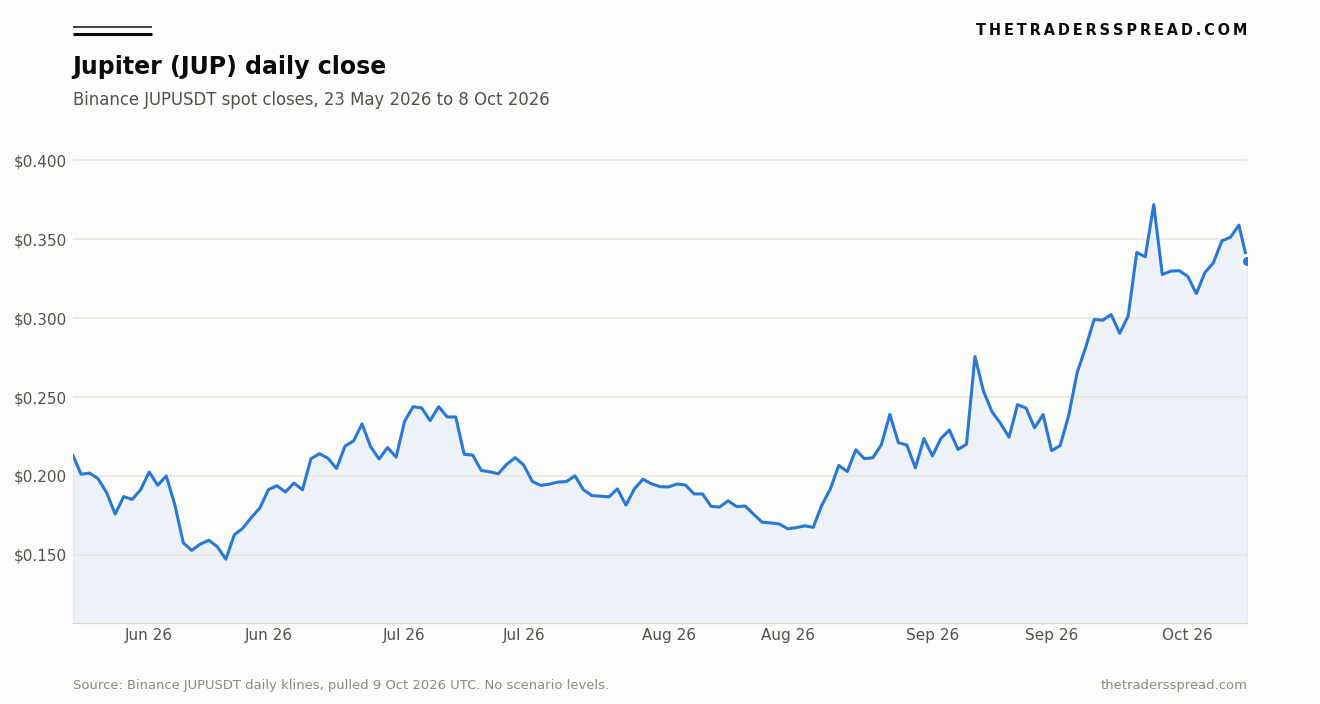
Turnover is why the morning story traveled. At $18,097,976, 8 October was the second-heaviest Binance spot day back to 23 May 2026. Only 6 September was larger, at $18,989,307, and that session closed up 25.3%. Trade count jumped from 76,738 to 172,152. Token volume was 50.02 million JUP against 28.17 million. This was not a thin print.
| Market | 7 Oct close | 8 Oct close | Change | 8 Oct high | 8 Oct low |
|---|---|---|---|---|---|
| JUPUSDT | $0.3590 | $0.3361 | -6.38% | $0.3881 | $0.3286 |
| SOLUSDT | $116.30 | $109.62 | -5.74% | $116.81 | $105.71 |
| BTCUSDT | $83,321.81 | $81,754.45 | -1.88% | $83,521.15 | $80,393.56 |
Source: Binance spot daily klines, 7 and 8 October 2026. JUP quote volume those days was $9,286,358 and $18,097,976.
By 06:42 UTC on 9 October the last trade was $0.3607, which is 7.32% above the close and still 3.87% below the $0.3752 price of 24 hours earlier. A green screen on the morning of the 9th is a bounce inside a window that is still down. The close does not move. The rolling window does. The headline uses the close.
Jupiter (JUP) price and the 10:30 UTC print
Crypto Times had price in the right neighborhood for 10:30 UTC. The 09:00 hour traded up to $0.3866, and the 10:00 hour was still near $0.379. A live reading of $0.3775 can be accurate. It is not the session once the candle is finished, and the outlet framed it as why the price was up on the day.
Two bases, two stories. From the 7 October close of $0.3590 to $0.3775 is +5.15%. From about $0.3235 to $0.3775 is +16.7%. The prior session ranged from $0.3125 to $0.3604, so $0.3235 sits in the lower half of that day. A rolling change taken at 10:30 UTC on the 8th reaches back into the dip and counts the climb out as the whole day. From $0.3775 to the $0.3361 close is another 10.97% given back.
The week and the month split the same way. From the 1 October close of $0.3265 to the 8 October close of $0.3361, Jupiter (JUP) price is up 2.94%. The morning print is 15.62% above that 1 October close, which is how a "15% week" appears if you stop at 10:30 UTC. From the 8 September close of $0.2407 to the 8 October close, the gain is 39.63%. The same September close to $0.3775 is 56.83%. This desk measured Binance closes, not a vendor's rolling window. On that measure the month is still a large gain. It is not a 50% gain, and the day is a loss.
Solana's snapshot aged with it. A $114.88 reading fits inside the 8 October range of $105.71 to $116.81. The close was $109.62, down 5.74% from $116.30. Bitcoin closed at $81,754.45, down 1.88% from $83,321.81. JUP fell a little more than SOL and much more than BTC. It did not decouple upward. Wide up-days on the chain token are a separate file: the 27 August Solana note covers one of them.
A 24-hour statistic stays honest when the window is named and left named, which is the method in the LayerZero tape note from 6 October. It stops describing the day when a later close erases it. Full-session rises do happen. Numeraire posted one on 7 October. This JUP candle, on heavier spot turnover than the day before, went the other way.
Fees left the spot aggregator
Price is not the book. A down day asks whether the Solana spot router shrank with the token, or whether the token just marked Solana's session with a wider wick. The fee file and the volume file answer different halves, and only one of them has an 8 October bar.
Total Jupiter fees on 8 October were $825,851, up 49.5% from $552,362. Inside that rise the spot aggregator went the other way. Aggregator fees were $78,423, down 29.3% from $110,916, and 9.5% of the day's fees against 20.1% a day earlier. Perpetual-exchange fees were $611,597, up 109.5% from $291,899, and 74.1% of the total against 52.8% before. The fee dollar moved to the perp venue. Figures are from DefiLlama's fees endpoint, retrieved 9 October 2026, under that adapter's labels.
Jupiter Lend fees printed $30,250 after $139,273, a 78.3% drop, following several days near $130,000. A break that clean can be activity or an adapter timing quirk. Until the next posted day repeats it, it is a recorded print, not proof that deposits left.
Aggregator volume stops a day earlier. On the aggregator endpoint, Jupiter's last bar was 7 October at $510.6 million. DFlow's 7 October bar was $257.9 million and Titan's was $47.8 million. Of those three, Jupiter was 62.6%. DFlow does have 8 October, at $289.0 million, up 12.1% from its own prior day. Jupiter's 8 October bar was absent at retrieval, and so was Titan's. The trailing 30-day Jupiter Aggregator total was $14.28 billion, and its last daily bar is 7 October, not the down day.
Share cannot be scored until that bar lands.
DefiLlama's Jupiter protocol page, same morning, showed about $1.94 billion of Solana TVL and about $1.15 billion marked borrowed. That is a stock of deposits, not the day's routing flow, and it does not fill in the missing volume bar.
The fee-versus-price tension already has a name on it. In a 3 January 2026 Cryptopolitan report, Jupiter co-founder Siong Ong wrote on X: "We spent more than 70m on buyback last year and the price obviously didn't move much. We can use the 70m to give out growth incentives for existing and new users. Should we do it?" The $70 million is his figure, as reported. This desk did not re-audit the 2025 repurchase wallet. The sentence matters because 8 October rhymes with it: recorded fees rose, and the token fell.
He was reacting to a different protocol, not announcing a Jupiter vote. Amir Haleem, chief executive and co-founder of Nova Labs, the company behind Helium, had written that his team would stop directing cash at repurchases. "We will be directing all our $ into those endeavors until morale improves, and data credits will continue to be burned for all carrier offload as always." Cryptopolitan reported both posts. Haleem was talking about Helium's subscribers, not about JUP. Ong treated that choice as the question in front of his own token. A single down day with a fatter perp-fee line does not answer it.
Perps, funding, and the chain tape
Binance's perp book was busy without a funding extreme. Over the 24 hours to 06:42 UTC on 9 October, the JUPUSDT perpetual went from $0.3743 to $0.3602, down 3.77%, high $0.3880, low $0.3281. Quote turnover was $97.20 million. Spot quote turnover in the matching window was $14.46 million, so perp quote volume was 6.72 times spot on this venue and this clock. It is not a global ratio, and it is not whatever a 10:30 UTC snapshot would have shown.
Open interest rose in tokens while price sat under the spike. The daily history shows 54.31 million JUP on 8 October, valued then at $19.47 million. At 06:42 UTC on 9 October the live endpoint showed 60.00 million JUP, about $21.64 million at the $0.3607 spot print. That is 10.5% more coins than the prior snapshot, not a surge in dollar exposure, because the coin was cheaper than the high those positions faced. More contracts. A smaller price. Not a side to take.
Funding stayed tiny and changed sign. At 20:00 UTC on 8 October the settled rate was +0.00500%, mark $0.3360. At 00:00 UTC on 9 October it was -0.00228%, mark $0.3359. At 04:00 it was +0.00411%, mark $0.3495. The live reading at 06:42 was -0.00313%. These are fractions of a basis point. Neither side was paying a stress premium. A claim that positive funding proved a healthy rally was reading a number too small to carry the sentence, and reading it before the close.
The chain did the broader work. SOL's 5.74% down close came on $389.8 million of Binance quote volume, with its own wide range from $116.81 to $105.71. BTC's 1.88% down close was the quieter tape. JUP's extra bit versus SOL is real, and so is the round trip. Jupiter trades as a high-beta claim on Solana activity, plus whatever the perp book is doing that hour. By the close, both were pointed down, and the protocol's fee dollar had gone to perps.
RelatedLayerZero (ZRO) Rises 10.88% to $2.109 in 24 Hours
Supply, rank, and fully diluted value from the morning headline are not repeated here. Circulating supply was not verified from a primary source in this session, so market cap stays out. Global liquidation totals stay out for the same reason. The Binance candles, the Binance perp endpoints, and the DefiLlama bars are the set.
What this changes
The move does not say the Solana spot aggregator lost its book. The close fell, the router fee line fell, and the volume bar that would prove a share shift is missing. Jupiter's last aggregator day on file is 7 October, at $510.6 million, 62.6% of the Jupiter, DFlow, and Titan trio. DFlow rose to $289.0 million on 8 October. A Jupiter bar well under $510.6 million would line the down day up with a smaller routing day. A bar near or above that print would mean the token fell while the router held. Spot fees fell either way.
A second Binance daily close under $0.3361, with spot quote volume still near $18.1 million rather than back at $9.3 million, would confirm the price decline. A later daily close back above the 8 October open of $0.3589 would fade it. That open already printed. It is not a target, and this piece does not set one. JUP and SOL fell together on 8 October. A second leg that SOL does not share would be the idiosyncratic confirm. A joint bounce would just be the chain.
For the router, damage is an 8 October aggregator bar materially under $510.6 million with fees staying below $110,916. The concern fades if volume lands near that prior bar and fees climb from $78,423 back toward $110,916. The lend print of $30,250 either repeats or snaps back. Perp fees of $611,597 show where the protocol dollar went. They do not retire the router, and they do not settle Ong's January question on repurchases versus user incentives. Higher fees with a lower token are the pattern he described. One session does not choose.
The 16.7% gain was a rolling window into a spike, not a new regime. The day closed down 6.38% on the second-heaviest Binance spot turnover since May, with funding near zero. Close to close from 8 September, the month is still up 39.63%. Treating the spike as the result was the mistake. Calling the down close the end of that month would be the next one.
Questions the tape actually answers
Did Jupiter (JUP) price rise 16.7% on 8 October?
No. Crypto Times reported a 16.7% rise to $0.3775 at about 10:30 UTC, and Binance hourly candles were in that area. The daily candle closed at $0.3361, down 6.38% from the 7 October close of $0.3590. That morning print was only 5.15% above the prior close. A 16.7% change needs a base near $0.3235, inside the prior day's range. The close gave the spike back.
Where did the high and the low print?
The high of $0.3881 printed in the 07:00 UTC hour, which closed back at $0.3797. The low of $0.3286 printed in the 18:00 hour. From high to low was 15.33%, and the close at $0.3361 sat 13.40% under the high. The heaviest hours in the slide were about 4.93 million JUP at 15:00 UTC and 4.12 million at 16:00 UTC, before the low printed.
How did Solana and Bitcoin finish?
SOLUSDT closed at $109.62, down 5.74% from $116.30, after a low at $105.71. BTCUSDT closed at $81,754.45, down 1.88% from $83,321.81. JUP's 6.38% drop was a bit larger than Solana's and much larger than Bitcoin's. The morning line that Jupiter was rising while Solana fell did not survive either close. Both finished the day down.
Did the spot aggregator lose volume on 8 October?
Not on evidence posted by the morning of 9 October. DefiLlama's last Jupiter Aggregator day was 7 October, at $510.6 million. The 8 October bar was absent. DFlow's 8 October bar was in, at $289.0 million, up from its own prior day. Aggregator fees, which were posted, fell to $78,423 from $110,916. Share has to wait for the missing bar.
What would confirm the decline, or fade it?
A second Binance daily close under $0.3361, on heavy spot quote volume, would confirm the price drop. A later daily close back above the 8 October open of $0.3589 would fade it. For the router, an aggregator volume print well under $510.6 million would confirm a softer spot book. A print near that level, with fees back near $110,916, would fade the concern. These are past prints used as tests, not targets.
Is this a recommendation?
No. The record is a finished session, a fee split, and a volume bar that has not arrived. Funding near zero and a rise in token open interest describe the perp book. They do not assign a side. A token that travels from $0.3881 to $0.3286 inside one session can take capital with it. This is analysis of prints that already exist.
Disclaimer: this is analysis, not a recommendation. Digital assets move fast and you can lose your capital. Figures are historical prints from Binance and DefiLlama at the timestamps named above. They are not a forecast, and they are not an offer to trade.