

Cardano (ADA) changed hands at $0.2215 on 4 September 2026, up 6.9% in a day and 54% above the $0.1436 low printed on 29 June, according to CoinGecko data pulled at 08:20 UTC. The interesting question is not whether that bounce continues. It is what the $8.30bn sitting on top of the token is buying. Cardano's ledger collected 41,214 ADA in transaction fees during epoch 651 and 28,533 ADA during epoch 652, per the network's own Koios API. Annualise the faster of those two and the chain earns roughly 3.0m ADA a year, about $666,000. That puts ADA at somewhere between 12,000 and 18,000 times realised network revenue depending on which window you use.
Solana trades at 225 times. So the market is not pricing Cardano's fee revenue at all. It is pricing a promise about future fee revenue, and the promise has a name and a date attached to it.
Here is the part that rarely makes it into an ADA piece. Cardano's treasury took in 4,076,843 ADA between epochs 652 and 653, of which transaction fees contributed about 5,700 ADA, or 0.14%. The rest came out of the reserve pot, which fell 10.03m ADA in the same epoch and is shrinking around 11.2% a year. Staking runs on the same subsidy: fees are 0.67% of what stakers and pool operators receive, and newly issued ADA is the other 99.3%. Nor is the treasury accumulating. It held 1.635bn ADA at epoch 613 in February and 1.349bn at epoch 653, a fall of 285.8m ADA or 17.5% in roughly 200 days, because 457.4m ADA of withdrawals were enacted across the same stretch. Cardano's economy runs on a finite, decaying subsidy that is currently being spent faster than it refills, and Ouroboros Leios is the plan to fix that before the subsidy thins out.
Key facts
- ADA spot $0.2215, market cap $8.30bn, rank 19, 24-hour volume $702m — CoinGecko, 4 September 2026, 08:20 UTC.
- Down 92.8% from the $3.09 all-time high of September 2021 and 72.9% over the past year — CoinGecko, 4 September 2026.
- Network fee revenue of 41,214 ADA in epoch 651 across 143,328 transactions, a realised 0.280 ADA ($0.062) per transaction — Koios API, 4 September 2026.
- Staking rewards of 6.12m ADA per epoch, roughly 447m ADA a year, against a 58.3% staking ratio and a 2.09% nominal yield — Koios API, epoch 651.
- Total value locked on Cardano of $64.5m, down 82.7% from the $372.9m peak of July 2025 — DefiLlama, 4 September 2026.
- Leios raises block throughput from 4.5 KB/s toward 200 KB/s, with a ₳27.7m withdrawal already enacted and a November 2026 hard-fork target — BeInCrypto, 23 June 2026.
- Treasury down 17.5% since February to 1.349bn ADA after 457.4m ADA of withdrawals, reserves of 6.147bn ADA left — Koios API, epoch 653.
What $8.3bn is actually paying for
Fee revenue is a crude lens for a settlement layer, and a monetary network can be valuable without charging much. But it produces a number nobody can argue with, and when the number sits this far from its peers the gap becomes the story.
The table below sets Cardano against six other layer-1 networks on two ratios computed the same way for all of them: total value locked as a share of market capitalisation, and market capitalisation divided by fee revenue over the trailing 30 days annualised. Both come from DefiLlama and CoinGecko snapshots taken on 4 September 2026.
| Network | Market cap | TVL | TVL / market cap | Annualised fees | Cap / fees |
|---|---|---|---|---|---|
| Tron | $31.12bn | $5,414m | 17.40% | $310.2m | 100x |
| Solana | $60.78bn | $5,908m | 9.72% | $270.6m | 225x |
| Ethereum | $306.76bn | $49,689m | 16.20% | $127.9m | 2,398x |
| Sui | $3.16bn | $463m | 14.64% | $1.26m | 2,506x |
| Avalanche | $3.24bn | $489m | 15.09% | $1.24m | 2,609x |
| Stellar | $6.38bn | $247m | 3.87% | $0.46m | 13,916x |
| Cardano | $8.30bn | $64.5m | 0.78% | $0.47m | 17,831x |
Sources: DefiLlama and CoinGecko, 4 September 2026. Fee figures are trailing 30-day totals annualised.
Two things fall out of that table. Cardano keeps the smallest share of its market capitalisation in on-chain capital of any network listed, at 0.78%, and it carries the highest price against realised fees. Stellar is the only comparable case, and Stellar at least runs a live cross-border payment corridor business that does not show up in DeFi metrics.
For ADA to trade at Solana's 225x multiple without the price moving, Cardano's fee revenue would need to rise about 79-fold.
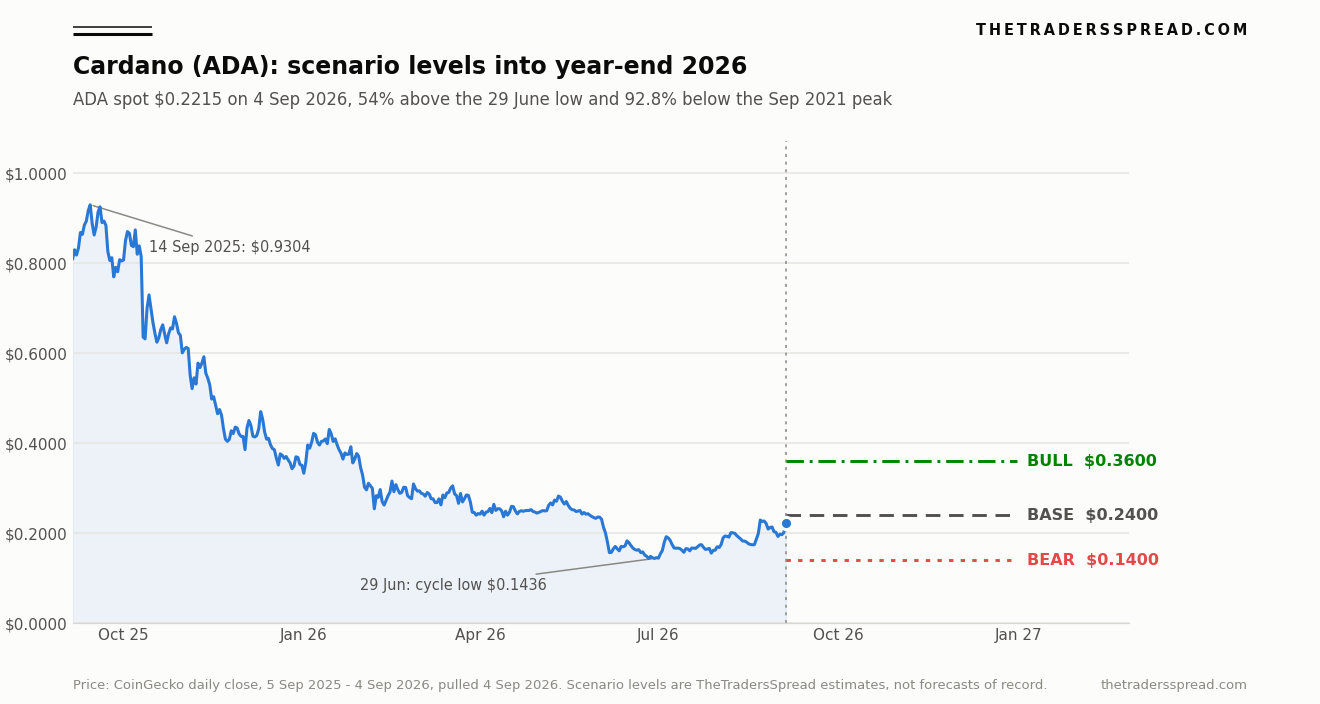
The chart shows the shape of the year. ADA spent September 2025 above $0.90, lost the $0.35 shelf in December, ground through the $0.24 to $0.29 band for most of the first quarter, then broke to $0.1436 at the end of June. What has happened since is a 54% recovery on rising volume that has still not reclaimed the March close. Anyone reading the bounce as a trend change is reading a rally inside a downtrend, which is the most common way to be wrong about an asset in this position. Bitcoin losing the $80,000 level in late August set the tone for the whole complex, and ADA's rebound is beta to that, not independent of it.
The reserve clock nobody sets an alarm for
Cardano's monetary policy takes a fixed fraction of the remaining reserve each epoch, splits it between stakers and the treasury, and returns the unclaimed remainder. It is elegant and it is also arithmetic: the pot only shrinks.
Reserves stood at 6.147bn ADA at epoch 653, down from 6.167bn two epochs earlier. That is a drawdown of roughly 10.0m ADA per epoch, or 0.163% of the remaining balance, which compounds to an 11.2% annual decline in the size of the annual emission. Every year the network has about 11% less new ADA to pay stake pool operators, delegators and the treasury with than it had the year before. Fees are supposed to take up the slack. At 0.67% of current staker income they are not close.
The ecosystem knows this. On 3 August 2026 the Intersect Parameter Committee submitted a governance action cutting minPoolCost, the fixed fee every stake pool keeps before splitting rewards, from 170 ADA to 75 ADA. Cardano's own announcement gave the reason plainly: the lower fixed fee "gives small pools breathing room as block rewards decline". That is the foundation acknowledging, in a routine parameter note, that the reward stream is contracting.
The spending side has its own arithmetic. Thirty treasury withdrawal actions have been ratified and enacted since epoch 613, totalling 457,395,629 ADA, against a net change limit that Intersect's budget documentation still describes as 350m ADA for the year. Lloyd Duhon told the organisation's Budget Committee on 8 June, per the published minutes, that "the 18-month NCL was a compromise to reset the fiscal year, but it didn't work because the NCL simply got filled". The same minutes record what the price has done to everyone drawing on that money: proposals were submitted at roughly 25 to 30 cents against an ADA then trading near 16, which the committee described as a 40% to 50% effective cut. Stephen Wood of the Cardano Foundation told that session ADA is "too volatile to budget in".
Carlos Lopez de Lara, a product manager at Input Output, put the same point more directly when the Leios testnet was announced on 22 June 2026. Asked about the network's long-run sustainability as reserves deplete, he said "transaction fees need to be sufficient". He also explained why throughput will not be switched on all at once: "A rapid increase might imply additional costs for SPOs, which is not needed at the moment."
The strategy is coherent: raise capacity gradually, hold operator costs down while rewards shrink, and hope fee volume arrives before the subsidy thins. It is a solvency schedule dressed as a scaling roadmap. The question is the timing.
Leios, measured against its own target
The Musashi Dojo testnet went live on 23 June 2026, structured in five phases named Earth, Water, Fire, Wind and Void. The governance proposal cleared with more than 84% support from delegated representatives, and the treasury has already paid for it: a 27,714,342 ADA withdrawal to Input Output's Consensus Initiative was enacted at epoch 634, matching the ₳27.7m the company said in May it needed to take the prototype to a mainnet-ready release candidate. Lopez de Lara has targeted a November 2026 hard fork. The design lifts block throughput from 4.5 KB/s toward 200 KB/s, which the roadmap frames as 30 to 65 times current Praos levels.
Charles Hoskinson, founder of Input Output Global, described the ceiling on The Breakdown podcast in July: "Leios will be 60x in terms of throughput inside the system". He has also said the network will end up as performant as the XRP Ledger, which is a comparison worth taking at face value given where XRP itself trades on a similar throughput story.
So test the plan against its own published destination. Input Output projects 27 million monthly transactions by 2030. Cardano processed 24,949 transactions a day across epochs 651 and 652, roughly 758,000 a month, so the target implies a 35.6-fold increase in usage.
Now price it. At the realised fee of 0.280 ADA per transaction, 27 million monthly transactions generate about 90.6m ADA a year, or $20.1m at today's price. That is a genuine transformation of the network's economics, and it still leaves ADA at roughly 414 times fees at the current market capitalisation — nearly double where Solana trades today. It would also cover only about 20% of the current 447m ADA reward budget, or around a third of the smaller budget that 11.2% annual decay implies by 2030.
None of that makes Leios a failure. It makes it necessary rather than sufficient, and it means the bull case for ADA cannot rest on fee capture alone. It has to rest on something the fee data does not measure.
The DeFi economy that never arrived
Cardano has 53 protocols tracked by DefiLlama holding a combined $65.2m. The largest, the Minswap DEX, holds $14.9m. Liqwid, the main lending market, holds $12.4m. Djed, the algorithmic stablecoin, holds $5.5m.
Chain-level TVL peaked at $372.9m in July 2025 and sat at $64.5m on 4 September 2026, a decline of 82.7% that runs deeper than the token's own drawdown over the same period. Capital did not merely mark down in dollar terms. It left.
The comparison that stings is not Ethereum. It is Avalanche, a network with a $3.24bn market cap — 39% of Cardano's — holding $489m of TVL, seven and a half times as much. Or Solana, which converts 9.72% of its market cap into locked capital against Cardano's 0.78%. The only major network sitting alongside Cardano on this measure is Hedera at 0.77%, and Hedera is explicitly an enterprise settlement network that has never claimed DeFi as its market.
There is a defensible counter-argument here, and it deserves a hearing. Cardano's governance apparatus is real in a way almost no other chain's is. The Van Rossem hard fork activated on 22 July 2026 at protocol version 11, the first upgrade in Cardano's history proposed, debated and ratified entirely through on-chain governance. Whatever the TVL says, the network runs itself through a functioning constitutional process, and it has a $298.7m treasury to direct at whatever it decides to build. That combination does not exist elsewhere at this scale.
The process is also tighter than it looks. Intersect's weekly update of 28 August put the Constitutional Committee replacement vote at 64.24% DRep support against a 67% threshold, warning that failure would drop the committee from seven members to three, below the minimum of five, and "would effectively stall most of Cardano's governance system". Koios shows the replacement action still not recorded as enacted at epoch 653, with four of the eight member records carrying an epoch-653 expiry. The machinery works, and this month it has been running against its own clock.
Whether a market pays for governance quality is a separate question, and eleven months of price action suggest the answer has been no.
What the tape is doing
ADA is up 14.4% over 30 days and 20.2% over 60, against a 24.8% loss over 200 days and 72.9% over a year. The 24-hour range on 4 September ran from $0.2054 to $0.2268 on $702m of volume, respectable turnover for a token this deep into a drawdown and a sign the bounce is meeting real two-way flow rather than a thin squeeze.
Overhead supply is the constraint. The monthly closes tell the story cleanly: $0.351 in December 2025, $0.2935 in February, $0.2435 in March, $0.1456 in June. Every one of those levels represents a cohort of holders now underwater, and the first meaningful shelf sits right where the base case lands. Reclaiming $0.24 to $0.29 requires absorbing the entire first quarter of 2026.
RelatedInternet Computer (ICP) Rises 11.97% in a Single Day
Staking takes some pressure off. With 21.42bn ADA delegated, 58.3% of circulating supply sits with pools, and the free float doing price discovery is smaller than the market cap implies. Compare that with Ethereum's treasury-company bid, where a single buyer absorbing supply changed the shape of the market. Cardano has no equivalent.
The call: base, bull and bear into year-end 2026
Base case, $0.24, 45% probability. The Leios hard fork lands in the November window or slips a few weeks, the market treats it as a milestone rather than a revenue event, and ADA grinds back into the lower half of the first-quarter band. Fee revenue stays under $1m annualised because capacity without demand does not generate transactions. This is what happens if nothing breaks: an 8.4% move over four months, which is another way of saying flat.
Bull case, $0.36, 25% probability. Three things have to happen together. Leios ships on schedule and the phased rollout demonstrates real throughput on mainnet rather than in Musashi. Broad crypto beta turns, which mostly means Bitcoin reclaiming the $80,000 handle it lost in August. And capital starts returning to Cardano DeFi, with chain TVL recovering back through $150m as a visible signal. That combination takes ADA through the March close at $0.2435 and into the December 2025 congestion around $0.35. It is a 62.6% move and it does not require the fee multiple to normalise at all — it requires sentiment to re-rate a delivered upgrade.
Bear case, $0.14, 30% probability. The hard fork slips into 2027, which the roadmap already floats as a possibility. Bitcoin stays heavy. TVL keeps bleeding through the $50m level, and the 11.2% reward decay starts showing up as visible stake pool consolidation as smaller operators exit despite the minPoolCost relief. ADA retests the 29 June low at $0.1436, a 36.8% decline, and the question becomes whether $0.14 holds or whether the network's first genuine valuation reset begins.
The probability-weighted outcome is $0.24, which is why the base case and the expected value sit on the same line. The distribution is wide and skewed left, and the honest reading of that is that ADA is cheap against its own history and expensive against its own cash flows at the same time.
What would change my mind
Sustained mainnet transaction counts above 100,000 a day after the hard fork would break the fee argument outright. That is four times current volume, and it would make 17,831x look like a temporary artefact rather than a structural fact. A Cardano stablecoin supply that starts growing rather than shrinking would do similar work.
Against the bullish case, a Leios delay announced before November would remove the only dated catalyst in the story and leave ADA trading purely on beta. And if chain TVL loses $50m while the token is rising, that divergence would say the rally has nothing underneath it.
FAQ
Why is Cardano's market cap so high relative to its fee revenue?
Because ADA's valuation rests on the token's monetary and governance role rather than on network revenue. Roughly 58.3% of supply is staked and the network holds a 1.349bn ADA treasury, so a large share of the float is held for reasons unconnected to transaction throughput. The 17,831x multiple is real, but it measures something the median holder is not buying.
What is Ouroboros Leios and when does it launch?
Leios is Cardano's throughput redesign, lifting block capacity from 4.5 KB/s toward 200 KB/s across a phased rollout the roadmap describes as 30 to 65 times current levels. The Musashi Dojo testnet opened on 23 June 2026 with five phases. Input Output's Carlos Lopez de Lara has targeted a November 2026 mainnet hard fork, though published material also references end-2026 or early 2027.
Is Cardano's staking yield sustainable?
The 2.09% nominal yield is paid almost entirely from reserves rather than fees, and the reserve draw is falling about 11.2% a year. The yield will keep declining unless transaction fees grow to replace the subsidy. That is the explicit reason the Intersect Parameter Committee moved to cut minPoolCost from 170 to 75 ADA in August 2026.
Why has Cardano's TVL fallen so far?
Chain TVL went from $372.9m in July 2025 to $64.5m on 4 September 2026, an 82.7% decline that exceeds ADA's own drawdown over the period. Both price depreciation and capital withdrawal contributed. The largest venue, Minswap, now holds $14.9m, which limits the size of position a DeFi user can take on the chain and creates a feedback loop against new capital.
What is the single most important number to watch?
Daily transaction count after the Leios hard fork. Throughput capacity is only useful if it is used, and every argument in the bull case eventually routes through whether transactions per day move meaningfully above the current 24,949. Fee revenue, treasury sustainability and staking yield all follow from that one series.
Disclaimer
This article is analysis and information, not financial advice or a recommendation to transact in any asset. The scenario levels above are estimates derived from public on-chain and market data and may prove wrong. Cryptocurrency prices are volatile and capital is at risk. Anyone considering a position should carry out their own research and consider consulting a regulated adviser.