

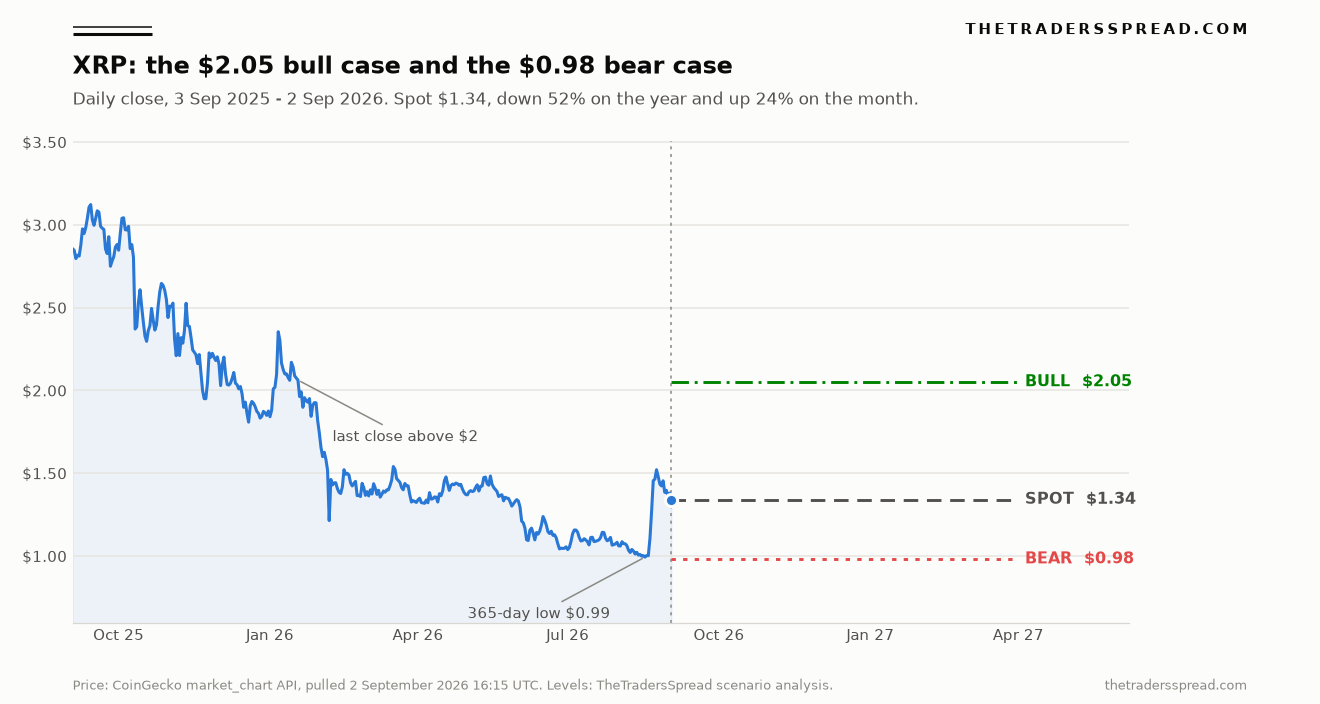
Ripple wired the United States Treasury the full $125,035,150 civil penalty plus statutory interest on 18 August 2025, and the permanent injunction ordering it not to sell unregistered securities has never been lifted. The case that hung over this asset for four and a half years is finished, and Ripple lost it. XRP trades at $1.34, which is 52% below where it traded a year ago and 24% above where it traded a month ago.
Both halves of that are true, and the second half is what makes the first one interesting. We pulled Ripple's escrow directly from the XRP Ledger this morning rather than quoting a tracker: 31,700,000,000 XRP sitting in exactly 100 escrow objects across eight Ripple-labelled accounts, releasing one billion tokens on the first of every month from October 2026 until April 2029, with a final 700 million in May 2029. That is 50.5% of circulating supply on a published timetable. In the same session we sampled sixty consecutive ledgers and found 408,122 XRP actually delivered from one account to another, worth about $547,000 across four minutes of ledger time, against $2.52bn of exchange turnover in the preceding twenty-four hours.
This piece sets out a $2.05 bull case and a $0.98 bear case for XRP, and shows the working for both.
What the court decided, and what it left alone
Almost everything written about XRP's legal position in the last eighteen months contains a factual error, so the record here comes from the docket itself rather than from coverage of the docket.
On 13 July 2023 Judge Analisa Torres granted the parties' cross-motions for summary judgment in part. Ripple's institutional sales of XRP were unregistered securities offerings under Section 5 of the Securities Act; its programmatic sales into exchange order books were not. That split survives intact today. Nothing since has disturbed it.
On 7 August 2024 the court reached remedies. Working from Ripple's own expert report, Torres counted the qualifying transactions herself and arrived at a number that has been misquoted ever since: "the Court finds that 1,278 transactions violated Section 5, resulting in a civil penalty of $125,035,150." The same day she entered a final judgment permanently restraining Ripple from violating Section 5. A month later the court stayed enforcement of the money, requiring Ripple to deposit 111% of the penalty into an interest-bearing account at Truist Bank held in the name of its counsel, and specified that the stay "does not apply to any other part of the Judgment, including, but not limited to, the Judgment's injunctive relief."
Both sides appealed. Then, on 8 May 2025, they signed an agreement to settle the litigation on terms conditioned on the court vacating the injunction and releasing only $50 million of the fund to the SEC, cutting the penalty by sixty percent.
That is the settlement everybody remembers. It never took effect.
Torres denied the joint motion for an indicative ruling on 15 May 2025, holding that a request to erase the injunction and most of the penalty is a Rule 60 motion for relief from judgment however the parties choose to label it, and that such relief is available "only upon a showing of exceptional circumstances" which neither party had attempted to make. The parties renewed the request. She denied it again on 26 June 2025, in language unusually direct for a district court order:
"Indeed, if the Court should not be concerned about Ripple violating the law, why do the parties want to eliminate the injunction that tells Ripple, 'Follow the law'?"
— Analisa Torres, United States District Judge, Southern District of New York, order of 26 June 2025 (ECF No. 989)
Seven weeks later the appeals were abandoned and Ripple paid. The confirmation is a letter to the court from the firm that had been holding the money:
"Ripple and the SEC have agreed on the amount to be transferred, including the full court-ordered penalty plus statutory interest; the SEC has provided the appropriate wire transfer instructions; my firm has directed the bank to transfer the agreed amount as instructed; and the bank has confirmed that the agreed amount has been released."
— Michael K. Kellogg, counsel for Ripple Labs Inc., Kellogg, Hansen, Todd, Figel & Frederick, letter of 18 August 2025 (ECF No. 992)
The resolved status is therefore this. Ripple paid $125,035,150 and interest, not $50 million. The injunction stands. The 2023 holding that secondary-market XRP trading is not itself a securities transaction stands. And the case is closed without an appellate ruling, so no circuit-level precedent was created in either direction. Anyone pricing XRP off an expected Second Circuit opinion is pricing something that will not arrive.
The supply nobody has to guess about
Most token supply arguments are guesswork. This one is not, because escrow on the XRP Ledger is a ledger object carrying an amount and a release date that anyone can read.
Querying the eight Ripple-labelled accounts that hold escrows against validated ledger 106,714,985 returns 100 objects totalling 31.7 billion XRP. The release schedule is mechanical: one billion on the first of each month, October 2026 through April 2029, then a 700 million remainder in May 2029. At $1.34 a monthly tranche is $1.34bn of notional against roughly $2.5bn of daily turnover.
The honest caveat is that Ripple has historically re-escrowed most of each tranche rather than selling it, so the gross release figure overstates realised supply by a wide margin. The point is not that 31.7 billion tokens are about to hit the market. The point is that the decision to sell or re-escrow sits with one company, on a monthly cadence, for the next thirty-two months, and no holder gets a vote on it.
Two further numbers from the same ledger. Total supply now stands at 99,985,621,278.10 XRP, meaning 14,378,722 XRP have been destroyed in transaction fees since 2012, or 0.0144% of the original hundred billion. The deflation is real and it is rounding error. Circulating supply is 62.74 billion, so the gap between a market capitalisation of $83.99bn and a fully diluted value of $133.85bn is almost entirely escrow plus Ripple's unescrowed holdings.
What the ledger is actually used for
Ripple's institutional story is payments. The measurable version of that story is thinner than the announcements suggest, and the important word is measurable.
Across sixty consecutive validated ledgers on 2 September 2026, between 16:27:30 and 16:31:30 UTC, the network processed 6,063 transactions. Of those, 2,451 were OfferCreate instructions and 2,363 were Payments. More orders were placed on the built-in exchange than payments were sent. Of the 2,363 payment attempts, 1,822 succeeded, and 674 of the successes delivered an issued token rather than XRP itself. The XRP genuinely delivered from one account to another across those four minutes came to 408,122 tokens, about $547,000.
Extrapolating a four-minute window to a full day is an order-of-magnitude exercise rather than a census, and it deserves to be read as one. It implies roughly $197m a day of XRP actually moved on-chain, against $2.52bn of reported exchange volume over the same twenty-four hours. XRP is traded around thirteen times more than it is used.
One transaction in six did not succeed at all. In the sample, 1,081 of 6,063 returned a failure code, dominated by tecPATH_DRY and tecKILLED, which is what a thin order book looks like from the inside.
RLUSD, Ripple's dollar stablecoin, makes the same point from a different angle. The issuing account on the XRP Ledger shows obligations of 1,027,383,569 RLUSD outstanding. CoinGecko puts total RLUSD across all chains at $2.39bn. Ripple's own stablecoin therefore keeps 57% of its supply somewhere other than the ledger Ripple built. Set that beside how Ethena's synthetic dollar concentrates on its home venue and the distribution reads as a deliberate choice about where liquidity actually lives.
Sizing the ETF bid
Eleven XRP exchange-traded products now list in the United States, with combined assets of $1.81bn on 2 September 2026 according to StockAnalysis.com data pulled this session.
Only six of them hold XRP outright rather than futures or options overlays: the Bitwise XRP ETF at $506.30m, Franklin's XRPZ at $370.02m, the Canary XRP ETF at $341.60m, 21Shares' TOXR at $153.05m, Volatility Shares' XRPI at $104.50m and REX-Osprey's XRPR at $53.01m. That is $1.53bn of physically backed demand against an $83.99bn market capitalisation, or 1.82% of the float.
For scale, when we looked at Solana's ETF complex crossing $1.06bn in assets, that sum sat against a materially smaller market capitalisation and produced a visibly larger proportional bid. The XRP funds have gathered more money in absolute terms and less in relative terms. A product launch is not the same thing as a flow.
RelatedCosmos (ATOM) Price Prediction: $2.44 Bull vs $1.40 Bear
Who gets a vote on consensus
The validator question is usually argued badly in both directions. Read from the signed list at vl.ripple.com this session, the measurable position is that the default unique node list contains 35 validators at sequence 85, valid until 6 April 2027, while public trackers see 273 validators running on the main network.
Exactly one of the 35 publishes a ripple.com domain. The rest include universities, exchanges, wallet providers and independent operators, a genuinely broader set than critics allow. So the concentration is not in who runs the machines. It is in who publishes the list. A node that accepts the default configuration trusts a roster signed by a key Ripple controls, and the other 238 validators have no say in consensus unless an operator edits a configuration file by hand. That is a governance fact rather than a scandal, and it is why the XRP Ledger is a poor comparison for chains where stake determines voting weight.
The $2.05 bull case
The bull level is not arbitrary. XRP last closed above $2.00 on 18 January 2026, at $2.0618. Everything since has been the unwind of that breakdown, and $2.05 is the price at which the January structure is reclaimed.
Getting there needs three conditions to hold at once. Litigation risk has to stay priced as resolved rather than merely dormant, which the docket supports and which is arguably not yet reflected at $1.34. The ETF complex has to keep compounding: moving from 1.82% of market capitalisation to the 4-5% range the larger crypto ETF cohorts occupy would represent roughly $2.5bn of net new physically backed buying, and that is the cleanest bull mechanism available. And escrow has to keep behaving, meaning Ripple continues re-escrowing the bulk of each monthly tranche rather than monetising it into a rising tape.
A move to $2.05 is a 53% gain from spot and implies a market capitalisation near $128.6bn. XRP has spent time above that inside the last twelve months, so it is a reclaim rather than a discovery. The month just past, in which the token rose 24% off a low of $0.9927 set on 17 August, shows the beta is still there when flows turn.
The $0.98 bear case
The bear level is the 365-day low of $0.9927, set on 17 August 2026, rounded down to a clean $0.98. A daily close beneath it means the base that has held all summer has failed.
The mechanism is the gap between narrative and settlement. If XRP is priced as payments infrastructure, then $547,000 of value delivered in four minutes, more exchange orders than payments, a 17.8% transaction failure rate, and a house stablecoin keeping 57% of its supply on other chains are all evidence that the infrastructure is not yet carrying the load the valuation assumes. Add a monthly billion-token release resuming in October and continuing for thirty-two months, and the bear path needs nothing dramatic to happen. It needs the ETF bid to stall while supply arrives on schedule.
$0.98 is 27% below spot and implies a market capitalisation of $61.5bn. XRP traded there as recently as three weeks ago, so this is not a tail scenario. It is a retest.
What would change the read
Our stored bias on this piece is neutral, and the reason is that the evidence genuinely points both ways. The legal overhang is gone, a real and permanent improvement in the asset's risk profile. The on-ledger usage is thin, a real and persistent problem for the valuation. Those two facts are not in tension with each other; they simply resolve on different timescales.
Four developments would move the assessment. Weekly ETF creations turning consistently positive at a scale above $50m would confirm the flow mechanism the bull case depends on. Ripple selling rather than re-escrowing a full monthly tranche, visible on-chain within hours, would confirm the supply mechanism the bear case depends on. A sustained rise in successful XRP-denominated payment value, measurable by anyone against the same ledger queries used here, would close the gap between narrative and settlement. And a legislative outcome giving XRP a statutory classification would matter more than the litigation ever did, because the litigation only ever answered a question about Ripple's own sales.
The pattern of a payments-focused ledger trading on institutional announcements rather than settled volume also shaped how we read Hedera's enterprise adoption gap, and the ownership-concentration question echoes our work on a single treasury holding 4.9% of Ethereum.
Sources and method
Spot price, market capitalisation, supply and the 365-day price series come from the CoinGecko API, pulled 2 September 2026 at 16:15 UTC. Escrow objects, total supply, the RLUSD issuer balance and the transaction sample were queried directly against a public XRP Ledger node at validated ledgers 106,714,985 to 106,715,052. The validator list came from vl.ripple.com and validator counts from XRPScan. ETF assets are from StockAnalysis.com. Court documents are filings in SEC v. Ripple Labs, Inc., No. 20-cv-10832 (S.D.N.Y.), read from the RECAP archive: ECF Nos. 973, 974, 977, 984, 989 and 992, of which the 26 June 2025 order quoted above is available here as filed. The hero photograph shows the Daniel Patrick Moynihan United States Courthouse at 500 Pearl Street, the address on every filing in the case; it is by Ken Lund via Wikimedia Commons, CC BY-SA 2.0.
.jpg)
Not investment advice. This article is analysis and information only. It does not recommend any transaction in XRP or any other asset, and nothing in it should be read as a recommendation to transact. Prices quoted were accurate at the stated time and will have changed since. Cryptocurrency prices are volatile and capital is at risk. Readers should conduct their own research and consider consulting a licensed financial adviser.