

A loading gallery is the least glamorous object in a grain terminal: a covered steel bridge that carries wheat from a silo out over the water and into a ship's hold. One of them, at United Grain Company's Novorossiysk Grain Plant on Russia's Black Sea coast, came down in the early hours of 12 August 2026 after a Ukrainian drone attack, and several silos beside it were damaged. Two weeks later the terminal next door, NKHP, said its own repairs could take up to four months. NKHP moved 6.23 million tonnes of grain in the 2025/26 marketing year against a nameplate capacity of 7.1 million. Chicago has been repricing itself around that steel ever since. The front-month CBOT wheat contract settled at 716.00 cents a bushel on Friday 4 September 2026, per the USDA's Agricultural Marketing Service. The same weekly report a year earlier put the front month at 501.00 cents. That is 42.9% in twelve months, and more than a third of it landed in the four weeks after the gallery fell.
The part that does not fit the headline is the balance sheet. In the very report where it cut Russian wheat exports by 1.5 million tonnes and Ukrainian exports by 1.0 million, the USDA raised projected world ending stocks for 2026/27, by 0.41 million tonnes to 273.25 million. Russia's own carryout went up, from 12.09 to 13.59 million tonnes. Ukraine's rose from 2.53 to 4.80 million. Nothing was harvested away on 12 August. Wheat was reclassified, from grain that can reach a buyer into grain that cannot, and the board is pricing that reclassification. It is the same trade oil ran through a chokepoint earlier this year, when the market put a premium on accessible barrels rather than on barrels. Wheat has now borrowed the structure wholesale.
Key facts
- CBOT front-month wheat settled at 716.00 cents a bushel on 4 September 2026, against 501.00 cents on 5 September 2025, a rise of 42.9% — USDA AMS, National Weekly Non-GMO/GE Grain Report, 4 September 2026 and 5 September 2025.
- The contract reached $7.67 a bushel on 28 August 2026, a three-and-a-half-year high — TradingEconomics benchmark series, retrieved 8 September 2026.
- NKHP's terminal at Novorossiysk shipped 6.23 million tonnes in 2025/26 and may need up to four months of repair, its owner said on 26 August 2026 — The Moscow Times, 26 August 2026.
- USDA cut 2026/27 Russian wheat exports to 46.00 million tonnes from 47.50 and Ukraine's to 13.50 from 14.50, while raising world ending stocks to 273.25 million tonnes — WASDE-674, 12 August 2026.
- Russia set its weekly floating wheat export duty at RUB 787.5 a tonne for 2–8 September, down from RUB 1,012.1, then moved on 2 September to suspend the duty entirely through 31 December 2026 — APK-Inform and UkrAgroConsult, 2 September 2026.
- IKAR put Russian August 2026 grain exports at 2.1 to 2.6 million tonnes, against the 5 million-plus a month the Azov-Black Sea ports normally handle — Agweek, 21 August 2026; UkrAgroConsult, 2 September 2026.
- The next USDA balance sheet lands at noon Eastern on 11 September 2026 — USDA Office of the Chief Economist release calendar.
The twelve days that moved the board
Wheat did not gap higher on the night of the attack. It ground.
The 12 August session traded twelve to fifteen cents higher. The market spent the following fortnight testing whether Russian grain would find another way out of the Azov-Black Sea basin, and slowly concluding that it would not. Then, on Wednesday 26 August, NKHP put a number on the outage. Chicago's September contract jumped 6.57% that day to $275.53 a tonne, with Kansas City at $291.01 and Minneapolis at $265.10, according to UkrAgroConsult's tally of the close. Paris milling wheat added 3.83% to €236 a tonne in the same session. Two days later the Chicago front month printed $7.67, its best level since early 2023.
The listed proxy tells the same story in shares. The Teucrium Wheat Fund, which holds CBOT wheat futures rather than wheat, traded 1.52 million shares on 26 August against a daily average nearer 450,000 earlier that month, and closed the year to 4 September up 27.0%. That is the fund, not the grain, and the two are not interchangeable. It is still the cleanest daily record of where the money went.
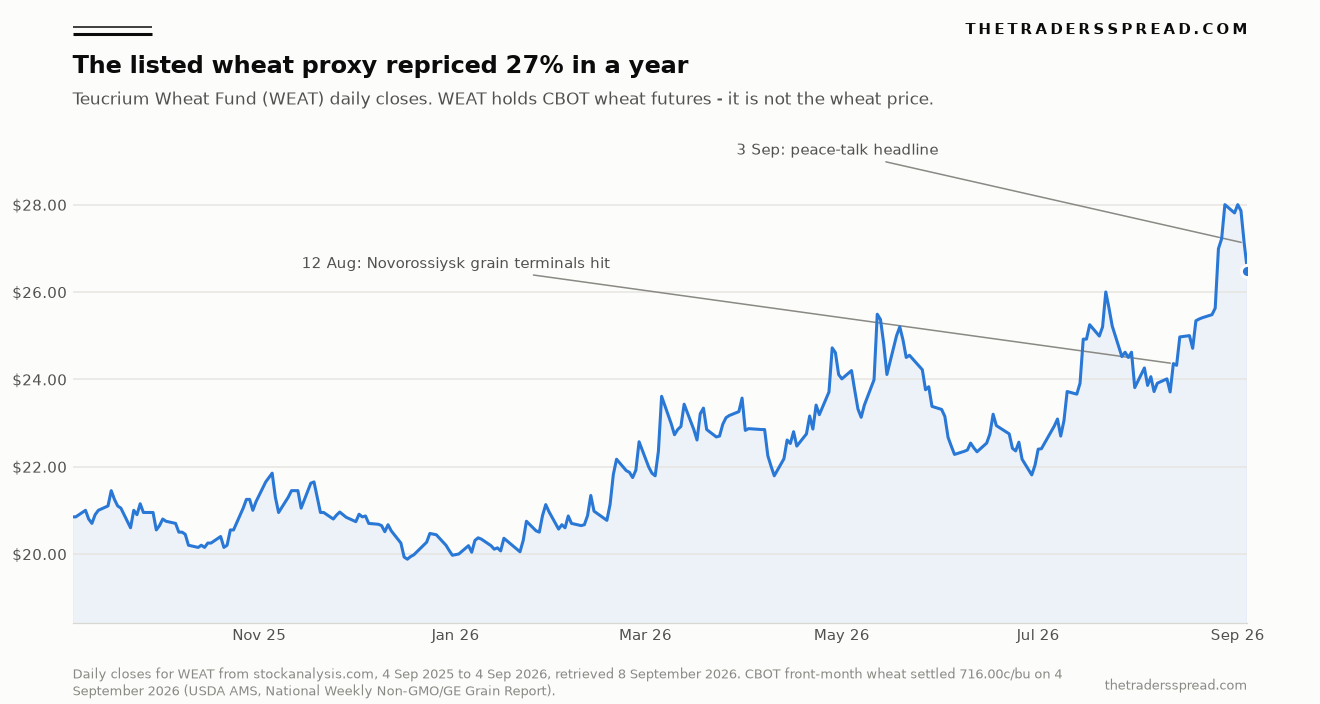
What the flat price hides is the shape of the curve and the spread between the three American wheat classes. Here is the full settlement grid from the USDA's own weekly report for 4 September 2026, in cents a bushel:
| Contract | CBOT (soft red winter) | KCBT (hard red winter) | MGE (hard red spring) |
|---|---|---|---|
| Sep 2026 | 716.00 | 786.75 | 720.00 |
| Dec 2026 | 734.00 | 802.25 | 745.00 |
| Mar 2027 | 749.25 | 815.25 | 762.75 |
| May 2027 | 756.75 | 819.75 | 773.00 |
| Jul 2027 | 753.25 | 811.25 | 774.75 |
| Sep 2027 | 756.50 | 810.75 | 761.50 |
| Dec 2027 | 764.00 | 815.50 | 763.75 |
Source: USDA Agricultural Marketing Service, National Weekly Non-GMO/GE Grain Report, settlements as of 4 September 2026, retrieved 8 September 2026.
Two things in that grid matter more than the headline number. The first is that December 2027 sits 48.00 cents above the front month, and every deferred month except July 2027 settles above the one before it. That is not what a market short of physical wheat looks like; genuine scarcity pulls the nearby above the deferred. The second is the 70.75-cent premium of Kansas City hard red winter over Chicago soft red winter, still 51.50 cents fifteen months out. Milling-quality wheat is what the Black Sea mostly sells. Chicago's soft red winter is not a substitute for it, and the board is saying so in the spread rather than in the flat price.
One more comparison is worth holding in view. Corn settled at 512.00 and soybeans at 1,293.75 in that same report. On TradingEconomics' benchmark series as at 8 September, soybeans were up 11.81% on the month and 25.53% on the year against wheat's 15.03% and 41.62%. Wheat is leading the complex, which is the signature of a single-commodity logistics event rather than a broad agricultural bid.
What the USDA's own numbers say
WASDE-674 was approved on 12 August 2026, the same day the drones reached Novorossiysk. That timing is the most useful fact in this whole story, because it means the report everyone has been trading off does not contain the event. Its Russian and Ukrainian cuts were made for the earlier disruption in the Sea of Azov, which the board itself describes as "logistical disruptions arising from the increased conflict between the two countries in the Sea of Azov and the Black Sea."
The revisions were small and, read closely, they are not bullish at all:
| 2026/27 wheat exports, million tonnes | July WASDE | August WASDE | Change |
|---|---|---|---|
| Russia | 47.50 | 46.00 | −1.50 |
| Ukraine | 14.50 | 13.50 | −1.00 |
| Canada | 27.50 | 28.50 | +1.00 |
| Kazakhstan | 9.00 | 10.00 | +1.00 |
| United States | 21.09 | 21.09 | 0.00 |
| World trade | 213.05 | 212.71 | −0.34 |
| World ending stocks | 272.84 | 273.25 | +0.41 |
Source: USDA World Agricultural Supply and Demand Estimates, WASDE-674, 12 August 2026, pages 19–20.
Take 2.5 million tonnes away from the two Black Sea exporters and world trade falls by a third of a million, because Canada and Kazakhstan pick up two million between them. The United States is given precisely nothing. Its export line sits unchanged at 21.09 million tonnes, or 775 million bushels, even though American ending stocks are already forecast at 717 million bushels, down 22% on the year, and the season-average farm price was raised twenty cents to $6.20.
Set that against what the market is being told by the sell side. Stefan Vogel, General Manager of RaboResearch in Australia and New Zealand, put it plainly on 7 September: "If you look at supply and demand now, the world is losing as much wheat, barley and corn stocks as it built up last season." He is describing accessible stocks. The USDA table is describing total stocks. Both can be right at once, and the gap between them is exactly the premium sitting in the Chicago price.
Moscow stopped taxing the exports it cannot ship
The clearest evidence that this is a shipping problem rather than a growing problem came out of Russia itself, and it came in the form of tax policy.
Russia runs a floating export duty on wheat, reset weekly by the Agriculture Ministry. For the week of 2 to 8 September the rate was cut to RUB 787.5 a tonne from RUB 1,012.1, a reduction of more than a fifth, with the corn duty going from RUB 607.3 to RUB 406.5. Then, on 2 September, the government went further and moved to suspend the grain duty outright from 1 September to 31 December 2026, with the Economy Ministry citing the need to restructure logistics. Barley was already at zero.
Governments do not zero out an export tax on a commodity that has just become scarce at home. They do it when domestic grain is piling up, farmgate prices are falling, and exporters cannot clear the crop. ProZerno estimated the duty removal could take $3 to $4 a tonne off Russian FOB offers. SovEcon's read on the alternative routes was blunter: rail, the Caspian and the smaller Azov berths might add only several hundred thousand tonnes a month against the five million-plus the deep-water ports were moving. Tuapse, the smallest of the deep-water grain terminals, is reported to be the only one in the region still working.
The volume numbers match. IKAR put Russian August exports at 2.1 to 2.6 million tonnes. APK-Inform reported that shipments fell roughly two-and-a-half-fold on the month and that less than a million tonnes moved in the first ten days of August. On the Ukrainian side, agricultural exports in the first half of August came to 794,000 tonnes, and Kyiv has cut its 2026/27 grain export forecast to 38–40 million tonnes from 43 million while warning of an 11 million tonne storage shortfall if the ports stay shut. Russia struck Izmail, Ukraine's largest Danube grain port, in the same period.
Andrey Sizov, head of SovEcon, had framed the season's opening risk months earlier, in July: "The start of the season may be relatively slow, however. Key importers have little need to replenish stocks urgently while their own harvests are underway, and high stocks in Ukraine are increasing overall Black Sea supplies." Those high Ukrainian stocks are now the problem rather than the cushion. They are sitting on the wrong side of a closed door.
Why one sentence took thirty cents out on 3 September
The disconfirmation case has already been run, in public, in a single session.
On Thursday 3 September, after a weekend of US envoy meetings in Moscow and Kyiv, President Putin was reported to have ordered a three-day pause in strikes on Kyiv. No ceasefire was agreed and no terminal reopened. Chicago and Kansas City wheat still fell 24 to 32 cents a bushel in the early session and Paris milling wheat lost €8 to €10 a tonne. By the Friday settlement the Chicago front month was back at 716.00, roughly 51 cents below the 28 August high.
A market that hands back 6.6% on a headline that changed no physical fact is telling you how much of its own price it does not trust. That is the cost of owning a geopolitical premium, and it is the same asymmetry that ran through crude oil's move to $91 on the Iran strikes: fast to build, faster to leave, and impossible to hedge against a press conference. Soft commodities have shown the mirror image this quarter, with coffee giving up 13.5% on one raised Brazilian crop estimate. The metals desk has been running the physical-disruption version of the trade for weeks, with palladium bid on a mine walkout in Montana. Wheat is now the largest and least hedgeable of the three.
By Tuesday morning the premium was rebuilding. TradingEconomics had the benchmark contract at roughly 736.8 cents, up 2.90% on the day and 15.0% on the month, as the talks produced nothing.
RelatedAlumina Price Prediction: $430 Bull Case vs $280 Bear
What this changes
The first thing it changes is the status of the 11 September WASDE. That report, out at noon Eastern, is the first official balance sheet with the authority to price a four-month outage at Novorossiysk, because the August edition was signed off before anyone knew there was one. Three lines carry the weight: Russia's 46.00 million tonne export figure, which sits above IKAR's 44.5 and below SovEcon's 46.5; Ukraine's 13.50; and the American export line frozen at 775 million bushels. The USDA has so far handed the redirected business to Canada and Kazakhstan. If it starts handing any of it to the United States, a 717 million bushel carryout stops being comfortable in a hurry.
The second is that the trade has moved from flat price into basis and freight. An importer in North Africa or the Gulf is not buying an index. It is buying a cargo that arrives, and the WASDE has North African imports at 29.10 million tonnes and the selected Middle East at 19.84 million for 2026/27. Those buyers are now paying an origin premium to load anywhere but the Black Sea, which shows up in the Kansas City over Chicago spread and in Matif's stubbornness rather than in the Chicago screen. Euronext milling wheat was still €242.00 a tonne on 7 September, up 1.36% on the session, on a day when Chicago was closed for Labor Day.
The third is a slower structural point about who carries the risk. Russia has removed its export duty, which transfers revenue from the state to exporters and to the farmgate, and does nothing at all about berth capacity. Ukraine faces a storage shortfall it has quantified at 11 million tonnes. Both countries are accumulating grain they cannot monetise, which builds a supply overhang that lands on the market the moment shipping normalises. The bull case and the bear case are made of the same tonnes.
What would settle the argument is dull and physical: berth repairs, war-risk insurance rates on Black Sea voyages, and the weekly loading line-ups out of Novorossiysk and Taman. None of those are diplomatic. All of them are observable.
FAQ
How much did wheat actually rise, and over what window?
The CBOT front-month contract settled at 716.00 cents a bushel on 4 September 2026 against 501.00 cents on 5 September 2025, a gain of 42.9% over twelve months, both figures taken from the same USDA Agricultural Marketing Service weekly report. On a single-contract basis, December 2026 wheat went from 587.50 to 734.00 cents over the same year, a rise of 24.9%.
Is the world actually short of wheat?
Not on the USDA's numbers. WASDE-674 of 12 August 2026 raised projected 2026/27 world ending stocks to 273.25 million tonnes and raised Russian and Ukrainian carryout at the same time. The shortage is one of access rather than tonnage: grain that cannot be loaded is not available to an importer, however much of it exists.
What is WEAT, and why is it not the wheat price?
The Teucrium Wheat Fund is a US-listed ETF holding a basket of CBOT wheat futures at different maturities. It carries roll cost and expense drag, and its holdings are not the front-month contract, so its return diverges from any single futures price. It is used here as a daily record of listed flows, and the actual settlements quoted throughout come from the USDA.
Why did Russia scrap its grain export duty?
Because grain is stuck inside the country. The Agriculture Ministry cut the weekly floating wheat duty to RUB 787.5 a tonne for 2 to 8 September, and on 2 September the government moved to suspend it entirely to 31 December 2026, with the Economy Ministry pointing to the need to restructure logistics. A duty holiday improves exporter margins; it does not rebuild a loading gallery.
What should be watched on 11 September?
The Russian and Ukrainian export lines, and whether any of the redirected trade is assigned to the United States. In August the USDA moved it to Canada, up one million tonnes, and Kazakhstan, also up one million, while leaving American exports untouched at 775 million bushels.
Which wheat market is the right benchmark here?
For milling quality, Kansas City hard red winter and Euronext milling wheat are closer to what Black Sea buyers substitute. Kansas City settled 70.75 cents over Chicago on 4 September and was still 51.50 cents over it in December 2027, which is where the disruption is being expressed most directly.
This article is analysis and information, not investment advice. Commodity futures and the funds that track them carry a high risk of loss, and capital is at risk. Prices and estimates cited are as at the dates stated and change without notice.