

Alumina was the asset named on the voting card. On 15 October 2026, at South32's hybrid annual general meeting, chair Stephen Pearce put the sale of Worsley Alumina in front of the register, together with the Hillside smelter, the MRN bauxite mine, and South32's stakes in the Brazil alumina refinery and the Brazil aluminium smelter. Proxies lodged before the meeting had already lined up 3,048,224,086 votes, 99.18 percent of the usable total, behind Resolution 7. Alcoa's exhibit, filed in Pittsburgh the same day, said shareholders had approved, and that the bundle the company calls AliGroup is still aimed at a close in the first half of 2027. Refineries do not settle on a vote. They settle on a price. Fastmarkets' alumina index, free on board Australia, was corrected to $365.94 a tonne for the assessment of 2 October 2026.
The awkward part is that the index and the largest Western producer are not describing the same moment in the same units. Alcoa's realized third-party price for the quarter ended 30 September was $353 a metric ton. Its adjusted operating cost on produced alumina shipped was $354. For the fourth quarter, the same release expects alumina-segment adjusted EBITDA to stay consistent with the third quarter, while alumina costs inside the smelting segment are guided about $30 million worse. The seaborne index has still climbed from $301.47 a tonne on 13 March to $365.94 on 2 October, a rise of 21.4 percent. A producer at breakeven, a flat alumina-profit guide, and a benchmark up by a fifth since March can all be true. They cannot all be the whole story.
Key facts
- Fastmarkets' MB-ALU-0002 alumina index, fob Australia, was corrected to $365.94 a tonne for 2 October 2026, from an erroneous $358.42 — Fastmarkets pricing notice, 5 October 2026.
- The same index was corrected to $301.47 a tonne for 13 March 2026 and to $303.20 a dry metric tonne for 15 April 2026 — Fastmarkets pricing notices, 16 March and 16 April 2026.
- Alcoa's average realized third-party alumina price was $353 a metric ton in the third quarter of 2026, up from $334 in the second quarter and $324 in the first — Alcoa exhibit 99.1, filed 15 October 2026.
- Adjusted operating cost per metric ton of produced alumina shipped was $354 in that third quarter, against $368 in the second and $334 in the first — Alcoa exhibit 99.1, 15 October 2026.
- Alumina production rose 11 percent from the prior quarter, to 2.5 million metric tons, on better stability at the Pinjarra refinery in Australia — Alcoa exhibit 99.1, 15 October 2026.
- The most-traded SHFE alumina contract, 2701, closed at 2,584 yuan a tonne on 15 October 2026, down 51 yuan, or 1.94 percent — Shanghai Metals Market, 15 October 2026.
- The World Bank's October pink sheet, dated 2 October 2026, puts the September LME aluminium average at $3,283 a tonne and carries no alumina row at all — World Bank Commodity Markets pink sheet.
A rally that stopped at the cost line
Start with the producer's own arithmetic, because a reader can audit it. In the 15 October exhibit, Alcoa's realized third-party alumina price runs $575, $378, $377 and $341 across 2025, then $415 for the year. The 2026 quarters are $324, $334 and $353. Cost on produced alumina shipped was $334, then $368, then $354. The second quarter was a $34 gap, price under cost. The third closed it to a dollar, on the wrong side of zero.
That is a catch-up, not a windfall. The realized price rose $19 a metric ton from the second quarter to the third. The cost fell $14. Most of what looks like an improvement is the cost coming off a bad quarter.
Pinjarra explains the tonnes. Alumina production increased 11 percent on the quarter, to 2.5 million metric tons, primarily because the Pinjarra refinery ran more stably. Third-party shipments rose 2 percent. A refinery that runs better adds supply. Supply does not, on its own, lift a realized price from $334 to $353. Something else in the quarter was firm enough to absorb those tonnes and still pay $19 more.
The full-year guide was not rewritten around a spike. Alcoa reaffirmed 2026 alumina production of 9.5 to 9.6 million metric tons and shipments of 11.5 to 11.6 million. For the fourth quarter it expects alumina-segment adjusted EBITDA consistent with the third, and alumina costs inside the smelting segment about $30 million worse. Against aluminium shipments guided at 2.6 to 2.8 million metric tons, thirty million dollars is a nudge. It fits an index that has lifted. It does not require the index to keep lifting.
What Pearce, Daley and Oplinger actually said
The sale documents are about ownership, and they are easy to misread as a view on the price.
Stephen Pearce, South32's chair, in the address released on 15 October before the poll, called the 30 June agreement "a step change, that repositions us as an upstream base metals company with high margin assets and transformational growth." Consideration is up to US$5.6 billion, for Worsley Alumina, Hillside, MRN, the Brazil alumina refinery and the Brazil aluminium smelter. Completion in that address was the second half of South32's 2027 financial year, still subject to the vote later in the meeting. The 99.18 percent is proxies lodged in advance, not a scrutineer's final tally. Alcoa's exhibit is the document that states the approval as a fact.
Matt Daley, South32's chief executive, told the same meeting the sale "allows us to realise the value that comes from combining our alumina operation with Alcoa's in Western Australia." Worsley sits in the same ore province as Pinjarra. Combining them is a 2027 event if the close lands on the timetable both companies have given. It does not take a tonne out of the fourth-quarter balance.
William F. Oplinger, Alcoa's president and chief executive, stayed on operations: "During the third quarter, we advanced the AliGroup acquisition, delivered improved refinery performance, and increased production across our smelting portfolio." The rest of that paragraph is safety, stability, and a close in the first half of 2027. No price.
The financing is already done. On 23 September Alcoa completed $1.5 billion of 6.625 percent notes due 2034 and $1.1 billion of 6.875 percent notes due 2036, to fund about $3.1 billion of cash consideration with cash on hand. The bridge was cancelled. Cash on 30 September was $4.408 billion, including $2.6 billion raised for the deal. Interest expense for 2026 is now expected near $185 million. Alcoa has paid up, in coupon, to own more of a chain whose third-quarter alumina tonne earned nothing above operating cost.
Three prints, and the chart they can support
The benchmark for the cases below is the Fastmarkets fob Australia index, code MB-ALU-0002. It is not Alcoa's realized price, which averages one seller's invoices, and it is not a Shanghai settlement in yuan. The index is an assessment of the seaborne cargo market out of Australia.
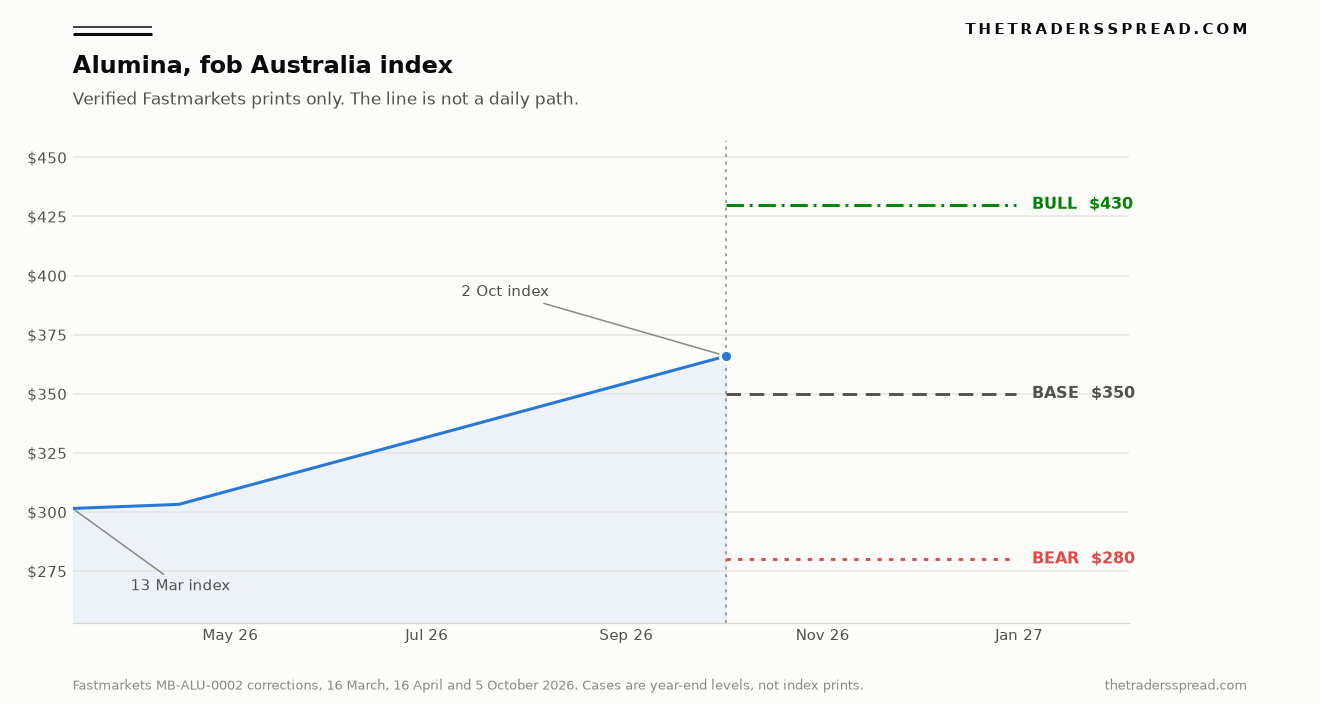
Three prints are verified from Fastmarkets' own correction notices, a thin history and labelled as one. On 13 March 2026 the index was corrected to $301.47 a tonne. On 15 April it was corrected to $303.20 a dry metric tonne. On 2 October it was published in error at $358.42 and corrected to $365.94. There is no verified daily path between April and October in the sources opened for this piece, so the chart connects the dates it has.
The World Bank pink sheet of 2 October 2026 is why this chart is built from correction notices rather than from the Bank. The sheet has a full aluminium row: $2,632 a tonne for the 2025 average, $3,232 for the third quarter of 2026, and $3,283 for September. It has iron ore. It does not have an alumina line. The iron ore cases on this desk can sit on a series the Bank publishes every month. Alumina cannot.
Set the October index against the September metal price and the ratio is the point. $365.94 divided by the September LME aluminium average of $3,283 is 11.1 percent. Alcoa's third-quarter realized price of $353, set against the Bank's third-quarter aluminium average of $3,232, is 10.9 percent. The same company's full-year 2025 realized price of $415, set against the Bank's 2025 aluminium average of $2,632, is 15.8 percent. The metal's own inventory story, including the halving of LME stocks tracked in the aluminium piece, is why the denominator is high. The numerator has not kept up.
| Marker | Level | Date | What it measures |
|---|---|---|---|
| Fastmarkets MB-ALU-0002, fob Australia | $365.94/t | 2 October 2026 | Seaborne index, corrected 5 October |
| Same index | $303.20/dmt | 15 April 2026 | Corrected assessment |
| Same index | $301.47/t | 13 March 2026 | Corrected assessment |
| Alcoa realized third-party price | $353/metric ton | Quarter ended 30 September 2026 | One producer's average |
| Alcoa adjusted operating cost | $354/metric ton | Same quarter | Produced alumina shipped |
| SHFE alumina 2701 close | 2,584 yuan/t | 15 October 2026 | Most-traded contract, SMM |
| ECB yuan per dollar, via Frankfurter | 6.691 | 15 October 2026 | Reference rate, not a metal price |
| World Bank LME aluminium | $3,283/t | September 2026 | Monthly average, pink sheet 2 October |
Shanghai is not a Western Australian cargo
On 15 October the most-traded alumina contract on the Shanghai Futures Exchange, 2701, closed at 2,584 yuan a tonne. SMM put the range at an open of 2,620, a high of 2,624 and a low of 2,571. Volume was 198,639 lots. Open interest rose 27,223 lots, to 308,063, so the decline came with new positions. The close sat under the 5-day average of 2,647.40 yuan, the 10-day at 2,668.10, the 30-day at 2,704.77 and the 60-day at 2,729.72.
The physical book behind that close was heavy. SMM said national alumina inventory was still rising, and that the build had sped up. Weekly production was still rising, from new capacity in Guangxi and from Shanxi plants coming back after red-mud constraints. No maintenance cuts had been reported.
Put the close into dollars with a rate that has a date. Frankfurter's ECB reference for 15 October 2026 was 6.691 yuan per dollar. Dividing 2,584 by 6.691 gives $386 a tonne, still with Chinese VAT in it. Strip a customary 13 percent and the result is about $342. That stripping is a desk calculation, not a settlement. The gap to the $365.94 index is about $24 a tonne. This piece has no freight quote clean enough to land it.
The longer path is the harder fact. Eastmoney's daily bars for the SHFE alumina main continuous, retrieved on 16 October 2026, put that day's last price at 2,631 yuan. Month-end closes on the same series run from 3,222 yuan at the end of July 2025 to 2,723 at the end of September 2026.
Two markets can diverge for months when one tonne cannot freely become the other. A refinery in Shanxi is not a seaborne cargo. Chinese stocks are building, and the contract is under every moving average SMM listed, while the seaborne assessment is at the high of its verified 2026 prints. A surplus that stays inside China does not, by itself, print $280 in Australia. That is why the bear case is not yet the base.
The $575 quarter is the wrong template
The first quarter of 2025 is sitting in the same Alcoa table, and it will be misused. A realized price of $575 a metric ton, against an adjusted operating cost of $312, was a $263 gap on the producer's own tonnes. By the fourth quarter of that year the realized price was $341 and the cost was $314. The full year still averaged $415 realized against $317 of cost, which is where the 15.8 percent ratio comes from. A straight line from $575 back to late 2026 uses a quarter the next three had already left behind.
The 2026 path inside that table is flatter. Realized prices of $324, $334 and $353. Costs of $334, $368 and $354. The third-quarter price got back to the cost. It did not get back to 2025. The bull case here is $430 on the seaborne index, 13.1 percent of September's $3,283 aluminium price. That is a partial repair of the ratio, from about 11 percent toward the 15.8 percent of 2025, not a rerun of the spike.
Feedstock and metal are not one price with two stickers. Nickel's year-end cases are a price for nickel. Alumina's cases are a price for the oxide, and the oxide can fall while the metal is tight if refineries are oversupplied and smelters are not the marginal taker that week. The September pink sheet makes the split obvious: aluminium at a high monthly average, and no alumina price on the page.
Base, bull, bear, and what would change the weights
Spot for this piece is the corrected index, $365.94 a tonne on 2 October 2026. The horizon is 31 December 2026. The weights are a judgement about which description is doing the work. They are not a model.
RelatedRubber TSR 20 Rises 8.3% in a Month to 264.8 Cents
The base case is $350. That is a drift back toward Alcoa's third-quarter realized price of $353, and a give-back of part of the rise since March, without a break of the spring floor near $301. It matches the fourth-quarter language: alumina-segment profit consistent with the quarter just reported. Pinjarra's extra tonnes count as supply. The Chinese surplus stays mostly inside China. Weight: about half.
The bull case is $430, above the spot. It needs the index, now 11.1 percent of September's $3,283 aluminium price, to move nearer the 15.8 percent relationship of 2025, and it needs the metal price not to sag enough to eat the gain. A firmer seaborne market can sit next to a weak Shanghai contract if the surplus SMM describes does not become an Australian cargo. A 2027 change of ownership does not tighten this quarter. Weight: about a fifth.
The bear case is $280, below the spot and below every verified 2026 print used here, including $301.47 on 13 March. It is the case in which refinery stocks SMM already says are accumulating find a bid offshore, Guangxi's new tonnes keep coming, and no cuts show up. At $280 the index would be about 8.5 percent of the September aluminium price. Weight: about three in ten.
What would change the weights is a print. A fob Australia assessment that holds above $400 would move weight toward $430. A print back under $310, near the March and April marks, would make $280 the path to argue and $350 a hopeful midpoint. A Shanghai main-continuous close back above the September month-end of 2,723 yuan, with refinery stocks drawing rather than building, would retire the surplus as the main bear mechanism. Until one of those shows up, the centre sits a little under the October index.
Questions the index actually gets
What price is this alumina prediction using?
The cases sit on Fastmarkets' MB-ALU-0002 alumina index, fob Australia, not on a futures settlement and not on one company's invoices. The last verified print is $365.94 a tonne for 2 October 2026, after Fastmarkets corrected an erroneous $358.42 published the same day. Earlier verified prints on the same code were $301.47 on 13 March and $303.20 on 15 April. The chart connects those dates. It is not a daily history.
Why is Alcoa's $353 not the spot?
Because it is the average Alcoa realized on third-party tonnes in the quarter ended 30 September 2026. It mixes contracts, timing and quality, and it is one seller. The index is one day's assessment of the seaborne market. Alcoa can print $353 for the quarter while the index prints $365.94 on 2 October. The cases are drawn on the index. The realized price stays in the table beside them.
Why can Shanghai and Australia print such different markets?
The SHFE alumina 2701 contract closed at 2,584 yuan a tonne on 15 October 2026. At 6.691 yuan per dollar, the ECB reference that day, the close is about $386 before tax. Strip a customary 13 percent VAT and a desk calculation gets to about $342. That is not an exchange print and not a fob Australia cargo. Stocks in China were still building while the Australian index sat at its high verified 2026 mark.
What would push the index toward $430?
$430 would be 13.1 percent of September's LME aluminium average of $3,283 a tonne. Alcoa's 2025 realized price of $415 was 15.8 percent of that year's aluminium average of $2,632. $430 repairs part of the ratio. It is not a return to the $575 realized in the first quarter of 2025. It needs smelter demand to outrun refinery runs, and a metal price that does not sag.
What would push it toward $280?
A print at $280 would sit under the March index of $301.47 and under April's $303.20. SMM's 15 October brief described rising stocks, new tonnes in Guangxi, a Shanxi recovery, and no announced cuts. If that surplus is offered seaborne, the fob Australia index is the price that adjusts. $280 is that case. The October index, at $365.94, is still well above it.
Does the South32 vote reset alumina this year?
No. Alcoa says the close is still the first half of 2027, and the 15 October exhibit does not say Worsley's tonnes leave the market. Proxies were overwhelmingly in favour. Approval changes the future owner of the refinery. It does not, on the documents filed that day, change fourth-quarter production. Pinjarra's extra stability is the supply fact that is already in the numbers. The vote is not.
Disclaimer
This is analysis, not a recommendation and not advice. Nothing here is an instruction to take a position in alumina, aluminium, or any other commodity, and nothing here considers your circumstances. Assessments get corrected, one company's realized price is not the market, and a case can be wrong. Capital is at risk.