

Is cheddar's cash close a price the milk market has to live with, or a Friday bid that October futures have already left behind? Cheddar blocks, the 40-pound lot on the CME cash call in Chicago, closed at $1.6825 a pound on Friday 16 October. Seven days earlier the same call had closed at $1.3850. The difference is 29.75 cents, 21.5 percent, and it is not a number taken from a single session. USDA Dairy Market News adds the five daily changes for the week of 12 to 16 October and gets the same 29.75 cents. The futures answer is already on the screen. October cash-settled cheese settled at $1.4460 that Friday, 23.65 cents under the block, on the Daily Dairy Report sheet for 16 October. That contract is a monthly average of surveyed sales, and the last block survey, for the week ending 10 October, was $1.4309. The market is pricing a higher cheese price into November. It is not pricing $1.6825 as October.
Three days before Friday's print, the old pairing between whey and cheese was still a complaint, not a price. Betty Berning, contributing dairy economist at HighGround Dairy, wrote on 13 October that any other time whey had surpassed $0.80 a pound, cheese had been over $1.70, while spot cheese was still in the low $1.30s. Extra-grade dry whey then closed Friday at $0.8950. The block, at $1.6825, stopped under that $1.70 line. USDA's weekly note had Western plants on full schedules for the whey return, and August cheddar output was only 0.9 percent below a year earlier. The survey that settles cheese futures last printed $1.4309, on more than 10 million pounds of blocks. Spot and the survey are no longer the same week.
Key facts
- Cheddar blocks closed at $1.6825 a pound on Friday 16 October, up 29.75 cents, or 21.5 percent, from $1.3850 on Friday 9 October — USDA Dairy Market News, CME cash call, 16 October 2026.
- The weekly average for 40-pound blocks was $1.5395, up 19.15 cents from $1.3480, a 14.2 percent rise in the average — USDA Dairy Market News, at a glance, 16 October 2026.
- October cash-settled cheese futures settled at $1.4460 on Friday, against a block survey price of $1.4309 for the week ending 10 October, on 10,443,477 pounds — Daily Dairy Report, 16 October 2026, and the National Dairy Products Sales Report as carried in Dairy Market News.
- The Daily Dairy Report and HighGround Dairy both logged zero block sales on Friday and 17 block loads for the week. They disagree on the bid count — both sheets, 16 October 2026, read 18 October 2026.
- Extra-grade dry whey closed at $0.8950. HighGround Dairy called the print a new all-time high — USDA Dairy Market News, 16 October 2026, and HighGround's CME spot sheet the same day.
- August cheddar production was 325.876 million pounds, down 0.9 percent from August 2025. Total natural cheese stocks on 31 August were 1,442.7 million pounds, up 2 percent on USDA's rounded comparison — NASS Dairy Products, 5 October 2026, and NASS Cold Storage, 25 September 2026.
Five sessions, one direction
Monday did almost nothing. The block closed at $1.3900 on 12 October, half a cent over the prior Friday. Tuesday added 5.25 cents, to $1.4425. Wednesday added 8.75 cents, to $1.5300. Thursday was the session that changed the level: up 12.25 cents, to $1.6525, an 8.0 percent rise on the day from Wednesday's close. Friday added 3.00 cents, to $1.6825, which is 1.8 percent, not 21.5. The week is the story. Friday is the last tick of it.
Those closes sit in one USDA table, the CME daily cash sheet for 16 October, slug MD_DA997. The weekly issue, volume 93, report 42, states the rule in a footnote. Weekly change is the sum of the daily changes. The weekly average is the simple average of the closes. On that definition the change is 29.75 cents and the average is $1.5395, up 19.15 cents, or 14.2 percent, from the prior week's $1.3480. Friday-to-Friday and average-to-average are both real. A contract that says "CME blocks" without saying which one is pointing at two numbers.
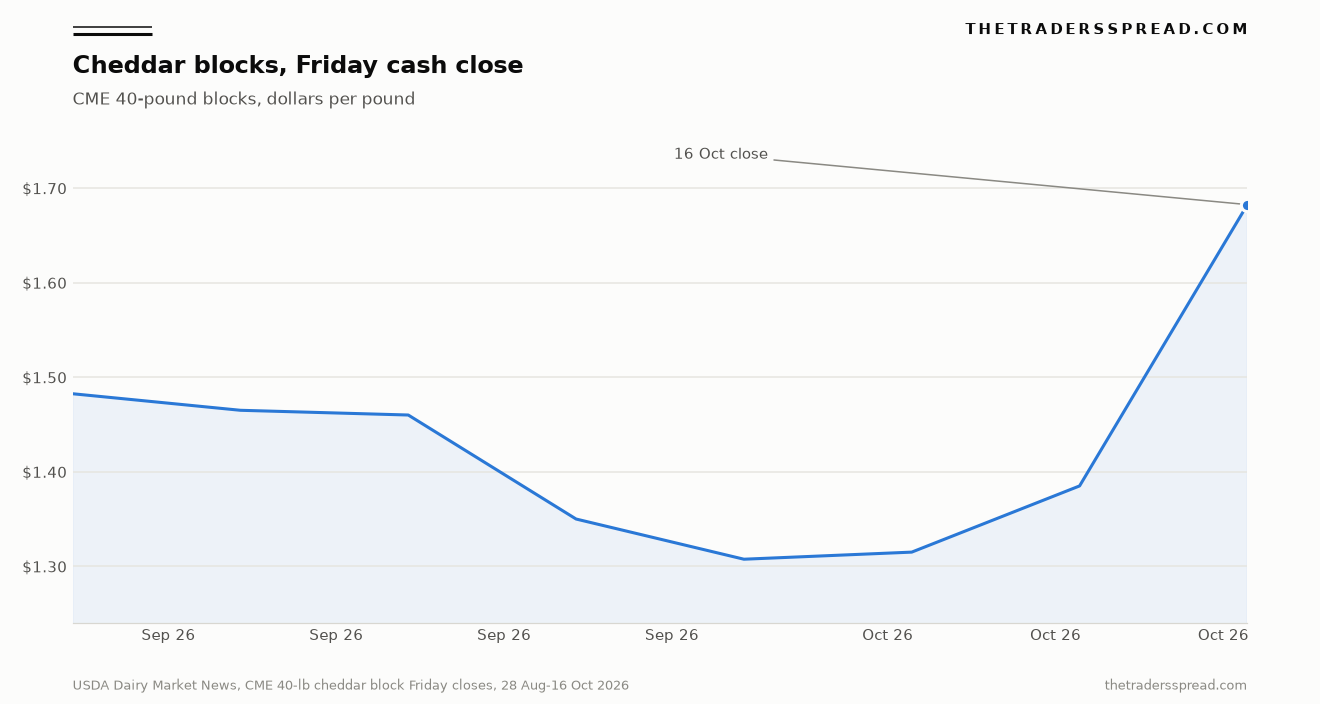
The week before was a drift. From 5 to 9 October the block went $1.3250, $1.3350, $1.3400, $1.3550, $1.3850. On 30 September, in the prior weekly report, the mid-week print was $1.2700, and the 25 September Friday close was $1.3075. From that Friday to 16 October the block rose 37.5 cents, 28.7 percent. The chart further down is those Friday closes, nothing projected past the last print.
Barrels moved too, and less. The 500-pound barrel closed Friday at $1.6200, up 5.00 cents on the day and 16.75 cents from $1.4525, where it had sat, unchanged, from Monday through Wednesday and where it had closed the previous Friday. That is 11.5 percent on the Friday-to-Friday barrel close. The barrel weekly average rose only 5.70 cents, to $1.5095, because three of the five closes were still $1.4525. Blocks led. By Friday the block was 6.25 cents over the barrel. On Monday the barrel had been 6.25 cents over the block. Same gap, opposite sign.
The spread flipped, and the call was thin
A CME cash close is an official price even when nothing trades. The call is a brief session in carlot size. USDA's own footnote puts a cheese carlot at 40,000 to 44,000 pounds. The close can be the last sale, or the bid, or the offer, under the exchange's rules for an untraded market. Readers who treat $1.6825 as a cleared price of goods are ahead of what the logs show.
Two sheets that follow the call agree on the awkward fact and disagree on the detail. The Daily Dairy Report for 16 October shows the cheddar block at $1.6825, up 3.00 cents, with zero trades, four bids and zero offers. HighGround Dairy's spot sheet for the same Friday shows the same $1.6825 close, trades marked none, one unfilled bid at $1.6825 and no uncovered offers. Barrels on both sheets: $1.6200, up 5.00 cents, no trades. Butter, by contrast, actually traded. Both logs show five butter sales.
For the week, the two logs again match on volume. Blocks: 17 loads. Barrels: zero. Seventeen carlots at USDA's 40,000 to 44,000 pounds is about 0.68 to 0.75 million pounds. The block survey for the single week ending 10 October covered 10,443,477 pounds. The entire spot week in blocks was on the order of 7 percent of one survey week, and none of the 17 loads, on these two counts, printed on Friday. The price that will be screenshotted is a bid. The cheese that moves through plants is a different pile of pounds.
A cash complex on this desk has already left its board behind. Pork bellies lost a third in a month over the summer and took cash hogs with them, while part of the board's drop was a roll. Here the cash bid leapt instead of the primal falling. The spot call and the futures settlement are still different contracts, and a week can open a gap the monthly average is not obliged to close.
Cash, the survey, and the October future
The chart is the Friday block close from 28 August through 16 October, taken from the cheese line in each week's Dairy Market News. Late August was $1.4825. The market then bled lower for a month: $1.4650 on 4 September, $1.4600 on 11 September, $1.3500 on 18 September, $1.3075 on 25 September. October opened with $1.3150 and $1.3850 before the week just ended. The last segment is the 21.5 percent week. Month labels on the axis repeat because the series is eight Fridays, not eight months. The source line dates them.
| 9 October | 16 October | Change | |
|---|---|---|---|
| 40-lb blocks, Friday close | $1.3850 | $1.6825 | +29.75 cents, +21.5% |
| 500-lb barrels, Friday close | $1.4525 | $1.6200 | +16.75 cents, +11.5% |
| Block weekly average | $1.3480 | $1.5395 | +19.15 cents, +14.2% |
| October cash-settled cheese | $1.423 | $1.4460 | +2.3 cents, +1.6% |
| October Class III future | $14.98/cwt | $15.28/cwt | +30 cents, +2.0% |
Block and barrel closes, and both weekly averages, are USDA Dairy Market News. The 9 October futures are the 10/9 column of that weekly issue. The 16 October futures are the Daily Dairy Report. USDA's own futures table stops on Thursday 15 October, with October cheese at $1.443 and October Class III at $15.20. Friday is a few cents on from Thursday, not a second market. November is the leg that repriced, and the USDA sheet has no Friday November settle. From Monday 12 October to Thursday 15 October, in that one table, November cash-settled cheese went from $1.506 to $1.623. October cheese, same columns, went from $1.421 to $1.443.
That is 11.7 cents on November against 2.2 cents on October. October cannot swallow a $1.6825 Friday spot print. Most of the pounds that settle October were already surveyed near $1.43. November can still take them, and it has started to. It has not gone to $1.68. Thursday's November settle was 5.95 cents under Friday's block. December that Thursday was $1.618. The curve lifted the forward month and left the spot bid unendorsed.
The survey is the price that enters the milk cheque. In the National Dairy Products Sales Report line carried in the 12 to 16 October Dairy Market News, the week ending 10 October showed 40-pound blocks at $1.4309 on 10,443,477 pounds. Friday's spot close was 25.2 cents above that survey, 17.6 percent. October cheese futures at $1.4460 sat 1.5 cents above the survey and 23.65 cents below the spot.
Jasper Endlich, dairy and oils analyst at Vesper, dated a note 16 October that still described Wednesday. Blocks, he wrote, had rallied to $1.53 a pound on 14 October, up from $1.27 two weeks earlier, as some extra demand appeared at the lower prices. Both stamps match USDA: $1.5300 on 14 October, and $1.2700 on 30 September. The note does not go on to Thursday's $1.6525 or Friday's $1.6825. His 1.44 billion pounds of August cheese stocks, up 2.3 percent, is the total natural cheese line. It is not the cheddar line. That split is a balance-sheet fact, and it comes next.
Ample inventories, full vats
USDA's cheese note for 12 to 16 October does not read like a scramble for blocks. Output was generally steady. In the Central region, cooler weather was lifting milk, spot Class III milk was limited at flat to $3.00 over class, cheddar production was steady, and inventories were ample. Mozzarella and parmesan were the styles keeping some stocks light. In the West, supplies were abundant and plants kept full schedules for the whey return. Buyers were starting to ask about first-quarter 2027. None of that describes an empty store.
The August pounds, out before this cash week, say the same thing. NASS Dairy Products, released 5 October, put August cheddar at 325,876 thousand pounds, 0.9 percent under both August 2025 (328,904 thousand) and July 2026. American-type cheese, which folds in cheddar, Colby, Monterey and Jack, was 477.038 million pounds, also down 0.9 percent on the year. Total cheese excluding cottage cheese was 1,245.418 million pounds, up 1.4 percent on the year. Italian-type cheese was up 3.7 percent. The vats that grew were not the cheddar vats.
Stocks show where the extra cheese sat. NASS Cold Storage, released 25 September, put total natural cheese on 31 August at 1,442,738 thousand pounds, against 1,410,350 thousand a year earlier. The summary line says up 2 percent. Dividing the pounds gives 2.3 percent, which is the figure in Endlich's note. American-type cheese was 815,526 thousand pounds, against 811,553 thousand a year earlier. USDA's comparison column prints 100. Other natural cheese did build, to 604,367 thousand pounds from 578,071 thousand, 105 percent of a year earlier. The block rally is sitting on flat American stocks.
Whey is why the vats stay on. Extra-grade dry whey closed Friday at $0.8950, up half a cent, and the weekly average was $0.8830, up 3.70 cents. HighGround headlined $0.8950 as a new all-time high. Berning had already written, on 13 October, that cheese was being talked about as a byproduct of whey, and that outside 2025 and 2026 a whey price above $0.70 had come with cheese of at least $1.60. USDA's dry-product note this week put whey protein concentrate 80 percent mostly in the $9s, instant product from around $9 into the $11s, and whey protein isolate mostly in the $14s. The block has climbed back toward the cheese price that used to sit beside this whey market, without a cheddar production cut large enough to call a shortage.
Feed does not explain the week either. The protein in a dairy ration is a different futures market. Soybean meal has its own December argument on this desk, and a meal move changes the cost of making milk over a season. It does not print a 12-cent Thursday in Chicago blocks. Class III milk in the Central spot market, flat to $3 over, says cheese plants were not being handed distressed milk. They were paying up to class, or a little over, and still running.
What this changes
Friday's close does not rewrite October's milk cheque. It decides which month can believe the cash call, and which average a contract is using.
RelatedPotash Price Prediction: $420 Bull Case vs $290 Bear
October cheese at $1.4460 describes weeks mostly already surveyed. The block survey for the week ending 10 October was $1.4309 on 10.44 million pounds. Seventeen carlots cannot pull that average to $1.68. Only unpublished survey weeks still inside October can move the settlement. If they stay near $1.45, the future matched the pounds. If they jump toward the spot close, the gap shows up in the Class III announcement at the start of November. September's announced Class III price was $16.04 a hundredweight. October Class III futures finished Friday at $15.28, still under last month.
The weekly average is a third number. It printed $1.5395, up 19.15 cents, and Thursday's $1.6525 sits inside it whether Friday's last 3 cents traded. November, up 11.7 cents by Thursday to $1.623, has room for the spot move and is still about 6 cents under the block.
WASDE-676 had already cut 2026 cheese to $1.525 a pound from $1.570, and Class III to $15.80 a hundredweight from $16.20. The all-milk price stayed at $19.90 because Class IV was raised to $18.90. Those are annual averages of surveyed prices, not CME spot. One week at $1.6825 does not overturn a $1.525 year. Butter's weekly average rose 2.30 cents, to $1.3110. The powder average fell 3.95 cents, to $2.2105.
Friday is more than a bid only if later prints say so: block volume past a 17-load week, a survey that lifts off $1.4309, and a November settle that holds Thursday's gain. It is an air pocket if the survey stays near $1.45 and the spot bid fades when a carlot is shown. Until the survey follows the bid, $1.6825 is the top tick of a thin week. August feedlot placements, already on this desk, make the companion point. A record-low cattle placement and an ample cheddar inventory can land in the same season. They are not one story.
Questions the cash week leaves open
What is the cheddar cheese price that actually changed?
The Friday close of the CME 40-pound block, $1.6825 on 16 October, up from $1.3850 on 9 October. That is 21.5 percent. The weekly average was $1.5395, up 14.2 percent from $1.3480. Friday's own session was only the last 3 cents, 1.8 percent, on top of Thursday's $1.6525. All three are in USDA Dairy Market News for 16 October 2026, and they are not interchangeable.
How can the price rise if Friday did not trade?
The CME cash call can close on a bid when no carlot changes hands. The Daily Dairy Report counted zero block trades, four bids and no offers. HighGround Dairy counted zero trades and one unfilled bid at $1.6825. Both sheets are dated 16 October 2026. The close is still USDA's official print. It is not evidence that a 40,000-pound lot cleared at that price on Friday. The week's 17 block loads were logged against the earlier sessions.
Why did October cheese futures ignore the block?
October cash-settled cheese settles to a monthly average of surveyed sales, not to Friday's CME spot close. The latest block survey, week ending 10 October, was $1.4309. October futures settled Friday at $1.4460, near that survey and 23.65 cents under the spot. November, with most of its survey weeks still ahead, rose to $1.623 by Thursday in USDA's futures table. The board moved the month that can still take the rally.
Does this reset the Class III milk price?
Not October's, on the futures evidence. October Class III settled at $15.28 a hundredweight on Friday, up 30 cents from $14.98 on 9 October, and still under September's announced price of $16.04. Class III uses the surveyed cheese price, not the CME spot bid. A spot gap reaches the milk price only after it shows up in the sales report. The survey inside this week's Dairy Market News had not moved.
Was cheddar scarce in the latest supply reports?
No. August cheddar production was 325.876 million pounds, down 0.9 percent from a year earlier, in the NASS Dairy Products report of 5 October 2026. Total cheese was up 1.4 percent. On 31 August, American-type cheese stocks were 815.5 million pounds, unchanged on USDA's rounded comparison, while total natural cheese was up 2 percent because other cheeses built. USDA's own weekly note called Central cheddar inventories ample and Western supplies abundant.
This is analysis and information, not a recommendation. Cheese, milk and futures prices move, and capital put to work in any of them is at risk. Nothing here is an instruction to take a position in cheddar, cheese futures, Class III milk or any other contract.