

Is December soybean meal a protein price that has to live near $357 a short ton, or a nearby premium the rest of the board has already refused? CBOT December 2026 soybean meal, the ZMZ26 contract, settled at $357.10 a short ton on Friday 16 October 2026. MarketWatch labels that figure the settlement for the session. The last trade was $356.70, time-stamped 1:19 p.m. CDT, with the contract closed. USDA's October WASDE, released on 9 October, left the 2026/27 season-average soybean meal price unchanged at $340 a short ton. The same Friday, October 2027 meal last traded at $343.30, a few dollars above the official average and $13.80 under December. The curve is asking whether December keeps that premium until expiry on 14 December, or gives it up and meets the back months.
October did not touch the US meal sheet that December delivers against. Production stayed at 65.800 million short tons, exports stayed at 22.700 million short tons, and ending stocks stayed at 450,000 short tons. World ending stocks rose, from 19.65 million metric tons in the September projection to 19.89 million in October, and Argentina's meal-export projection rose from 29.60 million metric tons to 30.00, all in WASDE-676 of 9 October 2026. A stocks-to-use ratio of 0.67 percent, 450,000 short tons against use of 66.800 million, is a pipeline residual on a large sheet. It is not a vote that meal stays scarce all year. December at $357.10 sits $17.10, or 5.0 percent, rich to the USDA average. The back months already sit on the official number. Our base case is convergence toward $340 before this contract expires. The bull case at $410 needs a high December has never settled. The bear case at $310 needs a full unwind through the August low.
Key facts
- CBOT December 2026 soybean meal (ZMZ26) settled at $357.10 a short ton on 16 October 2026, with the last trade at $356.70 — MarketWatch, 16 October 2026
- USDA left the 2026/27 season-average soybean meal price unchanged at $340 a short ton, and ending stocks unchanged at 450,000 short tons — WASDE-676, 9 October 2026
- Stocks-to-use is 0.67 percent: 450,000 short tons against total use of 66.800 million short tons — WASDE-676, 9 October 2026
- NOPA's September crush was 196.3 million bushels, down 4.5 percent from August and 0.8 percent from September 2025, a 13-month low and the first year-on-year decline in 18 months — Farm Progress, citing NOPA and StoneX, 16 October 2026
- Managed money held a net long of 206,000 soybean meal contracts as of Tuesday 13 October, after selling 673 contracts on the week, a net long that has lasted 34 weeks — Farmbucks, drawing on the CFTC Commitments of Traders report, 13 October 2026
- December soybean meal was $8.50 lower on the week in Jerry Gulke's recap, while MarketWatch showed a five-day performance of minus 2.38 percent — AgWeb, 16 October 2026; MarketWatch, 16 October 2026
- From the 11 August settlement low of $310.90 to the 24 September settlement high of $372.40, December meal rose $61.50; the Friday settlement sat 4.1 percent under that high — Farmbucks, settled closes, retrieved 17 October 2026
The October sheet left US meal alone
WASDE-676, dated 9 October 2026, is the document this contract has to live with. On the US soybean meal table, in thousand short tons, the October column for 2026/27 barely differs from September. Beginning stocks 450. Production 65,800. Imports 1,000, up 100. Total supply 67,250. Domestic disappearance 44,100, up 100. Exports 22,700, unchanged. Total use 66,800. Ending stocks 450, unchanged. The season-average price stayed at $340.00 a short ton, against $325.32 for 2025/26 and $300.33 for 2024/25 on the same line. $340 is already a step up from the recent past. It is not a step up from September.
Those two 100,000-short-ton edits cancel. Ending stocks of 450,000 against use of 66.800 million is 0.67 percent. Farmbucks rounds the same October sheet to 0.7 percent. Spread across a year, 450,000 tons is about 2.5 days of use. A pipeline that thin can gap a week. It cannot fund a claim that meal belongs $50 over the Department's own average. USDA could have raised $340 in October. It did not.
Beans are context. Crushings stayed at 2,780 million bushels while soybean production moved from 4,535 million bushels to 4,562 million. The crush line that feeds meal did not blink. We already covered the record US soybean crop. Meal's own balance was the line USDA left alone.
In million metric tons the US row matches: production 59.69, exports 20.59, ending stocks 0.41, all unchanged, with imports up from 0.82 to 0.91. World production rose from 301.94 to 302.40 and world ending stocks from 19.65 to 19.89. December can ignore a quarter of a million tonnes for a week. It should not ignore them for the two months it has left.
Who is on the other side of the 206,000
Someone is long this premium. As of Tuesday 13 October, managed money held a net long of 206,000 soybean meal contracts, futures and options combined, on the CFTC disaggregated report as Farmbucks presents it. They sold 673 contracts on the week. The net long has lasted 34 weeks. Open interest across the complex was 742,000 contracts, up 14,800 on the week, with 364 traders. Each contract is 100 short tons.
Six hundred and seventy-three contracts is not an exit. It is about 0.3 percent of that net long. A story that funds are liquidating a crowded meal position outruns the report. The position is large. The weekly change is not. Producers and merchants stood at a net short of 358,000 contracts on the same Tuesday: processors and merchants have sold what the funds have held.
December open interest was 258,315 on MarketWatch and 258,320 on Farmbucks. The 206,000 fund figure covers every month, so it is not a share of this expiry alone. Friday volume was 70,700, 93 percent of the 65-day average of 75,980. The prior settlement was $359.80, and the settlement change was $2.70. The $3.10 last-trade change belongs to the $356.70 print, not to the official close.
On 17 September, with meal at contract highs, Craig Turner, Senior Risk Management Consultant at StoneX, told Michelle Rook at AgWeb: "Argentina is busy exporting corn. The United States is busy exporting meal." He tied it to "very high prices for livestock," and to a record US meal-export year with fresh European demand. A month later the funds still held the length. The price had stopped paying them.
Where $357.10 sits
Farmbucks measures each return from that session's settlement to the latest trade of $357.10. One week was minus 3.1 percent, or $11.60, from the 12 October settlement of $368.70. One month was minus 0.4 percent, or $1.50, from $358.60 on 18 September. Three months was plus 9.1 percent, or $29.80, from $327.30 on 21 July. Six months was plus 13.4 percent, or $42.10, from $315.00 on 20 April. Year to date was plus 12.7 percent, or $40.20, from $316.90 on 31 December 2025. One year was plus 17.5 percent, or $53.10, from $304.00 on 16 October 2025.
MarketWatch, measuring off the last trade, shows five days minus 2.38 percent and a year to date of plus 12.49 percent. Gulke's $8.50 weekly loss is a third window, back to the prior Friday rather than to the 12 October settlement. The clocks differ. The direction does not.
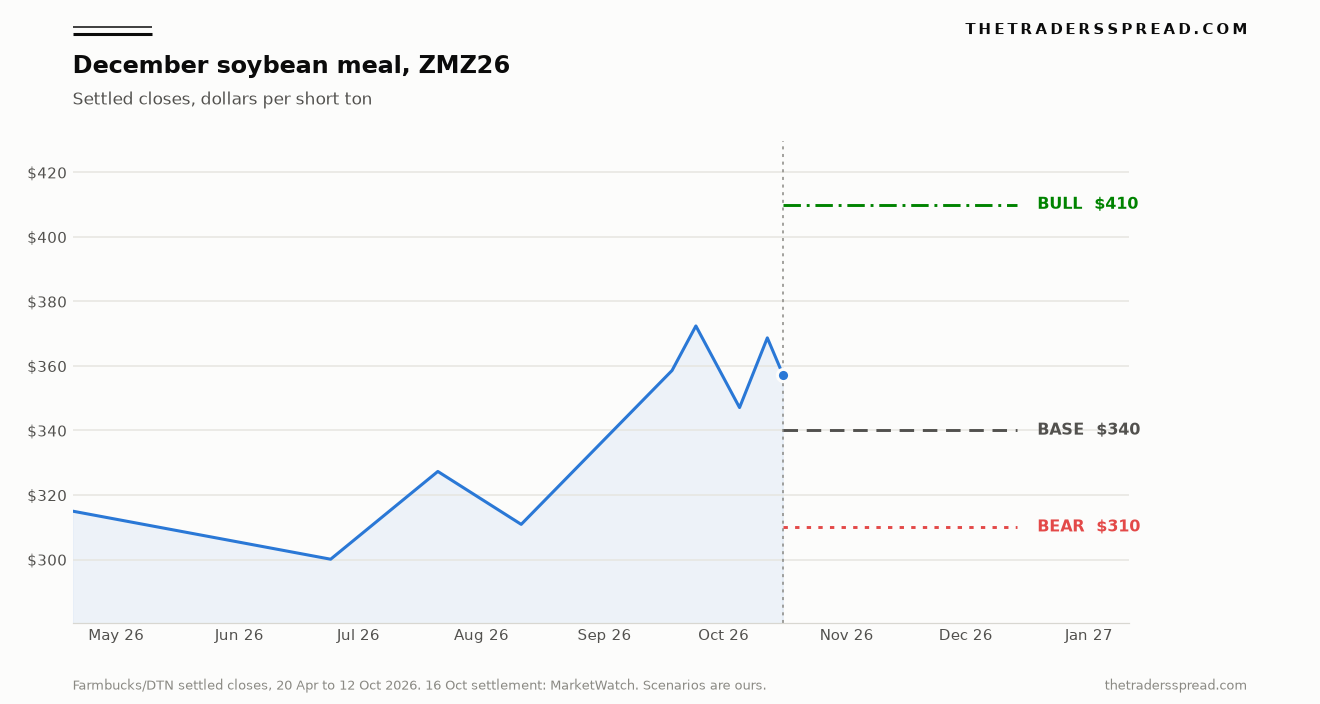
Farmbucks puts Friday 4.1 percent under the settled high. The 20-session range runs from $347.10 on 5 October to $372.40 on 24 September. The 60-session low is $310.90 on 11 August. The 52-week settlement low is $300.10 on 24 June. August to September covered $61.50, so a push from $357.10 toward $410 has a precedent and would still be a new high. MarketWatch's intraday 52-week range is $299.10 to $376.90. The settlement high is the $372.40, not the $376.90.
| Reference | Level | Versus the $357.10 settlement |
|---|---|---|
| 16 October 2026 settlement, ZMZ26 | $357.10 | The anchor |
| USDA 2026/27 season-average price | $340 | $17.10 below |
| October 2027 last trade, 16 October | $343.30 | $13.80 below |
| 24 September settlement high | $372.40 | $15.30 above |
| 11 August settlement low | $310.90 | $46.20 below |
| 24 June settlement low | $300.10 | $57.00 below |
| Bull case | $410 | $52.90 above |
| Base case | $340 | $17.10 below |
| Bear case | $310 | $47.10 below |
The forward curve, using MarketWatch lasts around 1:19 p.m. CDT on 16 October rather than settlements, is inverted out of December. January 2027 last traded at $354.70, July at $355.40, October 2027 at $343.30 and December 2027 at $344.80. Farmbucks's chain, a separate feed, had October 2027 at $343.20. A dime. By October 2027 the board is already within a few dollars of USDA's $340. December is the expensive month, not the market's opinion of the year.
Friday opened at $359.80 and traded $354.10 to $359.80, never above the previous settlement. Farmbucks showed a $357.30 bid and ask on the same 1:19 p.m. stamp, then a closed market until Sunday at 19:00 CT.
A crush report that undercut the tight-stocks story
If 0.67 percent stocks-to-use were the whole story, September crush would have been defended. It was not. The National Oilseed Processors Association reported September crush at 196.3 million bushels, a 13-month low, Bruce Blythe, Senior Editor, Commodities at Farm Futures, wrote on 16 October. Crush was down 4.5 percent from August and 0.8 percent from September 2025. StoneX, in that report, called it the first year-on-year decline in 18 months. Blythe's at-a-glance line said the figure came in sharply below expectations. The prices in his column were the 6:55 a.m. CDT overnight market, so they are not the settlement used here.
One soft month does not rewrite a 2,780-million-bushel crush forecast. It does retire the idea that the plant gate is bid every week. USDA held meal production at 65.800 million short tons on the assumption that crush runs. A second light month would make that the number which has to fall. The thin residual was never the scarce part. The crush rate was the assumption under it.
Processors are the commercial short, still 358,000 net short on 13 October. A slower crush can mean less meal to hedge, which is how that position shrinks without a rally. The latest week did not show it. The miss and the short can coexist until the miss repeats and the funds treat the premium as optional.
Neighbouring boards are not meal forecasts. Canola is a separate oilseed, quoted in Canadian dollars. Rough rice had its own soft session in our pages. Neither figure belongs on the soybean meal balance. October has been a month for giving back grain rallies. That is context, not a template for where ZMZ26 must print.
Argentina's extra meal, and a quiet China
October edited the world table, not the US one. Argentina's meal production rose from 33.11 million metric tons to 33.50, exports from 29.60 to 30.00, ending stocks to 3.02. Brazil's production stayed at 50.01 and its exports at 27.10, with ending stocks up from 3.84 to 3.96 on higher beginning stocks. China was unchanged: domestic use 86.85 million metric tons, ending stocks 1.28. The extra meal is South American supply.
China's 86.85 million metric tons of domestic use did not change, so October found neither a new appetite nor a retreat. The bearish increment is Argentina's extra 0.40 million metric tons of exports, plus 0.24 million on world stocks. That is the cargo which competes with US meal when the US premium is wide. Turner's September line described a year of record US meal exports. The forward sheet now hands Argentina more to sell.
Jerry Gulke, president of The Gulke Group, told Michelle Rook on 16 October that grain prices have to fall far enough to find demand. "To stop going down the grain markets will need to see a production problem in Brazil and so far, it looks like a decent start to the season," he said. China keeping a 10 percent tariff, and stopping at 25 million metric tons of soybeans, "likely put the top in," in his words. He was talking about the grain complex. His recap still had December soybean meal $8.50 lower on the week.
Conab, inside that same piece, put Brazil's 2026/27 soybean crop at 181.62 million metric tons, up from 180.4 million. Beans are not the asset here. The figure matters only as the seed of the crush USDA just raised. Gulke added that El Nino talk had not yet become a production threat, and that Brazilian planting was at a record pace. A decent start is not a finished crop. It is enough to keep $410 off a weather premium no one can point to yet.
RelatedTungsten Price Prediction: 550,000 Yuan Bull vs 420,000 Bear
Base, bull and bear into 14 December
The base case is $340 a short ton: USDA's 2026/27 season average, and the neighbourhood where October 2027 already trades. From $357.10 that is a give-back of $17.10, about 4.8 percent. No demand collapse is required. December only has to stop charging a premium the rest of the board will not pay, between now and the 14 December expiry. We put the most weight here. October's WASDE could have lifted the average. It did not.
The bull case is $410, $52.90 above the settlement and $37.60 above the 24 September settlement high of $372.40. It also sits $33.10 above the $376.90 intraday extreme on MarketWatch's 52-week range. The August-to-September run covered $61.50, so the distance has a precedent. The October sheet does not fund it. Crush has to refill, exports have to keep the lead Turner described in September, and December has to refuse convergence. A settlement above $372.40 would be the first evidence. We put less weight on $410 than on $340.
The bear case is $310. That is $47.10 under the settlement and $0.90 under the 11 August low of $310.90, still $9.90 above the 24 June low of $300.10. It is a full unwind, not the centre. It becomes the path if a second NOPA month shows that 65.800 million short tons of production was too high, and if the 206,000-contract fund net long shrinks by tens of thousands rather than by 673. Argentine exports of 30.00 million metric tons make that break plausible. They do not make it the base.
A ZMZ26 settlement above $372.40 retires the convergence view. That price is the invalidation. A second soft crush month plus a real cut in the fund net long would make $310 the working case. A November WASDE that lifts the season average through $357 would retire $340, because the official number would then sit above the settlement this piece uses. Until one of those prints, the centre is the $340 the back of the board already shows.
Questions readers actually ask
Which soybean meal contract is this?
December 2026 soybean meal on the Chicago Board of Trade, code ZMZ26, shown as SMZ26 on MarketWatch. The quote is US dollars per short ton. Contract size is 100 short tons, the tick is $0.10, and a one-dollar move is worth $100, on the specification Farmbucks lists beside the Friday quote. Expiry is 14 December 2026. These levels cover the life of this contract, not the whole 2026/27 marketing year behind USDA's $340 average.
Why is the bear case $310 if USDA says $340?
$340 is the base, not the floor. It is a season average, and October 2027 already trades close to it. A bear case has to clear both the $357.10 settlement and that average. $310 sits just under the 11 August low of $310.90 and above the June low of $300.10: a full give-back of the late-summer rally, not the price the sheet currently points at.
Does 0.67 percent stocks-to-use mean meal is scarce?
It means the residual is small beside use. Stocks of 450,000 short tons against 66.800 million cover about two and a half days. That can gap a price for a week. It did not lift USDA's average off $340, and October 2027 still traded at $343.30. A thin pipeline and a $340 average can both be true. September's crush miss is the test.
What did the September crush miss change?
September crush of 196.3 million bushels was a 13-month low, down 4.5 percent on the month and 0.8 percent on the year, StoneX told Farm Progress on 16 October. One month does not rewrite the 2,780 million bushel forecast. It does drop the claim that the plant gate is continuously bid. A second soft month would put 65.800 million short tons of meal production in doubt. Until then it is a warning.
When does December soybean meal stop trading?
Farmbucks lists ZMZ26 as expiring on 14 December 2026, the business day before the 15th of the contract month. The chart runs bull, base and bear out to that date. The call is for this contract, not for October 2027, which already trades near $343. After expiry the relevant price is a later month, and the $17 premium either will have been paid or given up.
Is this a recommendation to trade soybean meal?
No. The levels are an analytical range around a settlement we opened, not an instruction. Base $340, bull case $410, bear case $310, with invalidation on a settlement above $372.40. Futures can travel through any of those prices. Nothing here is a solicitation, and capital put into this contract can be lost.
This is analysis, not advice. Soybean meal futures are volatile, the settlement used here is a delayed exchange print, and capital is at risk.