

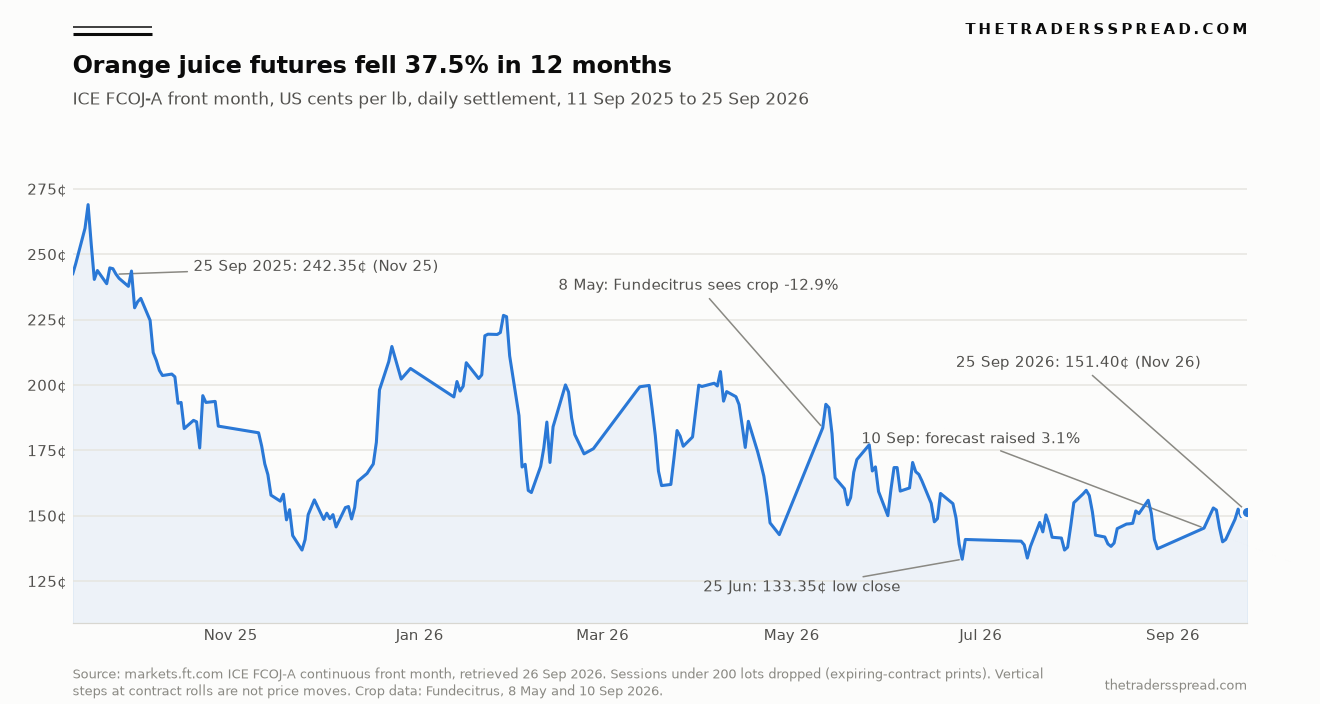
Orange juice futures on ICE settled at 151.40 US cents a pound on Friday 25 September 2026, down 37.5% from the 242.35 cents the front-month contract settled at on 25 September 2025. Over the same twelve months, Brazil's crop watchdog Fundecitrus told the market that the São Paulo and Minas Gerais citrus belt, the largest single source of the world's traded orange juice, will produce 10.2% fewer oranges this season than last. A smaller crop from the dominant supplier and a price that lost more than a third of its value do not sit comfortably together. Commodity textbooks say scarcity lifts prices. This market did the opposite, and it kept falling after the May forecast confirmed the shortfall. The resolution is not a data error or a speculative flush. It sits in a number most price commentary skips: how much juice was already sitting in Brazilian tanks before this season's first orange was picked.
Here is the piece the headline comparison misses. The 10.2% cut is measured against the 2025-26 season, which Fundecitrus finalised at 292.94 million boxes, a rebound of 26.9% from the 230.9 million boxes of 2024-25. The juice from that bumper year is what the market is trading. CitrusBR, the exporters' association, reported audited global stocks of Brazilian juice at 616,460 tonnes of FCOJ-equivalent on 31 December 2025, up 75.4% in a year. This season's "smaller" crop of 263.15 million boxes is still 14.0% larger than the 2024-25 harvest, which CitrusBR called the smallest in more than 30 years. Brazil is short of last year's oranges, not short of juice.
- ICE FCOJ-A front month settled at 151.40¢/lb on 25 Sep 2026 versus 242.35¢ on 25 Sep 2025, a fall of 37.5% — markets.ft.com daily history, retrieved 26 Sep 2026
- Fundecitrus raised its 2026-27 citrus belt forecast by 3.1% to 263.15 million boxes, still 10.2% below the 292.94 million of 2025-26 — Fundecitrus forecast update, 10 Sep 2026
- Audited Brazilian juice stocks reached 616,460 tonnes FCOJ-equivalent on 31 Dec 2025, up 75.4% from 351,483 tonnes — CitrusBR, published 4 Mar 2026
- Florida's 2025-26 all-orange crop was put at 12.92 million boxes, up 5.2% on 2024-25 and about 4.9% of the Brazilian belt's forecast volume — USDA NASS, 10 Jul 2026
- Non-commercial traders held a net long of 700 FCOJ contracts on 22 Sep 2026, down from 2,841 a year earlier, while open interest rose 18.5% to 9,571 — CFTC Commitments of Traders, 22 Sep 2026
- US retail orange juice prices ran 8.5% above the prior crop year with volumes down 6.4% — Rabobank Brazil Agribusiness Quarterly citing Nielsen data published by the Florida Department of Citrus, reported 21 Sep 2026
Reading the 37.5% without the roll noise
The number in the headline compares two November contracts, each observed on the same calendar day as the front month: the November 2025 contract on 25 September 2025 and the November 2026 contract on 25 September 2026. That symmetry matters because the continuous orange juice series is unusually noisy. ICE lists six contract months (January, March, May, July, September and November), and the exchange's contract specification sets the last trading day 14 business days before the last business day of the delivery month. Each switch from an expiring contract to the next one can produce a vertical step that no trader actually experienced.
Two of those steps are large enough to mislead. Between the last liquid May-contract session on 27 April (142.75¢) and the first July-contract session on 11 May (183.60¢), the continuous series jumps 28.6%. Between the thinly traded September contract's last print on 10 September (125.75¢ on zero reported volume) and the November contract's first front-month session on 11 September (145.25¢), it jumps again. Neither is a rally. Both are artefacts of the rollover between contracts that were priced differently all along.
The same caution applies to the 52-week low that data vendors now quote. The FT tearsheet shows a range of 116.50 to 254.95 cents. The 116.50 was an intraday low on 31 August 2026 in the expiring September contract, on 81 lots. Strip out sessions under 200 lots and the lowest settlement in the window is 133.35¢ on 25 June 2026.
| Measure | Sep 2025 | Sep 2026 | Change |
|---|---|---|---|
| FCOJ-A front-month settlement (25 Sep) | 242.35¢ | 151.40¢ | -37.5% |
| Citrus belt crop, million boxes (season) | 292.94 (2025-26 final) | 263.15 (2026-27 forecast) | -10.2% |
| Florida all oranges, million boxes | 12.28 (2024-25) | 12.92 (2025-26) | +5.2% |
| FCOJ open interest (CFTC) | 8,076 (23 Sep) | 9,571 (22 Sep) | +18.5% |
| Non-commercial net position | +2,841 | +700 | -75.4% |
Price series: markets.ft.com historical prices for ICE FCOJ-A (xid 1067048), retrieved 26 September 2026 09:12 UTC. Crop: Fundecitrus and USDA NASS. Positions: CFTC.
The tanks filled before the trees thinned
Orange juice is a storable commodity in a way that fresh fruit is not. Frozen concentrate and not-from-concentrate juice move from Brazilian processing plants into bulk storage, onto dedicated tankers and into terminals in Europe and the United States. A season's crop therefore feeds the market over many months, and the price of the front-month contract responds to the whole pipeline: fruit on the trees, juice in storage, and what bottlers are willing to purchase at the shelf price they have to set.
On that pipeline measure, 2025-26 was a refill year. CitrusBR's September 2025 statement put audited stocks at just 146.3 thousand tonnes on 30 June 2025, which the association itself described as among the lowest in its records, after a 2024-25 season in which only 194.8 million boxes were processed. Six months of processing the 292.94-million-box crop later, the 31 December 2025 audit showed 616,460 tonnes. The two dates are different points in the seasonal cycle, so the fair comparison is December to December: 616,460 tonnes against 351,483 tonnes, the 75.4% rise CitrusBR published. We could not find a CitrusBR audit for 30 June 2026 on the association's release pages as of 26 September, so the December figure is the latest audited level.
Prices responded to that rebuild long before Fundecitrus published a word about 2026-27. The front month had already settled below 145 cents by 21 November 2025. When the May forecast of 255.2 million boxes arrived, it described a crop that was smaller than the previous one but still bigger than the one that caused the squeeze.
Rabobank's reading, published in its Brazil Agribusiness Quarterly and reported by Citrus Industry on 21 September, was that the market understands stocks are back close to normalised levels. The bank put the price processors paid for spot fruit at BRL 31 a box in August, up from BRL 25 in May but still below production costs for a significant share of growers.
What the growers said, in Brazil and in Florida
The people closest to the trees have been describing a different problem from the one the futures price describes. "This is a crop season impacted by climatic variability and increased pressure from greening disease, with repercussions on fruit set, crop load and fruit drop rates," said Juliano Ayres, executive director of Fundecitrus, when the May forecast was released (Citrus Industry, 8 May 2026).
The September update partly softened that. Rainfall across the belt from May to August reached 210 millimetres, 51% above the 1991-2020 average, and fruit grew heavier: the crop now needs 246 oranges to fill a 40.8-kilogram box, against 255 in the May estimate. The early Hamlin, Westin and Rubi group was raised 7.1%. Yet the premature drop rate also rose, from 23.7% to 24.1%, because the harvest was running late (only 27% picked by mid-August) and fruit hung on trees through a wet winter with greening, leprosis and canker all above historical levels. Larger fruit, more of it on the ground. That is the texture behind a 3.1% upgrade.
Greening, the bacterial disease that has hollowed out Florida, is not getting cheaper to fight in Brazil. Fundecitrus's 2026 survey put incidence at about 48% of belt trees, with the year's increase of 0.45 percentage points the smallest in nine years, according to FreshFruitPortal's report of the survey on 3 September. Severity in producing orchards still rose, from about 26% to 31%. "The increase in plants in a very serious stage is mainly related to the low eradication rate of diseased plants in older orchards," said Renato Bassanezi, a researcher at Fundecitrus, in the same report. Ayres was blunter: "We cannot consider the war against citrus greening won."
Florida's story runs the other way, and it is almost irrelevant to price. USDA NASS closed the 2025-26 season on 10 July at 12.92 million boxes of all oranges, up 6% from its April forecast and 5.2% above 2024-25. "This final citrus crop estimate of the season is exciting to see, and it's encouraging to end a season marked by historic freezing on a positive note," said Matt Joyner, executive vice president and chief executive officer of Florida Citrus Mutual (Citrus Industry, 10 July 2026). Both regions report in 90-pound boxes, and Florida's crop equals roughly 4.9% of the Brazilian belt's forecast. The contract settles against US Grade A juice, but the swing supply that sets its price is Brazilian.
A thin contract with fewer believers
FCOJ is one of the smallest futures markets on any major exchange. Each contract covers 15,000 pounds of orange juice solids, so at 151.40 cents one lot is worth about $22,710, and the 9,571 contracts of open interest the CFTC counted on 22 September amount to roughly $217 million of notional exposure. Volume on Friday's session was 406 lots. A handful of orders can move the tape several cents in minutes, and why the 146.90-to-153.50 intraday range on 25 September was unremarkable.
The positioning shift over the year is the clearest sign that speculative money read the stock rebuild early. Non-commercial traders, the CFTC's legacy category for funds and other non-hedgers, held 3,805 longs against 964 shorts on 23 September 2025, a net long of 2,841. On 22 September 2026 they held 4,570 longs against 3,870 shorts: net long 700. Longs rose by 765 contracts. Shorts rose by 2,906, while total open interest climbed 18.5%. A market can fall 37.5% with rising participation when the new participants are sellers.
Retail demand has not rushed in to absorb the cheaper juice either, because shoppers have not seen it yet. Rabobank, citing Nielsen data published by the Florida Department of Citrus, put US retail orange juice prices 8.5% above the previous crop year with volumes down 6.4%. Shelf prices lag futures by months. The desk has tracked the same squeeze on household budgets at the pump, where US gasoline rose to $4.478 this week, and in the cost of moving goods by air, covered in our note on Gulf Coast jet fuel. Juice is a discretionary line on that receipt.
What would reverse the pattern
The case against the stocks explanation deserves a fair hearing. Three developments would weaken it.
First, a much weaker late crop. Valencia, Folha Murcha and Natal, the late varieties, make up 105.37 million of the 263.15 million boxes and were at most 1.2% harvested by mid-August. Fundecitrus left their estimates unchanged because it had almost no harvest data. Its next update, due on 10 December 2026, will be the first read on whether the wet winter and heavy drop hit those groves harder than assumed.
Second, weather for the next crop. Rabobank flagged a possible strong El Niño, dry spells at the end of winter and prolonged heat as risks to flowering for 2027-28, and said low grower margins and reduced investment make a lower crop next year likely. A market with 616,460 tonnes of December stocks can absorb one short season. Two in a row would be a different conversation.
Third, demand turning faster than shelf prices suggest. If bottlers start passing lower juice costs to retail, volumes could recover and pull stocks down faster. USDA's first Florida forecast for 2026-27, due at 12:00 ET on 9 October 2026, will matter less for supply than for the tone it sets in US trade.
RelatedTungsten Price Prediction: 550,000 Yuan Bull vs 420,000 Bear
Other soft commodities have shown how quickly a Brazil crop number can reset a price. Our coffee note on StoneX's 77.2-million-bag estimate and the sugar outlook both turned on Brazilian crop estimates.
What this changes
For anyone reading the orange juice market from the crop headlines, the September record rewrites the order of cause and effect. The fall from 242.35 to 151.40 cents between 25 September 2025 and 25 September 2026 was not a reaction to this season's harvest. It was the unwinding of a shortage that ended when the 292.94-million-box 2025-26 crop was processed and Brazilian stocks rebuilt to 616,460 tonnes by the end of 2025. The 2026-27 forecast of 263.15 million boxes is smaller than that crop, larger than 2024-25's, and was revised up on 10 September rather than down.
Three practical consequences follow. The first concerns what to watch: the CitrusBR stock audit and the processing yield it publishes carry more price information than the tree count, and the most recent audited figure is nine months old. The second is about how to read the chart. The front-month continuous series contains roll gaps of up to 28.6%, and the widely quoted 116.50-cent low was set on 81 lots of an expiring contract; any study of this market that does not handle the roll will find rallies and crashes that did not happen. The third is about exposure size. With $217 million of notional open interest and 406 lots traded on the last session, a single large order can move this price by more than a crop revision.
The November 2026 contract has risen 4.2% since its first front-month settlement on 11 September (145.25¢), the day after Fundecitrus raised its estimate. That is a small, contradictory move in its own right: a bigger crop forecast, followed by a firmer price. It is consistent with a market that had already priced the supply and is now watching demand, the late-variety harvest and the 10 December update. It does not tell us the direction of the next move, and we make no forecast of it here.
FAQ
Why did orange juice futures fall when Brazil's crop got smaller?
Because the market prices juice supply, not only fruit on trees. The 2025-26 Brazilian crop of 292.94 million boxes rebuilt stocks to 616,460 tonnes FCOJ-equivalent by 31 December 2025, up 75.4% year on year according to CitrusBR. The 2026-27 crop is 10.2% smaller than that bumper season, but still 14.0% larger than the 2024-25 crop, the smallest in more than 30 years.
How much did orange juice futures fall, and over what window?
The ICE FCOJ-A front-month contract settled at 242.35 cents a pound on 25 September 2025 and at 151.40 cents on 25 September 2026, a fall of 37.5%. Both observations are November contracts on the same calendar date, which avoids comparing different points in the roll cycle. The data come from markets.ft.com daily history, retrieved on 26 September 2026.
Is the 116.50-cent 52-week low real?
It is a real print, but not a representative one. It was the intraday low on 31 August 2026 in the expiring September contract, on a session of 81 lots. Excluding sessions under 200 lots, the lowest settlement between September 2025 and September 2026 was 133.35 cents on 25 June 2026, in the July contract.
When is the next Brazil orange crop forecast?
Fundecitrus has scheduled its second 2026-27 update for 10 December 2026, a third for 10 February 2027 and the final estimate for 9 April 2027. The December update will be the first with meaningful harvest data for the late Valencia, Folha Murcha and Natal varieties, which account for 105.37 million of the 263.15 million forecast boxes.
Does Florida's orange crop still move the price?
Much less than it once did. USDA NASS put Florida's 2025-26 crop at 12.92 million boxes on 10 July 2026, about 4.9% of the Brazilian citrus belt's current forecast measured in comparable 90-pound boxes. Florida news can still move a thin market for a session, but Brazilian supply and stocks set the level.
Disclaimer
This article is market analysis and a record of published data. It is not investment advice and does not recommend any transaction. Futures are traded on margin and orange juice futures are thinly traded; you can lose more than your initial margin, and your capital is at risk. Figures are as retrieved on 26 September 2026 from the sources named and may be revised.