

The easy story about this month's oats rally, that Statistics Canada ambushed the market with a surprise 22.7% cut to the Canadian crop, does not survive a look at the agency's own tables. The 16 September model-based estimate put 2026 Canadian oat production at 3.03 million tonnes, down from 3.92 million, but most of that decline was locked in back in the spring, when Prairie farmers seeded 2.54 million acres, the second-smallest oat area in a StatCan series that starts in 1908. Yield, the part of the number the weather controls, slipped only 3.5% to 94.7 bushels an acre, still the fourth-highest on record. Chicago moved anyway. December oats on the Chicago Board of Trade settled at 416.25 cents a bushel on Monday 21 September, up 6.5% from 391.00 cents on 15 September, the session before the release, and 34% above the 310.00 cents the December 2025 contract settled at a year earlier.
Two numbers explain why the price move is bigger than the news. The first is that Chicago now sits far above Ottawa's own price forecast. At the European Central Bank reference rate of 1.4004 Canadian dollars per US dollar for 21 September (via frankfurter.dev), 416.25 cents works out to roughly C$402 a tonne, which is 27% above the C$315 a tonne that Agriculture and Agri-Food Canada projected as the average CBOT oat price for the whole 2026-27 crop year in its 20 August outlook. The second is size. The latest oats entry in the CFTC's Commitments of Traders data, for 1 September, shows 3,132 contracts of open interest held by exactly 20 reportable traders. That is about 227,000 tonnes of oats, or 7.5% of the crop StatCan just estimated. A market that small does not need a shock to reprice. A late, wet harvest will do, and the Prairies have one.
Key facts
- Canadian oat production is projected at 3.03 million tonnes in 2026, down 22.7% from 3.92 million tonnes in 2025 — Statistics Canada, 16 Sep 2026
- Harvested oat area is projected down 19.9% to 2.08 million acres and yield down 3.5% to 94.7 bushels per acre — Statistics Canada table 32-10-0359-01, 16 Sep 2026
- CBOT December 2026 oats settled at 416.25 cents a bushel on 21 Sep, up 6.5% from 391.00 cents on 15 Sep — USDA AMS Iowa Daily Grain Bids, 21 Sep 2026, and CNBC daily bars, retrieved 22 Sep 2026
- That settle equals about C$402 a tonne, 27% above AAFC's C$315 a tonne 2026-27 CBOT oat price projection — AAFC outlook, 20 Aug 2026; ECB reference rate, 21 Sep 2026
- AAFC projects 2026-27 Canadian oat carry-out stocks at 0.4 million tonnes, half the 0.8 million tonnes projected for 2025-26 — AAFC, 20 Aug 2026
- Saskatchewan oats were 19% harvested at 14 Sep, with the province's overall harvest at 32% against a five-year average of 71% — Saskatchewan Ministry of Agriculture crop report, 17 Sep 2026
- CBOT oat open interest stood at 3,132 contracts with 20 reportable traders — CFTC Commitments of Traders, report dated 1 Sep 2026
Where 889,000 tonnes of Canadian oats went
Start with the arithmetic, because it is where the misunderstanding lives. StatCan's 2026 estimate of 3,030,964 tonnes is 888,832 tonnes below the 3,919,796 tonnes Canada harvested in 2025. Three things produced that gap, and they are very different in kind.
The largest is a planting decision. Seeded area fell 15.1%, from 2,996,100 acres to 2,544,800, a choice farmers made months before any harvest weather arrived. AAFC's August outlook put the national seeded area 21% below the previous five-year average and called it the second-lowest on record, "surpassing only slightly the level recorded in 2023." Growers had reason to cut: the 2025 crop was big, and AAFC expected 0.8 million tonnes of old-crop oats to be carried into the 2026-27 year that began on 1 August, which it described as the third-highest carry-out in ten years.
The second piece is harvested area, and it is less dramatic than the 19.9% headline suggests. This year 81.6% of seeded oat acres are expected to be harvested for grain. In 2025 the figure was 86.5%, the highest share since 2022. Across 2016 to 2025 the average was 82.3%. So 2026 is roughly normal; last year was the outlier. Some of the reported fall in harvested area is simply a return to the usual share of oats cut for greenfeed or abandoned.
Yield is the smallest piece. At 94.7 bushels an acre, StatCan's model puts 2026 behind only 2025 (98.1), 2022 (97.8) and 2019 (95.1).
| Crop year | Seeded (acres) | Harvested (acres) | Yield (bu/acre) | Production (tonnes) |
|---|---|---|---|---|
| 2021 | 3,711,811 | 2,999,311 | 62.7 | 2,898,619 |
| 2022 | 3,936,700 | 3,464,500 | 97.8 | 5,226,465 |
| 2023 | 2,535,100 | 2,040,400 | 83.9 | 2,643,058 |
| 2024 | 2,899,900 | 2,454,300 | 88.7 | 3,357,551 |
| 2025 | 2,996,100 | 2,591,000 | 98.1 | 3,919,796 |
| 2026 (model, 16 Sep) | 2,544,800 | 2,076,100 | 94.7 | 3,030,964 |
Source: Statistics Canada table 32-10-0359-01, downloaded 22 Sep 2026. Canadian oat yields use a 34-lb bushel; CBOT oat prices use a 32-lb bushel.
Seen in that table, 2026 is not a disaster year. It is larger than 2021, when drought cut the national yield to 62.7 bushels, and larger than 2023. Since 2000 there have been eight smaller Canadian oat crops. Nor was the estimate far from where forecasters already stood: AAFC's August balance sheet assumed production "below 3.0 Mt", and Western Producer analyst Bruce Burnett had pencilled in 3.1 million tonnes after a July crop tour. StatCan landed between them.
The price Ottawa forecast, and the price Chicago is paying
If the crop number was close to expectations, the market's reaction is the part that deserves attention. The chart shows a year of CBOT front-month oat futures. Across that stretch the front month climbed from $3.10 a bushel to $4.16, with a gap in late June that belongs to the contract roll rather than to the crop: the expiring July contract sagged into its first notice day while the series switched to September.
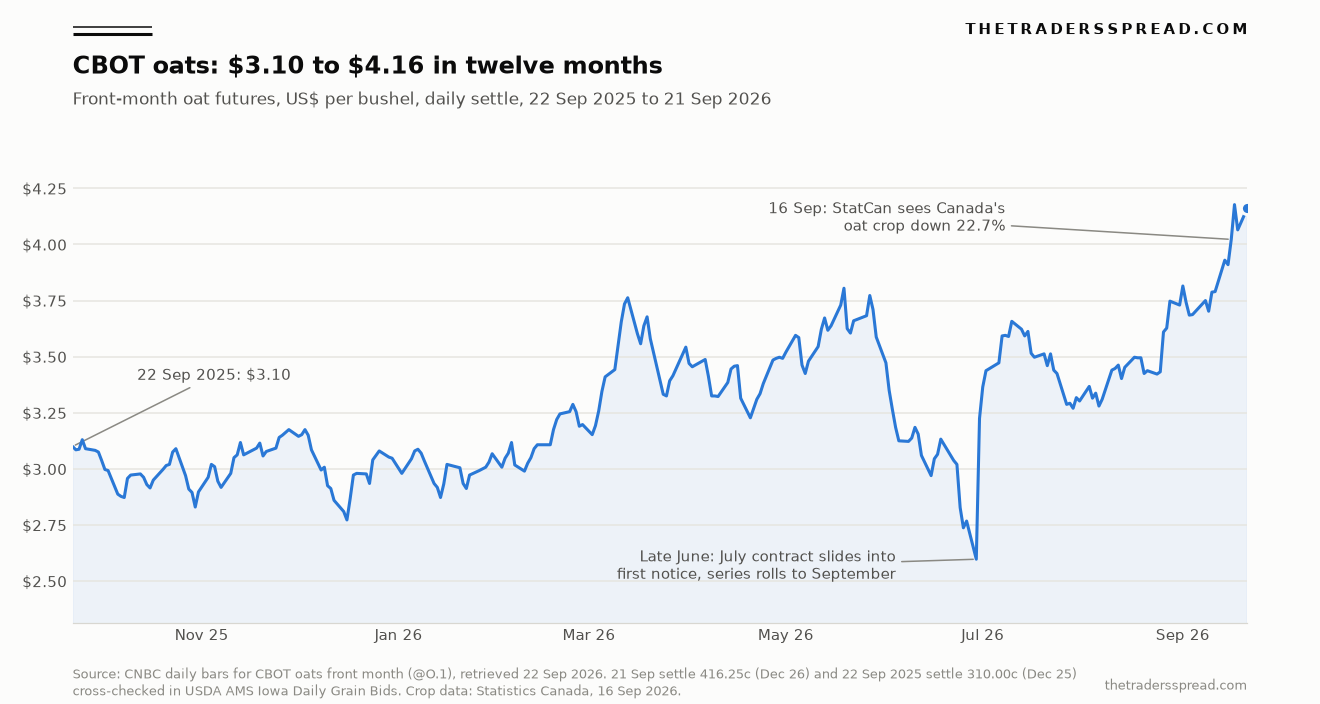
The more useful comparison is against the government's own forecast. AAFC set its 2026-27 average CBOT oat price at C$315 a tonne on 20 August, up just C$8 from the C$307 it finalised for 2025-26. That C$307 checks out against the tape: the front-month settles from August 2025 to July 2026 average about 323 cents a bushel, which converts to roughly C$307 a tonne at about 1.38 Canadian dollars per US dollar, close to the 1.377 ECB reference rate on the day AAFC published. On the same basis, Monday's 416.25 cents is about C$402. The futures curve also slopes upward, with March 2027 at 428.25 cents and May 2027 at 431.50 cents in the same AMS settlement table, so the market is not pricing a quick fade back toward AAFC's number.
| Date | Contract | Settle (cents/bu) | What happened |
|---|---|---|---|
| 22 Sep 2025 | Dec 2025 | 310.00 | Year-ago anchor (Dec 2026 then 350.00) |
| 20 Aug 2026 | Front month | 342.50 | AAFC outlook: C$315/t for 2026-27 |
| 15 Sep 2026 | Dec 2026 | 391.00 | Session before the StatCan release |
| 16 Sep 2026 | Dec 2026 | 402.25 | StatCan: oats down 22.7% |
| 17 Sep 2026 | Dec 2026 | 417.75 | Saskatchewan: harvest 32% complete |
| 21 Sep 2026 | Dec 2026 | 416.25 | Latest settle |
Sources: USDA AMS Iowa Daily Grain Bids for 21 Sep 2026 and 22 Sep 2025; CNBC daily bars for the other dates, retrieved 22 Sep 2026.
One detail in that table matters more than the rest. A year ago, the December 2026 contract already traded at 350.00 cents, so the market was pricing a tighter year well before anyone knew the acreage. Since then it has added another 18.9%. Grain bulls elsewhere in the complex have had their own drivers, from Black Sea logistics in wheat to a record US crop weighing on soybeans, and oats have historically taken cues from corn as a feed-grain substitute. This September's move is specific to oats.
Twenty traders
Oats trade in a thin corner of the Chicago grain complex, and the positioning data shows it. The CFTC's legacy futures-only report for 1 September lists 3,132 contracts of open interest, each for 5,000 bushels. Non-commercial traders held 737 contracts long and 642 short, a net long of just 95. Commercial participants were 389 long and 1,543 short. The previous oats entry in the CFTC dataset is dated 2 June, when open interest was 4,630 contracts and the speculative net long stood at 910.
Two readings follow. Speculators were not crowded into the long side going into September, so the rally was not a squeeze of an obviously one-sided position, at least on the last data the CFTC published. And with 20 reportable traders in total, liquidity is thin enough that a handful of orders can move a daily settle by several cents, which is the practical meaning of an illiquid market. Both points argue against reading any single session, including the 15.50-cent jump on 17 September, as a verdict on the crop.
Thinness cuts both ways, and it is also why the move could reverse as quickly as it came.
The rain StatCan's satellites could not see
StatCan's September figures are model estimates built from satellite vegetation indices and agroclimatic data "as of August 31," in the agency's words. Everything that happened to the crop in September sits outside the number. That is where the live risk is.
The Saskatchewan crop report released on 17 September said widespread rain had "stalled harvest operations," with the province 32% harvested against a five-year average of 71% and a 10-year average of 63%. Oats were 19% combined. The Rural Municipality of Sarnia logged 97 millimetres of rain in the week, and the Rural Municipality of Aberdeen, the area where the photograph above was taken, logged 80. The ministry reported that "excessive rainfall received in many areas affected grain quality," and the grades it published for other cereals show the damage: 18% of harvested barley graded as malt, against a 10-year average of 31%.
Oats were not graded in that report. Milling buyers pay for plump, bright kernels and heavy test weight, the attributes a crop standing in wet swaths tends to lose, so the question for the market is less how many tonnes Canada grows than how many of them meet a mill's specification. Saskatchewan is the country's largest oat province, with more than 40% of the national area according to AAFC.
Heat earlier in the summer may also have cost more than the model registered. "The heat in July hurt the crop more than we were anticipating," Jerry Klassen, analyst at Resilient Capital, told Reuters on the day of the release, speaking about the Canadian crop broadly after StatCan's wheat figure came in below his expectations.
South of the border the offset is small. The USDA's August Crop Production report forecast the US oat crop at 68.4 million bushels, down 2% from 2025, with record yields forecast in Iowa, Michigan and Minnesota. That is roughly 0.99 million tonnes, about a third of Canada's crop. Put the two estimates together and North American oat production falls about 18% year on year, from roughly 4.93 million tonnes to 4.02 million.
The buyer who expected no fireworks
The strongest case against reading too much into the rally comes from the buy side. In July, before StatCan had published a single production figure, Scott Shiels, grain procurement manager at Grain Millers, told Glacier FarmMedia that a smaller crop would not make for a wild market. "Supply is going to be tighter than it has been the last few years, but it's not going to be crazy unless we have some kind of disaster between now and harvest," Shiels said at the Ag in Motion show in Langham, Saskatchewan. At the time his company was offering $4 a bushel into January. "The price guys are seeing today, that's probably the floor," he said.
His argument rested on the carry-in: 0.8 million tonnes of good-quality old-crop oats, by AAFC's estimate, cushioning a steep acreage cut through the end of the calendar year, with any real tightness pushed into the back half of the 2026-27 crop year. He put $5 a bushel as roughly the top end in a disaster scenario, and said a widespread disaster looked unlikely given how the crops then looked.
Nothing StatCan published contradicts him. The yield estimate is close to the "average to above" he described in July, and total supply, using AAFC's framework, still comes to about 3.7 million tonnes. Demand is the other variable. AAFC expects exports to slip to 2.35 million tonnes in 2026-27 from 2.4 million, and the United States took almost 80% of Canada's raw oat exports in the first eleven months of 2025-26. AAFC already expects total domestic use, particularly feed use, to fall in 2026-27 because supplies are smaller, and a price that runs well ahead of competing feed grains would only add to that pressure.
RelatedAntimony Price Prediction: 112,000 Yuan Bull vs 94,000 Bear
What this changes
StatCan's release changed less than the price suggests, and the price changed more than the balance sheet can yet justify. That gap is the story to track.
The first thing that has to move is the official forecast. AAFC's next monthly outlook will either lift its C$315 a tonne crop-year price toward the C$400-plus that the futures curve now implies from December through May, or it will stand by a number the market has already left 27% behind. Either answer is informative. A large upward revision would confirm that the ministry reads the tightness the way Chicago does; a small one would say the futures are pricing harvest weather, not the balance sheet.
The second checkpoint is the USDA's Small Grains Annual Summary, which NASS publishes at the end of September and which replaces the August US oat forecast with an end-of-season estimate. A US crop above 68.4 million bushels would add supply to the market that receives most of Canada's exports.
The third is the harvest itself. If the Prairies dry out and Saskatchewan's pace catches up toward its averages, the weather premium built into the week of 15 September has little to hold it. If the rain persists and quality reports for oats start showing the same downgrades as barley and durum, milling-grade supply could tighten beyond anything in StatCan's tonnage.
What would change this read: evidence that yields are falling well below 94.7 bushels, such as provincial harvest reports showing oat yields in the 80s, would turn an acreage story into a production shock. The definitive answer arrives on 4 December, when StatCan publishes its survey-based final estimate for 2026.
FAQ
Why did oat futures rise after the Statistics Canada report?
CBOT December oats rose 6.5% between the 15 September settle and the 21 September settle, to 416.25 cents a bushel. StatCan projected Canada's crop 22.7% smaller, but most of that was already known from spring acreage data. The timing also coincided with a harvest delay in Saskatchewan, where rain stalled combining and the province was only 32% harvested at 14 September.
How big is Canada's 2026 oat crop compared with past years?
StatCan's model puts it at 3.03 million tonnes. That is well below the 3.92 million tonnes of 2025 and the 5.23 million of 2022, but larger than 2021 at 2.90 million and 2023 at 2.64 million. Eight Canadian oat crops since 2000 were smaller. The final, survey-based estimate is due on 4 December 2026.
What is the official Canadian price forecast for oats?
Agriculture and Agri-Food Canada's 20 August outlook projected the 2026-27 crop-year average CBOT oat price at C$315 a tonne, up from C$307 in 2025-26. At the 21 September exchange rate, December futures at 416.25 cents equal about C$402 a tonne, roughly 27% above that forecast.
Why are oat futures so volatile?
The contract is small. The CFTC's 1 September data showed 3,132 contracts of open interest and 20 reportable traders, equal to about 227,000 tonnes of oats. With that little depth, a few orders can move the settle by several cents, and moves can reverse quickly. Contract rolls also create jumps in continuous price charts that are not real price changes.
Does the US oat crop offset Canada's decline?
Only slightly. USDA forecast the 2026 US oat crop at 68.4 million bushels in August, down 2% from 2025, or about 0.99 million tonnes. Canada produces roughly three times as much. Combined North American output is down about 18% on the year, and the US remains the largest buyer of Canadian oats.
This article is analysis and information only, not investment advice or a recommendation to trade any instrument. Futures and other leveraged products carry a high risk of loss, and you can lose more than your initial capital. Prices and data are as of the dates stated and may have changed.