

I have been pulling the westmetall LME tin table most Sunday mornings since the Wa State suspension took Man Maw offline in 2023, and this weekend the number that stopped me was not the price. Tin cash settled at $53,600 a tonne on 18 September 2026, which is a perfectly ordinary print in a year that has ranged from $41,700 to $57,525. The arresting figure sat two columns to the right: LME warehouse stock of 4,855 tonnes. That is the lowest reading of 2026, and it is down from 9,025 tonnes as recently as 17 June. Against world mine production of roughly 290,000 tonnes a year, the entire visible exchange inventory of the metal that solders every circuit board on earth now amounts to about six days of mine supply.
Here is what almost nobody writing about that inventory number has bothered to check. The tin forward curve is not confirming it. On 18 September, cash settled $100 below three-month metal. That is a contango, and a market in contango is a market that will pay you to wait. The four deepest backwardations of 2026 all occurred with LME stocks between 7,130 and 8,720 tonnes, which is 47% to 80% above today's level. The relationship that the squeeze thesis depends on has inverted this year, and understanding why is worth more than another chart of falling tonnes.
Key facts
- LME tin cash settled at $53,600/t on 18 September 2026, up 27.5% from $42,050 on 2 January — westmetall LME Sn cash table, retrieved 20 September 2026
- LME tin stock stood at 4,855 t, the lowest of 2026 and 46.2% below the 9,025 t of 17 June — westmetall, retrieved 20 September 2026
- Cash traded $100 under three-month metal on 18 September, a contango rather than a squeeze — westmetall, retrieved 20 September 2026
- Myanmar mine output fell to an estimated 12,000 t in 2025 from 34,000 t in 2023 — USGS Mineral Commodity Summaries 2026
- Alphamin's Q2 2026 all-in sustaining cost was $19,043/t sold against a realised tin price of $51,957/t — Alphamin Resources, 13 July 2026
- World mine production was an estimated 290,000 t in 2025, led by China at 71,000 t and Indonesia at 61,000 t — USGS Mineral Commodity Summaries 2026
- Tin is set to become the first commodity traded on Indonesia's new ICOMEX exchange from 4 January 2027 — International Tin Association, 17 September 2026
The curve is arguing with the warehouse
An exchange inventory is a residual. It measures the metal nobody wanted badly enough to take somewhere else, and it falls for two very different reasons that produce opposite price outcomes. Either consumers are scrambling and pulling warrants because they cannot source units, which shows up instantly as a backwardation, or the metal has simply migrated off-warrant into Chinese bonded stock and consumer sheds because the flat price is high enough to make holding it worthwhile. Only the first is a squeeze. The second is a redistribution, and it leaves the visible number looking alarming while the physical market stays comfortable.
The 2026 spread record says tin is doing the second thing.
| Date (LME settlement) | Cash | Cash vs 3-month | LME stock |
|---|---|---|---|
| 5 February 2026 | $46,700 | +$500 | 7,130 t |
| 12 February 2026 | $49,500 | +$400 | 7,490 t |
| 2 March 2026 | $57,200 | +$300 | 7,470 t |
| 27 March 2026 | $44,850 | +$300 | 8,720 t |
| 18 September 2026 | $53,600 | −$100 | 4,855 t |
Read the last row against the four above it. Every one of the year's genuine tightness episodes arrived when warehouses held far more metal than they hold now. Across the 27 sessions in 2026 when LME stock sat at or below 5,500 tonnes, the average cash-to-three-month spread was minus $170. The inventory drawdown of the past three months has been steady, it has been large, and the forward curve has declined to care.
Realised volatility tells the same story from another angle. Tin's annualised volatility across all of 2026 was 47.4%, a number inflated by the violent February and March swings. Over the most recent 60 sessions it collapsed to 18.5%. The metal is at its quietest of the year at the exact moment its visible inventory hit the year's low. Whatever is draining the warehouses is not frightening anybody. The same divergence between a headline stock figure and the curve that prices it showed up on the zinc desk earlier this month, where backwardation collapsed from $217 to $79 while stocks rose, and in reverse when aluminium stocks halved to 244,525 tonnes.
Price, levels and the shape of the year
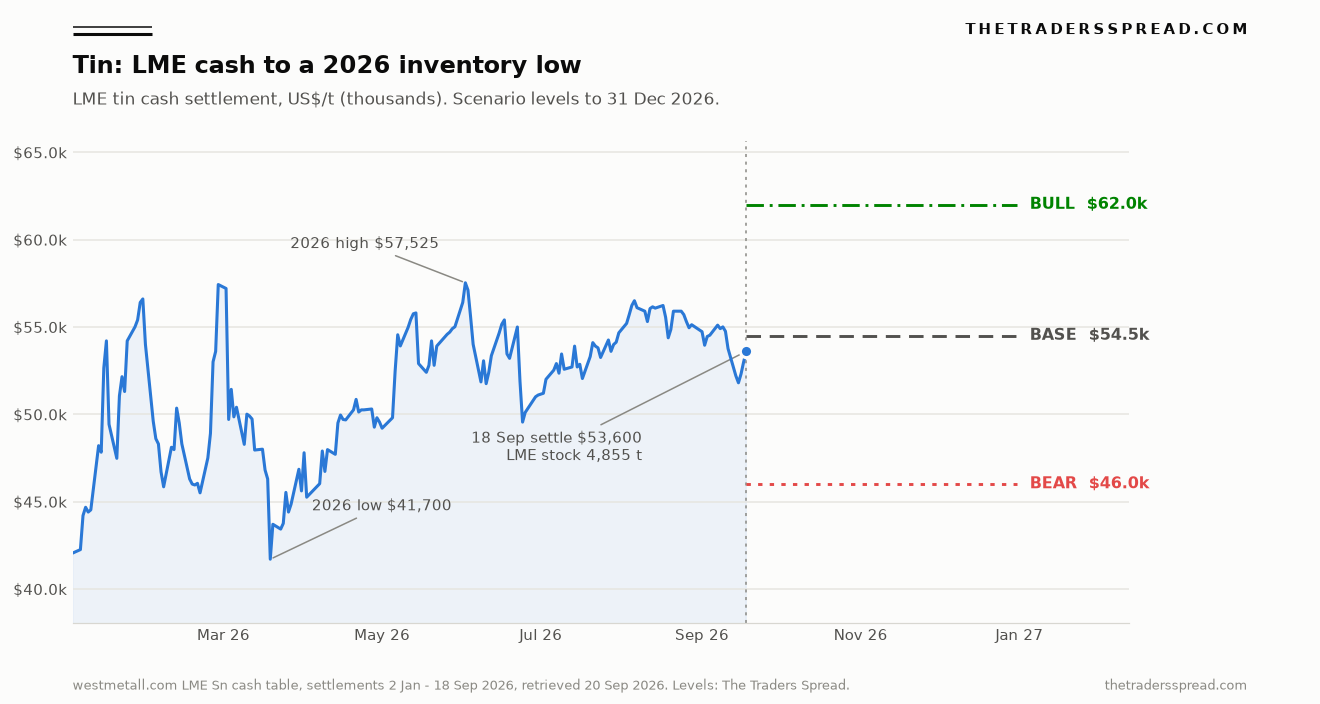
Tin has had a good year by any measure. Cash has appreciated 27.5% since the 2 January settlement of $42,050. The trough came on 19 March at $41,700 and the peak on 2 June at $57,525, and the metal has spent the subsequent three months oscillating in a band roughly $4,000 wide without threatening either extreme. The IMF global tin price series carried by FRED corroborates the level independently, averaging $52,882 a tonne in July against $53,102 on my own reading of the daily LME settlements for the same month.
| Scenario | Level (LME cash) | Change from $53,600 | What it requires |
|---|---|---|---|
| Bull | $62,000 | +15.7% | Stock below 3,500 t with the curve flipping to a sustained backwardation |
| Base | $54,500 | +1.7% | Man Maw ramps slowly, Indonesian exports steady, curve stays flat |
| Bear | $46,000 | −14.2% | Myanmar concentrate returns toward 2023 volumes and off-warrant metal reappears |
A word on why the bull case sits above the June high. Breaking $57,525 requires something the market has not seen in 2026, which is warehouse tightness that the spread actually validates. The level is reachable, but it is not the path of least resistance from a contango.
Flooded adits in the Wa hills
The single largest variable in tin is a mining complex most traders could not place on a map. Man Maw, in the autonomous Wa region of Myanmar, accounted for the bulk of national output before its operators suspended work in August 2023. The consequence is visible in the USGS series: Burma produced an estimated 34,000 tonnes in 2023, about 11% of world mine production that year, then 20,000 tonnes in 2024 and 12,000 tonnes in 2025. That is a 65% contraction in two years from a single jurisdiction, and it is the reason tin spent 2026 re-rating.
The restart is real but slow, and the reason is water. According to the International Tin Association's account of a 27 February notice from the Wa State Industrial and Mineral Resources Management Bureau, authorities have formalised a cost-sharing mechanism for dewatering deep shafts across eleven mine portals, effective 1 March 2026, funded by a 5% levy on concentrate from the first batch of transported ore. Man Maw is not one mine. It is a warren of interconnected underground workings run by different companies, and the highest-grade ground sits in the deepest adits, which have been under water since the suspension.
That detail matters more than the restart headline. Pumping out the deepest workings of a multi-operator complex is slow, capital-hungry and easy to stall, and until it is finished the ore coming out of Man Maw is the shallower, lower-grade material. Volume can return long before grade does. Anyone modelling a clean return to 34,000 tonnes is modelling the wrong mine.
Indonesia rewires the plumbing
The world's second-largest producer is changing how its tin is sold. Indonesia mined an estimated 61,000 tonnes in 2025, up from 55,000 tonnes in 2024, and from 4 January 2027 tin is scheduled to become the first commodity traded on the country's new Mineral and Strategic Commodity Exchange, known as BMKS or ICOMEX. Sarjito, Chief Executive for Mineral and Strategic Commodity Exchange Supervision at Indonesia's financial regulator OJK, told local media that tin was chosen to "encourage transparency in trading".
Transparency has a price, and it is not obviously a higher one.
Indonesian tin has long moved through an opaque licensing system prone to export interruptions, and those interruptions have been reliable bullish shocks. A formal domestic exchange with published pricing does two things at once. It gives Jakarta a clearer view of what leaves the country, which should suppress the smuggling that has periodically shown up as phantom supply, and it reduces the frequency of the administrative jams that have repeatedly spiked the LME price. The August decision to let state producer PT Timah purchase ore from local miners in Bangka Belitung points the same way: formalise the artisanal tonnage, and fewer units go missing.
Smelters elsewhere are already enjoying the flat price. Malaysia Smelting Corporation reported second-quarter revenue of RM637.3 million, up 68.2% year on year, on a 44.7% rise in refined tin sales volumes and a 60.3% higher average realised price.
The cost curve nobody is watching
Alphamin Resources runs Mpama North and Mpama South in the Democratic Republic of Congo, the highest-grade tin mines in the world at a blended 3% Sn, producing roughly 20,000 tonnes of contained tin a year, or about 7% of global mine supply. In the June quarter it produced 5,013 tonnes and sold 5,014, delivering record EBITDA guidance of $167.3 million. Its all-in sustaining cost was $19,043 a tonne sold.
Set that against a realised price of $51,957 and the margin is 2.7 times cost. This is what a commodity looks like when it is paying producers extravagantly to find more of it, and capital responds to that signal with a lag measured in quarters rather than years for brownfield ounces and tonnes. Alphamin drilled 5,547 metres in the second quarter and described the results as mixed, with the deepest cassiterite intersection yet recorded at Mpama North running one metre at around 610 metres below surface. Congo's reserves, on the USGS estimate, are only 91,000 tonnes against 27,000 tonnes of annual output, which is a reserve life of a little over three years on current drilling.
So the cost curve cuts both ways. Incumbent producers have every incentive to push volume, which caps the upside; but the orebodies that support the cheapest tonnes are not deep enough to do it indefinitely, which supports the floor. The same tension runs through the nickel market's quota-driven cost curve and shows up again in copper's grade decline.
The call
My base case is $54,500 for LME tin cash at the end of 2026, 1.7% above the 18 September settlement, with a probability of about 45%. The reasoning is arithmetic rather than narrative: a market in $100 contango with 60-day realised volatility of 18.5% is telling you it expects to be roughly where it is, and the two large forces in the market point in opposite directions with similar magnitude. Man Maw is returning, slowly and at lower grade. Warehouse stock is genuinely thin. Neither is winning.
The bull case is $62,000, +15.7%, at roughly 32%. It needs LME stock to keep draining below 3,500 tonnes and the cash-to-three-month spread to flip into a sustained backwardation of $200 or more. The second condition is the one that matters, and it is the one absent today. Without it, a low inventory print is just metal sitting somewhere else.
RelatedCobalt Price Forecast: $52,000 Bull vs $32,000 Bear
The bear case is $46,000, −14.2%, at roughly 23%. It requires Myanmar concentrate to move back toward 2023 volumes faster than the dewatering schedule suggests, probably combined with off-warrant metal returning to LME sheds once holders decide the carry is no longer worth it. Alphamin's $19,043 cost base leaves an enormous cushion before any major producer would curtail.
What would change my mind: a move to a backwardation wider than $200 sustained for more than two weeks would kill the redistribution explanation and force me toward the bull case regardless of the stock number. In the other direction, a monthly Chinese customs print showing Myanmar concentrate imports running above 2023 levels, or a single week in which LME stock rises more than 800 tonnes, would tell me the Man Maw ramp has outrun the dewatering constraint and the floor is lower than $46,000.
Frequently asked questions
Why is low LME tin inventory not automatically bullish?
Because exchange stock is a residual, not a measure of scarcity. Metal leaves LME warehouses either because consumers cannot get units elsewhere, which produces a backwardation, or because it has moved off-warrant into bonded and consumer storage, which does not. Tin's curve settled in a $100 contango on 18 September, which is the second pattern rather than the first.
How much tin does Man Maw actually supply?
Before the August 2023 suspension Man Maw accounted for most of Myanmar's tin output. USGS estimates Myanmar produced 34,000 tonnes in 2023, about 11% of world mine production, falling to 20,000 tonnes in 2024 and 12,000 tonnes in 2025. The restart is under way but constrained by flooded deep shafts, where the highest-grade ore sits.
What does Indonesia's new ICOMEX exchange mean for tin prices?
Tin is scheduled to be the first commodity traded there from 4 January 2027. A transparent domestic pricing venue should reduce the licensing jams and smuggling that have periodically disrupted Indonesian exports. Those disruptions have historically been bullish shocks for LME tin, so formalisation plausibly removes a source of upside volatility rather than adding one.
What is the cost of producing tin today?
Alphamin Resources, operator of the world's highest-grade tin mines in the DRC, reported all-in sustaining costs of $19,043 per tonne sold for the second quarter of 2026 against a realised price of $51,957. That is not a full industry cost curve, but it indicates how far prices would have to fall before the lowest-cost tonnes came under pressure.
Which sources set the levels in this article?
Every price is an LME cash settlement taken from the westmetall LME Sn cash table, retrieved on 20 September 2026 and covering settlements from 2 January to 18 September 2026. Production and reserve figures come from the USGS Mineral Commodity Summaries 2026. Company data comes from Alphamin's own releases. The scenario levels are ours.
Why does this piece quote an 18 September price on 20 September?
The London Metal Exchange does not trade at weekends. Friday 18 September 2026 is the most recent official cash settlement, and every price in this article is anchored to that settlement date rather than to an indicative weekend quote. Vendors that stamp a Saturday or Sunday date on a Friday settlement are a recurring source of error in commodity reporting.
Disclaimer
This article is analysis and information, not investment advice. It does not recommend any transaction in tin, tin futures, or the securities of any company named. Commodity markets are volatile and capital is at risk. Scenario levels and probabilities are the author's estimates and may prove wrong. Readers should conduct their own research and consider professional advice before making any financial decision.