

Live cattle feedlots took in fewer animals in August than in any August since the US Department of Agriculture began the series in 1996, and the benchmark cash steer price is still 15% below where it stood in May. Those two facts sit badly together. The Cattle on Feed report released by USDA's National Agricultural Statistics Service (NASS) on Friday 18 September counted 1.617 million head placed on feed during August, down 9% from 1.780 million a year earlier. Marketings, the fed cattle shipped out to packers, fell 3% to 1.519 million head, also the lowest August in the series. Yet the number of cattle standing in feedlots on 1 September was 11.163 million head, up about 1% on the year. Meanwhile USDA's weekly 5-area negotiated cash steer price printed $222.82 per hundredweight in the week reported 14 September, against a peak of $262.85 in the week reported 18 May. Supply at the front door is the tightest on record. The price at the back door has fallen anyway.
The reason both can be true is sitting inside the report, and it is the part most summaries skipped. Cattle are not leaving feedlots on schedule. Divide the 1 September inventory by August marketings and you get 7.35 months of supply on hand, up from 7.05 a year earlier (NASS figures, our arithmetic). Animals held longer come out heavier: the average live weight in USDA's negotiated cash trade was 1,563 pounds in the week reported 14 September, against 1,519 pounds in the comparable week of 2025. So a 3.3% drop in head count shipped to packers translates into a much smaller drop in beef tonnage. The headcount shortage is real. The pound shortage, for now, is not, and packers pay for pounds.
Key facts
- August feedlot placements were 1.617 million head, down 9.2% from 1.780 million, the lowest August since the series began in 1996 — USDA NASS Cattle on Feed, 18 Sep 2026
- Cattle on feed on 1 September totalled 11.163 million head, 0.7% above the 11.080 million of 1 September 2025 — USDA NASS, 18 Sep 2026
- August marketings fell 3.3% to 1.519 million head, also the lowest August in the series — USDA NASS, 18 Sep 2026
- July placements had already fallen 11% to 1.422 million head, the lowest July in the series — USDA NASS Cattle on Feed, 21 Aug 2026
- The 5-area weighted average cash steer price was $222.82/cwt, down 15.2% from $262.85 and 6.9% below $239.33 a year earlier — USDA AMS LM_CT150, report dates 18 May and 14 Sep 2026, 15 Sep 2025
- A presidential proclamation opened an extra 300,000 metric tons of in-quota lean beef trimmings in three 100,000-ton tranches from 1 September — Proclamation 11059, Federal Register, 31 Aug 2026
Fewer in, fewer out, more on hand
Feedlot inventory is a bathtub. Placements are the tap, marketings are the drain, and a small line called "other disappearance" (death loss, mostly) is the evaporation. In August the tap ran at 1.617 million head and the drain at 1.519 million, with 52,000 head of other disappearance. Net of that, the tub gained 46,000 head over the month, taking it from 11.117 million on 1 August to 11.163 million on 1 September.
A year ago the same three numbers were 1.780 million in, 1.571 million out and 51,000 lost, which left the tub 158,000 head fuller over the month. So the inventory is growing much more slowly than it was. It is still growing, because the drain has narrowed alongside the tap.
Why would feeders slow the drain when fed cattle are worth more than $220 per hundredweight? Because every extra day on feed adds weight to an animal that is already scarce and already expensive to replace. With placements this low, the cost of a replacement feeder is the constraint, and a steer that stays in the pen another few weeks postpones that problem. The Chicago Mercantile Exchange's November feeder cattle contract settled at $318.00 on Friday 18 September, according to both Pro Farmer's report on the session and CNBC's daily bar for that date. Replacing a finished steer with a 750-pound feeder at that price is a large outlay; keeping a finished steer on feed for longer is a smaller one.
The result shows up in weights. USDA's Agricultural Marketing Service reports the average live weight of steers traded in its negotiated cash sample every week. That figure rose from 1,519 pounds in the week reported 15 September 2025 to 1,563 pounds in the week reported 14 September 2026, a gain of 44 pounds or 2.9%. As a rough illustration only, and a single week's sample at that: 3.3% fewer head at 2.9% more weight per head works out to roughly 0.5% less live weight marketed. That is a trim, not a shortage.
Dr. Derrell Peel, Extension Livestock Marketing Specialist at Oklahoma State University, read the inventory the same way before the drain caught up. "For the second month in a row, we got very low placements," he told the Oklahoma Farm Report on 19 September. "Placements in August came in down 9%… Marketings were down 3%… So the on-feed total came in 0.7% larger than one year ago." He expects the total to fall back below year-ago levels within a couple of months.
What the tape did while the tap was closing
Between May and September, the cash market gave back almost everything it had gained in the spring. The chart below uses USDA's own weekly series rather than a futures continuation, because continuous futures roll between contract months and mix different delivery periods into one line.
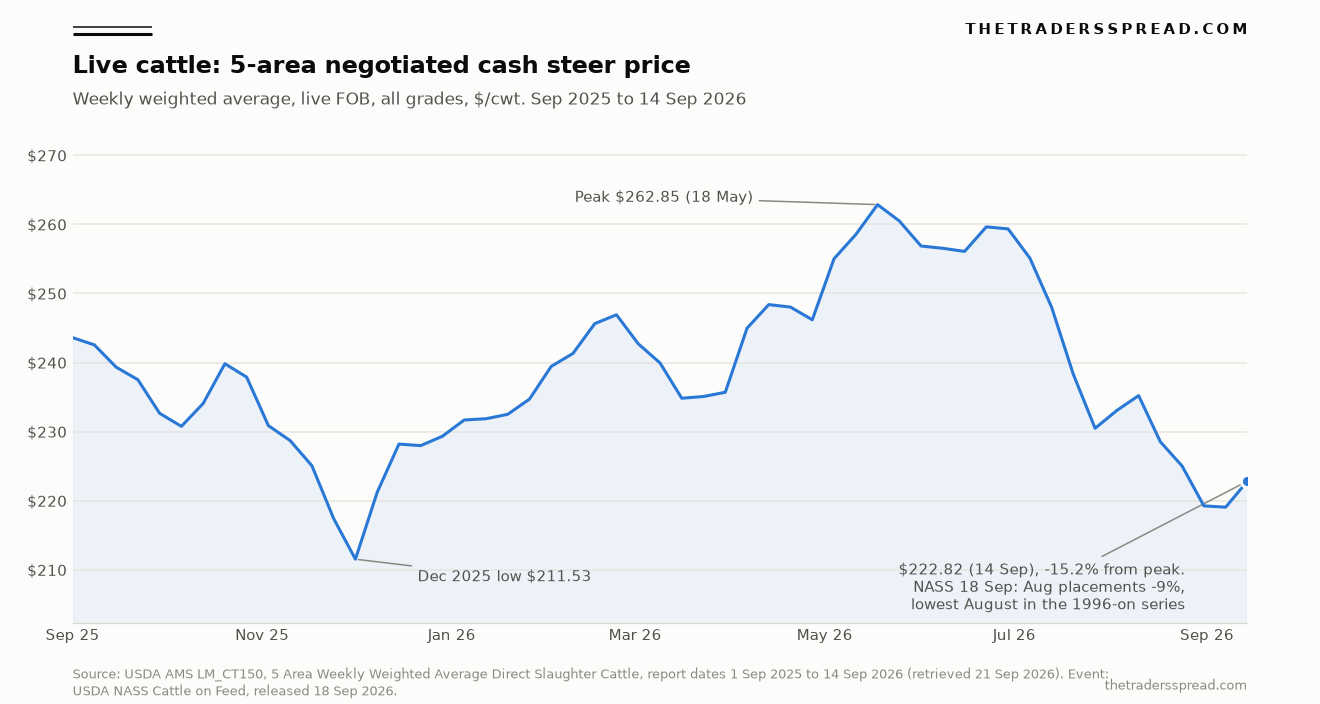
The weekly series peaked at $262.85 in the week reported 18 May, held above $255 through the start of July, then broke. By the week reported 31 August it was $219.25, and it traded $219.06 a week later before a small bounce to $222.82. The December 2025 low of $211.53 was not breached.
| Measure | Year earlier | Latest | Change | Source, date |
|---|---|---|---|---|
| Cash steer price, $/cwt | $239.33 (15 Sep 2025) | $222.82 (14 Sep 2026) | -6.9% | USDA AMS LM_CT150 |
| Average live weight, lb | 1,519 | 1,563 | +2.9% | USDA AMS LM_CT150 |
| August placements, head | 1.780m | 1.617m | -9.2% | USDA NASS, 18 Sep 2026 |
| August marketings, head | 1.571m | 1.519m | -3.3% | USDA NASS, 18 Sep 2026 |
| On feed 1 Sep, head | 11.080m | 11.163m | +0.7% | USDA NASS, 18 Sep 2026 |
| Inventory / monthly marketings | 7.05 | 7.35 | +0.30 | Our calculation from NASS |
Futures tell the same story on a smaller canvas. CNBC's daily bars show the December live cattle contract settling at $216.625 on Friday 18 September, and Pro Farmer reported the October contract settling at $215.925 the same day, up $0.275. Both prints sit a little below the latest cash average, which means traders were not pricing a squeeze into year-end before the report.
And the report arrived after the close. RFD-TV's preview noted it would be released on Friday after markets closed, so Friday's settlement is a pre-report price. Anyone reading this after the Monday open is looking at the first reaction; we have not quoted it here because it did not exist when this was written.
Where the shortfall came from
Placements fell across the map and across every weight class, which matters because a shortfall in one state can be weather and a shortfall everywhere is supply. By weight, NASS counted fewer placements in all six categories than in August 2025. Calves under 600 pounds fell 9.9% to 320,000 head. The 800-to-899-pound group, the largest at 387,000, fell 7.9%. Cattle weighing 900 to 999 pounds dropped 11.5% to 230,000.
| State | Aug 2025 placements (000 head) | Aug 2026 placements (000 head) | Change |
|---|---|---|---|
| Nebraska | 475 | 410 | -13.7% |
| Kansas | 475 | 440 | -7.4% |
| Texas | 340 | 320 | -5.9% |
| Colorado | 140 | 115 | -17.9% |
| Iowa | 65 | 61 | -6.2% |
| Oklahoma | 49 | 53 | +8.2% |
| South Dakota | 28 | 20 | -28.6% |
| United States | 1,780 | 1,617 | -9.2% |
Source: USDA NASS Cattle on Feed, 18 September 2026, feedlots with 1,000+ head capacity.
Nebraska, the second-largest feeding state, lost 65,000 head of placements on the year, the biggest absolute decline. Oklahoma was the only state in the table to place more cattle, and its 1 September inventory stood at 111% of a year earlier.
Nobody in the trade saw a number this low coming. Pre-report estimates compiled for RFD-TV put placements down 3.2% on average, with the most bearish guess at 6.1% lower. The actual figure missed the entire range by three points. Peel's verdict: "This is way, way outside the range… I think this will be taken as a pretty bullish number for cattle markets."
Two months of record-low placements is not a fluke; it is the calf crop running out. A calf that was never born in 2025 cannot be placed in 2026, and the heifers that would rebuild the herd are, on Peel's reading, being held back rather than fed. "Heifer slaughter so far this year is down about 10% to 11%," he said in the same interview, adding that it is falling about twice as fast as steer slaughter.
The import valve Washington opened on 1 September
Beef supply is not only a feedlot story. On 26 August President Trump signed Proclamation 11059, published in the Federal Register on 31 August, which raises the quantity of lean beef trimmings allowed in at the lower in-quota tariff rate by 300,000 metric tons. It runs in three 100,000-ton tranches: 1 to 30 September, 1 to 30 October, and 31 October until the quantity fills or 30 November, whichever comes first. The whole amount goes to "other countries or areas", meaning suppliers without their own country quota. It follows Proclamation 11010 of 6 February, which added 80,000 tons of trimmings from Argentina for 2026.
The proclamation's own reasoning restates the contradiction in this article. It cites the USDA forecast that beef output will fall by around 4% this year from 2025, alongside consumption expected to rise. Lean trimmings are the ingredient that gets blended with fat trim from fed steers to make ground beef, so the imports compete most directly with cow beef and least directly with the Choice steaks that come from feedlot cattle.
That distinction has not stopped a political fight. Congressman Shomari Figures (D-Alabama) introduced a bill to nullify the proclamation, and said in his 2 September statement: "The President's beef order is yet another move that takes direct aim at the well-being of our agricultural community." Peel, writing in Oklahoma State's Cow-Calf Corner column as republished on 14 September, was cooler: he estimated imported beef makes up about 39% of the beef used for ground beef and judged it "unlikely that beef imports will increase an additional 300,000 metric tons."
For the live cattle market the proclamation matters at the margin. It does nothing to the number of steers on feed. It can lower the value of the trim that comes off every carcass, which feeds back into what a packer can pay for the whole animal. With the first tranche closing on 30 September, the import data for September will show how much of it was used.
What would make the bullish reading wrong
The straightforward reading of Friday's report is bullish: fewer cattle placed now means fewer finished cattle in the first quarter of 2027. Several things could spoil that.
First, weight can keep substituting for head count longer than the calendar suggests. If feeders continue to hold cattle and weights keep climbing, tonnage stays close to last year even as head counts fall, and packers are under less pressure to bid up. Second, the drain can open suddenly. If the heavier cattle now in pens are marketed in a rush, perhaps because the cost of gain rises or because packers pull forward purchases, the inventory would fall fast but so would near-term cash prices as supply briefly jumps. Third, demand. The proclamation's own text assumes consumption keeps rising; any slip there would weigh on boxed beef and, through it, on cash cattle.
Last, the feeder market. Placements are low partly because replacement cattle are scarce, and anything that eases that scarcity, from pasture rain to more cross-border feeder supply from Mexico, would raise placements and soften the argument for tight 2027 supply.
What this changes
This is a news piece, so there is no price target. What changes is the timing of the supply squeeze and where it shows up.
The placement shortfall is a first-quarter-2027 story, not a September story. Cattle placed in August spend months on feed before they reach slaughter weight, which puts the missing animals in the slaughter mix around the turn of the year. The February and April live cattle contracts carry that exposure more directly than October or December. On Friday's pre-report settle, the February 2027 contract stood at $217.35 on CNBC's quote, less than a dollar above December; the curve was barely pricing a scarcer first quarter. That spread is the cleanest place to watch whether the market accepts the report's message.
RelatedRhodium Price Forecast: $11,000 Bull Case vs $7,500 Bear
The inventory will start shrinking. Peel expects cattle on feed to fall below year-ago levels within the next couple of months. The next test is the October Cattle on Feed report, which NASS has scheduled for 23 October according to its release calendar. A third consecutive month of placements near 10% down would confirm the calf supply is tapped out.
Weights become the swing variable. If AMS weekly weights stay 40-plus pounds above last year, the tonnage argument holds and the cash market can stay heavy despite the headcount. A turn lower in weights would be the first sign that the pounds shortage is catching up with the head shortage.
What would change our view: a September placement figure back near year-ago levels, a sharp and sustained jump in marketings that drains the pens, or boxed beef weakness deep enough to pull the cash steer price below the December 2025 low of $211.53. Any of those would say the record-low August was the bottom of a trough rather than a step down.
For readers following the rest of the protein complex, our look at the pork belly slide and lean hog cash covers the competing meat. Feed costs sit behind every placement decision; see our corn price scenarios and the record US crop in our soybean report. Fuel is the other input, covered in our diesel outlook.
FAQ
What did the September 2026 Cattle on Feed report show?
USDA NASS reported on 18 September that 1.617 million head were placed in feedlots of 1,000+ head capacity during August, down 9% on the year and the lowest August since the series began in 1996. Marketings fell 3% to 1.519 million, also a record low for August, while the 1 September inventory rose 0.7% to 11.163 million head.
Why is cattle on feed higher when placements hit a record low?
Because marketings also fell. Feedlots are holding cattle longer, so fewer animals leave each month. Inventory on 1 September equalled 7.35 months of August marketings, up from 7.05 a year earlier. Longer feeding also raises weights: AMS reported a 1,563-pound average in mid-September against 1,519 pounds a year before.
Why have live cattle prices fallen if supply is so tight?
Heavier cattle offset part of the headcount decline, so beef tonnage has fallen far less than the number of animals. The USDA 5-area cash steer price dropped from $262.85 in the week reported 18 May to $222.82 in the week reported 14 September. An extra 300,000 tons of tariff-rate lean trimmings imports also opened on 1 September.
When will lower placements affect beef supply?
Cattle placed in August generally need several months on feed before slaughter, so the gap should show up in fed cattle supplies from around the start of 2027. That is why analysts, including Oklahoma State's Derrell Peel, read the report as supportive for deferred contracts rather than for this month's cash trade.
What does Proclamation 11059 do?
Signed 26 August 2026, it temporarily raises the in-quota amount of lean beef trimmings by 300,000 metric tons, released in three 100,000-ton tranches between 1 September and 30 November, allocated to countries without their own quota. It follows an 80,000-ton increase for Argentina under Proclamation 11010 in February.
When is the next Cattle on Feed report?
NASS lists the next Cattle on Feed release for 23 October 2026, followed by 20 November and 18 December. The October report will cover September placements and will show whether a third straight month of record-low intake has occurred, which would strengthen the case for tighter 2027 fed cattle supplies.
Disclaimer
This article is analysis and information, not financial advice. Futures and commodity markets are volatile, and trading them puts your capital at risk; you can lose more than your initial deposit on leveraged products. Figures are from the named primary sources on the dates stated and may be revised. Consult a licensed adviser before making any financial decision.