

The United States had more propane in storage in the week to 4 September than in any week the Energy Information Administration has published in its current inventory series, 110.47 million barrels. Over the month around that record, the Mont Belvieu spot price rose 19.5%, from $0.723 a gallon on 21 August to $0.864 on 22 September, the latest daily assessment EIA has released. Both facts come from the same agency's spreadsheets. They cannot both be comfortable, because a market holding record stock is not supposed to reprice a fifth higher in four weeks, and the usual explanation, that crude dragged everything up, does not survive the week to 22 September: WTI fell 9.9% in those five sessions and propane gave back only 1.3%. Something inside the propane balance moved, and it shows up in two places that most price coverage skips, the direction of the September stock change and the ratio of those barrels to the export dock.
Here is what the headline number hides. In each of the eleven years from 2015 to 2025, US propane and propylene stocks rose between the first and third weeks of September, by anywhere from 180,000 barrels in 2021 to 7.07 million in 2022. This year they fell 2.60 million barrels over the same fortnight. Inventories peaked on 4 September, roughly six weeks before the late-October peaks of 2023 and 2025, while weekly exports climbed to 2.469 million barrels a day. Measured against what actually leaves the system each day at home and abroad, the record pile covers 34.9 days, fewer than in any of the three previous Septembers.
Key facts
- Mont Belvieu, TX propane spot FOB was $0.864/gal on 22 September 2026, up 19.5% from $0.723 on 21 August and up 41.6% from $0.610 on 31 December 2025 — US EIA daily spot series, retrieved 27 September 2026
- US propane/propylene stocks (excluding propylene at terminals) hit 110.47 million barrels in the week to 4 September, the series high since 2015, then fell to 107.87 million by 18 September — EIA weekly stocks, 2026
- Stocks on 18 September sat 8.0% above a year earlier and 19.8% above the 2021–2025 same-week average of 90.04 million barrels — EIA weekly stocks, TTS calculation
- Weekly propane exports reached 2.469 million b/d in the week to 18 September, up 28.5% year on year and the third-highest week in the series — EIA weekly exports, 2026
- US refiner, blender and gas plant propane/propylene output ran at 2.968 million b/d, 2.9% above a year earlier — EIA weekly production, week to 18 September 2026
- Propane priced at 37.6% of WTI on a per-barrel basis on 22 September, against 45.9% a year earlier — EIA daily spot series for propane and WTI, TTS calculation
Two numbers that should not sit together
Start with the price. EIA's Mont Belvieu propane series is the benchmark for US Gulf Coast product and, increasingly, the reference for cargoes sold to Asia and Europe. Its last print is $0.864 a gallon for Tuesday 22 September, which is the most recent day the agency has published; the spot series runs a few sessions behind the calendar, so this is a last-available assessment rather than a Friday close.
From 22 September the windows read cleanly, each computed from daily closes with the anchor date stated. One week back, $0.875 on 15 September, gives a 1.3% decline. One month back, $0.723 on 21 August, gives the 19.5% gain in the headline. Three months, $0.703 on 22 June: up 22.9%. A year, $0.689 on 22 September 2025: up 25.4%. Since the last trading day of 2025, when the price stood at $0.610, the gain is 41.6%.
Most of that month happened in seven sessions: $0.736 on 1 September, $0.878 on 10 September, a 19.3% jump, and a $0.851 to $0.875 range since.
Now the stock. EIA's weekly propane and propylene inventory figure, excluding propylene held at terminals, has existed in its current form since January 2015. The 110.47 million barrels reported for the week to 4 September is its highest reading. For context, the agency's older and broader series, which included terminal propylene and ran from 1993 to 2020, peaked at 106.2 million barrels in November 2015. By either yardstick, the United States had never reported holding this much propane.
Stocks eased to 109.09 million on 11 September and 107.87 million on 18 September, still 8.0% above a year earlier. Anyone reading only the level would call the market heavy.
Why a record pile can still be a tight one
The level is not the useful number. Propane stocks are built on a calendar: production runs roughly flat through the year, domestic heating demand collapses in spring, and the surplus goes into salt caverns at Mont Belvieu and Conway until autumn. The build normally carries on into October or November. In the eleven years of this series before 2026, the peak came as early as 8 September once, in 2017, and as late as 25 November in 2022. In the three most recent years it landed on 20 October 2023, 11 October 2024 and 31 October 2025.
This year the build stopped on 4 September. The two weeks since then produced a 2.60 million-barrel draw, in a fortnight that added between 0.18 million and 7.07 million barrels in every prior year of the series. An early turn in the inventory curve means the outlet for barrels is running faster than the inlet.
The outlet is the export dock. Weekly propane exports averaged 2.199 million b/d over the four weeks to 18 September, against 1.893 million in the same four weeks of 2025. Domestic product supplied, EIA's proxy for US consumption, averaged 896,000 b/d over those four weeks against 830,000 a year earlier. Add the two and divide the stock by the total, and the United States held 34.9 days of combined demand on 18 September. The same arithmetic gives 36.7 days in September 2025, 37.2 days in 2024 and 40.9 days in 2023.
That ratio is the information a record stock level conceals. EIA's own days-of-supply figure, which divides stock by domestic demand only, printed 120.4 days on 18 September, identical to a year earlier and down from a series high of 195.3 days in late July. It looks calm because it ignores the ships.
| Week ending (Sep) | Stocks, m bbl | Exports, 4-wk avg, kb/d | Product supplied, 4-wk avg, kb/d | Days of combined cover |
|---|---|---|---|---|
| 22 Sep 2023 | 101.43 | 1,658 | 820 | 40.9 |
| 20 Sep 2024 | 97.56 | 1,752 | 873 | 37.2 |
| 19 Sep 2025 | 99.92 | 1,893 | 830 | 36.7 |
| 18 Sep 2026 | 107.87 | 2,199 | 896 | 34.9 |
Source: EIA weekly series WPRSTUS1, W_EPLLPZ_EEX_NUS-Z00_MBBLD and WPRUP_NUS_2, retrieved 27 September 2026; cover is stock divided by the sum of four-week average exports and product supplied, TTS calculation.
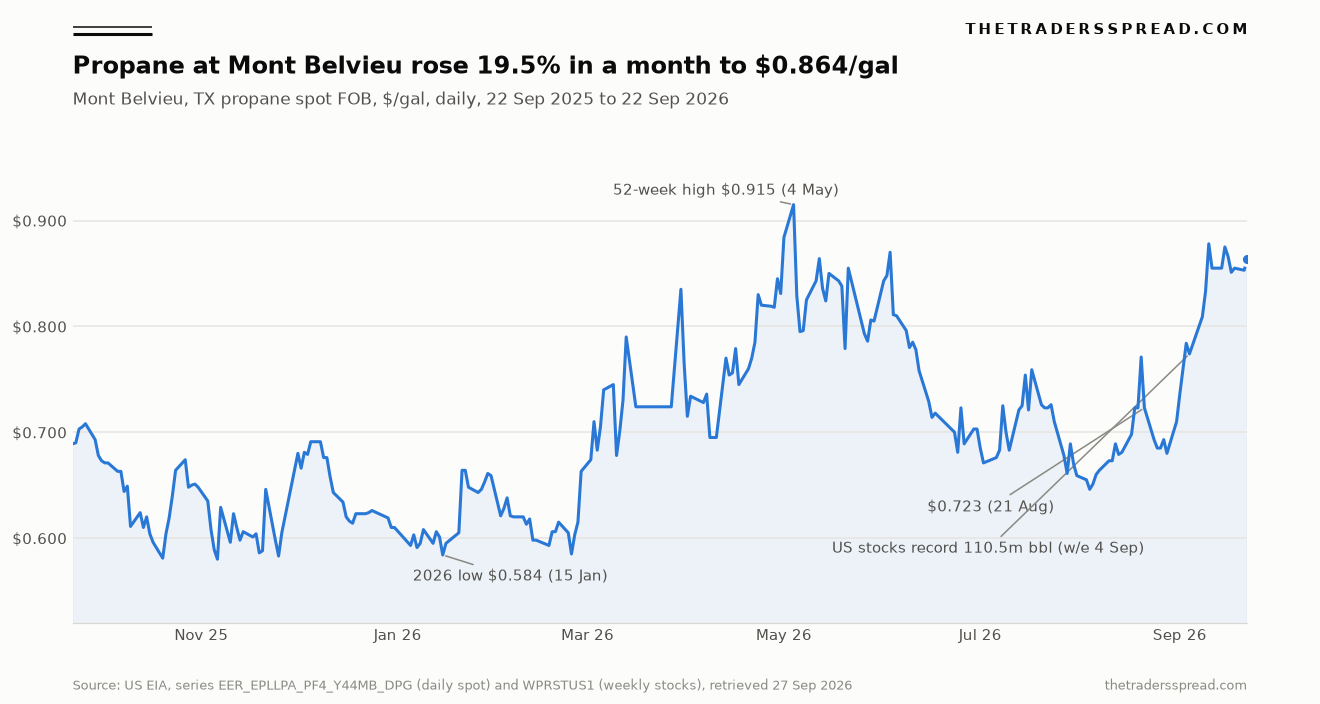
The September run did not set a new high. May's $0.915, recorded on 4 May, is still the 52-week peak, against a low of $0.580 on 6 November 2025. Propane is in the upper third of its annual range, not breaking out of it.
The Gulf that pulled the barrels away
The export surge has a known cause. Gulf exporters Saudi Arabia, Qatar and the United Arab Emirates ship a large share of the world's seaborne LPG through the Strait of Hormuz, and the conflict in the Persian Gulf this year shut much of that route. OPIS reported in June that the closure had disrupted nearly 40% of global LPG export supply, and that Mont Belvieu had become "increasingly tethered to U.S. Gulf Coast exports" as buyers in Asia replaced those cargoes. Our Hormuz odds analysis counted transits at five a day.
"Mont Belvieu propane prices are more influenced by international propane prices than Conway due to the vast amount of propane export capability on the Gulf Coast," Peter Fasullo, principal at EnVantage, told OPIS in June. "It may take several months for this crisis to be resolved, but when it normalizes, the upward influence on Mont Belvieu should lessen."
Several months have now passed. EIA's September Short-Term Energy Outlook, released on 9 September, forecast Middle East production rising "because of gradually increasing flows through the Strait of Hormuz and the use of alternative routes out of the region," but assumed some export constraints persist through year-end and keep Gulf output below pre-conflict levels until the second quarter of 2027. The agency put Brent at an average of around $90 a barrel for the second half of 2026 and $74 in 2027, according to the September STEO.
On the US side, Enterprise Products Partners, which runs fractionators and storage at Mont Belvieu, described the spring as a scramble. It reported record marine terminal volumes of 2.8 million b/d across all products in the second quarter, with combined propane export volumes at its Morgan's Point, Neches River and Enterprise Hydrocarbons terminals up 141,000 b/d on a year earlier.
"Volumes at our marine terminals have returned to normal levels in June and July after the initial rush to backfill volumes affected by hostilities in the Middle East in April and May," A. J. "Jim" Teague, co-chief executive officer of Enterprise's general partner, said in the company's second-quarter results on 30 July. "Global shipping of energy, however, continues to be disrupted due to damage to production facilities and navigation restrictions in the Middle East, longer transits due to reroutes and the continuing uncertainty in the region."
Teague's "normal levels" held through the summer in EIA's data: weekly exports ran between 1.92 million and 2.04 million b/d in the four weeks to 21 August. September broke that pattern. The four prints since, 2.153 million, 1.960 million, 2.213 million and then 2.469 million b/d, trace a second wave rather than a fading first one.
Crude went up and down; propane did not follow
Propane has a second master, crude, and traders often quote it as a percentage of WTI on a per-barrel basis. That ratio explains why a 41.6% year-to-date gain still leaves propane cheap against oil.
At $0.864 a gallon, a barrel of propane was worth $36.29 on 22 September. WTI settled at $96.41 that day on EIA's spot series, putting propane at 37.6% of crude. A year earlier the ratio was 45.9%, when WTI was $62.99 and propane $0.689. At the worst point of this year's crude spike, 20 March, propane fell to 30.8% of WTI. Record inventories help explain why propane lagged the oil rally. They did not stop it rising.
The last week of data is where the two separate. WTI peaked at $107.02 on 15 September and fell to $96.41 by 22 September, a 9.9% drop that unwound much of the run-up in our earlier WTI coverage. Brent went from $121.18 on 17 September to $114.89. Propane moved from $0.875 to $0.864. A product simply shadowing crude would have fallen with it. This one held, which points back to the export pull and the early stock draw.
Supply is not the constraint. Most US propane is stripped from wet gas at processing plants, Henry Hub spot sat at $2.90 per million Btu on 22 September, and weekly propane output of 2.968 million b/d is close to April's series high of 3.038 million (see our natural gas outlook). The bottleneck is the path from Mont Belvieu to the ship's rail.
Where the winter risk actually sits
The domestic market meets the export market in October, when crop drying in the Corn Belt (mid-October through November, per OPIS) and the first Midwest heating loads arrive together. Both draw on the Conway hub in Kansas far more than on Mont Belvieu.
That split matters for how the September move reaches households. OPIS reported that Mont Belvieu traded more than 10 cents a gallon above Conway in early June, against a spread of about 2.9 cents a year earlier, and that the gap was drawing Midcontinent barrels south to the export coast. The logic is simple. Every barrel that moves from Conway to Texas to fill a ship is a barrel that is not waiting in Kansas when a cold snap arrives.
Retail heating prices follow wholesale with a lag, and EIA's Heating Oil and Propane Update, which tracks residential propane by state, normally restarts its weekly survey in October. The distillate side of the heating market is already tight: EIA's September outlook forecast US distillate stocks below 100 million barrels in September and below the five-year low through much of 2027, which our diesel analysis covered. Propane arrives at winter in a much better place on volume. It arrives in a worse place on direction than the record inventory headline suggests.
New dock capacity is coming too. Enterprise expects its Houston Ship Channel LPG export expansion to start by the end of 2026, which means more of the US surplus can reach higher-priced markets abroad.
RelatedTungsten Price Prediction: 550,000 Yuan Bull vs 420,000 Bear
What would make the early draw a false signal
The case above rests on two weekly prints and one early peak, and each can be challenged.
Weekly export data are noisy. The series swings by 200,000 b/d or more from week to week as ships arrive in clumps, and a 1.9 million print next week would undo the fortnight's story.
A reopening Strait would pull the rug from the export premium. If Gulf LPG flows recover faster than EIA's September outlook assumes, Asian buyers return to shorter voyages, the Mont Belvieu discount to Asian prices widens again and US stocks resume building into October. Fasullo's view that the upward influence "should lessen" matched what the forward curve implied at the time, per OPIS: on 9 June, January 2027 Mont Belvieu propane was assessed near 80 cents a gallon, below today's spot.
And the stock is genuinely large: 107.87 million barrels exceeds anything the United States held before this year.
What this changes
The September data change the reading of US propane from "oversupplied" to "well supplied but being drawn early." An oversupplied market absorbs a shock through price weakness at the hub and wider discounts to foreign markets. A well-supplied market being drawn early absorbs a shock by selling down inventory it expected to carry into winter, and it becomes more sensitive to each weekly export and stock print than the level alone implies.
Three measurable things now carry the story, and none of them requires a price target to watch. First, the weekly stock change for the weeks to 25 September and 2 October, published by EIA on Wednesdays: a third straight weekly draw would confirm that the build season ended early. Second, the four-week average of exports against the 2.2 million b/d level of the last month; a fall back toward 1.9 million b/d would restore last year's balance. Third, the propane-to-WTI ratio, which at 37.6% is still well below last year's 45.9%. If that ratio climbs while crude falls, propane is trading its own fundamentals rather than oil's.
What would change this reading? A return to weekly builds of a million barrels or more through October, alongside exports back under 2 million b/d, would say the early peak was a timing quirk of ship schedules. A decisive reopening of Gulf LPG export routes would do the same thing faster. Until one of those shows up in EIA's numbers, the record stock is a buffer that is already being spent, not a ceiling on the Mont Belvieu price.
FAQ
What is the Mont Belvieu propane price?
It is the spot price for propane at the Mont Belvieu storage and fractionation hub about 30 miles east of Houston, the main US pricing point for natural gas liquids. EIA publishes it daily in dollars per gallon; the latest print, for 22 September 2026, was $0.864, up 19.5% from $0.723 on 21 August.
How much propane does the US have in storage?
EIA reported 107.87 million barrels of propane and propylene, excluding propylene at terminals, in the week to 18 September 2026. That is 8.0% more than a year earlier. The figure peaked at 110.47 million barrels in the week to 4 September, the highest level in the series, which dates from 2015, and above the 106.2 million peak of EIA's older series.
Why did propane rise if inventories are at a record?
Exports. Weekly US propane exports reached 2.469 million barrels a day in the week to 18 September as Asian and European buyers replaced Middle East cargoes disrupted by the Gulf conflict. Stocks fell 2.60 million barrels in the first half of September, a period in which they rose in every year from 2015 to 2025. Record barrels now cover fewer days of combined demand than in 2023, 2024 or 2025.
Does the propane price just follow crude oil?
Partly. Propane is often compared with WTI on a per-barrel basis; on 22 September it was worth 37.6% of WTI, down from 45.9% a year earlier. But between 15 and 22 September WTI fell 9.9% while propane slipped only 1.3%, which points to propane-specific drivers, chiefly export demand and the early inventory draw, rather than crude alone.
Will this affect home heating propane prices this winter?
Wholesale moves reach retail with a lag, and Midwest residential prices lean on the Conway hub and local delivery costs. EIA's Heating Oil and Propane Update normally restarts its weekly state retail survey in October. Large national stocks are a cushion, but exports pulling barrels to the Gulf Coast shrink the part of it sitting near heating markets.
Disclaimer
This article is market analysis and information, not investment advice or a recommendation to trade any product. Commodity prices, and derivatives or CFDs referencing them, are volatile and can move against any position; trading them puts your capital at risk, and margined products can lose more than the initial deposit. Figures are sourced and dated as stated and may be revised by the publishing agency.