

Sugar's March 2027 contract has gained 26% since mid-June, and the market is asking one question: will Brazil's mills keep sending cane to ethanol instead of sugar until the next harvest starts in April? The futures curve answers yes, but only as far as March. ICE Sugar No. 11 for March 2027 delivery settled at 19.06 cents a pound at Monday's close, 14 September, which is 61 points above May 2027 and 93 points above July 2027. That shape is the answer. Traders are paying up for a single delivery window, the gap between Brazilian harvests, and they are already pricing relief once the 2027/28 crush gets going. The October 2026 contract settled at 18.16 cents, expires on 30 September and trades 90 points under March, so nearby sugar is not scarce today. The curve is pricing a hole in the first quarter of 2027. Whether that hole exists depends on a fuel decision that São Paulo mills revisit every fortnight.
The price chart hides a bigger shift, and it sits in the positioning data. In the CFTC's disaggregated Commitments of Traders report for 8 September, managed money held a net long of 238,684 contracts in Sugar No. 11. On 23 June it was net short 186,290. That 424,974-contract reversal equals about 21.6 million tonnes of sugar at 112,000 pounds a contract, double the 10.75 million tonnes Brazil's centre-south had made by 1 July. The fund net long is now the largest since the first week of January 2023. Producers and merchants took the other side, lifting short hedges to 554,269 contracts, the most since September 2021, and total open interest hit 1,276,579 contracts, higher than in any week since at least July 2007. The short covering is finished. Any further gain needs fresh demand, and the mills are hedging into every rally.
Key facts
- ICE Sugar No. 11 March 2027 settled at 19.06¢/lb and October 2026 at 18.16¢/lb, a 0.90¢ discount for the nearby month — ICE settlements via CNBC, 14 Sep 2026
- March 2027 is up 26.3% from 15.09¢ on 12 June and 21.1% year to date, and 3.5% below its 19.75¢ closing high of 10 September — ICE via CNBC daily bars, 14 Sep 2026
- Managed money was net long 238,684 contracts, against a net short of 186,290 on 23 June — CFTC Commitments of Traders, report of 8 Sep 2026
- Brazil centre-south sugar output fell 12.38% to 10.75 million tonnes as the sugar share of the mix dropped to 42.52% from 51.04% — UNICA crop report, position to 1 Jul 2026, published 6 Aug 2026
- Hydrous ethanol sold at 57.9% of the gasoline price in São Paulo, its widest advantage since 2018, and Brazil's E32 blend took effect on 1 August — UNICA citing ANP data, 3 Aug 2026
- India expects about 306 lakh tonnes of sugar this season against an initial 343 lakh tonnes, and has cleared 10 lakh tonnes of duty-free raw sugar imports — Press Information Bureau, 21 Aug 2026
The ethanol pull on Brazilian cane
A centre-south mill can move its output between crystal sugar and ethanol within the limits of its equipment, and it chooses according to which product pays more per kilogram of recoverable sugar in the cane. This season the arithmetic has favoured the fuel tank.
UNICA's latest report on its data portal, covering the season from 1 April to 1 July, shows the scale of it. Centre-south mills crushed 214.47 million tonnes of cane, 3.82% more than a year earlier, yet produced 10.75 million tonnes of sugar, 12.38% less. The sugar share of the mix fell to 42.52% from 51.04%, and sugar per tonne of cane dropped to 50.14 kg from 59.42 kg. Ethanol output rose 20.44% to 11.37 billion litres. June alone was starker: sugar production fell 26.33% to 3.90 million tonnes, with the mix at 44.50% against 52.34% a year earlier. More cane went through the mills and less of it came out as sugar.
The reason is the pump price. On 3 August UNICA reported, using ANP survey data, that hydrous ethanol averaged R$3.70 a litre in São Paulo against R$6.39 for gasoline. After adjusting for ethanol's lower energy yield, that is an effective saving of R$1.32 a litre and a price parity of 57.9%, the widest advantage since 2018 and the second-widest since the ANP series began in 2013. Brazil also raised the mandatory anhydrous blend in gasoline from 30% to 32% on 1 August. Luciano Rodrigues, Director of Sector Intelligence and Regulation at UNICA, said in the association's release: "The greater share of ethanol in the energy matrix represents an efficient alternative to replace fossil fuel, imported and more expensive, with biofuel produced domestically" (our translation from Portuguese).
Crude oil is the engine behind that parity. WTI's October contract settled at $101.39 a barrel on 14 September, according to CNBC's delayed quote, up from $91.48 on 4 September, extending a climb we followed when WTI first pushed through $91. We track the oil side on our WTI crude hub, and our Brent crude price prediction maps the scenarios for the other oil benchmark. While oil holds near triple digits, Brazilian gasoline stays expensive, ethanol stays competitive and mills have little reason to swing back to sugar.
There is a leak in that logic, though. Corn ethanol supplied 20.98% of centre-south ethanol in June, and output from corn reached 2.39 billion litres in the season to 1 July, up 9.96%. Every litre made from corn is a litre that cane does not have to supply, so a fast-growing corn ethanol industry caps how far ethanol prices can run ahead of sugar. The real matters too: a weaker currency, which we follow on our USD/BRL page, raises the local-currency value of export sugar and can pull the mix back.
Where the curve puts the shortage
Price charts of "sugar" usually show a continuous front-month line, and this year that line misleads. CNBC's continuous series prints a 52-week low of 13.31 cents on 17 April, but that close belonged to the expiring May 2026 contract. The October 2026 contract closed at 13.90 cents that day, and its own low was 13.82 on 13 February. On the continuous line the three-month gain is 32.6%. The October contract itself rose 27.6% over the same window and March 2027 rose 26.3%. The splices at each roll add points that no single contract ever earned, so every figure below names its delivery month.
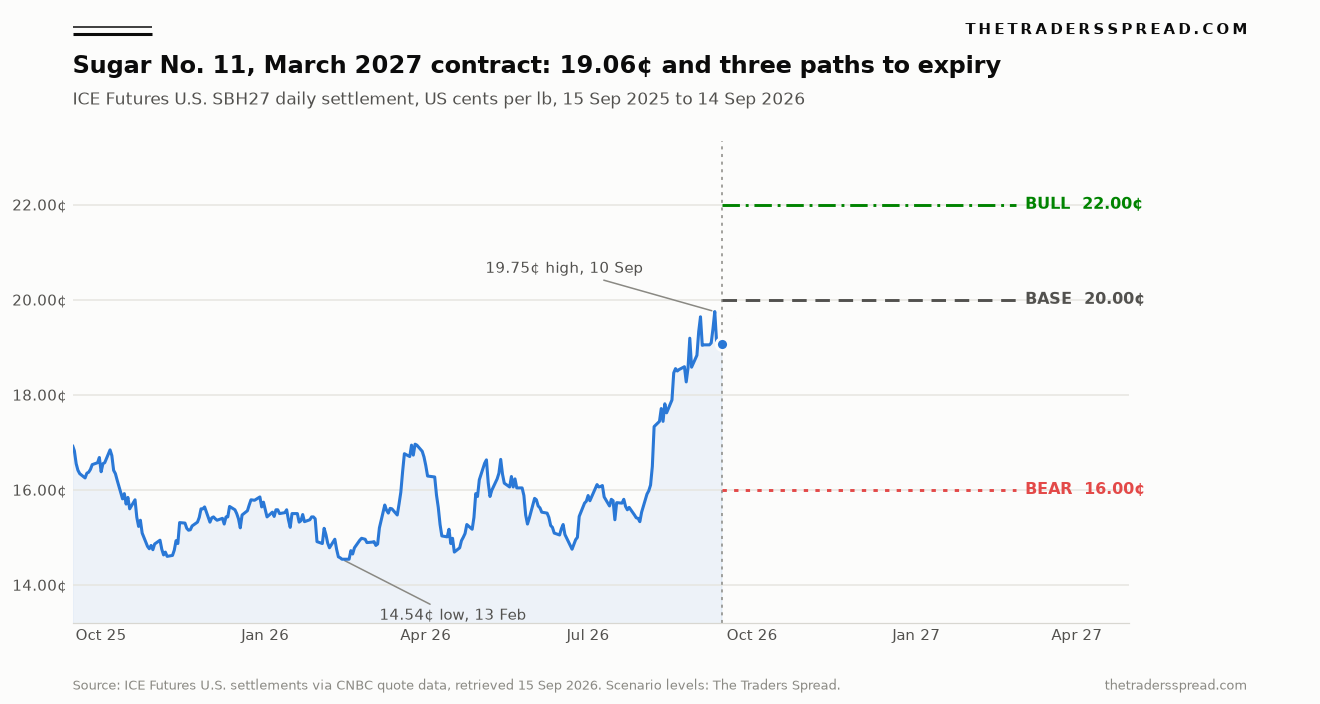
The chart shows March 2027, the contract that becomes the benchmark once October expires. ICE's contract rules set the last trading day as the final business day of the month before delivery, which puts October's on 30 September and March's on 26 February 2027. The spreads between delivery months say more than the outright price:
| Date | Oct 2026 minus Mar 2027 | Mar 2027 minus May 2027 | Mar 2027 settlement |
|---|---|---|---|
| 2 Jan 2026 | -0.75¢ | +0.10¢ | 15.43¢ |
| 12 Jun 2026 | -0.86¢ | +0.19¢ | 15.09¢ |
| 14 Aug 2026 | -1.02¢ | +0.31¢ | 17.62¢ |
| 10 Sep 2026 | -1.02¢ | +0.70¢ | 19.75¢ |
| 14 Sep 2026 | -0.90¢ | +0.61¢ | 19.06¢ |
Source: ICE Futures U.S. daily settlements for SBV26, SBH27 and SBK27 via CNBC, retrieved 15 Sep 2026.
Read the two columns separately. October trades at a discount to March that is close to a normal carrying charge, and that discount has barely moved all year. If raw sugar were short for delivery this month, October would have jumped to a premium. It has not. The March-over-May premium has multiplied sixfold since January, from 10 points to 61, peaking at 70 points on 10 September. So the tightness the market is paying for is dated. It starts after Brazil's harvest winds down in the fourth quarter and ends when the new crop arrives from April. July 2027 at 18.13 cents sits below October 2026.
Brazil sets the tone for more than one soft. Our coverage of coffee's fall after StoneX lifted its Brazil crop estimate to 77.2 million bags showed how one crop revision can move a contract, and cocoa's slide on higher Ivory Coast arrivals did the same from West Africa. For sugar, the revision risk sits in UNICA's next report.
Funds flipped long. Mills hedged the other side.
The positioning shift happened fast. Managed money was still net short 87,188 contracts in the report of 4 August. A week later it was net long 43,584, and the net long then grew to 138,613 on 18 August, 198,017 on 25 August, 233,771 on 1 September and 238,684 on 8 September. The pace has slowed sharply. The latest week added 4,913 contracts, against a 130,772-contract swing in the week to 11 August.
Commercial hedgers met that demand. Producer and merchant short positions climbed from 353,862 contracts on 4 August to 554,269 on 8 September, an increase of 200,407. Those are largely mills and trading houses fixing prices for sugar they have not yet shipped, and they are doing it at the best prices of the year. At 112,000 pounds a contract, the producer short book represents about 28.2 million tonnes of sugar. The fund net long equals about 12.1 million tonnes.
Does a crowded fund long mark the top? The CFTC data offer two recent cases, and neither gives a clean signal.
| Managed-money net-long peak | Net long (contracts) | Front month at the peak | Lowest close in next 3 months | Front month 3 months later |
|---|---|---|---|---|
| 17 Aug 2021 | 268,336 | 20.02¢ | 18.79¢ (-6.1%), 10 Sep 2021 | 20.42¢ (+2.0%) |
| 27 Dec 2022 | 260,952 | 20.32¢ | 18.96¢ (-6.7%), 6 Jan 2023 | 20.93¢ (+3.0%) |
| 8 Sep 2026 | 238,684 | 18.10¢ (Oct 2026) | open | open |
Source: CFTC disaggregated futures-only reports; front-month prices from CNBC's continuous series, which splices contracts at each roll and is used here only for direction.
Both times the front month fell 6% to 7% within a month of the positioning peak, then finished three months later above where it started. A crowded long made the market fragile without turning it lower for good. The difference now is that this net long was built in five weeks from a deep net short, so many of these positions are newer and less committed. The next report, for positions as of 15 September, is due on Friday 18 September.
Can India's import window cool the rally?
India's government has spent August trying to cap domestic sugar prices, and its own figures explain the global tightness better than any analyst note. In a 21 August release the Ministry of Consumer Affairs, Food and Public Distribution said production this season is expected at about 306 lakh tonnes (30.6 million tonnes), against an initial estimate of about 343 lakh tonnes from the cane-growing states. It blamed red rot and top borer disease and waterlogging from excess rain. Domestic prices rose from ₹48.18 a kilogram on 20 July to ₹55.70 on 20 August.
The response was a package: a 400-tonne stock limit on dealers from 1 August to 30 November, a 15-day stock cap for bulk consumers from 1 September, physical checks of mill inventories, and permission for duty-free imports of 10 lakh tonnes (1 million tonnes) of raw sugar. Business Today reported that the tariff-rate quota runs until 31 October, and that the Indian Sugar and Bio-energy Manufacturers Association said stocks are adequate until the new season. The ministry has also asked mills to start crushing from 15 October, which it expects to lift October output above 10 lakh tonnes from the usual 3 to 4 lakh tonnes.
The same release puts the 2026-27 global deficit at about 33 lakh tonnes, or 3.3 million tonnes, and says international prices climbed from $474 a tonne on 30 June to $552 on 20 August. The ministry does not name its benchmark. At $552 a tonne, or roughly 25 cents a pound, it cannot be the raw No. 11 contract, so it is best read as a white sugar series.
For March 2027 the Indian story cuts both ways. A country importing raw sugar under a duty-free quota has no sugar to spare for the world market in the first quarter, the very window the curve is pricing. An early October crush restores domestic supply before that window opens. If the new crop recovers toward the 320 to 340 lakh tonnes the ministry calls normal, New Delhi could turn to export permissions for 2026-27, and March's premium would be the first thing to go.
The call: base, bull and bear to March expiry
We hold a mildly bullish bias on March 2027 at 19.06 cents, with a conviction of 2 out of 5 and a horizon to the contract's last trading day on 26 February 2027.
RelatedCaustic soda futures fell 3.89% to 1,632 yuan a tonne
Base case, 50%: 20.00 cents (+4.9%). The sugar share of Brazil's mix stays below 47% while WTI holds above $90, ethanol keeps its parity advantage through the harvest tail, and the March-over-May premium holds at 40 to 80 points. Producer hedging near the 19.75 high keeps the gain modest.
Bull case, 25%: 22.00 cents (+15.4%). This needs UNICA's July and August data to show the mix still under 45%, a further cut to India's crop estimate, and oil above $100 into the fourth quarter. Funds would add length from here, and the August 2021 peak of 268,336 contracts would come into view.
Bear case, 25%: 16.00 cents (-16.1%). A WTI retreat toward $80 would narrow the ethanol advantage, corn ethanol absorbs fuel demand, and funds unwind a large part of their 238,684-contract net long into 554,269 contracts of producer hedges. The March-over-May premium would fall back toward January's 10 points.
Our invalidation level is 17.00 cents, 10.8% below spot. A March settlement there would erase the August breakout, since March stood at 17.62 on 14 August, and would tell us the rally was positioning, not supply.
What would change our mind: a UNICA report with the sugar share of the mix back above 48%; the March-over-May spread falling below 20 points while the outright price holds, which would mean the first-quarter shortage is being priced out; or India announcing export quotas for 2026-27 before December. Any one of these would move us to neutral. Two together would push the bear case above the bull case.
Sugar price prediction FAQ
What is the sugar price today?
At Monday's close, 14 September 2026, ICE Sugar No. 11 for October 2026 delivery settled at 18.16 cents a pound and March 2027 at 19.06 cents, according to delayed CNBC quote data. March becomes the benchmark once October expires on 30 September. Quote a specific contract month, because continuous charts splice contracts and overstate recent gains.
Why has sugar risen in 2026?
Brazil's centre-south mills diverted cane to ethanol, cutting sugar output 12.38% in the season to 1 July as the sugar mix fell to 42.52%. Oil above $100 kept ethanol competitive, Brazil lifted its blend to E32, and India's crop came in well below forecasts. Managed money then reversed a deep net short, adding fuel to the move from June.
Are hedge funds long sugar?
Yes. The CFTC's report for 8 September showed managed money net long 238,684 Sugar No. 11 contracts, the largest since January 2023, after a net short of 186,290 on 23 June. The weekly additions have slowed to under 5,000 contracts, while producer short hedges rose to 554,269, their highest since September 2021.
What would take sugar to 16 cents?
Our bear case at 16.00 cents for March 2027 needs cheaper oil, which would narrow ethanol's price advantage in Brazil and send cane back to sugar. A sizeable fund liquidation would add to the fall. A falling March-over-May spread would be the early warning that the market no longer expects a first-quarter shortage.
Does India import or export sugar this season?
India's government cleared duty-free imports of 10 lakh tonnes of raw sugar in August after cutting its production estimate to about 306 lakh tonnes, according to a 21 August government release. It has asked mills to begin the new crush on 15 October. That release sets no export quantity for the 2026-27 season.
Disclaimer: This article is analysis and opinion, not investment advice or a recommendation to trade. Sugar futures and CFDs are margined, volatile products, and losses can exceed the initial deposit. Prices quoted are delayed exchange settlements at the stated dates. Your capital is at risk.