

November rough rice settled at $16.36 per hundredweight on Friday, down 15.5 cents from Thursday, and the same contract is still 63.5 cents above its own close on 2 September. A down day and an unfinished rally are both in the price. Neither one lets the other off the hook. The print is the CBOT November 2026 future, not a cash bid and not a spliced front-month history.
The 15.5-cent decline is 0.9% of Thursday's $16.515 close, and January fell by the same 15.5 cents, to $16.82. Friday marked the strip. It did not single out the front month, and it did not close the larger gap: the season-average farm price USDA still carries for 2026/27 is $14.90, so November sits $1.46 above the average farmers are forecast to receive.
That is the split that matters.
Key facts
- November 2026 rough rice closed at $16.36 per hundredweight on Friday 2 October, down 15.5 cents, or 0.9%, from Thursday's $16.515 (Yahoo Finance ZRX26.CBT, pulled 3 October 2026; the same close and change are in Brownfield Ag News and on the Feedstuffs board).
- Friday's range was $16.28 to $16.565, open $16.435. Thursday's range was $16.10 to $16.70 (Yahoo Finance daily bars, same pull).
- This contract's own close on 2 September was $15.725. Friday is 63.5 cents, or 4.0%, above that print.
- January 2027 settled at $16.820, also down 15.5 cents, so January is $0.46 per hundredweight over November (Brownfield futures table, 2 October, Barchart settlements).
- A 15.5-cent move on the 2,000-hundredweight contract is $310. A one-dollar move is $2,000 (CME Group contract specifications).
- The all-rice season-average farm price for 2026/27 is unchanged at $14.90 per hundredweight, about 20% above the revised 2025/26 price of $12.40. Ending stocks are a three-year low. Beginning stocks are a 40-year high (ERS, 18 September 2026).
- First notice day is 30 October 2026. Last trade is 13 November (CME Group rough rice calendar).
Friday belonged to November, not to a stitched chart
Yahoo Finance labels ZRX26.CBT as Rough Rice Futures, Nov-2026. At 18:19 UTC on 2 October that feed's regular market price was 16.36, the same figure as the daily close. The timestamp is 13:19 in Chicago, a few minutes after the 13:15 Central settlement.
Brownfield's 2 October closing recap put November rice at $16.36, down 15 and a half cents. The futures table under that story shows ZRX26 at 16.360s, change minus 0.155, and January ZRF27 at 16.820s, the same 0.155 lower. Feedstuffs matches the November open, high, low and last: 16.435, 16.565, 16.28, 16.36.
Three boards, one print.
The other series lies if you use it for September. Yahoo's continuous symbol, ZR=F, is also labelled November now, and its Friday close is also $16.36. On 2 September that continuous history closes at $15.235, not the November contract's $15.725. The difference is the September contract, which stopped trading on 14 September. From 15 September the two histories agree on the closes checked here. Before that date they do not. Measuring "rough rice since the start of September" on the continuous chart measures a roll. The 4.0% gain below is November against November. The 0.9% loss is Thursday's November close against Friday's.
Thursday was the wide day. November opened at $16.275, traded $16.10 to $16.70, and closed at $16.515. Friday never left a 28.5-cent band and settled $16.36, seven and a half cents under its own open and eight cents off the low. It gave back part of Thursday's close. It never revisited Thursday's high. The highest close in this contract's run from 3 August, on the Yahoo series, was $16.585 on 25 September.
One earlier cross-check. On 9 September November closed at $16.04 on Yahoo, and CME Group's settlements page for that Wednesday showed a November settle of 16.040. The chart below is not only a Friday file.
Fifteen and a half cents is $310
CBOT rough rice is a deliverable contract on 2,000 hundredweight of U.S. No. 2 or better long-grain rough rice, quoted in dollars and cents per hundredweight. CME's specifications put the minimum fluctuation at $0.005 per hundredweight, which is $10 a contract. Fifteen and a half cents is 31 ticks. The mark-to-market from Thursday's settle to Friday's, on one November contract, is $310. A one-dollar move is $2,000. Quiet, for a session with no new government number in it.
The next grains report on the Foreign Agricultural Service calendar is Friday 9 October, at 12:15 p.m. Eastern, with the world agricultural production release beside it. Weekly export sales are due Thursday 8 October. Friday 2 October sat between those prints.
Grade rules are why a futures price and a farm price can both be honest and still disagree. Deliverable rice needs a milling yield of not less than 65%, including head rice of not less than 48%, with premiums and discounts against 55% head rice and 15% brokens. A load at 51% head rice is deliverable and is not par. Kevin McGilton, chief executive of Riceland Foods, told members on 4 September that samples graded by 1 September, 4.3 million bushels of long grain, were averaging 51/69. Early medium-grain samples were at 58/69. Head rice four points under the futures par, total yield four points over the floor: a cash conversation that does not have to move November by itself.
Delivery is close enough to notice and far enough that Friday was not a notice-day print. First notice is 30 October, first delivery 2 November, last trade 13 November. Four weeks from Friday's close to first notice. A 15.5-cent down day, with January down by the same amount, looks like a book marking the strip, not a fight over receipts in the front contract.
The rally Friday did not give back
The chart is the November contract's daily close from 3 August through 2 October, pulled from Yahoo Finance on 3 October. No other month is spliced in. There is no forecast line.
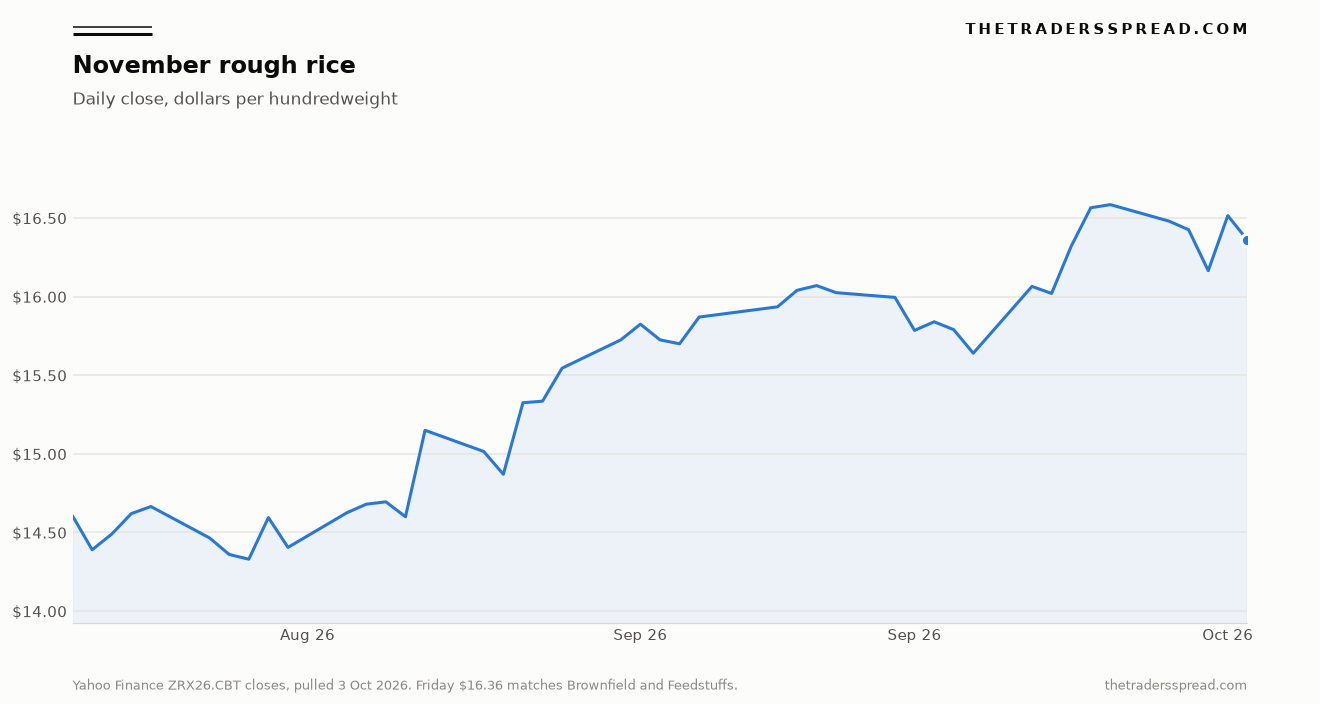
Friday is a nick in a climb. The lowest close in the window was $14.33 on 12 August. Friday's $16.36 is $2.03 above that print, 14.2% on the same contract. From the 2 September close of $15.725 the gain is 63.5 cents, 4.0%. The path bent. The contract closed $15.64 on 18 September, $16.585 on 25 September, $16.165 on 30 September, $16.515 on 1 October, and $16.36 on 2 October.
| Session | November close, $/cwt | What else that day |
|---|---|---|
| 12 August | 14.33 | Lowest close from 3 August to 2 October |
| 2 September | 15.725 | Base for the 4.0% gain |
| 9 September | 16.04 | Matches CME's November settlement that day |
| 18 September | 15.64 | Dip before the late-September run |
| 25 September | 16.585 | Highest close in the window |
| 30 September | 16.165 | Gave back most of the prior week's gain |
| 1 October | 16.515 | High $16.70, low $16.10 |
| 2 October | 16.36 | Down 15.5 cents. Open $16.435, range $16.28 to $16.565 |
Closes are Yahoo Finance ZRX26.CBT, retrieved 3 October 2026. Friday's settle and the 15.5-cent change are also in Brownfield's recap and on Feedstuffs.
From the $16.585 close on 25 September to $16.165 on 30 September the contract lost 42 cents. Thursday took back 35 cents, including a $16.70 high that did not stick. Friday handed back 15.5 cents of Thursday. Net from 25 September to Friday is a loss of 22.5 cents. Net from 2 September is still a gain of 63.5 cents. Both are true. Printing only one of them is how the same afternoon gets described as a break or as a market that is still running.
January's $0.46 premium to November is $920 on one contract. March settled at $17.135, down 15 cents. A parallel markdown does not flatten that carry and does not invert it. The zinc backwardation that narrowed as LME stocks rose was a spread story. Friday in rice was a price-level story. The front spread barely moved.
A 33-year production low beside a 40-year stockpile
The supply sheet can hold two large facts at once. A 15.5-cent downtick does not pick between them.
On 18 September the Economic Research Service said U.S. all-rice supply for August 2026 to July 2027 had been raised 4.4 million hundredweight, to 266.4 million, still the lowest supply in four years. Beginning stocks were raised 4.6 million hundredweight, to 58.4 million, a 40-year high. Production was cut 0.2 million hundredweight, to 158.2 million, a 33-year low, because a smaller harvested-area forecast more than offset a higher yield. Imports stayed at 49.8 million hundredweight. Total use stayed at 226.0 million. Ending stocks rose with the supply revision, to 40.4 million hundredweight: a three-year low, and 31% under last year.
The season-average farm price was left at $14.90, about 20% above the revised 2025/26 price of $12.40. Friday's futures close is $1.46 per hundredweight, about 9.8%, above the average USDA thinks farmers will receive. Some of that distance is simply futures versus the farm gate. Some of it is basis. None of it was created on Friday. The session spent 15.5 cents of it.
Grayson Daniels, vice president of grain procurement at Riceland, had put the August reading in class-level terms. Long-grain production, he wrote on 11 August, was projected down 34% from the year before, and rice acres in Arkansas, at 851,000, were the lowest since 1977. He tied those acres to high stocks, low prices, high input costs, and imports. That note is not the 18 September balance sheet. Long grain is not all rice, and a 34% drop is not the same statistic as a 33-year low. They point the same way. They should not be added together.
A smaller official crop does not force the futures price up on a given Friday. Oats rose to $4.16 after StatCan cut the Canadian crop, the version where the estimate and the price moved together. Orange juice futures fell 37.5% even with Brazil's crop marked 10% smaller, the version that blocks the shortcut. Rice on 2 October was neither headline. The crop estimate was already in the market from mid-September. Friday did not bring a new one.
Chicago rose. The mill price did not.
McGilton's 4 September note is the clearest account, from the largest U.S. rice miller, of why a higher Chicago price can feel like a missed cheque.
He had been glad to see rough rice rise. "Finally, prices respond to all the increases in input costs and the historically short crop." Then the turn: "But the other side of the ledger is milled rice prices. My joy over higher rough rice prices has turned to frustration with the lack of response in milled rice prices."
He named three lids. Old-crop stocks are large, and holders who are not obliged to push the rough-rice return to a farmer can treat them as margin. Milled buyers, he wrote, often compare today's offer with last year's price rather than with Chicago. Imports keep taking domestic share, so milled sellers compete harder for what is left. "Basis is the tool to keep rough rice prices and milled prices in balance," he wrote. "No one hates this more than I, but just like the math won't math on input prices versus commodity prices on the farm, the math won't math on current milled rice prices and Chicago rough rice prices."
Daniels had said the mechanism a month earlier, with less heat: "Unfortunately, milled rice prices have been much slower to rise than CBOT rough rice, causing basis to weaken." He added that milled prices should improve as the carryover is consumed. That is his view of the order, not a date.
RelatedEthanol Price Prediction: $2.22 Bull Case vs $1.79 Bear
Cotton has been living with a cousin of the gap. In the cotton piece on a 95-cent bull case against a 72-cent bear case, the figure that mattered was the spot price sitting hundreds of points under the futures settlement. Rice does not publish an equivalent daily average, so this article does not invent an Arkansas or Gulf basis for 2 October. What it can say is that the futures-versus-farm-price distance on the USDA sheet is $1.46 per hundredweight, that the co-op spent September telling members the milled market had not followed Chicago, and that a $310 move on one contract did not hand that difference back.
If a cash price were the November future minus $1.46, Friday's settle would line up with the $14.90 farm-price forecast exactly. That is an illustration of the gap, not a scale-house quote. No cash bid for 2 October was verified for this piece, so none is used.
What this changes
Friday changes the mark. It does not change the crop, the carryover, or the argument between Chicago and the mill.
November is now marked at $16.36 rather than $16.515, $310 a contract, with January down the same 15.5 cents. The November-to-January carry is still 46 cents. The contract is still 63.5 cents above its 2 September close, still $2.03 above its 12 August close, and still $1.46 above the farm price USDA left unchanged on 18 September. A book that stores only the daily percent change will call this a quiet loss.
Export sales on 8 October show whether commitments moved. The 9 October grains and production reports are the first full USDA pass since the September outlook. A higher production number, or another rise in beginning stocks, would make the stockpile half of the sheet heavier and the short-supply half weaker. A cut to use would stop 40.4 million hundredweight of ending stocks looking like a three-year low in the making. None of that is in Friday's trade.
First notice on 30 October is the other clock. Between now and then, either milled prices rise, which is the order Daniels suggested, or futures fall toward the cash market McGilton says is stuck. Friday did a little of the second and none of the first that can be documented. A parallel 15.5-cent shift is a weak hint. It is not evidence that a larger retreat has started, and it is not evidence that the retreat is finished.
What would make this reading wrong is specific. A 9 October report that lifts the farm price, or cuts ending stocks back toward the pre-revision path, would say the 33-year production low is what the board is still paying for. A posted cash bid that closed most of the $1.46 gap without futures falling would say basis did the work. Either print beats one quiet session. Until one arrives, rough rice futures fell 0.9% on Friday, and the discomfort in the rally is still larger than 15.5 cents.
FAQ
Which rough rice price fell 0.9%?
The CBOT November 2026 contract, not a generic rice quote and not the continuous chart. It settled at $16.36 per hundredweight on 2 October, down 15.5 cents from $16.515. Yahoo Finance, Brownfield Ag News and Feedstuffs all carried that futures close. The continuous chart's early-September history is an expired contract and is not used here.
Is $16.36 what a farmer is paid?
No. It is a futures settlement on a 2,000-hundredweight deliverable contract. The farm price is that future adjusted for basis and for milling yield against the grade scale. USDA's season-average farm price for 2026/27, updated 18 September, is $14.90 per hundredweight. The $1.46 difference is not itself a cash bid.
Why did January fall by the same 15.5 cents?
The session marked the front of the curve down together. January settled at $16.82, still $0.46 over November, and March at $17.135 was down 15 cents. A move that hits November and January equally does not tighten or blow out the nearby spread. It is not the signature of a scramble for receipts.
When does November rough rice stop trading?
CME's calendar puts first notice on 30 October 2026 and last trade on 13 November 2026. Trading ends on the business day before the 15th of the contract month. A position still open after first notice is in a delivery month, not in a paper contract with a distant expiry.
Did Friday's volume confirm the decline?
It cannot, on the file in hand. Yahoo printed 1,081 contracts on both the 1 October bar and the 2 October bar. A repeated volume is a reason to drop the volume, not the price. The price is what three boards agree on. Friday's turnover is left out on purpose.
This is analysis of published settlements and official supply figures, not a recommendation. Futures can move further than one session's $310 a contract, and losses can exceed margin. Capital is at risk.