

Ivory Coast has put 2.14 million tonnes of cocoa through its ports since the 2025/26 season opened, 19% more than at the same point last year, and certified stock in ICE warehouses reached 3,411,776 bags on 1 September, the highest reading in two years. On that same 1 September the Conseil du Café-Cacao opened a new main-crop marketing season for beans that its own officials had warned, six days earlier, might not reach the drying yards for another eight to ten weeks.
Both statements are sourced, dated and correct. Cocoa spent the past fortnight trying to price them simultaneously and could not. The December contract on ICE Futures US gained 6.93% in one session on 27 August, ran to $6,768 a tonne by 1 September, then surrendered 12.4% to settle at $5,927 on 8 September, per Investing.com data retrieved on 9 September 2026. The session traded between $5,735 and $6,235 on 25,904 lots.
What lifts this above a positioning story is that the official balance sheet has gone dark. In its August bulletin, released on 31 August, the International Cocoa Organization put the 2024/25 surplus at 37,000 tonnes, then disclosed that the Secretariat had temporarily withheld production and grindings data for 2025/26 altogether. Private forecasters have filled that vacuum with numbers that do not overlap. Guan Chong, Asia's largest grinder, models a 300,000 to 400,000 tonne deficit in 2026/27. BMI models an 82,000 tonne surplus. Hedgepoint models 111,000 tonnes. Roughly half a million tonnes separates the most bearish published balance from the most bullish, on a world crop of about 4.7 million. Price discovery cannot settle while the sign of the balance is disputed, and that dispute, not any single arrivals print, is what a fortnight of 7% daily ranges has been measuring.
Key facts
- ICE Futures US December cocoa settled at $5,927 a tonne on 8 September 2026, down $261 or 4.22% on the day — Investing.com, retrieved 9 September 2026.
- The same contract settled at $6,768 on 1 September, making the four-session slide 12.4% — CocoaIntel daily reports, 1 and 8 September 2026.
- ICE certified stocks reached 3,411,776 bags on 1 September, a two-year high — Trading Economics cocoa page, retrieved 9 September 2026.
- Ivory Coast port arrivals hit 2.14 million tonnes through 30 August, 19% above the year-earlier pace — Trading Economics, 2 September 2026.
- The Conseil du Café-Cacao warned on 26 August that the 2026/27 main crop could open eight to ten weeks late, cutting October–December arrivals to about 900,000 tonnes from 1.1 million a year earlier — Reuters, 27 August 2026.
- Ivory Coast set the 2026/27 main-crop farmgate price at CFA1,200 per kilogram, 57% below the CFA2,800 that opened 2025/26 — CocoaIntel, 1 September 2026.
- The ICCO daily price bottomed at $2,893.81 on 27 February 2026 and printed $6,251.93 on 4 September, the most recent published session — ICCO daily prices, retrieved 9 September 2026.
How the week actually broke
The sequence matters more than the total. On 26 August the ICCO daily price closed at $5,896.83, unremarkable against a summer that had ranged from $5,116 to $6,127 since 1 July. Reuters then published the Conseil du Café-Cacao warning, and on 27 August the December New York contract added $404 to close at $6,233, a 6.93% session, with volume up 75.6% at 57,670 contracts. London December rose £203 to £4,464 the same day.
Three sessions later the ICCO daily price stood at $6,780.73, a gain of exactly 15.0% from the 26 August print. Then it stopped.
Selling began on 1 September and did not pause. December New York gave up 3.36% on 2 September to $6,290, 2.38% on 3 September to $6,140, and 4.22% on 8 September to $5,927, with 4 September little changed and the 7 September session lost to the US Labor Day holiday. Nothing about West African weather changed across those four sessions. What changed was the arrival of hard supply data covering the crop already harvested: the 2.14 million tonne arrivals figure through 30 August, and the certified stock count that crossed 3.4 million bags.
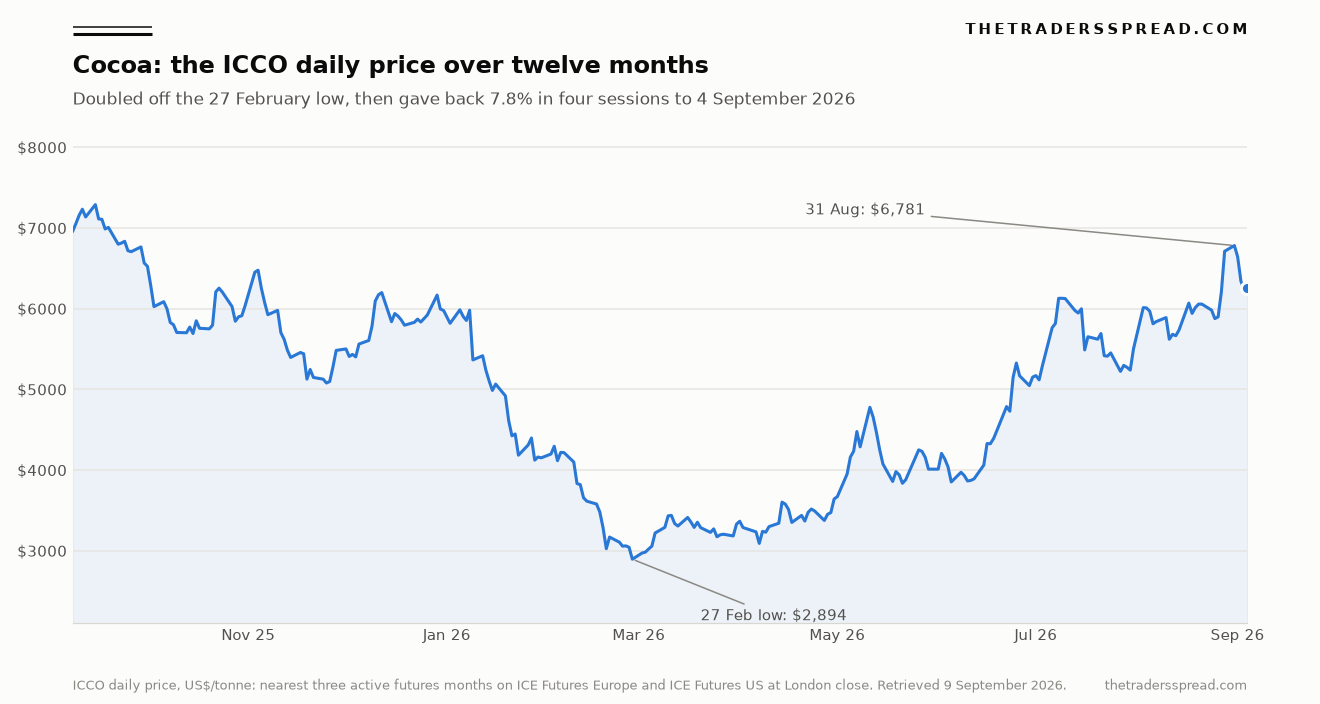
The twelve-month picture explains why traders are jumpy in both directions. Cocoa opened 2026 at $5,817.22 on 2 January, collapsed through February to $2,893.81 on the 27th, and has since more than doubled. Lucca Bezzon, Brazil market intelligence analyst at StoneX, described the first leg of that collapse in a note dated 26 February 2026: "Futures have dropped about 50% just in the first weeks of 2026." Anyone holding from the February low is up more than 100%. Anyone who bought the 1 September settlement is down 12.4% four sessions later. Both cohorts are in the same market, reading the same headlines.
The arrivals number describes a crop that is already gone
Here is the part the price action keeps forgetting. The 2.14 million tonnes counted at Abidjan and San Pedro belong to the 2025/26 season, which ran from October 2025 and is now finished. That season was a genuine recovery: the ICCO's August bulletin recorded world gross production up 8.5% year on year to 4.733 million tonnes for 2024/25. Certified stocks are high because that crop was large and because grindings were weak, not because next year's beans are already in the warehouse.
Demand is the other half of the arithmetic, and it has been contracting. The ICCO put 2024/25 world grindings down 3.3% at 4.649 million tonnes, which pushed the stocks-to-grindings ratio to 28.2% on end-of-season stocks of 1.309 million tonnes. Bezzon, in a note dated 22 April 2026, was blunt about the mechanism: "the biggest drop and the biggest reason why we're having surpluses is that demand has fallen faster than the supply recovery." He added that manufacturers had responded to two years of record prices with "smaller product sizes, reformulation and a greater use of substitution", three changes that do not reverse when the futures price halves.
That is a different market from the one the 27 August rally was pricing. Reading a two-year high in certified stocks as a verdict on the 2026/27 crop confuses a settled balance with an unsettled one. The same error appeared in metals earlier this year, when lithium carbonate held 161,000 yuan while a restarted mine sat idle, and it is the reason inventory data and forward crop risk should be read on separate clocks.
Four houses, one crop, and no agreement
The published 2026/27 balances are not close to each other. They are not even the same sign.
| Forecaster | 2026/27 balance | Stated basis |
|---|---|---|
| Guan Chong (CEO Brandon Tay Hoe Lian) | 300,000–400,000 t deficit | El Niño damage to West African output; steadying demand |
| Hedgepoint | 111,000 t surplus | ~2% global production decline, 2.5% processing increase |
| BMI | 82,000 t surplus | Côte d'Ivoire −17.5% to 1.7 Mt; Ghana −9.1% to 627,000 t |
| ICCO | Not published | 2025/26 production and grindings data temporarily withheld |
Sources: CocoaIntel daily report, 2 September 2026; ICCO August 2026 Quarterly Bulletin of Cocoa Statistics, 31 August 2026. Retrieved 9 September 2026.
Brandon Tay Hoe Lian, chief executive of the Malaysian processor Guan Chong Bhd, told Bloomberg on 2 September that futures could reach about $8,000 a tonne by December, from roughly $6,500 at the time. In the same coverage, Michel Arrion, executive director of the International Cocoa Organization, offered a qualitative view that sits alongside the withheld data rather than replacing it: "We will have relatively bad production in the upcoming season globally," he told a conference reported by The Edge Malaysia on 2 September 2026.
Note the shape of the disagreement. It is not about weather; every forecaster on that table assumes a strengthening El Niño and worse West African yields. It is about how much surplus the market carries into the deficit, and about whether grindings stabilise or keep falling. BMI cuts Ivorian output by 17.5% and still lands on a surplus, because it assumes demand does not recover. Guan Chong cuts output by a similar order and lands on a 400,000 tonne shortfall, because it assumes demand does. One assumption is doing all the work.
A crop that has not started, against a deadline that will not move
The Conseil du Café-Cacao attributed the delay to three compounding causes: difficult weather, insufficient farm maintenance, and a mid-crop strong enough to hold back main-crop development. Two council sources and five exporters told Reuters on 27 August that they expect weekly arrivals below 15,000 tonnes in September, rising to about 25,000 tonnes in October, against a full main crop of 1.4 million tonnes for September to February.
Compression is the risk, not shortage. About 900,000 tonnes are now expected at port between October and December, against 1.1 million in the same window of 2025, and the beans that do not arrive in that window have to arrive later. That collides with a fixed regulatory date. The EU Deforestation Regulation applies to large and medium operators from 30 December 2026 after two postponements, and cocoa is one of its seven listed commodities. An exporter shipping non-compliant beans into the European Union after that date has a compliance problem rather than a logistics one, which is why the trade wants cargoes gone before the year ends.
One European export executive in Abidjan, speaking to Reuters on condition of anonymity, put the consequence plainly: "With this looming delay, we will find ourselves having to export enormous quantities in a short period in December." Storage capacity at Abidjan and San Pedro is the binding constraint in that scenario, and port congestion in a soft commodity is not a theoretical cost. Wheat repriced 43% in a year on a single Black Sea terminal outage, which is a useful reminder that the loading berth, not the field, often sets the marginal price.
The farmgate arithmetic adds a second-round effect. On 1 September the council fixed the 2026/27 main-crop price at CFA1,200 per kilogram, unchanged from the March mid-crop level but 57% below the CFA2,800 that opened 2025/26, because more than 1.1 million tonnes of 2026/27 cocoa had already been forward-sold between March and June at far lower international prices. Farmers who watched the ICCO's New York futures reading clear $6,700 in late August are paid against contracts written when the ICCO daily price averaged $3,794 between 1 March and 30 June. Cross-border leakage, weaker farm investment and lower official arrivals are the documented responses to that gap, and each of them corrupts the arrivals series that the futures market is currently trading off.
What this changes
Three things are different after this week, and none of them is a price target.
First, the arrivals series has become a less reliable instrument at exactly the moment the market is leaning on it hardest. A 57% farmgate cut creates a measurable incentive to move beans across borders unrecorded, and a delayed main crop means the weekly print for September and October will be compared against a base period that was not delayed. Traders reading a 19% year-on-year gain as a clean supply signal are reading a number that now carries two structural distortions.
Second, the ICCO's withheld 2025/26 data has shifted the market's reference point from an official balance to a set of commercial ones. Guan Chong is a grinder with a physical book. BMI and Hedgepoint are analytical houses. Their numbers are not wrong for being commercial, but they are produced by participants with positions, and the market has no neutral anchor to average them against until the Secretariat publishes again.
RelatedCheddar Rises 21.5% to $1.68 in the Week to Friday
Third, the December window is now a scheduling problem with a hard edge. If Ivorian arrivals genuinely run at 15,000 tonnes a week in September and 25,000 in October, the physical market tightens into November regardless of how full ICE warehouses look, because certified stock in New York and London does not help a European chocolate manufacturer that needs EUDR-compliant beans documented before 30 December. Watch the weekly arrivals prints, the certified stock direction rather than its level, and whether the London-New York arbitrage widens as the EU deadline approaches. The relationship between a full warehouse and an accessible bean is the thing this market has yet to price properly.
For a comparison across the softs complex, the same tension between a recovering crop and a repricing demand curve is visible in coffee, where a StoneX upgrade to the Brazilian crop moved arabica 13.5%. Supply-side shocks in thin agricultural markets rarely stay contained to one bean.
Frequently asked questions
What is the current cocoa price?
ICE Futures US December cocoa settled at $5,927 a tonne on 8 September 2026, down $261 or 4.22% on the session, with a range of $5,735 to $6,235 on 25,904 lots, according to Investing.com data retrieved on 9 September 2026. The ICCO daily price, a separate benchmark averaging the nearest three active months across London and New York, last published at $6,251.93 for 4 September 2026.
Why did cocoa fall 12.4% in four sessions?
The slide followed the release of supply data covering the completed 2025/26 crop. Ivory Coast port arrivals reached 2.14 million tonnes through 30 August, 19% above the year-earlier pace, and ICE certified stocks hit a two-year high of 3,411,776 bags on 1 September. That data arrived immediately after a 15% three-session rally driven by a crop-delay warning, so the market was unwinding a fresh position as well as absorbing new information.
How late is the Ivory Coast 2026/27 main crop?
The Conseil du Café-Cacao warned on 26 August 2026 that the season, due to open on 1 September, could start eight to ten weeks behind schedule. It blamed difficult weather, insufficient farm maintenance and an unusually strong mid-crop that held back main-crop development. October to December arrivals are now projected at about 900,000 tonnes against 1.1 million in the same period of 2025.
What does the EU Deforestation Regulation mean for cocoa?
The regulation applies to large and medium operators from 30 December 2026 following two postponements, and cocoa is one of the seven commodities in scope. Beans placed on the EU market after that date must be documented as deforestation-free and legally produced. Combined with the Ivorian crop delay, that concentrates export demand into November and December and raises the risk of congestion at Abidjan and San Pedro.
Why are the 2026/27 balance forecasts so far apart?
The ICCO temporarily withheld its 2025/26 production and grindings data in the August bulletin, removing the official reference point. Commercial forecasts now range from a 300,000 to 400,000 tonne deficit at Guan Chong to an 82,000 tonne surplus at BMI. The forecasters largely agree on weather damage and disagree on demand: whether grindings stabilise after a 3.3% fall in 2024/25 decides the sign of the balance.
Are ICE certified stocks a reliable indicator of tightness?
They measure deliverable stock at exchange-approved warehouses, so they describe availability against futures rather than availability to a manufacturer with origin and compliance requirements. A two-year high in bags can coexist with a physically tight forward market, particularly when a regulatory deadline restricts which beans a European buyer can accept.
Disclaimer
This article is analysis and information, not investment advice, and nothing in it is a recommendation to buy, sell or hold any instrument. Commodity futures are leveraged products and capital is at risk. Prices, forecasts and regulatory dates cited here were verified on 9 September 2026 and can change without notice. Readers should carry out their own research and consider taking independent professional advice before acting on any market view.