
Palm oil fell 6.60% between the 17 September and 30 September settlements on the table I pulled from the Malaysian Palm Oil Council on 1 October. The first of those ten Bursa prints is 4,936 ringgit a tonne. The last is 4,610. The gap is 326 ringgit, and 326 divided by 4,936 is 6.60%, the 6.6% in the headline.
I have sat with this benchmark through the late-summer rise, and the council page is the file I reopen when two accounts of the same close are a couple of ringgit apart. They are apart now. Reuters' closing wrap, published in the early hours of 1 October, had the December contract down 12 ringgit, or 0.26%, at 4,612. That was a fourth straight down session, and Reuters called it the lowest close since 21 July. The council's 30 September cell says 4,610.
Two ringgit is a rounding quarrel until the next session's change is added to the wrong base. On the morning of 1 October a Dow Jones market-talk note had December down 21 ringgit at 4,589, and a Reuters morning report had it down 19 ringgit, or 0.41%, at 4,591. Both subtractions land on 4,610. Neither lands on 4,612. Neither note is an official close, and the council page still ended on 30 September when I retrieved it.
Indonesia does not belong in that sentence. Reuters reported on 30 September, in a headline carried by MarketScreener, that Jakarta set the October crude palm oil reference price at $1,042.15 a tonne. September's reference was $1,007.51. The October figure is $34.64 higher, a rise of 3.44%, in the same month the Malaysian settlement fell. The reference price is a lagged tax base, built for September from prices between 20 July and 19 August. It is not the futures screen.
The figures that hold
- Council settlement 4,610 ringgit on 30 September, down 326 ringgit, or 6.60%, from 4,936 on 17 September (Malaysian Palm Oil Council, retrieved 1 October 2026).
- Reuters' December close: 4,612 ringgit, down 12, or 0.26%, a fourth down session and the lowest close since 21 July. The wire called September the first monthly drop in four and converted that close at $1,132.06 (Reuters, published 1 October 2026).
- Morning marks on 1 October, not closes: 4,589, down 21 (Dow Jones) and 4,591, down 19 or 0.41% (Reuters). Both subtract from 4,610.
- Indonesia's October reference price $1,042.15 (Reuters, 30 September), against September's $1,007.51, up $10.99 or 1.10% from August's $996.52 (Trade Ministry, 2 September).
- End-August Malaysian palm oil stocks 2,824,488 tonnes, up 196,590 or 7.48% from 2,627,898 (MPOB figures parsed by Palm Oil Economics, retrieved 1 October 2026, marked preliminary). The Star reported the same release as 2.82 million tonnes, up 7.48%. September stocks are not out.
- India cut the basic customs duty on crude palm oil to 5% from 10%, effective 24 September (Reuters, 23 September). At the ECB rate on 30 September, 4.078 ringgit per dollar, 4,610 ringgit is $1,130.46.
Ten settlements, and the path into them
The live council table, courtesy of Bursa Malaysia, shows ten sessions and no more. The day-to-day change below is taken off the prior cell, not off a wire.
| Session | Settlement, ringgit | Change |
|---|---|---|
| 17 September | 4,936 | |
| 18 September | 4,898 | -38 |
| 21 September | 4,857 | -41 |
| 22 September | 4,810 | -47 |
| 23 September | 4,768 | -42 |
| 24 September | 4,772 | +4 |
| 25 September | 4,672 | -100 |
| 28 September | 4,664 | -8 |
| 29 September | 4,624 | -40 |
| 30 September | 4,610 | -14 |
Nine of the ten steps are down. The only up day is 24 September, four ringgit back after a 42-ringgit loss. Then 25 September took off 100 ringgit, from 4,772 to 4,672, which is 2.10% in one session. Bernama's Friday close had December down 100 at 4,672, the same cell. Reuters, in a story Business Recorder published on 27 September, had that session down 99 at 4,673. One ringgit. Same class of quarrel as 4,610 against 4,612. I am keeping the council cell.
The 28 and 29 September council prints match Bernama's December closes. On 28 September Bernama had December down 8 at 4,664. On 29 September it had December down 40 at 4,624. This window is the December contract.
From 29 to 30 September the council table falls 14 ringgit, 0.30%. Reuters said 12 ringgit, 0.26%, to 4,612. Bernama's 30 September story said December eased 12 ringgit and printed 4,624, which is the previous close, not a price 12 ringgit under it. Twelve under 4,624 is 4,612. I will not average 4,610 and 4,612 into a third number nobody printed.
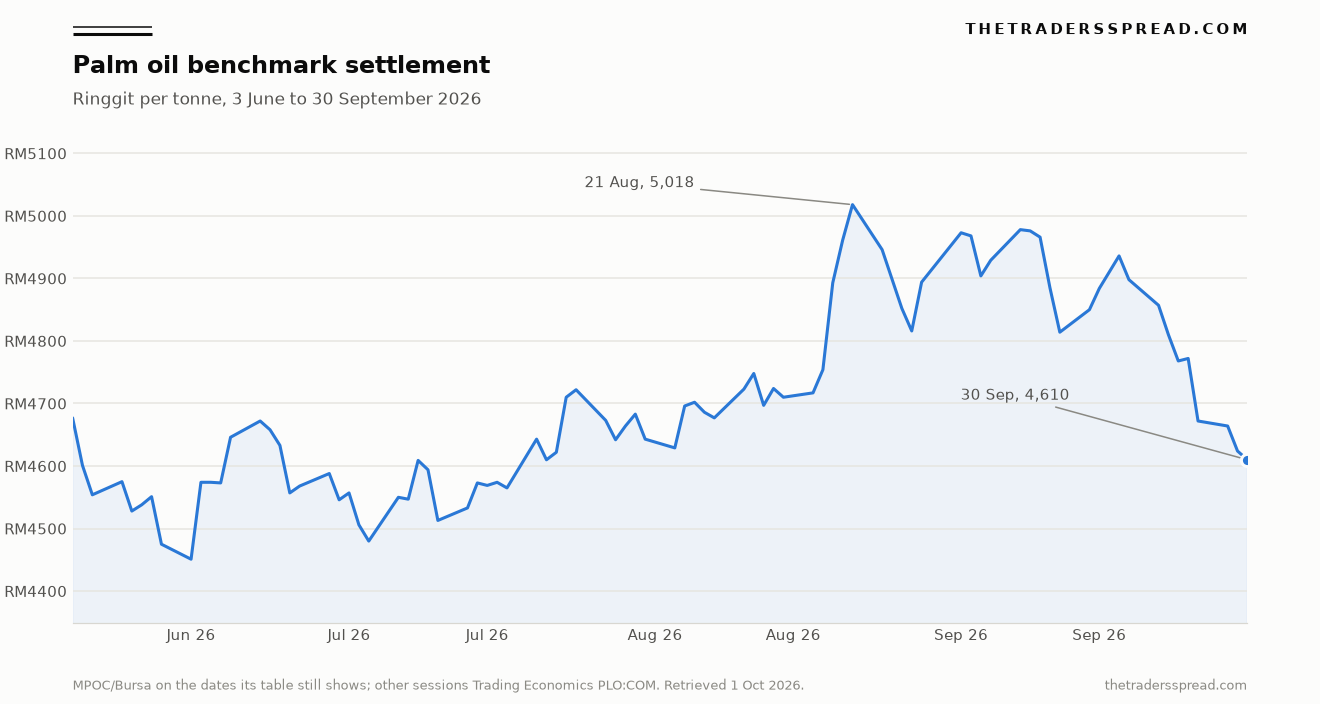
The chart runs from 3 June, the first session in the file, to 30 September. Where the council table still shows a date, the point is the council's: an archived copy for 28 July to 10 August, and the live page for 17 to 30 September. The archived prints matched a separate daily history to the ringgit. In September the two sources agreed on eight of ten sessions. They missed 17 September, 4,816 against the council's 4,936, and 30 September, 4,616 against 4,610. The chart uses the council print on both days.
The other sessions are Trading Economics' PLO:COM series, retrieved the same morning. On it, 15 June is 4,451 ringgit, the low of the window, so the 30 September council settlement is still 159 ringgit above that June print. 21 August is 5,018, the high. 28 August is 4,894. The file has no 31 August print, the Monday of Malaysia's National Day, and no 16 September print, Malaysia Day.
From 4,894 on 28 August to the council's 4,610 is 284 ringgit, or 5.80%, with both sources named. Reuters also published a September percentage. It does not fall out of a series whose 30 September point I can download, so that percentage stays off the page. The wire did say the contract booked its first monthly drop in four months. That claim does not need the percentage.
On the daily history, 21 July itself is 4,610, and no session from 22 July through 29 September printed below 4,612. A 4,612 close is the lowest since that July day without going under it. The council's 4,610 ties the July print. It does not undercut it.
What the people on the tape actually said
David Ng, proprietary trader at Iceberg X Sdn Bhd, told Bernama on 29 September that weaker rival oils and stocks were both leaning on the session. "The increase in stocks was linked to improving production, which added to expectations of higher supplies in the market." Those supplies, he said, "kept buying interest cautious and limited support for CPO prices." Support was 4,550 ringgit, resistance 4,700. December eased 40 to 4,624. Volume was 114,553 lots, from 92,860, and open interest rose to 339,820 contracts from 338,007. Physical October delivery in the south was 4,500 ringgit, 124 under December.
Bernama's 30 September note still had him at about 4,550 support and 4,700 resistance. By the morning of 1 October the band had moved. Dow Jones quoted him, as a trader at Iceberg X, pegging support at 4,500 and resistance at 4,650, with December indicated down 21 at 4,589. Those are his marks for that morning. A support line that shifts 50 ringgit between the close story and the next morning's note is a description of the tape, not a floor this desk is adopting.
On 25 September, Sathia Varqa, senior analyst at Fastmarkets Palm Oil Analytics, told Bernama that "Malaysia's end-month stocks may rise above three million tonnes in September," and that those stocks "remain the key driver of CPO futures, typically exhibiting an inverse relationship with prices." The same Friday, Anilkumar Bagani, research head at Sunvin Group in Mumbai, told Reuters the futures had stayed heavy despite India's duty cuts, and that higher production and weak exports had raised concern stocks could exceed 3.1 million tons. Bernama's December close was 4,672, down 100.
Neither man was publishing the September stock. They were describing a print the Malaysian Palm Oil Board has not released. August is the last official inventory. Reuters, in its 29 September midday story, called that August stock the highest in eight months.
August is the last hard inventory
Palm Oil Economics, parsing the board's August table and marking it preliminary, puts end-August stocks at 2,824,488 tonnes when retrieved on 1 October. That is 196,590 tonnes, or 7.48%, above July's 2,627,898. Crude palm oil stocks did the lifting: 1,645,570 tonnes, up 217,092, or 15.20%, from 1,428,478. Processed stocks fell to 1,178,918 tonnes from 1,199,420, or 1.71%. The Star, citing Bernama on 10 September, reported the same release as 2.82 million tonnes, up 7.48%.
Production did not surge. Crude palm oil output was 1,817,499 tonnes, up 24,903, or 1.39%, from 1,792,596. Exports were the soft leg: 1,294,664 tonnes, down 104,915, or 7.50%, from 1,399,579. A small production gain and a larger export drop is enough to explain a stock build of this size. Palm oil imports were 49,524 tonnes, against 49,566 in July. The Star put that at a 0.09% decline.
The surveys deteriorated into the close. Reuters' midday story on 29 September had Intertek Testing Services and AmSpec Agri Malaysia estimating 1-25 September exports of Malaysian palm products down between 15.1% and 24.3% on the same stretch of August. By the closing story the same two surveyors had full-month September exports down between 17.1% and 28.8% against August. That is a range, not a single tonne count, and it is not the board's stock print.
In that closing story Reuters quoted a Kuala Lumpur trader saying the market is waiting for the board's September inventory on 12 October. A figure above three million tonnes would confirm the fear that already took 326 ringgit off the council settlement. A figure near the August level would make the late-month break look fast relative to the stock that actually arrived. I do not have the figure.
Visible inventory does this in other markets we have already written. Zinc's backwardation narrowed from $217 to $79 as LME stocks rose. Different metal, same mechanism: stocks change what the nearby price can claim. Palm has an August stock Reuters called an eight-month high, and no September stock yet.
India cut the duty into a falling tape
Reuters reported on 23 September that a notification late that Wednesday cut the basic import duty on crude palm oil and crude soyoil to 5% from 10%, and on refined palm oil and refined soyoil to 27.5% from 32.5%. Crude sunflower oil went to zero from 10%. With the cess and the surcharge, the total duty on crude palm oil and crude soyoil fell to 11% from 16.5%. The Hindu reported on 24 September that the change took effect that Thursday.
On the Bursa table, 24 September rose 4 ringgit, to 4,772. The next session fell 100. Bagani's remark, that the market stayed heavy despite the duty cut, is those two cells. A lower Indian tariff changes the landed cost for the biggest buyer. It did not set the Malaysian settlement while production crept up and the export surveys were soft.
The buyer's currency is a separate lever. The rupee's path into the next Indian fiscal year decides how many dollars an Indian refiner needs for a tonne priced in ringgit. I am not folding that forecast into this settlement. Only the duty moved on 24 September.
The ringgit conversion I can recompute. Frankfurter's ECB reference for 30 September was 4.078 ringgit per dollar. Divide 4,610 by 4.078 and the dollar price is $1,130.46 a tonne. Reuters' $1,132.06 belongs to the 4,612 close. A 6.60% fall in the ringgit price, across nine intervals, is the move the named traders explained with stocks and exports.
Jakarta's reference price went the other way
Tommy Andana, director general of foreign trade at Indonesia's Trade Ministry, set the September reference in a statement carried on 2 September. The price for 1-30 September was $1,007.51 a tonne, up $10.99, or 1.10%, from August's $996.52. Under the finance ministry regulation, he said, the export duty was $148 a tonne and the levy was 12.5% of the reference price, "equivalent to USD 125.9389 per MT." Averaged from 20 July to 19 August, the inputs were $904.75 in Indonesia, $1,110.27 in Malaysia and $1,548.92 at Rotterdam. The gap exceeded $40, so Rotterdam was dropped under Trade Ministry Regulation No. 35 of 2025.
A falling Bursa screen in late September does not automatically cut October's export tax, because the reference looks backward. October's price, $1,042.15 in the Reuters report of 30 September, is $34.64 above September, or 3.44%. I do not have October's duty or levy in a text I can quote. The reference alone shows the split: the dollar value used to tax Indonesian exports rose, while the Malaysian hedge fell to a print that ties 21 July.
Rival soyoil did not rescue the contract on the monthly close. Reuters had Dalian's most-active soyoil up 1.32% and its palm contract up 0.1%, with Chicago soyoil up 0.06%. On 30 September the rivals were not the weight. The next morning Reuters had the contract lower again, alongside weaker Chicago soyoil. Soybeans had already taken a hit from a record US crop estimate. A heavy soybean balance does not set the Bursa print.
What this changes
The base for the next session is the council cell, if the morning of 1 October is the guide. "Down 21 at 4,589" and "down 19 at 4,591" both start from 4,610. Start from 4,612 and you print a price the notes did not. I will read the council settlement before the dollar figure in a wrap, and I will read Bernama's stated change separately from the level beside it. On 30 September those two did not agree.
"Above three million tonnes" is a forecast of a release. Varqa said stocks may clear three million. Bagani's version was 3.1 million tons. The last published stock is 2,824,488 tonnes. The trader Reuters quoted put September's number on 12 October. I am not putting a ringgit figure on what happens between now and that morning.
A producer who hedges in Malaysia and pays tax in Indonesia is living with two prices that moved apart. The lagged reference rose 3.44%. The late-September settlement fell 6.60%. Calling the month simply weak skips the tax base. Calling the official market strong skips 326 ringgit on Bursa.
RelatedUrea fell 42.4% from the second to the third quarter
Ng's 4,500 and 4,650 are the 1 October morning band. His 4,550 and 4,700 are the band from 29 September, still in the 30 September story. The shift is the information. Neither pair is a target. Until the board prints September stocks, the settlement is a price, the reference price is a tax base, and the inventory argument is still an argument.
Questions the tape is actually asking
Why did the palm oil settlement fall in the second half of September?
On the council table the move is 326 ringgit, from 4,936 on 17 September to 4,610 on 30 September. Ng, Varqa and Bagani pointed at the same cluster: production holding up, export surveys soft, and the fear that September stocks clear three million tonnes when the board reports. Rival oils were not a one-way weight. On the monthly close, Reuters had Dalian soyoil up 1.32%.
Is 4,610 ringgit the same close as Reuters' 4,612?
No. The council table, retrieved 1 October, shows 4,610 for 30 September. Reuters' closing wrap shows 4,612, down 12 ringgit. The morning indications on 1 October, 4,589 down 21 and 4,591 down 19, both reconcile with 4,610 and not with 4,612. Two ringgit is the whole disagreement. It matters when the next change is chained onto it.
When is the September stock figure due, and what is the last official one?
Reuters quoted a Kuala Lumpur trader saying the Malaysian Palm Oil Board's September inventory is due on 12 October. The last published stock is August: 2,824,488 tonnes, up 7.48%, in the board's table as carried by Palm Oil Economics and, in round millions, by The Star on 10 September. A September figure above three million tonnes is still an expectation.
Did India's import-duty cut stop the decline?
It did not stop these ten sessions. The basic customs duty on crude palm oil went to 5% from 10%, taking effect on 24 September. The settlement that day rose 4 ringgit. The next session fell 100 ringgit, to 4,672, which is also Bernama's December close. A lower duty cuts the landed cost. In this window it did not set the Bursa print.
Why did Indonesia's October reference price rise if futures fell?
Because it is not the futures close. September's $1,007.51 was an average from 20 July to 19 August, with Rotterdam dropped because it sat too far from the Malaysian and Indonesian quotes. October's $1,042.15, reported by Reuters on 30 September, is $34.64, or 3.44%, higher. The tax base looked back at a firmer window. The hedge did not.
Does any of this say where palm oil settles next?
No. The 6.6% is a measured change between two council settlements, not a projection. Support and resistance here are David Ng's, dated to the session he gave them, and they moved between the 30 September close story and the next morning. The next dated official number is the stock release the trader put on 12 October. A price target does not belong on a record of a close that has already happened.
This is analysis, not a recommendation to trade. Palm oil futures and the currencies around them can move sharply, and a settlement table is a record of the past. Capital is at risk. The figures above are sourced to the council table, to the wires and to the agencies named, as of the dates given. They are not an instruction.