

Having rebuilt the lean hog tape one contract at a time this weekend, our commodities desk can say plainly what the continuous charts cannot: US hog futures did not crash 12.9% last week. The front-month line that most quote screens display, CNBC's @LH.1, went from 83.45 cents a pound on 3 September to 72.70 at Friday's close, 11 September. It was quoting October hogs at the start of that window and December hogs at the end. On the October 2026 contract itself, the move was 83.45 to 81.525, a 2.3% slip, and December gave up 1.7%. The real damage sits one layer down, in the USDA pork cutout, where the negotiated belly primal fell from $165.87 per hundredweight on 10 August to $110.96 on 11 September, a 33.1% drop in a month. Cash hogs have followed it lower, and the futures curve is simply pricing where that leaves October.
That ordering matters because it flips the usual story. A futures crash would imply fresh news hitting the pit. What the USDA files show instead is a wholesale pork market that cracked in early September, a cash hog price that has now slid 12.8% from its late-July peak, and an October contract that already sits 8.7% under the latest cash print. Nobody in the pit panicked on 8 September. That was the day the continuous line printed an 8.8% loss while the October contract actually rose 2.4%. The pressure point is the belly, not the barn: the June herd count was flat to slightly smaller, and USDA itself blamed "recent price weakness" when it cut its hog price forecast on Friday.
Key facts
- USDA's negotiated pork belly primal fell 33.1%, from $165.87/cwt on 10 August to $110.96 on 11 September — USDA AMS LM_PK602, 11 Sep 2026
- The national negotiated barrow and gilt net price was $89.32/cwt for 10 September purchases, 12.8% below the $102.45 peak of 27 July and 17.1% below $107.70 a year earlier — USDA AMS LM_HG201, 11 Sep 2026
- The negotiated pork cutout closed at $89.80/cwt, down 14.3% from $104.82 on 21 July and 20.7% below $113.17 a year earlier — USDA AMS LM_PK602, 11 Sep 2026
- October 2026 lean hog futures settled at 81.525 cents/lb (down 2.3% from 3 September) and December at 72.70 (down 1.7%) — CNBC delayed settlement data, 11 Sep 2026
- USDA cut its 2026 barrow and gilt price forecast to $64.82/cwt live-equivalent from $65.32, and trimmed 2026 pork exports to 7,110 million lb from 7,175 million — WASDE 675, 11 Sep 2026
- The 1 June US hog inventory was 73.7 million head with the breeding herd at 5.88 million, down 1% on the year — USDA NASS Quarterly Hogs and Pigs, 25 Jun 2026
How a contract roll printed a 12.9% crash
A continuous futures series is a splice. It shows the nearest active contract until that contract approaches expiry, then jumps to the next one. In most markets the jump is small. Lean hogs are different because the curve has a steep seasonal shape: summer hogs are scarce and expensive, and winter hogs are plentiful and cheap. Splice a summer month onto a winter month and you print a "loss" that no position ever suffered.
The CNBC bars we pulled show two such splices since June. Between 9 and 10 July the @LH.1 line fell from 98.15 to 85.075, a 13.3% drop in one session. On 10 July the August contract settled at 99.00, and the October contract, the one the line switched to, settled at 85.075. The second splice came between 4 and 8 September, when @LH.1 went from 82.30 to 75.05. October settled at 82.30 on 4 September and at 84.25 on 8 September, a gain. December, the new front month on the screen, settled at 75.05.
So the widely circulated arithmetic was wrong on both counts. The "12.9% week" compared an October price with a December price. The "24.2% slide since 11 June" compared the August contract, which settled at 95.90 that day, with December. On the October contract alone, prices are up 0.6% since 11 June, from 81.075 to 81.525. December is down 2.2% over the same stretch, from 74.30 to 72.70.
What did move is the gap between the two autumn months. October traded 6.775 cents over December on 11 June, 8.60 cents over on 28 July and 8.825 cents over at Friday's settlement. A widening October premium tells you the market expects winter cash hogs to be cheaper relative to autumn ones than it thought in June. That is a real signal. A 12.9% crash is not.
Any market with a steep seasonal curve carries the same risk. That is why this desk names the contract month in every futures figure, whether the story is cocoa's slide on Ivory Coast arrivals or coffee's fall on a bigger Brazil crop estimate.
Bellies broke first, and hard
USDA's afternoon negotiated pork report prices seven primal cuts every trading day and rolls them into a cutout value for a 215-lb carcass. Through July and most of August the belly carried that cutout. It peaked at $165.87 on 10 August, while the ham was already sagging from $105.95 on 21 July. Then, between 2 and 3 September, the belly primal dropped from $153.98 to $121.85, a 20.9% fall in one report.
Some of that single-day move is thin trade. The 3 September report was built on 174.45 loads of negotiated pork cuts, the lightest day in the fortnight we checked, against 198.86 loads the day before and 240 to 313 loads on 8 to 10 September. Thin days exaggerate moves. The bounce on heavier volume was only partial, though: bellies printed $118.49 on 8 September, recovered to $132.42 on 9 September when 313 loads changed hands, then slipped to $120.63 on 10 September and $110.96 on Friday, with 210 loads traded.
The other primals tell a more mixed story. Since 1 September the ham has risen 9.5%, from $73.87 to $80.92, and the picnic has gained 1.8%. The loin fell 3.3% to $86.05, the butt 5.0% to $111.20 and the rib 5.4% to $157.02. Against that, the belly's 31.3% fall since 1 September does almost all of the work in taking the whole cutout from $97.90 to $89.80, an 8.3% decline.
Our read, and it is a read rather than a USDA finding, is that summer bacon features are done and retail belly demand has not been rebuilt at the prices packers were asking in August. Year on year, the belly is 35.4% below the $171.67 of 11 September 2025.
Packers feel this directly. A crude way to watch their room to bid is to set the cutout against the negotiated hog price, both quoted per hundredweight of carcass. It ignores by-product value and plant costs, so treat it as a direction gauge only. On 28 July the cutout stood at $103.91 against cash hogs at $101.98, a gap of $1.93. On 10 and 11 September it was $89.80 against $89.32, a gap of $0.48. When that spread compresses, the packer bid for live hogs tends to soften, and that is exactly what the cash series shows.
Cash, cutout and the October discount, side by side
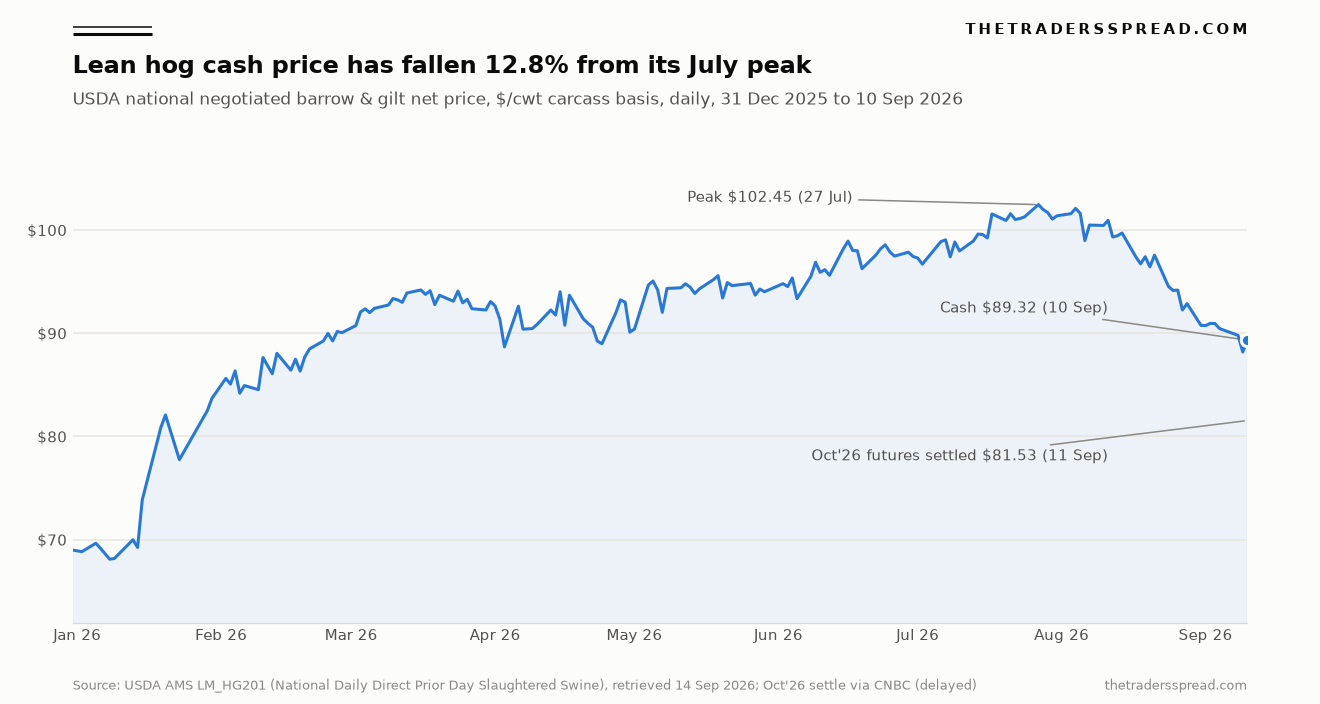
The chart plots USDA's national negotiated barrow and gilt net price, the cleanest daily read on what packers pay for hogs bought on the open market. It started the year below $70, climbed through spring, and topped at $102.45 for purchases on 27 July. It has fallen almost every week since. The broader all-purchase-types average, which includes formula and contract hogs, peaked at $98.60 on 29 July and was $87.93 on 10 September, a 10.8% decline.
The table lines up each series on the same three dates. Read it from left to right and one pattern stands out: from 3 September onwards, everything moved roughly 1.5% to 2.5% except the belly, which fell nearly 9%, and the continuous futures line, which "fell" 12.9% because of the splice.
| Series (unit) | 28 Jul | 3 Sep | 10 to 11 Sep | 3 Sep to latest |
|---|---|---|---|---|
| CNBC continuous @LH.1 (¢/lb) | 88.275 (Oct) | 83.45 (Oct) | 72.70 (Dec) | -12.9% (roll) |
| October 2026 lean hog futures (¢/lb) | 88.275 | 83.45 | 81.525 | -2.3% |
| December 2026 lean hog futures (¢/lb) | 79.675 | 73.925 | 72.70 | -1.7% |
| February 2027 lean hog futures (¢/lb) | 82.80 | 76.60 | 75.20 | -1.8% |
| USDA negotiated cash hogs ($/cwt) | 101.98 | 90.93 | 89.32 | -1.8% |
| USDA all purchase types ($/cwt) | 98.58 | 90.13 | 87.93 | -2.4% |
| USDA pork cutout ($/cwt) | 103.91 | 91.12 | 89.80 | -1.4% |
| USDA belly primal ($/cwt) | 156.42 | 121.85 | 110.96 | -8.9% |
Sources: futures settlements from CNBC delayed data (contract bars LHV26, LHZ26, LHG27 and the @LH.1 continuous line), retrieved 14 September 2026. Cash hog prices from USDA AMS LM_HG201 by purchase date (28 July, 3 September, 10 September). Cutout and belly from USDA AMS LM_PK602 by report date, latest 11 September. A cent per pound equals a dollar per hundredweight, so the rows are directly comparable.
The number that matters most in that table is the distance between the October contract and cash. October lean hogs cash-settle against the CME Lean Hog Index, which CME builds from these same USDA mandatory price reports. At 81.525, October sits $7.80, or 8.7%, below the latest negotiated cash price of $89.32. December sits 18.6% below it. The curve is not reacting to last week. It is pricing a cash market that keeps sliding into the autumn, as it usually does once summer supplies give way to heavier fall marketings.
What USDA changed on 11 September
Friday's World Agricultural Supply and Demand Estimates put numbers on the weakness without adding a new shock. USDA lowered its third-quarter 2026 barrow and gilt price forecast to $69 per hundredweight from $70, and its fourth-quarter forecast to $58 from $59. The full-year 2026 average moved to $64.82 from $65.32, and 2027 to $64 from $65. The report's own explanation was one line: "Hog price forecasts are decreased for the remainder of 2026 on recent price weakness."
A warning on units. WASDE quotes hogs on a live-equivalent basis, whereas the USDA daily reports above are on a carcass basis, so the $58 fourth-quarter forecast cannot be set against the $89.32 cash print directly. The direction of the revision is what counts.
The supply side moved the other way from what a price drop would suggest. USDA cut 2026 pork production to 27,787 million pounds from 27,892 million, on "a slower expected pace of slaughter and lighter dressed weights." Fewer pounds and lower prices together point to demand rather than supply as the pressure. Exports were trimmed to 7,110 million pounds from 7,175 million "on weaker demand and increased global competition," though that is still above 2025's 6,972 million.
The June Quarterly Hogs and Pigs report fits the same picture. NASS counted 73.7 million hogs and pigs on 1 June, down slightly from a year earlier. The breeding herd of 5.88 million head was 1% smaller. Producers said they intended to farrow 2.90 million sows in June to August, 2% fewer than a year before, and 2.89 million in September to November, 1% fewer. Litters were bigger, at 11.87 pigs saved against 11.75. None of that describes a flood of hogs. The next report, with the 1 September inventory, is scheduled for Thursday 24 September at 3:00 pm ET on the NASS release calendar.
Nor did the pressure start in the feed markets this week. Our soybeans desk covered Friday's 2.7% fall after USDA's record crop estimate, a move in the opposite direction to a feed-cost squeeze, while wheat's 43% annual rise is a reminder that grain markets are not uniformly cheap.
Last September looked nothing like this
Seasonal weakness is the easy explanation, and it is partly right. Cash hogs almost always soften after August. The size of this year's move is what the calendar does not explain.
Take the same three-week window a year apart. From 22 August to 12 September 2025, the negotiated cash price eased from $112.61 to $107.34, a 4.7% decline. From 21 August to 10 September 2026, it fell from $97.56 to $89.32, down 8.4%, and it did so from a lower starting point. The cutout held between about $111 and $116 through those weeks in 2025. The belly never traded below $171.67. This year the belly lost a third of its value inside a month.
There are reasons to be careful with that comparison. The belly is the most volatile primal on the board, and a market that fell 20.9% on a light-volume day can reverse just as quickly once retail features for the winter are booked. The ham's 9.5% rebound since 1 September shows that not every cut is sliding. And the all-purchase-types price, which covers most hogs actually sold, has fallen less than the negotiated series, 10.8% against 12.8%, because formula contracts smooth the moves.
RelatedEthanol Price Prediction: $2.22 Bull Case vs $1.79 Bear
What this changes
First, the headline. Anyone quoting a 12.9% weekly lean hog crash is quoting a roll. The honest description of last week's futures move is a 2.3% loss in October hogs and 1.7% in December, which is noise by the standards of this contract.
Second, the story moves to wholesale pork. The belly primal at $110.96 is now the variable to watch each afternoon. A cutout that keeps losing value leaves packers less room to bid for hogs, and the cutout-to-cash gap we computed from USDA's reports shrank from $1.93 in late July to $0.48 on Friday.
Third, the October contract has already done much of the adjusting. At 81.525 cents it implies cash hogs lose roughly another $6.40 to $7.80 before settlement, depending on whether you measure against the $87.93 all-purchase-types average or the $89.32 negotiated price. If cash stabilises near $89, October has to converge upward toward it. If bellies keep sliding and cash follows, the discount was correct and October converges downward. The market is pricing the second path as more likely.
Fourth, the dates. The belly and cutout print every weekday afternoon in LM_PK602. Cash prices print every morning in LM_HG201. The 24 September Hogs and Pigs report will say whether the breeding herd kept shrinking from June's 5.88 million.
What would change this reading: a belly primal back above $130 on normal volume of more than 200 loads, cash hogs holding flat for two weeks while the cutout recovers, or a September inventory that shows the herd growing again. Any of those would say the September break was a belly-specific wobble rather than the start of a deeper autumn low.
Frequently asked questions
Did lean hog futures really fall 12.9% last week?
No. The 12.9% figure comes from a continuous chart that switched from the October contract to December between 4 and 8 September. December normally trades well below October because winter hogs are cheaper. On a single contract, October fell 2.3%, from 83.45 to 81.525 cents a pound, and December fell 1.7%, from 73.925 to 72.70, between 3 and 11 September.
Why did pork belly prices fall so much?
USDA's negotiated belly primal fell from $165.87 per hundredweight on 10 August to $110.96 on 11 September. The sharpest single step, 20.9%, came in the 3 September report on light volume. USDA does not publish a reason. Our interpretation is that summer bacon demand has faded and retail interest has not returned at August's prices, but that is a desk read, not an official finding.
Why is December lean hog futures so far below October?
Hog supply rises through autumn as more animals reach market weight, and cash prices usually fall into winter. Futures price that ahead of time. On 11 September, October settled at 81.525 cents a pound and December at 72.70, a gap of 8.825 cents. That gap was 6.775 cents on 11 June, so the market now expects a steeper winter discount than it did in early summer.
Is the WASDE hog price the same as the USDA cash price?
No. WASDE forecasts barrows and gilts on a live-equivalent basis, which is why its fourth-quarter 2026 figure is $58 per hundredweight. The daily USDA Livestock Mandatory Reporting prices, such as the $89.32 negotiated price for 10 September purchases, are on a carcass basis. Compare revisions within each series, not levels across them.
When is the next major USDA hog report?
The Quarterly Hogs and Pigs report, with the 1 September inventory, is scheduled for Thursday 24 September 2026 at 3:00 pm ET according to the NASS release calendar. The June edition put the breeding herd at 5.88 million head, 1% below a year earlier, and intended September to November farrowings at 2.89 million sows.
Disclaimer
This article is market analysis and commentary, not investment advice or a recommendation to trade any futures contract or other instrument. Futures and derivatives are leveraged and can lose more than the initial margin; your capital is at risk. Prices quoted are settlements or USDA report values as of the dates stated and will have changed since publication. Do your own research or consult a qualified adviser before making any financial decision.