

Bismuth's refined quote rose 5.4% between the 23 October print of 120,000 yuan a tonne and the 9 November print of 126,500 yuan, and that repaired quote still sits 9.6% under the 140,000 yuan average Shanghai Metals Market recorded across 9 to 11 September. The two facts sit on one series. A buyer who treats 126,500 as a return to the autumn high is reading a different chart from the one the assessor published.
The 5.4% is 6,500 yuan divided by 120,000, and the 9.6% is 13,500 yuan divided by 140,000. On 26 October, with the quote already at 120,000 through the weekend, the weekly review said reversal conditions were still insufficient and that the quote would contest 120,000. The 2 November note then closed the quote at 125,000, up 5,000 yuan, and called it the first clear directional reversal in nearly a month. The 10 November review held 125,000 from 3 to 6 November and lifted the 9 November quote by 1,500 yuan to 126,500. Anyone tracking the bismuth price through those three notes is looking at a repair that began only after the assessor had described the tape as short of a turn.
Lemon Zhao is the inquiry contact printed on each of those Shanghai Metals Market notes. The prices below are the reviews' prints, dated on the pages.
23 October, the quote prints 120,000 yuan
The week of 19 to 26 October had one downward step. From 19 to 22 October the refined quote held at 121,000 yuan a tonne. On Friday 23 October it was lowered to 120,000 and it stayed there through the weekend. The review published at 15:49 GMT+8 on 26 October, with price data as of that day, called the move a single adjustment and said the decline had narrowed from the previous pace.
From a longer view the same review described a steady pullback from a staged high above 136,000 yuan a tonne in late September, with cumulative losses over the past month already exceeding 10%. Suppliers were still relatively willing to sell against weak demand, while sentiment to hold metal back was only beginning as the quote approached that psychological level. Downstream buying stayed as-needed, and large orders and long-term contracts were scarce.
A physical quote that steps once or twice in a week, rather than ticking through a session, is the kind of assessment the steel rebar price drivers explainer separates from a screen price. The bismuth figure moves when the weekly review moves it, which is why the 23 October print can sit from Friday into the following file.
That 120,000 level is the base of the 5.4% rise in the headline. It is also the previous close implied by the 2 November note, which put the rebound at 5,000 yuan a tonne. The two pages agree on the floor even though they were written a week apart.
From the September average down through the holiday
The path into that floor is a dated ladder, set out in the review published at 09:39 GMT+8 on 10 October. On 24 August the quote stood at 132,500 yuan a tonne. The average across 9 to 11 September was 140,000. It then stepped to 136,500 on 18 September, 131,000 on 24 September and 129,000 on 28 September. SMM called that drop from the high 11,000 yuan, or 7.9%. The seven-week fall of 2.6% from 24 August ends at that 129,000 print and leaves the later slide to 120,000 outside the percentage.
The spot market was closed from 1 to 7 October. The quote was 129,000 on 28 September and still 129,000 on 9 October, and the review read that pause as prices stopping their fall. September end-use demand was mediocre, acceptance above 130,000 yuan a tonne was thin, and pre-holiday stockpiling was cautious. Assessed refined production in September fell about 3.5% from August, with operating rates generally stable and the decline inside a reasonable range.
By 23 October the quote was 120,000, another 9,000 yuan under the 9 October print. From the 140,000 average to 120,000 is 20,000 yuan, or 14.3% on the same division used for the headline. SMM's "above 136,000" line in the 26 October review uses a looser base, which is why that page can say losses already exceeded 10% while the average produces 14.3%.
Exports in that earlier window were weak on the one line that carries a tonnage. China's bismuth trioxide exports in August were 623.65 tonnes, about 25.6% below July's 837.91 tonnes, and they stayed under 1,000 tonnes. The 10 October review said overseas demand gave domestic prices only a limited lift. September's rebound, in the later reviews, arrives without a tonnage.
Seven days later, the reversal was on the page
The turn is a short note. Published at 15:20 GMT+8 on 2 November, it says refined bismuth reversed its previous gradual downtrend, climbed step by step from the psychological level of 120,000 yuan a tonne, broke above 121,000 and 124,000 successively, and closed at 125,000, up 5,000 yuan a tonne from the previous close. It calls that the first clear directional reversal in nearly a month.
The 121,000 and 124,000 breaks are undated inside that sentence, so they are left off the chart as separate days. The close of 125,000 is dated to the note itself, 2 November, and the following weekly review treats 125,000 as the platform already in place when its window opened on 3 November.
The same morning, at 09:59 GMT+8 on 2 November, a separate SMM note estimated that China's refined output in October would drop by around 10% from September, inside a reasonable range, with tight feedstock and lacklustre demand. The price note and that output note share a date and a contact, Lemon Zhao: one prints a close, and the other prints an estimate of tonnes.
A second step, then a week that held
The weekly review published at 09:38 GMT+8 on 10 November covers 2 to 9 November, with price data as of 9 November. From 3 to 6 November the quote consolidated sideways at 125,000 yuan a tonne and gave nothing back. On Monday 9 November quotes moved to 126,500, up 1,500 yuan from the end of the previous period. SMM called that the second step above 120,000.
Over the longer window the review describes a pullback from a stage high above 136,000 yuan a tonne in late September, lows around 120,000, and a two-week rhythm of reversal, consolidation and a further rise. Those ranges are the review's own wording. The chart uses the dated prints: 140,000 as the 9 to 11 September average, plotted on 11 September, then 136,500, 131,000, 129,000, 121,000, 120,000, 125,000 and 126,500.
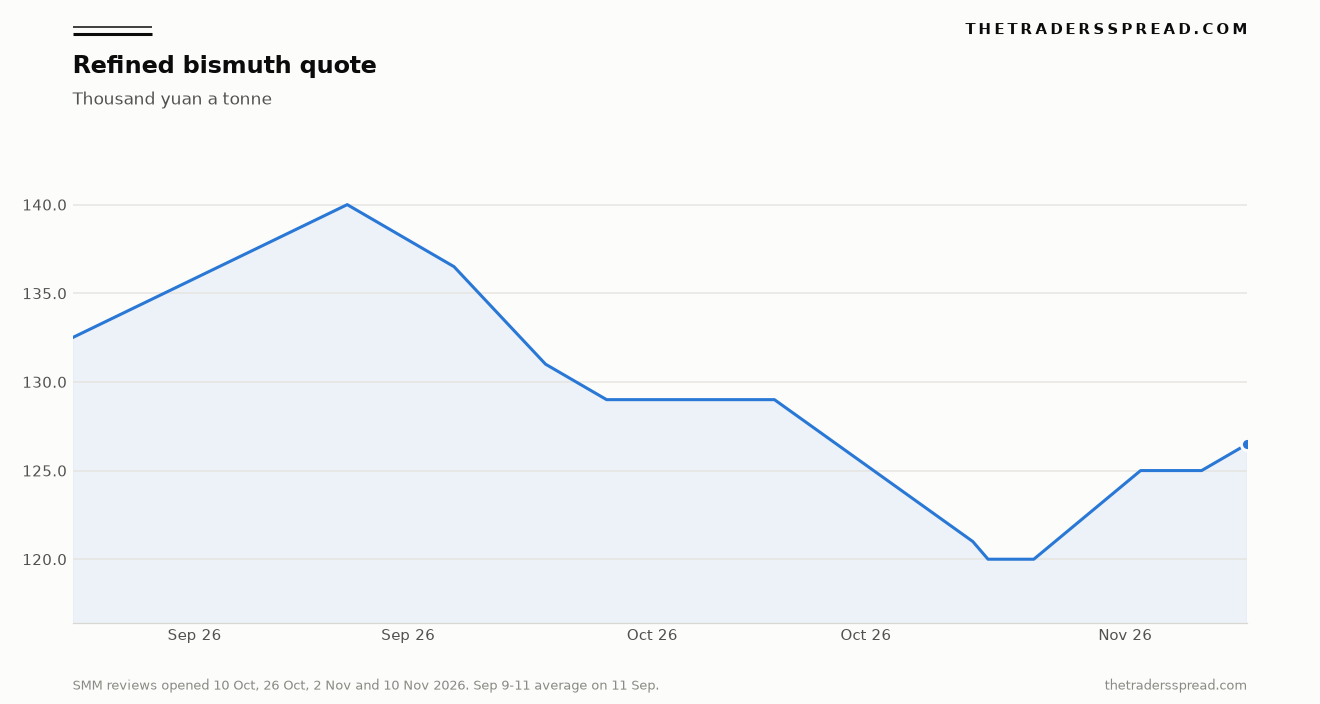
How an assessed quote earns a new print is the subject of the polysilicon quote explainer, and a bismuth number enters the record when a review prints it. The 10 November review says the 125,000 platform already had transaction support, suppliers held metal back after the rebound, and low-priced cargo stayed tight. Demand stayed dispersed across pharmaceutical preparations, pigments and catalysts, electronic solder and metallurgical additives. Dip-buying around 120,000 had already run through one round, and after the reversal buying remained as-needed, with large orders scarce.
The review's own short-term note, recorded here as theirs, says prices were expected to drift higher. If transactions followed Monday's lift, they expected the repair to continue toward 130,000 yuan. Production contraction plus supplier holdback was the floor they put under the downside. The medium-term note puts consolidation around 125,000 yuan if exports and demand do not improve together. The chart stops at the 9 November print.
Richard Perron on volumes that predate the low
The producer comment that names bismuth describes an earlier quarter. 5N Plus reported on 2 November in Montreal that the third quarter ended 30 September, three weeks before the 120,000 print. The press release put revenue at $136.4 million, up 30% from $104.9 million, on higher volumes in Specialty Semiconductors and Performance Materials. Adjusted EBITDA was $31.1 million, up 7% from $29.1 million, and adjusted gross margin was 31.4% of revenue against 36.9%, primarily from anticipated normalization under Performance Materials. The company kept full-year adjusted EBITDA guidance at $100 million to $105 million and said it expected the high end.
On the 3 November call, Richard Perron, president and chief executive of 5N Plus, said Performance Materials "delivered higher revenue year-over-year, primarily on stronger volumes of bismuth-based products, while anticipated margin normalization continued." Alban Fournier, chief financial officer, gave the segment figure: "In Performance Materials, revenue increased 20% to $35.7 million, primarily on higher bismuth-based product volumes." Segment margin normalized to 31.2% of revenue from 53.1% a year earlier, on higher metal input and chemical costs. Segment adjusted EBITDA was $9.2 million, down 31%. Segment backlog was 108 days, up nine days from the prior quarter.
Those volumes belong to the quarter when the Chinese refined quote was falling from the September average toward 129,000, so the 20% segment increase cannot be read as a consequence of the 9 November print. More bismuth-based volume came with a lower percentage margin and a segment profit that fell, while company EBITDA rose on the semiconductor side.
Amr Ezzat, an analyst at Canaccord Genuity, asked whether a GMP non-compliance finding at a competitor late in the quarter had helped Performance Materials, or could help the fourth quarter. Perron said the health and pharma portion typically renews annual contracts in the fourth quarter and the first, and that "we'll see over the course of Q4 and Q1 the benefits that we should obtain from the fact that our nearest competitor for pharma and health products lost its GMP certification." He added that the closest competitor "for pharma and health bismuth-based products lost its GMP certifications," that it was too early to put a volume or a margin on the change, and he did not name the firm. Nick Boychuk, an analyst at ATB Cormark Capital Markets, asked for a multi-year view, and Perron said there would be "some new products around bismuth that we're going to be slowly introducing over the course of next year and the following."
RelatedNewcastle Coal vs API2: What Actually Sets the Gap
Output, oxide exports, and an open channel
The 10 November review says China's refined production fell sharply month on month in October, inside a reasonable range, after prices softened, end-use demand stayed lacklustre and feedstock stayed tight. After the rebound, suppliers kept holding metal back.
Exports are dominated by compounds such as bismuth trioxide, and direct metal exports are limited. Volumes had been low for several months before a restorative rebound in September, which the 10 November review calls a mild overseas restocking, with fourth-quarter sustainability left open. The 26 October review uses the same shape and also withholds a September tonnage. Metal and trioxide are different lines, a split of the sort the flake versus synthetic graphite explainer draws for carbon.
The 10 November review places bismuth outside China's export-control list and describes the export channels as open. A sustained fourth-quarter export rebound alongside the production cut would, on that review, ease domestic oversupply faster, while a softer export tape would cap the repair.
Checks before the next SMM week
The next weekly file is where these prints either earn a third step or give the 1,500 yuan back. A reader checking the series can use the list the 10 November review already printed.
- Whether the 125,000 yuan platform holds after the 9 November lift to 126,500.
- Whether transactions follow that Monday lift, the condition SMM attached to any further repair toward the 130,000 area it named.
- Whether October's output decline, estimated near 10% on 2 November and described as sharp on 10 November, shows up as a verified tonnage.
- Whether fourth-quarter bismuth trioxide exports extend September's rebound, and whether that extension arrives with a tonnage.
- Whether pharmaceutical and solder orders accept the new quotes, or buying stays as-needed with large contracts still scarce.
- Whether 5N Plus, on its fourth-quarter and first-quarter Performance Materials renewals, puts any volume on the GMP shift Perron left unquantified on 3 November.
Questions on the refined quote
What window produced the 5.4% rise in the refined bismuth quote?
The 5.4% compares two Shanghai Metals Market prints: 120,000 yuan a tonne on 23 October 2026 and 126,500 yuan a tonne on 9 November 2026. The 26 October review said the Friday print held through that weekend. The 10 November review dated 126,500 to 9 November, up 1,500 yuan from 125,000. Dividing the full 6,500 yuan rise by 120,000 gives 5.4%. The window is those two dates, and it leaves the September average outside the percentage.
Why can the quote be higher and still well under the autumn high?
The average across 9 to 11 September was 140,000 yuan a tonne. From that average down to 126,500 is 13,500 yuan, or 9.6%. The 23 October low of 120,000 was 14.3% under the same average. The November rise repairs part of the slide from that low and leaves the quote under the platform the 10 October review treated as the stage high. SMM's separate line, a staged high above 136,000, is a looser base than the 140,000 average.
Did 5N Plus tie third-quarter bismuth volumes to the November rise?
The quarter 5N Plus reported on 2 November ended on 30 September, before the 23 October low and before the November repair. Richard Perron, president and chief executive, tied higher Performance Materials revenue to stronger bismuth-based volumes in that quarter. Alban Fournier, chief financial officer, put segment revenue at $35.7 million, up 20%, with the segment margin at 31.2% of revenue against 53.1% a year earlier on higher metal and chemical costs. Those figures describe the high-price quarter.
What did SMM say about October refined output?
At 09:59 GMT+8 on 2 November, SMM estimated China's refined bismuth output in October would drop by around 10% from September, inside what it called a reasonable range. Feedstock was tight and October demand was lacklustre, so producers were less willing to operate. The 10 November review said the assessed October drop had landed sharply month on month, again inside that range. A verified October tonnage remained a watchpoint on that page.
What should a reader check on the next weekly review?
Four items sit on the 10 November watchlist: whether 125,000 yuan holds, whether transactions follow the 9 November lift, whether October's production decline shows up in a verified figure, and whether fourth-quarter bismuth trioxide exports extend September's rebound with a tonnage attached. Pharmaceutical and solder acceptance at the new quotes is the demand check beside those four. The 130,000 area appears only as SMM's condition if transactions follow.
This is analysis for information only. Refined bismuth quotes can gap between weekly assessments, and money committed on a single print can be lost.