

| Series | Basis | Reading | Date on the page |
|---|---|---|---|
| USGS metal | 99.99% pure annual average. Footnote 5: pellets at 99.9%, Argus Non-Ferrous Markets. | $2,600/kg | 2025 estimate, Mineral Commodity Summaries, February 2026 |
| USGS ammonium perrhenate | Catalytic grade, annual average. Rhenium content of APR is 69.42%. | $2,300/kg | 2025 estimate, same sheet |
| SMM powder, VAT excluded | Re minimum 99.99%, ex-works China, YS/T 1017-2015, code SMM-RE-RE-002. | $5,732.23/kg | 13 November 2026, 11:40 GMT+8 |
| SMM powder, VAT included | Same powder. The dollar gap matches the 13% VAT inside the original quotation. | $6,477.42/kg | Same timestamp |
| SMM original | Yuan per kilogram. 43,150 divided by 6,477.42 is about 6.66 yuan per dollar. | 43,150 yuan/kg | Same timestamp |
| SMM range on that view | Printed beside the VAT-excluded assessment, which sits inside the range. | $5,699.02 to $5,765.44/kg | Same timestamp |
The comfortable claim that rhenium still trades near its 2025 average of $2,600 a kilogram falls apart against a powder assessment more than twice that high. On 13 November 2026, at 11:40 GMT+8, Shanghai Metals Market printed 99.99% rhenium powder, ex-works China, at $5,732.23 a kilogram with value-added tax excluded and at $6,477.42 a kilogram with the tax included. The original line was 43,150 yuan a kilogram, the dollar-printing page showed a 0% change, and dividing $5,732.23 by the USGS 2025 average gives 2.20. Using $2,600 as the live spot prices a year the February 2026 summaries had already closed.
The second comfortable claim treats a 1% rise in world mine output, to 81,000 kilograms from 79,800, and an 80% superalloy share as a straight path from $5,732 to $7,200. The same USGS rhenium sheet cuts against that path: imports of unwrought rhenium and powders rose 83%, to 23,000 kilograms from 12,600, and industry sources said recyclers need prices consistently above $3,000 a kilogram. Mine growth of 1% and a market that can pull scrap in are both printed, and only the first is a reason to pay up from here.
The spot for every case below is the VAT-excluded SMM print of $5,732.23 a kilogram on 13 November 2026, read on 15 November 2026 from the SMM rhenium powder page. The bear case is $4,400, below that print. The bull case is $7,200, above that print and above the VAT-included $6,477.42. The base, where the weight sits, is $5,500. The weights are a desk judgement for 31 March 2027 from the sheets opened that day, and they sum to 100. The market these weights describe is thin.
Key facts
- SMM assessed 99.99% rhenium powder, ex-works China, at $5,732.23 per kilogram excluding VAT, inside a printed range of $5,699.02 to $5,765.44, with a 0% change on the day. Source: Shanghai Metals Market, 13 November 2026, 11:40 GMT+8.
- The same page printed the VAT-included price at $6,477.42 per kilogram and the original quotation at 43,150 yuan per kilogram. Source: Shanghai Metals Market, 13 November 2026.
- USGS estimated the 2025 average of 99.99% rhenium metal at $2,600 per kilogram, a 90% rise from 2024, and catalytic-grade ammonium perrhenate at $2,300 per kilogram, 78% above 2024. Source: USGS Mineral Commodity Summaries, February 2026.
- World mine production was an estimated 81,000 kilograms in 2025, 1% above 79,800. Chile's 30,000 kilograms were about 37% of that total. Source: USGS Mineral Commodity Summaries, February 2026.
- Superalloys for high-temperature turbine parts were an estimated 80% of end use, and petroleum-reforming catalysts 15%. Rhenium improves the strength of some nickel-base superalloys above 1,000 degrees Celsius. Source: USGS Mineral Commodity Summaries, February 2026.
- Industry sources estimated global secondary output at 20,000 to 25,000 kilograms in 2025, excluding closed-loop catalyst recovery, and said recyclers need prices consistently above $3,000 per kilogram. Source: USGS Mineral Commodity Summaries, February 2026.
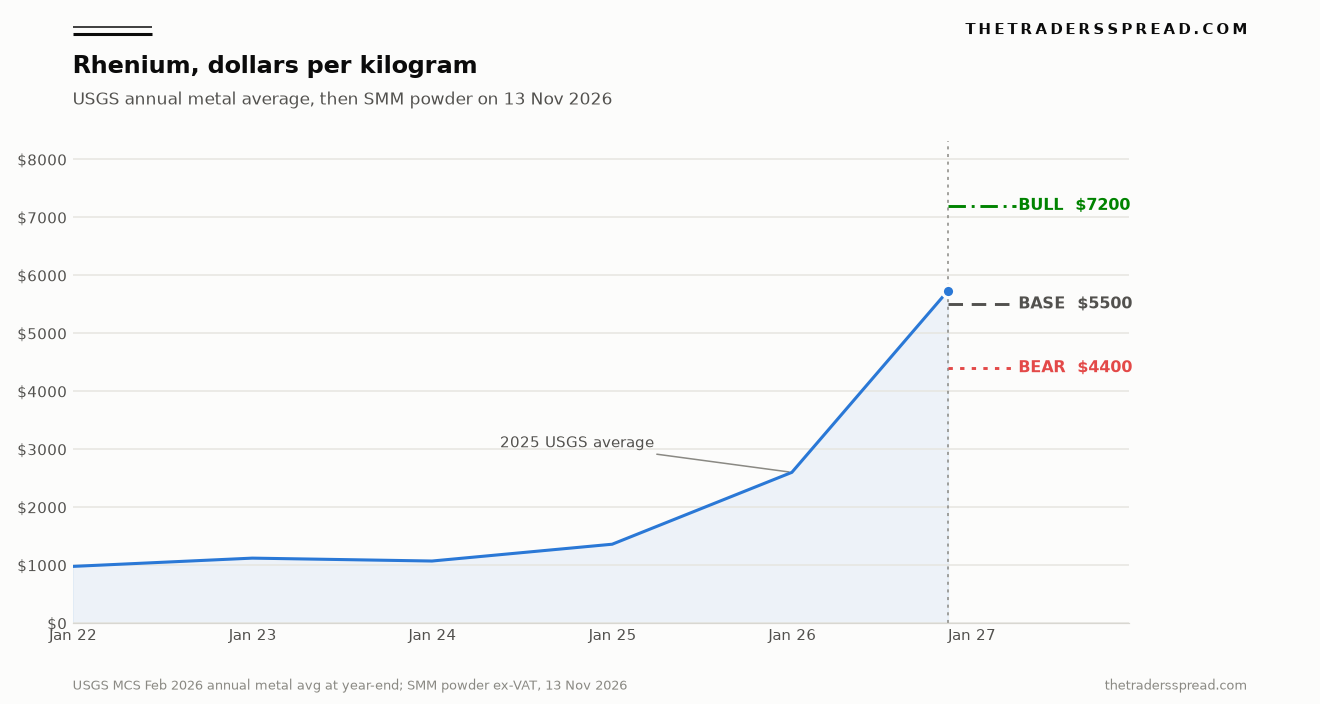
The chart forces two series onto one axis so the basis break stays visible. The USGS metal average moves from $977 a kilogram in 2021 through $1,120, $1,070 and $1,360, then to the $2,600 estimate for 2025, and the November 2026 powder print at $5,732.23 is the last dot.
Two prices, measuring different metal
The USGS price row is an annual average value in dollars per kilogram. The salient table labels the metal row "99.99% pure", while footnote 5 says the figure is the average price of rhenium in pellets at 99.9% content, sourced to Argus Media group, Argus Non-Ferrous Markets. The 2025 number is an estimate in a sheet dated February 2026. An annual average can hide a spike inside the year, and a February estimate stops when 2025 stops. That is why $2,600 anchors the history and fails as the spot for a case about the next four months.
The SMM number is one assessment of powder, minimum 99.99% rhenium, ex-works China, to standard YS/T 1017-2015. Multiplying $5,732.23 by 1.13 lands on $6,477.42, in line with the 13% VAT on the newer SMM page for the same code. That newer view said the price had risen 0.43% and then withheld the level behind a sign-in, while the page that prints dollars shows 0%. The daily change is left unused, and the level is used with its basis attached, because a China powder price can diverge from a pellet average for reasons of tax, shape and a thin book.
The scarcity number people reach for
Primary rhenium is a byproduct of roasting molybdenum concentrates from porphyry copper-molybdenum deposits in Arizona and Montana. USGS estimates United States primary output, 9,800 kilograms in 2025 against 9,310 in 2024, from an 80% recovery on those concentrates, and leaves secondary metal out of the line. The molybdenum price is the parent stream, and the recovery assumption plus the scrap line still sit between that roast and the kilogram a mill buys.
The trade book is where 2025 actually moved. Imports of unwrought rhenium and powders were an estimated 23,000 kilograms, against 12,600 in 2024, the 83% rise USGS states, while ammonium perrhenate imports rose only from 7,450 kilograms to 7,800, so the catalyst side looks calm beside the metal and powder side. Exports were 2,200 kilograms against 735, apparent consumption was 38,000 kilograms, up 34% on USGS's wording, and net import reliance was 75%. Canada, Chile, Germany, Kazakhstan and Poland supplied most of the imported metal, and the 23,000 kilograms stay unsplit by buyer, so a restock and a real surge both remain open readings.
World mine production, secondary excluded, puts Chile at 30,000 kilograms, China flat at 20,000, Poland at 10,000 and the United States at 9,800, inside the rounded 81,000. Reserves are marked "Large", with Chile at 1,300,000 kilograms and identified United States resources near 7 million kilograms, so the tight number is recovery plus scrap, which is a processing story rather than a missing deposit.
Turbine alloys set demand slowly
USGS puts the major uses in one sentence: superalloys in high-temperature turbine components were an estimated 80% of end use, and petroleum-reforming catalysts 15%. Rhenium improves the strength of some nickel-base superalloys above 1,000 degrees Celsius. Smaller uses run from crucibles to thermocouples, and several molybdenum-rhenium medical devices have Food and Drug Administration approval, with the count left unstated. The 80% and the 15% are the figures that can carry a price case.
An iridium-and-tin catalyst has reached commercial success as a substitute in platinum-rhenium catalysts, and USGS still has gallium, germanium, indium and several other metals under evaluation for that use, with gas-to-liquid projects named as a possible offset if catalyst share slips. The turbine-alloy use sits outside the sentence that announces a commercial substitute. A nickel-base specification written for strength above 1,000 degrees changes on an engine programme, which is slow, and the nickel price moves the host-metal cost while leaving the rhenium specification where the engine maker put it.
An 80% share says where the kilograms go once they are sold, and it can survive a give-back in the price. The 34% rise in apparent consumption, to 38,000 kilograms, is the demand fact the bull case gets at full weight, and it is still one estimated year that can pause if 2025 was a restock after a 90% rise in the annual average.
Scrap is the tonne that can still arrive
Nickel-base superalloy scrap and scrapped turbine blades and vanes are recycled hydrometallurgically into rhenium metal for new melts, and the same parts are turned into engine revert, a lower-cost superalloy meltstock, by an increasing number of companies in the United States, Germany, Japan, Poland and several other countries. Spent catalysts go back to the oil companies or the catalyst producer in a closed loop, which reuses the same atoms and is a poor candidate for new supply. Superalloy scrap is old turbines returning as meltstock, and in a given year those kilograms are excluded from the mine total the bull case likes to quote.
Industry sources put 2025 secondary output at 20,000 to 25,000 kilograms outside that loop, about 25% to 31% of the 81,000 kilogram mine total. The United States and Germany lead, and USGS says the data were insufficient to estimate the United States figure alone. Recyclers, on that same industry comment, need prices consistently above $3,000 a kilogram, and the $5,732 print is about 1.9 times that line, so the cost test is already open while a timetable for turning a parked turbine into powder is still missing. Hafnium's price makes a related point about separation on a different metal, and the band above is rhenium.
Bear case at $4,400, weight 35%
The bear case is a give-back of about 23% by 31 March 2027, to $4,400 a kilogram, which still leaves recyclers above the $3,000 line. Dividing 4,400 by 5,732.23 and subtracting one produces that 23%. The path uses the supply the 1% mine-growth headline skips. If the 23,000 kilograms of unwrought metal and powder imported in the 2025 estimate were a restock into a doubling market, the next few months can be fed from inventory and from scrap that is finally in the money, and the China powder assessment can slip toward $4,400 while APR trade stays dull.
Secondary output needs to land around or above 20,000 to 25,000 kilograms, and the shops that invested in recovery need to ship. A dated print at or under $4,400 would confirm the path, and a print that holds above the VAT-included $6,477, with scrap deliveries late, would kill it. The invalidation on the call is $7,200. The weight stays at 35%, under the base, because the 34% consumption rise is real on the sheet and the restock reading is still a hypothesis with the buyer split missing.
Base case at $5,500, weight 45%
The base case is a fade of about 4% to $5,500 a kilogram by the same date. Dividing 5,500 by 5,732.23 and subtracting one gives that 4%. Mine output stays near 81,000 kilograms because rhenium still comes off molybdenum roasters that follow copper and moly schedules. Turbine specifications stay put, so the 80% share survives and the 38,000 kilogram consumption year is treated as a level the market can live with. Scrap arrives, since $5,500 is also far above $3,000, and it arrives slowly enough to block a new leg while falling short of a flood into the $4,000s.
The 2025 metal average had already risen 90% before the powder assessment reached $5,732, so a further 26% to $7,200 is another leg and the claim that needs fresh evidence. Holding most of the spike fits a thin market whose bull facts and bear facts are both on the page, which is why this fade carries a 45% weight. The title bounds are $4,400 and $7,200, and the level the weights point to is $5,500, under the spot, which is why the bias is bear even though the single heaviest weight is the base.
RelatedBismuth refined quote rose 5.4% off the autumn low
Bull case at $7,200, weight 20%
The bull case takes the demand facts at face value and treats scrap as a promise until the tonnes appear later. Consumption of 38,000 kilograms was up 34%, superalloys were 80% of end use, and the commercial substitute USGS names is an iridium-and-tin catalyst rather than a turbine alloy. The government stockpile line is blank, and resources in the ground reach a buyer only after a roaster recovers them. If revert shops miss the window and the 2025 powder imports were consumption rather than a restock, the China assessment can extend to $7,200, about 26% above $5,732.23.
The weight is 20% because that path sets aside a supply response already printed: secondary output equal to roughly a quarter of mine output, a price about 1.9 times the recycler line, and powder imports that have already jumped. Rhenium joined the final 2025 critical-minerals list on 7 November 2025, Federal Register 90 FR 50494, in its own paragraph of the USGS sheet, apart from the price paragraph. Treating the label as a reason to pay $7,200 adds a causal step the authors left unstated. The case stays alive if scrap slips, and $7,200 is the level that invalidates the fade.
Where the weights sit
| Case | Level | Versus $5,732.23 | Weight | What has to show up by 31 March 2027 |
|---|---|---|---|---|
| Bear | $4,400/kg | about 23% below | 35% | Scrap and revert land in the 20,000 to 25,000 kilogram band or above it, and the 2025 powder-import pace cools. The price stays above $3,000. |
| Base | $5,500/kg | about 4% below | 45% | Mine output stays near 81,000 kilograms, turbine specifications stay put, and scrap arrives slowly enough to block a new leg. |
| Bull | $7,200/kg | about 26% above | 20% | Consumption holds the 38,000 kilogram pace and secondary plants miss the window despite a price near 1.9 times the recycler line. |
A blend of those levels, 0.35 times 4,400 plus 0.45 times 5,500 plus 0.20 times 7,200, comes to $5,455. That sits near the base and under the spot. That blend is desk arithmetic on the weights above. Conviction is 2 because the anchor is one China powder assessment beside an annual average, the two SMM views disagree on the daily change, and the buyer split is missing.
What would reprice rhenium
Which new dated page would move the metal off this map? An Argus-basis pellet print near $4,400 or near $7,200 would replace the China powder proxy with the series behind the official average. A 2026 mine figure well away from 81,000 kilograms, or secondary output outside 20,000 to 25,000 kilograms, including a United States estimate where February's data were insufficient, would reprice the scarcity claim and the scrap claim together. A cut in turbine loadings would reprice the 80% share, and the sheet leaves any such cut unstated. Until one of those pages exists, the three paths stay at the weights already set.
Questions the sheets actually answer
Why is the November powder print so far above the 2025 USGS average?
The USGS figure is an estimated annual average for 2025, published in February 2026 on an Argus pellet basis. The SMM figure is one ex-works China powder assessment on 13 November 2026, at $5,732.23 a kilogram with VAT excluded. Dividing the second by the first gives 2.20. An annual average stops when its year stops, so the 2026 move lives in the later print. The bases differ, and the gap stays wide after VAT and freight are allowed for.
Can scrap recovery cap the price while turbines still take most of the metal?
USGS keeps the 80% superalloy share and the scrap paragraph on the same sheet. Industry sources put secondary output at 20,000 to 25,000 kilograms in 2025, outside the closed catalyst loop, and said recyclers need prices consistently above $3,000 a kilogram. The spot opened here clears that line, so the cost test for scrap is already passed. Whether the tonnes arrive before 31 March 2027 is why the bear case is a 35% weight rather than a settled path.
What separates the $7,200 bull case from the $4,400 bear case?
Both cases keep rhenium inside turbine alloys and split on the supply response. The bull case needs mine output stuck near 81,000 kilograms and scrap shops missing a price already near 1.9 times their stated cost line, so the print extends by about 26%. The bear case needs the jump in metal and powder imports, to 23,000 kilograms, to cool, and secondary shipments to arrive, so the print gives back about 23% and still clears $3,000.
Figures here are general information rather than a recommendation to buy, sell or hold rhenium or any other instrument, and a thin powder assessment can be wrong by more than either case allows.