

What share of high-strength rebar, aerospace master alloy and redox-flow electrolyte buyers will actually take, against a supply line that still starts in steel slag, is the question a vanadium price answers, and the steel mill still supplies most of the answer. Désirée E. Polyak, a mineral commodity specialist at the U.S. Geological Survey, put the relationship in a single line in a note she compiled for EARTH Magazine: "The vanadium market closely follows the steel industry."
China recovers most of its vanadium while vanadiferous titanomagnetite is smelted for iron and steel, so the quote is a furnace coproduct as much as a mine bid. In the Survey's February 2026 Mineral Commodity Summaries, estimated world mine production for 2025 was 110,000 metric tons of contained vanadium, and China accounted for 82,000. Metallurgical use was more than 90 percent of reported U.S. consumption in 2025. Aerospace titanium and flow batteries remain the smaller lines on that ledger.
Updated 19 November 2026
Key facts
- Estimated world mine production in 2025 was 110,000 metric tons of contained vanadium, with China at 82,000, Russia at 21,000, Brazil at 5,300 and South Africa at 5,000. U.S. Geological Survey, Mineral Commodity Summaries, February 2026.
- Metallurgical use accounted for more than 90 percent of U.S. reported vanadium consumption in 2025, and estimated U.S. apparent consumption was 13,000 metric tons. U.S. Geological Survey, Mineral Commodity Summaries, February 2026.
- The China annual average for 98 percent vanadium pentoxide was estimated at $5.02 per pound in 2025, after $5.44 in 2024, $7.50 in 2023, $9.29 in 2022 and $8.17 in 2021. U.S. Geological Survey, Mineral Commodity Summaries, February 2026, citing Argus Media.
- The U.S. nominal unit value of contained vanadium printed at $64,500 per metric ton in 2018 and $64,100 in 2005, then $26,300 in 2020 and $36,400 in 2022. U.S. Geological Survey Data Series 140, 2022 update, modified 13 December 2023.
- In 2024 China reported ferrovanadium exports, HS 720292, of 6,599,210 kilograms valued at $129.3 million, while South Africa reported 8,629,040 kilograms valued at $72.7 million. World Bank WITS, drawing on UN Comtrade, page refreshed 19 November 2026.
- Largo Inc. produced 2,093 tonnes of vanadium pentoxide equivalent at Maracás Menchen in the third quarter of 2026, sold 2,428 tonnes, and recorded $6.03 of revenue per pound sold. Largo Inc. Form 6-K press release exhibit, 16 November 2026.
From erythronium to a Model T chassis
Andrés Manuel del Río named the element erythronium in 1801, Nils Gabriel Sefström rediscovered it in 1831, and Sir Henry Enfield Roscoe isolated the metal in 1867. In 1908 Henry Ford put vanadium alloy steel in the Model T chassis, which Polyak's note calls the first extensive commercial use and credits with cutting the car's weight by about half.
"Most vanadium is consumed in the form of ferrovanadium, which is used as a means of introducing vanadium into steel," Polyak wrote in that same EARTH note. Strength, toughness and wear resistance are what the alloy is bought for. A majority of world supply, she wrote, comes from mined ore, either as concentrates of vanadiferous titanomagnetite or as steelmaking slag from iron made out of that ore.
The furnace writes the supply
The February 2026 chapter, which Polyak prepared, puts numbers on that structure. U.S. primary production was zero from 2021 through the 2025 estimate, after Utah sandstone mining stopped in early 2020 and stayed idle. Secondary plants in Arkansas, Delaware, Ohio, Pennsylvania and Texas kept turning residues, spent catalysts and ash into ferrovanadium and pentoxide. That stream was estimated at 7,500 metric tons in 2025, up from 6,800 in 2024 and 3,200 in 2021.
Apparent U.S. consumption was an estimated 13,000 metric tons in 2025, 2 percent above 2024, and net import reliance was 41 percent, down from 61 percent in 2021. Over 2021 to 2024, ferrovanadium imports came mainly from Canada at 50 percent and Austria at 35 percent, and pentoxide mainly from Brazil at 47 percent and South Africa at 43 percent. The tariff schedule dated 31 December 2025 lists ferrovanadium at 4.2 percent and pentoxide at 5.5 percent.
For 2025 the chapter estimates China at 82,000 metric tons, Russia at 21,000, Brazil at 5,300 and South Africa at 5,000, inside a rounded world total of 110,000. The 2024 world total, after a revision to China, rounds to 118,000. Reserves round to 21 million metric tons, and Australia's 10 million line carries a footnote of 2.3 million tons of JORC-compliant or equivalent reserves. World resources exceed 63 million tons and are usually under 2 percent of the host rock. Tellurium's price rides on a host process the same way, and hafnium's price follows a separation plant.
The 2019 Minerals Yearbook, issued in March 2024, calls supply primary or joint: a vanadium mine, or slag from a furnace smelting vanadiferous titanomagnetite. China, Russia and South Africa provided 93 percent of world production that year. Panzhihua's pentoxide output fell 11 percent to 11,000 metric tons, which the company tied to lower prices and lower rebar use, while Chengde's rose 69 percent to 15,000.
A rebar standard reprices the alloy
The late-2010s spike has a dated paper trail. In February 2018 the Standardization Administration of China released a high-strength rebar standard for implementation on 1 November 2018. It eliminated Grade 2 and authorized Grades 3, 4 and 5. Polyak's yearbook records 0.03 percent vanadium in Grade 3, 0.06 percent in Grade 4, and more than 0.1 percent in Grade 5.
The January 2020 Mineral Commodity Summaries, again prepared by Polyak, says larger mills began the change in 2018 while smaller mills moved more slowly. The extra vanadium was originally expected to lift Chinese consumption by about 10,000 tons a year. Slag supply moves with iron output and ore grade, on a furnace timetable rather than a rebar chemist's.
The January 2020 chapter prints a 2018 China pentoxide average of $16.4 per pound and a 2019 estimate of $11.8, 28 percent lower, and says ferrovanadium fell 41 percent to $23 per pound. CRU Group, via the yearbook, puts U.S. ferrovanadium at $43.098 per pound in January 2019 and $10.911 at year-end. Polyak attributes the drop to incomplete enforcement, higher Chinese slag, and more niobium substitution. Inspections in January 2019 found roughly 30 to 40 percent of small mills still short of a full switch.
Data Series 140, modified on 13 December 2023, states a nominal U.S. unit value in dollars per metric ton of contained vanadium through 2022. The 2018 reading is $64,500 and the 2005 reading is $64,100, with 2008 at $50,800 between them, against $13,300 in 2016, and 2018 was about 4.8 times that reading. The window low is $5,270 in 2002, and 2022 printed $36,400.
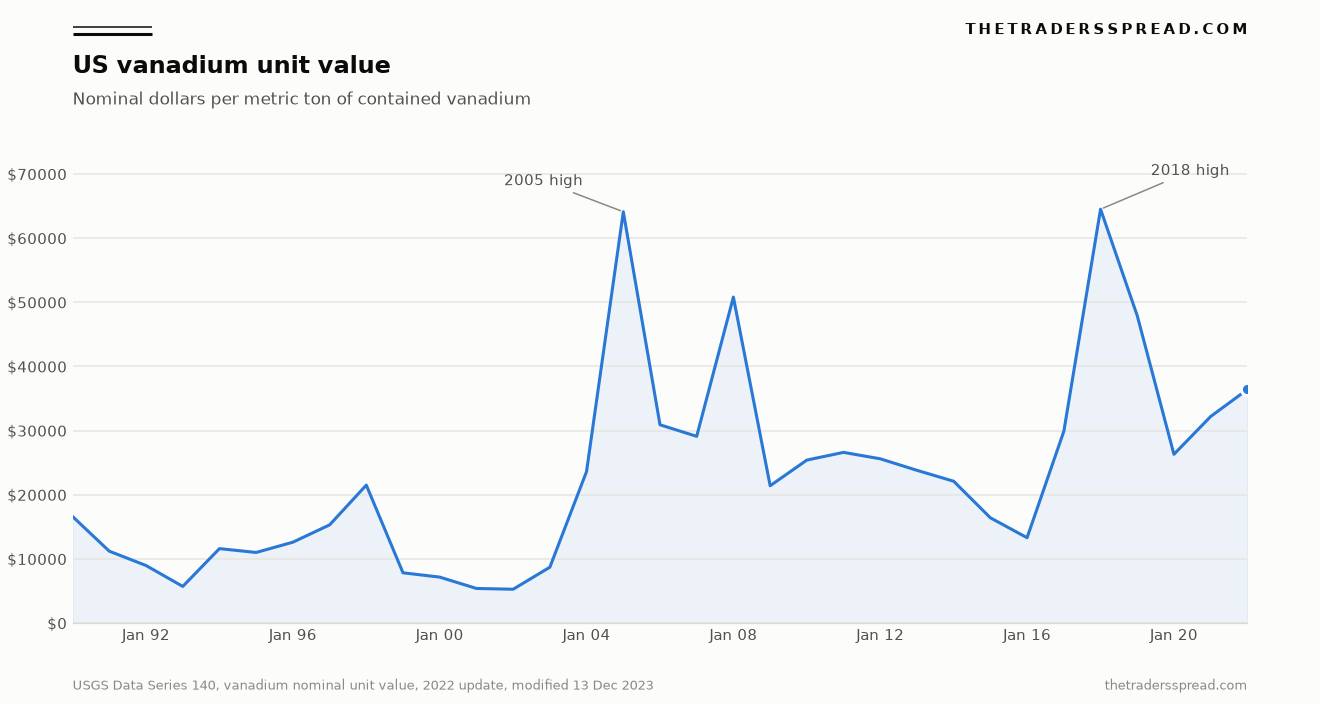
The unit value is dollars per metric ton of contained vanadium in U.S. apparent consumption. The China line is dollars per pound of pentoxide, 98 percent material in the Argus footnote from 2021. On those definitions, $5.02 in 2025 is about three-tenths of the $16.4 average in 2018. U.S. ferrovanadium, 78 to 82 percent vanadium, moved the other way, from $13.05 per pound in 2024 to $14.14 in 2025.
A primary mine sits beside the slag
A primary mine can choose a product mix in a way a steel furnace, whose first job is iron, often will. The 2019 yearbook says Largo Resources produced 10,600 metric tons of pentoxide at Maracás Menchen in Bahia, 8 percent above 9,830 in 2018, and sold it through Glencore until 30 April 2020.
Largo Inc.'s press-release exhibit, dated 16 November 2026 and filed on a Form 6-K, covers the quarter ended 30 September 2026. Alberto Arias, executive chairman and co-chief executive officer, said in that exhibit: "Our third-quarter results reflect progress in the transition toward a more diversified product mix at Maracás Menchen Mine. Vanadium sales remained stable year over year, while we began producing and selling copper, gold and platinum group metals ("PGMs") as by-products of our core vanadium business."
Pentoxide-equivalent production was 2,093 tonnes, 20.6 percent below 2,636 a year earlier, after an inventory cut and a shift toward higher-margin products. Sales were 2,428 tonnes, against 2,417. Vanadium revenue was $32.3 million in both quarters. Total revenue was $34.9 million, up 5.0 percent from $33.3 million, including $2.6 million of copper-gold-PGM concentrate. Revenue per pound sold, a non-GAAP ratio the release reconciles, was $6.03, against $6.06 a year earlier and $6.96 in the second quarter of 2026. European pentoxide ended the quarter at $5.35 per pound, against $5.54 a year earlier.
The $6.03 sits near the Survey's 2025 China average of $5.02 and far below the $16.4 of 2018: one is a quarter's realized revenue per pound, the other an annual benchmark. Full-scale copper-gold-PGM production began on 7 August 2026 after Brazil's National Mining Agency allowed those sales. Guidance in the exhibit stays at 9,500 to 10,500 tonnes of production and 7,500 to 9,500 tonnes of sales.
Aerospace alloy and the tank of electrolyte
Manganese, molybdenum, niobium, titanium and tungsten can stand in for vanadium in some steels, and platinum and nickel can replace it in some catalysts. Aerospace titanium alloys, the February 2026 chapter says, still lacked an acceptable substitute, so a master-alloy buyer can pay up in a quiet rebar year while the tonnes stay too small to reset the annual average. The major non-metallurgical use named for 2025 is catalysts for maleic anhydride and sulfuric acid.
James (Jim) Bannantine, co-chief executive officer of Largo, described that bid in the same 16 November 2026 exhibit: "Our first U.S. Defense Logistics Agency delivery order for $60 million provides an important opportunity to expand Largo's presence in the high-purity vanadium market, alongside our efforts to strengthen relationships with customers in the defense, aerospace, and energy storage sectors. During the quarter we loaded two shipments totalling 180 tonnes of High Purity V2O5 to the US for the DLA." The management discussion states dollars in thousands: a five-year ceiling of $125 million, and a first order of $60.1 million received in July 2026. The February 2026 summary had the government stockpile at zero. The later filing describes orders into it.
A vanadium redox battery, in Polyak's EARTH note, stores energy in two vanadium electrolytes separated by a membrane, and larger tanks raise the capacity. The February 2026 chapter says installations increased in 2025 on the back of renewable build-out, while capital cost and scarce high-purity feedstock stayed binding, and it leaves any megawatt-hour total unstated. Largo held 37.37 percent of Storion Energy, its electrolyte venture with Stryten Energy, as of 30 September 2026, then 26.51 percent on 2 October 2026 after skipping a funding round.
Trade policy lands on the high-purity slice while ferrovanadium stays on the older schedule. Executive Order 14323 raised tariffs from 10 percent to 50 percent on 6 August 2025 for many Brazilian imports, including high-purity vanadium products and excluding ferrovanadium. A major Brazilian producer sought an exemption after delays on high-purity contracts. The chapter leaves that company unnamed, and Largo's exhibit is where a named 180-tonne shipment appears.
Two export lines under one product code
Ferrovanadium trade statistics are a gross-weight ledger, so they sit on a different unit from a contained-vanadium price. World Bank WITS, using UN Comtrade and refreshed on 19 November 2026, lists 2024 exports of HS 720292. China reported $129,255,180 and 6,599,210 kilograms, about $19.59 per kilogram. South Africa reported $72,673,650 and 8,629,040 kilograms, about $8.42 per kilogram. Korea, Canada and the European Union are also large reporters, and adding the Union to its member states would double-count.
RelatedSix Iridium Price Myths About Sponge and Byproduct
The U.S. export row on the same page is $5,590,880 and 256,450 kilograms. Brazil reported $950,470 and 46,500 kilograms. A primary pentoxide producer can be a large mine and a small ferrovanadium exporter, because the oxide leaves under a different heading. How a polysilicon quote is assembled shows the same trap: the tradable unit and the industrial unit are neighbours, and mixing them produces a false spread.
| Country | 2024 production (metric tons) | 2025e production (metric tons) | Reserves (metric tons) |
|---|---|---|---|
| United States | 0 | 0 | 50,000 |
| Australia | 0 | 0 | 10,000,000 |
| Brazil | 5,190 | 5,300 | 94,000 |
| China | 84,000e | 82,000 | 5,800,000 |
| Russia | 21,000e | 21,000 | 5,000,000 |
| South Africa | 8,050 | 5,000 | 520,000 |
| World, rounded | 118,000 | 110,000 | 21,000,000 |
Production is mine output of contained vanadium. The 2025 column is estimated throughout, and China and Russia are estimated for 2024 as well. Australia's 10 million metric tons of reserves carry the Survey footnote that JORC-compliant or equivalent reserves were 2.3 million tons. Source: U.S. Geological Survey, Mineral Commodity Summaries, February 2026.
What the sequence asks a reader to check
Since Ford put the alloy in a chassis, the vanadium price has answered a steel question. A rebar code rewrites it by changing the grams in a tonne of bar, and slag supply or niobium can absorb the shock. Primary mines and a high-purity contract change who captures the margin. In the U.S. split, the steel mill is still the buyer of record.
A practical checklist of readings, free of a trading side and free of a price target:
- Read the rebar specification before a battery headline. Grades 3, 4 and 5 in the 2018 standard carried 0.03, 0.06 and more than 0.1 percent vanadium, and the 2019 fall followed slow adoption.
- Separate slag from primary mines. China's 82,000 metric tons in the 2025 estimate is mostly a steel coproduct. Brazil's 5,300 is a primary-country total.
- Keep pentoxide per pound, ferrovanadium per pound and the unit value per metric ton in three columns. February 2026 prints $5.02 and $14.14. Data Series 140 prints $36,400 for 2022.
- Treat HS 720292 kilograms as gross ferrovanadium. China and South Africa in 2024 imply about $19.59 and about $8.42 per kilogram.
- Count high-purity tonnes apart from steel tonnes. Largo loaded 180 tonnes for the Defense Logistics Agency in the third quarter of 2026, against 2,428 tonnes of sales.
- Read the substitution sentence in each new summary. In February 2026, aerospace titanium alloys still lacked an acceptable substitute.
Questions readers bring to the quote
What does a vanadium price clear?
It clears the tonnes of contained vanadium that rebar mills, other steelmakers, catalyst plants, aerospace melters and battery projects will take, against slag, primary mines and recycled catalyst. In the February 2026 US summary, metallurgical use was still more than 90 percent of reported consumption, and China supplied 82,000 of an estimated 110,000 metric tons of world mine output. The quote is a steel-chemistry price with smaller riders.
Why does furnace slag dominate supply?
Vanadium sits inside vanadiferous titanomagnetite at a low grade, and the iron furnace is already paying to melt that ore. Polyak's compiled note and the 2019 yearbook both describe joint production as slag taken off during steelmaking, distinct from a mine whose first product is pentoxide. Because the slag moves with iron output and ore grade, a rebar mill can face a shortage or a glut that a vanadium-only mine plan would have scheduled differently.
How did Chinese rebar rules move the quote?
In February 2018 China issued a high-strength rebar standard for 1 November 2018, with 0.03, 0.06 and more than 0.1 percent vanadium in Grades 3, 4 and 5. The Survey expected about 10,000 extra tons of Chinese consumption a year. Enforcement lagged at smaller mills, slag output ran ahead of the plan, and niobium took some of the alloy job. The China pentoxide average fell from $16.4 per pound in 2018 to an $11.8 estimate for 2019.
Where do aerospace alloys and redox batteries sit?
Aerospace titanium alloys still lacked an acceptable vanadium substitute in the February 2026 summary, which is why a master-alloy buyer can pay a premium in a soft steel year. The tonnes remain small beside rebar. Redox-flow batteries use high-purity electrolyte and, on the Survey's 2026 account, grew with renewable projects while capital cost and feedstock stayed binding. Largo's filing records a $60.1 million first defense order beside 2,428 tonnes of quarterly sales.
Why do ferrovanadium export lines show different dollars per kilogram?
HS 720292 is gross-weight ferrovanadium, and WITS reports each country's own export declaration for 2024. China's $129.3 million on 6.60 million kilograms is about $19.59 per kilogram. South Africa's $72.7 million on 8.63 million kilograms is about $8.42 per kilogram. Grade, contract structure and what else travels in the shipment can open that gap. Each figure stands apart from the Survey's contained-vanadium unit value and from a pentoxide benchmark.
This is analysis for information only, and it is not a recommendation to buy or sell vanadium, ferrovanadium, a producer share, or any related contract. Figures above are reference prints from the named sources and dates, and later prints can differ. Capital is at risk.