

Indium in China finished 11 November at 4,950 yuan a kilogram, 5.7 percent under the 5,250 yuan print that held on 12 October, while the Western CIF assessment sat at $895 a kilogram and stayed there. A buyer who still treats this metal as one world price is holding two numbers that refuse to tell the same story. The domestic assessment is lower than the plateau it left a month earlier. The benchmark outside China is the average Shanghai Metals Market printed after it lifted the CIF row on 23 October, and that average was unchanged on the morning we checked.
We opened the SMM price pages at the 11:30 GMT+8 update on 11 November 2026, and the three weekly reviews that carry the path into that print. On 12 October, SMM had 6N high-purity indium at 5,750 yuan a kilogram, 500 yuan over refined metal. On 11 November the 6N original price was 5,450 yuan, still 500 yuan over the 4,950 refined print. The ladder dropped 300 yuan and that premium stayed put.
The dollar lines on the same pages make the split concrete. SMM converted the 4,950 yuan refined assessment to $739.27 a kilogram including VAT and $654.22 excluding VAT, inside a VAT-excluded range of $647.61 to $660.83, daily change zero. The CIF page, which SMM describes as CIF Rotterdam, Europe, showed an average of $895, a range of $885 to $905, and a daily change of zero. The gap from that CIF average to the VAT-included China conversion is $155.73 a kilogram, 21.1 percent of the China figure, using the conversion printed on the page.
A grind from 21 August
SMM's review published at 14:40 GMT+8 on 16 October dates the slide to mid-August, about nine weeks by then. The average refined price fell from 5,350 yuan a kilogram on 21 August to 5,100 yuan on 16 October, a drop SMM states as 4.7 percent. Over the eight weeks into that review, crude indium fell 5.8 percent and refined indium 4.7 percent, while indium prices outside China rose 6.0 percent. The overseas average cited that day was about $885 a kilogram, against 5,100 yuan inside China.
From 12 October through 14 October, after the National Day holiday, refined indium held at 5,250 yuan a kilogram, crude at 5,050 and 6N at 5,750. On 15 October every grade was cut by 100 yuan, and on 16 October each was cut by another 50. Refined indium finished at 5,100, which SMM calculated as minus 2.9 percent, crude at 4,900, minus 3.0 percent, and 6N at 5,600, minus 2.6 percent. The refined-crude spread held at 200 yuan and the 6N premium at 500, which SMM read as a shift in the price centre.
Primary output, a by-product of lead and zinc smelting, was described as stable, and recycled feed from ITO target scrap was still reaching the spot market. ITO targets take roughly 70 to 80 percent of indium consumption, with panel makers buying as needed. SMM called the 150 yuan adjustment mild by the standards of earlier cycles.
The week the ladder stepped down
The next review, published at 15:44 GMT+8 on 26 October, is where the path stops being a grind. On 19 and 20 October refined indium dropped from 5,050 yuan a kilogram to 4,750. On 22 October it hit 4,700. On 23 and 26 October refined metal recovered to 4,900 yuan and crude indium to 4,725, and the week still finished about 150 yuan under its open. SMM called those last sessions the first meaningful recovery of the down-cycle. Refined, crude and 6N kept the same order on the ladder.
From the 5,250 yuan plateau of 12 October to that 4,700 yuan low is a fall of 550 yuan, or 10.5 percent. The 5.7 percent in the headline is the net change from 12 October to 11 November, not the depth of the 22 October low. Anyone who stops the tape on 22 October will tell a steeper story than the latest page supports, and anyone who starts the tape on 2 November will say the market has been quiet. Only the net, from the last pre-cut plateau to the print we opened today, is the move in the title.
SMM's 2 November review, published at 15:22 GMT+8, records the next step. Refined indium was raised from 4,900 yuan a kilogram to 4,950 on the first quotation day of a period covering 27 October through 2 November, crude rose to 4,775 and 6N to 5,450, and the next five quotation days were unchanged. SMM described three phases from 22 September: a high plateau, a stepwise decline, and a low-level recovery. The review said the rebound still needed confirmation in trading volume, and it published no tonnage.
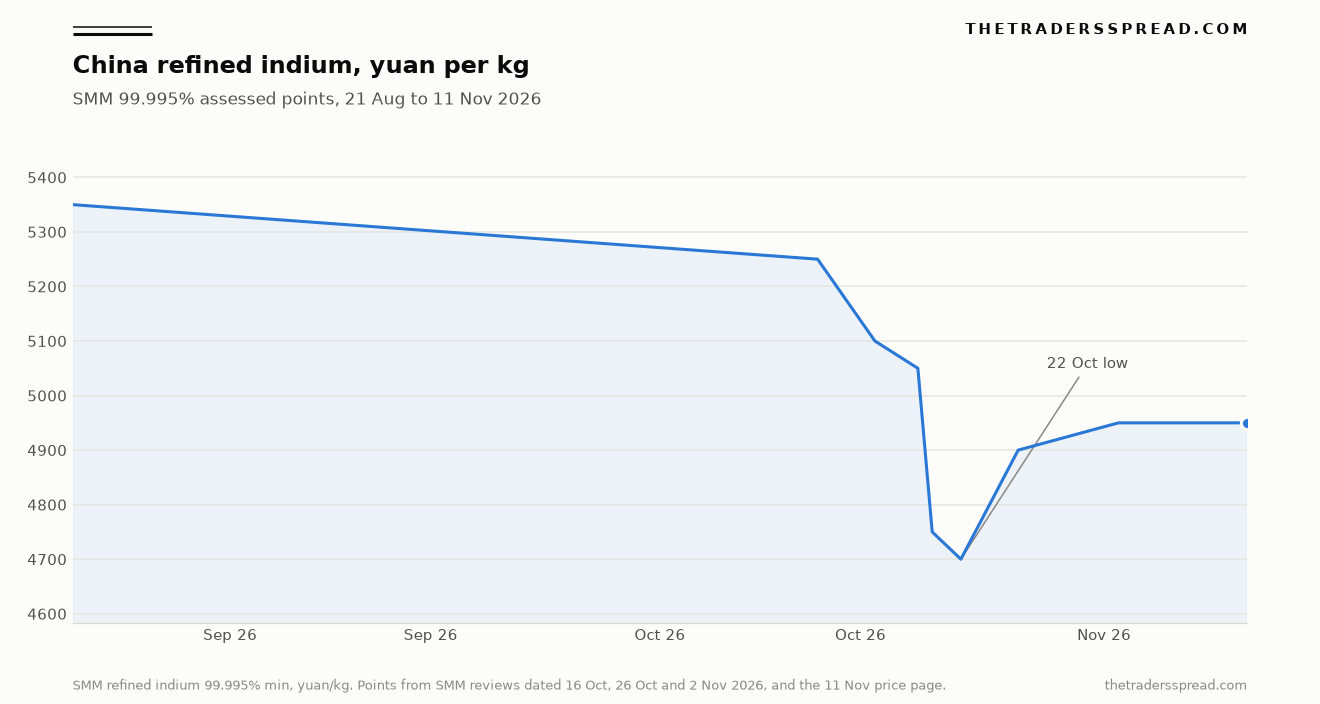
On the 11 November refined page, updated at 11:30 GMT+8, the original price was still 4,950 yuan a kilogram, daily change zero. The specification is at least 99.995 percent indium, in warehouses in China, under YS/T 257-2009, brands Jinyuan, Kaidi and Jinniu, with VAT included in the yuan original. From 5,250 to 4,950 is 300 yuan, or 5.7 percent. From the 21 August print of 5,350 the fall is 400 yuan, or 7.5 percent. SMM's stated 4.7 percent stops on 16 October at 5,100 yuan.
Rotterdam moved ten dollars
While the yuan quote was stepping down, the ex-China dollar quote moved up by a small amount and then sat. The 16 October review put the average refined price outside China at about $885 a kilogram. The 26 October review said CIF quotes were raised to $895 a kilogram on Friday 23 October. On 11 November the CIF average was still $895, the range still $885 to $905, and the daily change still zero.
Ten dollars on $885 is 1.1 percent, and that is the whole Western move across a window in which China refined metal fell 5.7 percent on a net basis and 10.5 percent at the low.
The wider board we opened the same morning shows the $895 average on more than one row. USA indium ingots, minimum 99.995 percent, were $885 to $905 with an average of $895 and a daily change of zero, and Europe indium ingots carried the same range, the same average and the same zero change. Three SMM rows, CIF, USA warehouse and Europe, sat on one number. China's VAT-included conversion sat $155.73 under it.
Fastmarkets, published on 23 October 2026 by Sebastian Evelyn and Niall Beamish, had Rotterdam indium of 99.99 percent, in warehouse, at $895 to $930 a kilogram, flat since 2 October and up by around 134 percent from $376 to $405 on 2 January. That purity differs from SMM's 99.995 percent row, so the chart stays on the SMM yuan series. The same piece put ex-works China indium of 99.99 percent at 4,600 to 4,700 yuan, or $689.66 to $704.65, down 6.44 percent on the session. The title's 5.7 percent is the SMM path from 5,250 yuan on 12 October to 4,950 on 11 November.
The same Fastmarkets piece records China's Zhonglianjin exchange falling 5.3 percent to 4,842 yuan a kilogram, from 5,112 on 15 October, then recovering to 5,065 by 23 October, after the US Defense Logistics Agency cancelled a 13 July request for 400 tonnes of 99.99 percent indium. The cancellation is dated 12 October, the day SMM's 5,250 yuan plateau was still in force. One unnamed source put the global market at around 1,000 tonnes a year, mostly consumed in China. SMM's 16 October review attributes the yuan cuts to soft ITO buying and supplier concessions, with no reference to the agency, and it publishes no tonnage that would tie the withdrawal to the 300 yuan net decline.
The 500 yuan gap between grades
The 6N page on 11 November, same 11:30 GMT+8 update, showed 5,450 yuan a kilogram, daily change zero, $720.30 excluding VAT and $813.94 including it, range $713.70 to $726.91. The specification is at least 99.9999 percent, YS/T 264-2012, brands Tuocai, Keneng, Eban, CNBM and Youteng. From 5,750 on 12 October to 5,450 is 300 yuan, or 5.2 percent, and the premium over refined metal is still 500 yuan, the gap SMM reported on 16 October at 5,600 against 5,100.
Crude metal's last yuan print on a page we opened is the 2 November review: 5,050 on 12 October, 4,900 on 16 October, 4,725 on 26 October and 4,775 on 2 November. The gap against refined metal was 200 yuan on 16 October and 175 yuan on 2 November. SMM had tied the wider crude decline to ample recycling supply. On the 11 November board the crude row was $631.09 a kilogram, daily change minus $0.63, in dollars only, so the latest yuan we cite remains 4,775.
Indium still comes out of the zinc circuit
The US Geological Survey's Mineral Commodity Summaries 2026 indium chapter records no US refinery production in 2025. Indium is produced mainly from residues of zinc-ore processing, most often sphalerite. Estimated world refinery production for 2025 is 1,100 metric tons, of which China is 760, about 70 percent. Estimated capacity is 1,700 tons, China 1,100 and Korea 310. US consumption is estimated at 220 tons, with net import reliance at 100 percent. Import sources for 2021 to 2024 were Korea 25 percent, Japan 22 percent, China including Hong Kong 12 percent, Canada 11 percent and other origins 30 percent. ITO accounted for most global consumption.
The chapter's price table sits far under the assessments we are using, and it conflicts with its own narrative. The table prints a 2025 estimate of $370 a kilogram for US warehouse material, free on board, 99.99 percent, source Argus, against $351 in 2024, and Rotterdam duties unpaid at $380 against $311. The events paragraph says the Argus US price began at $383, peaked in June at $408, and states an estimated average of $390. The table's $370 and the narrative's $390 are an unresolved difference inside one summary. Fastmarkets' $895 to $930 Rotterdam range on 23 October 2026 is a later commercial print on a market that had already rallied.
Fastmarkets also says indium in zinc and lead concentrates is being priced more often as its own payable, and it names Korea Zinc and Teck Resources' Trail refinery in British Columbia. The zinc spot concentrate treatment charge, CIF China, was a negative $115 to $150 a tonne on 9 October, a record low on that page. Our look at how LME zinc backwardation collapsed as warehouse stocks rebuilt is the refined-zinc curve next door, and indium's supply still starts in that ore.
The specification has to travel with the word indium. SMM's series is 99.995 percent minimum, VAT included in the yuan original, in warehouse in China. Fastmarkets on 23 October is 99.99 percent ex-works in China and 99.99 percent in warehouse in Rotterdam, and the USGS averages are Argus at 99.99 percent. A solar metal gets its price from a named specification and a named place, and the same habit shows up in what sets a steel rebar price. A 4N ex-works range set beside a 4N5 VAT-included price will manufacture a move that no single page printed.
Two descriptions of the export rule
The USGS chapter says that in February 2025 China's Ministry of Commerce subjected several critical minerals, including indium, to new export restrictions, and it cites Asian Metal for a 72 percent year-on-year decline in exports of unwrought indium from September 2024 to September 2025. That is the government summary's account of 2025.
RelatedPolysilicon Price: How a Solar Metal Actually Gets Quoted
SMM's reviews of 26 October and 2 November 2026 say export channels for indium are relatively smooth and place the metal outside the export-control list. Fastmarkets, on 23 October, draws a product line: indium metal left off that list, indium phosphide added in February 2025, the compound the USGS chapter links to fibre lasers.
A 72 percent drop in unwrought exports would fit a Western quote that rallied through the year and then sat still. A rule covering phosphide, with the metal left off the list, would leave the yuan weakness to ITO demand and recycled feed, which is what SMM writes down. We opened both sets of pages, and the Ministry text itself was outside that set, so the legal list stays unadjudicated here. From 12 October to 11 November the China refined quote fell on a net basis and the CIF, USA and Europe rows held.
The print that would change the reading
From the 5,250 yuan print of 12 to 14 October to 4,950 yuan at 11:30 GMT+8 on 11 November, China indium of at least 99.995 percent fell 300 yuan, or 5.7 percent, after touching 4,700 on 22 October and recovering 250 yuan. The 6N premium stayed at 500 yuan. The CIF average went from about $885 on 16 October to $895, and the VAT-included China conversion on 11 November was $739.27.
A later SMM refined page at 5,250 yuan a kilogram or higher would change that reading, because the net decline would be gone. A CIF average outside the $885 to $905 range would change the claim that the Western quote merely held after a ten-dollar step. A 6N original price that left the 500 yuan gap over refined metal, on the two pages read the same morning, would change the claim that the ladder moved as one price. Until one of those prints appears, the record of this stretch is a China decline of 5.7 percent against a Western benchmark that stayed on its own number.
Questions the prints actually answer
What is the indium price in China on the latest SMM page?
Shanghai Metals Market's page for China indium of at least 99.995 percent purity showed an original price of 4,950 yuan a kilogram at 11:30 GMT+8 on 11 November 2026, and the daily change was zero. The same page converted that price to $739.27 a kilogram including VAT and $654.22 excluding VAT. The VAT-excluded range printed beside it was $647.61 to $660.83. The specification is in-warehouse China material under YS/T 257-2009.
How far did the China indium price fall from 12 October?
Refined indium held at 5,250 yuan a kilogram from 12 to 14 October, according to SMM's 16 October review, and the 11 November page still showed 4,950. The difference of 300 yuan, divided by 5,250, is 5.7 percent. The path ran deeper than the net: SMM's 26 October review puts the low at 4,700 yuan on 22 October, which is 10.5 percent under 5,250, before the recovery to 4,950 that the headline treats as the close of the window.
Why is the Western indium quote higher than the China conversion?
On 11 November SMM's CIF, USA and Europe ingot assessments all averaged $895 a kilogram, against a VAT-included China conversion of $739.27. The gap is $155.73, or 21.1 percent of that China figure. SMM's October reviews describe soft ITO buying and ample recycled feed inside China, while the ex-China average rose from about $885 on 16 October to $895 on 23 October and then held. The assessments record the split across those two books.
Did high-purity indium fall with the standard quote?
SMM had 6N indium at 5,750 yuan a kilogram on 12 October and at 5,450 on both 2 November and 11 November, a drop of 300 yuan, or 5.2 percent. The premium over refined metal was 500 yuan on 16 October, when the pair was 5,600 and 5,100, and it was 500 yuan again on 11 November, when the pair was 5,450 and 4,950. The grade step held through the move.
What would show that this China decline had reversed?
A refined assessment back at 5,250 yuan a kilogram or higher, on the same SMM page we used for the 4,950 print, would erase the 5.7 percent net decline from 12 October. A CIF average outside $885 to $905 would mean the Western quote had left the range it held on 11 November. A 6N premium away from 500 yuan, read on the refined and 6N pages the same morning, would mean the ladder had stopped moving as one price.
This is analysis for information only, drawn from price pages and reviews opened on 11 November 2026. It is not a recommendation to buy or sell indium, and it sets no price target. Minor-metal assessments can gap when business is thin, and capital put at risk can be lost.