

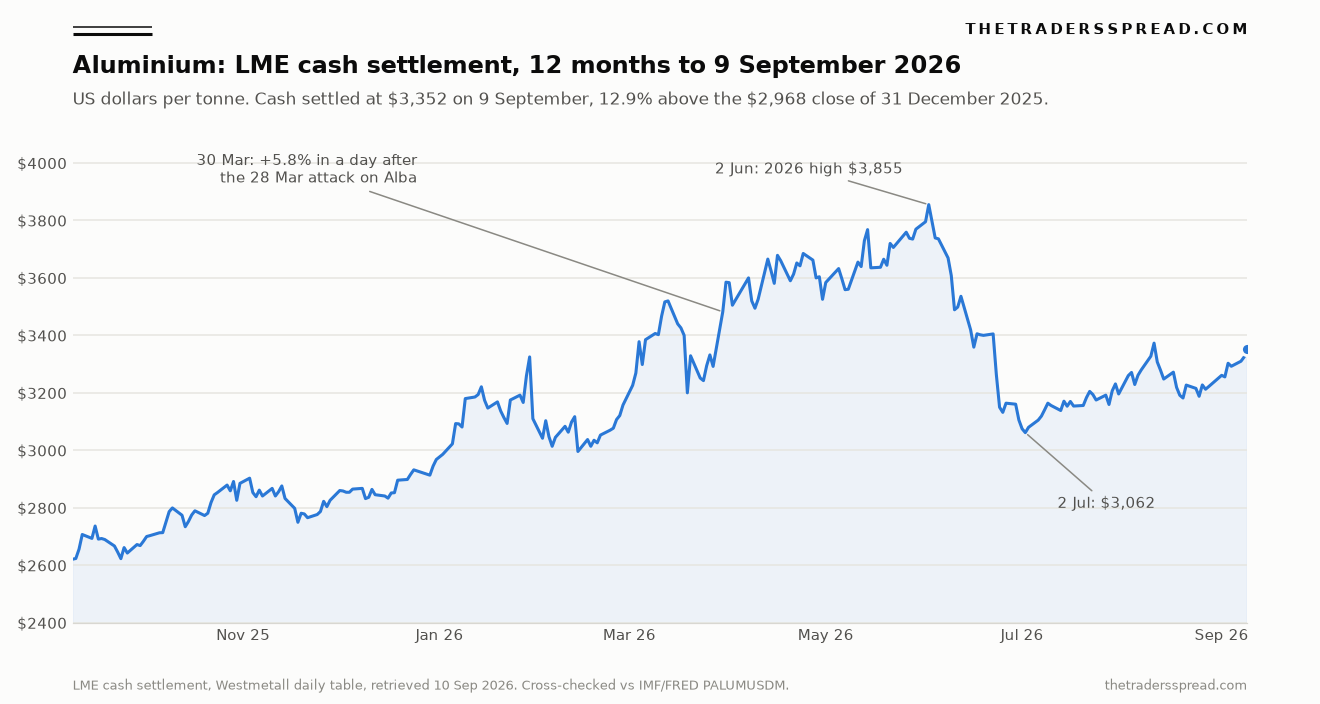
Aluminium's 2026 advance keeps being filed under Washington's tariff wall, and the calendar refuses to cooperate. The Section 232 rate on US imports of Canadian aluminium rose to 25% on 12 March 2025 and to 50% on 4 June 2025, where it has stayed, as Alcoa's quarterly report filed on 30 July 2026 sets out. A duty that has not changed in fifteen months cannot account for a price that has. What changed was the metal. LME cash settled at $3,352.00 a tonne on 9 September 2026 against $2,968.00 on the last trading day of 2025, a gain of 12.9%, and across the same stretch the exchange's warehouse stocks fell from 511,750 tonnes to 244,525 tonnes. Slightly more than half the visible inventory in the benchmark market for this metal left the system during 2026. The reason it left sits in a smelter yard on the Persian Gulf.
Here is the figure that has not made it into the commentary. Aluminium Bahrain shipped 280,799 tonnes in the second quarter of 2026 and produced 155,469 tonnes, according to the company's disclosure of 4 August 2026. The 125,330-tonne gap was met out of stock. Alba's quarterly profit fell to US$172.5 million from US$200.3 million in the first quarter, even though the average LME price it sold into rose from $3,195 to $3,576 a tonne over the same two quarters. An 11.9% better price did not cover a 54% smaller output. This rally is not a windfall being banked by producers. It is the market bidding for tonnes that a Gulf smelter stopped casting on 15 March.
Key facts
- LME aluminium cash settlement $3,352.00/t on 9 September 2026, up 12.9% from $2,968.00 on 31 December 2025 and 27.8% above $2,623.50 a year earlier — Westmetall daily table, retrieved 10 September 2026
- LME warehouse stocks 244,525 tonnes on 9 September 2026 against 511,750 tonnes on 31 December 2025, a fall of 267,225 tonnes or 52.2% — same source
- Alba shut reduction lines 1, 2 and 3 on 15 March 2026, taking down 19% of its 1,623,000-tonne annual capacity, citing "supply and transit disruptions affecting the Strait of Hormuz" — Aluminium Bahrain announcement, 15 March 2026
- The Alba site was struck in an Iranian attack on Saturday 28 March 2026; two employees suffered minor injuries — Aluminium Bahrain statement, 29 March 2026
- More than 2,500 kmt of annual regional smelting capacity and close to 2,000 kmt of refining capacity have been curtailed since the conflict began — Alcoa Form 10-Q, 30 July 2026
- Alcoa's average realised aluminium price was $4,504 per tonne in the first half of 2026 against $3,177 a year earlier, a 41.8% increase — Alcoa Form 8-K exhibit, 9 September 2026
- Alcoa launched a $2,600 million notes offering on 9 September 2026 to fund the $3.1 billion cash leg of its purchase of South32's bauxite, alumina and smelting assets — Alcoa press release, 9 September 2026
The fortnight that took a smelter off line
Alba runs 1,623,000 tonnes of annual capacity and made 1,623,139 tonnes in 2025, which is to say it ran flat out. On 15 March 2026 it announced a controlled shutdown of reduction lines 1, 2 and 3, roughly 308,000 tonnes a year, and called it an operational measure to preserve business continuity given supply and transit disruption through the Strait of Hormuz. Alumina, coke and pitch all reach Bahrain by sea, and a smelter that cannot land raw material has to bank power and metal before it loses the pots.
Thirteen days later the site was hit directly. Alba's statement of 29 March 2026 confirmed an Iranian attack on Saturday 28 March, two employees with minor injuries, and an assessment of damage under way. The LME reopened on Monday 30 March and cash settlement jumped from $3,292.00 to $3,482.00, a rise of 5.77% in one session and the largest single-day gain of the year to that point.
Bahrain was not the only casualty. Alcoa's 10-Q puts regional losses at more than 2,500 kmt of annual smelting capacity and nearly 2,000 kmt of refining capacity announced as curtailed since the conflict started, and adds that Hormuz transit disruption "has restricted the inflow of raw materials and caused vessel constraints globally". Aluminium is a low-value-density cargo, so when charter rates spike the arbitrage that normally pulls metal from a surplus region into a deficit one stops paying.
Energy did the rest. Alcoa recorded higher fuel oil and diesel costs in refining in both the second-quarter and half-year comparisons, attributing them to the conflict. The oil complex has told the same story all year, and our coverage of WTI crude at $91 after US strikes on Iran resumed traces the energy side of the same disruption. Smelters buy power, not crude, but the two are correlated through gas-linked contracts in exactly the places that lost output this year.
Where the inventory went
The drawdown has been relentless and, unusually, monotonic. LME stocks fell in every month of 2026.
| Month end 2026 | LME cash settlement | LME stocks (t) | Change in stocks (t) |
|---|---|---|---|
| 31 December 2025 | $2,968.00 | 511,750 | — |
| January | $3,110.00 | 495,725 | −16,025 |
| February | $3,157.50 | 465,550 | −30,175 |
| March | $3,585.00 | 416,775 | −48,775 |
| April | $3,525.50 | 367,050 | −49,725 |
| May | $3,769.50 | 338,000 | −29,050 |
| June | $3,105.50 | 303,675 | −34,325 |
| July | $3,196.00 | 264,400 | −39,275 |
| August | $3,222.00 | 246,725 | −17,675 |
| 9 September | $3,352.00 | 244,525 | −2,200 |
LME cash settlements and warehouse stocks from the Westmetall daily table, retrieved 10 September 2026. Monthly averages of the same series reconcile with the IMF aluminium price published as FRED series PALUMUSDM to within 0.6%.
Read the two right-hand columns against the price column and the standard narrative breaks. Cash peaked at $3,855.00 on 2 June, then fell 19.4% to $3,105.50 by 30 June, widely treated as the squeeze ending. Stocks drew 34,325 tonnes during that collapse and a further 39,275 tonnes in July, the second-heaviest monthly draw of the year. The physical market did not loosen while the price broke. What broke was positioning.
The forward curve agrees. Cash settled above the three-month price on 104 of the 174 LME sessions to 9 September 2026, and the spread has widened again this month, from three-month minus $19.00 on 28 August to cash plus $14.00 on 9 September. Backwardation is what a market prints when metal is wanted now rather than later, and it is expensive to carry a short position through it. That structure has been the default in aluminium for most of this year, which is not how a comfortable market behaves.
Regional premiums carry the same signal in another currency. Alcoa reported the average Midwest premium up 10% and Rotterdam up 47% quarter on quarter in the second quarter of 2026. Rotterdam is the tell: Europe has no tariff distortion of the American kind, so a 47% move in the cost of getting physical metal delivered on the Continent is a straight scarcity reading.
The producer arithmetic that argues with the rally
A rising price is usually good news for the people who make the thing. In 2026 it has been compensation, not gain.
Alba's numbers make the case because it discloses production, shipments and realised LME in one release. In the first quarter of 2026 it produced 339,734 tonnes, shipped 312,563 tonnes and earned BD75.3 million, or US$200.3 million, on an average LME price of $3,195 a tonne. In the second quarter it produced 155,469 tonnes, shipped 280,799 tonnes and earned BD64.9 million, or US$172.5 million, on an average LME price of $3,576. Value-added products held at 70% of shipments. The mix stayed premium and the price improved, yet profit fell, because the smelter had less than half as much metal and had to destock the difference.
Alcoa sits on the other side of that trade, and its half-year figures show what an unimpaired smelter earns now. Average realised aluminium of $4,504 a tonne in the first half of 2026 against $3,177 a year earlier, disclosed in the excerpt from its offering memorandum filed on 9 September 2026. Average realised alumina, the main input, of $329 against $475. Aluminium up 41.8%, its principal raw material down 30.7%. That is an unusually wide smelting margin, and it exists because Chinese and Indonesian refinery expansions kept alumina loose while conflict took metal out.
"During the second quarter, in addition to delivering strong financial results that captured favorable aluminum prices, our team executed on strategic initiatives, most notably the announced agreement with South32," said Alcoa President and Chief Executive Officer William F. Oplinger in the company's second-quarter results release of 16 July 2026. The Aluminum segment recorded adjusted EBITDA of $1,073 million on a 32% margin, a record.
Alba's chairman framed the same quarter from the damaged end of the market. "Alba delivered a resilient financial performance despite a challenging operating environment marked by regional tensions and supply chain disruptions," said Khalid Al Rumaihi, Chairman of Aluminium Bahrain, in the 4 August release. Chief Executive Officer Ali Al Baqali added that "through disciplined production curtailments and rigorous management of raw material flows, we maintained operational stability despite unprecedented supply chain challenges". Two producers, one price, opposite quarters.
Scarcity has started buying assets
Nothing signals a producer's read on the medium term like the cheque it writes. Two of them landed inside ten weeks.
On 2 June 2026, the day LME cash printed its high for the year at $3,855.00, Alba agreed to acquire Aluminium Dunkerque for approximately US$2.2 billion, adding around 300,000 tonnes a year of European capacity. Chairman Khalid Amro Al-Rumaihi called it "a defining moment for Alba that demonstrates strong confidence in the company's promising potential and long-term growth prospects". A smelter with a fifth of its own lines cold was buying capacity outside the Gulf on the same day the metal it could not make hit its high.
Four weeks later, on 30 June 2026, Alcoa signed an Umbrella Implementation Deed with South32 to buy the whole of South32's bauxite, alumina and smelting interests, paying $3,100 million in cash and roughly 17 million Alcoa shares. The registration statement went effective on 8 September 2026 and the $2,600 million bond that funds the cash leg was launched the next day, split between notes due 2034 issued by Alumina Pty Ltd and notes due 2036 from Alcoa Nederland Holding B.V. Completion still needs South32 shareholder approval and regulatory clearances.
Both deals move capacity from sellers to operators rather than adding a single new tonne. That is the tell of a market that does not believe new supply arrives quickly. Building a greenfield smelter takes four to five years and a power contract nobody wants to sign at current tariffs, which is why scarcity in base metals shows up as deal activity rather than construction. Lithium carbonate at 161,000 yuan followed the same script when restart schedules slipped.
The tariff explanation and why it does not fit
American trade policy is real and expensive, but it is not the 2026 variable.
Alcoa's filing dates the 25% Section 232 rate on Canadian aluminium to 12 March 2025 and the increase to 50% to 4 June 2025. Both predate the period under discussion. The company was still paying it in the third quarter of 2026, guiding to a sequential decrease of roughly $10 million on lower shipments and recent pricing, so nothing has been repealed. A static tariff raises the level of the US Midwest premium permanently and then stops contributing to the rate of change, which is exactly what the numbers show: the Midwest premium rose 10% quarter on quarter in the second quarter while Rotterdam, untouched by Section 232, rose 47%.
The other resident explanation, Chinese capacity discipline, has the opposite problem. Alcoa's filing attributes weak alumina prices to refinery expansions "primarily in China and Indonesia", and its alumina price index averaged $307 a tonne in the second quarter, down 1% sequentially and 38% year on year across the half. If Chinese supply restraint were the marginal force in 2026, alumina and aluminium would not be moving in opposite directions.
Power is the standing structural cost, and it is why curtailed capacity tends to stay curtailed. Restarting a frozen potline is a capital event, not a switch: Alcoa needed until 7 April 2026 to finish the restart of its San Ciprián smelter in Spain. Gas-linked tariffs make that decision hostage to another market entirely, which is why the natural gas curve belongs in any aluminium supply model.
RelatedGermanium Price Prediction: 33,000 Yuan Bull vs 24,000 Bear
What this changes
The first consequence is that visible inventory has stopped being a useful cushion. At 244,525 tonnes, LME stocks are the lowest of any session in the exchange's daily record since the start of 2025, when they stood at 634,650 tonnes. A market at that level reprices on headlines rather than on balances, because there is no buffer between a disrupted cargo and a physical buyer who needs metal in the same week. The August and early-September drawdowns slowed sharply, to 17,675 tonnes and 2,200 tonnes, which is the first sign in eight months that arrivals are catching up with withdrawals. Whether that holds is the single most watchable series in this market.
The second is that the spread structure now carries information the flat price does not. Cash moved from a $19.00 discount to the three-month on 28 August to a $14.00 premium on 9 September while the flat price rose only 3.0%. Sustained backwardation with falling stocks describes genuine scarcity; backwardation that fades while stocks stay low would suggest the tightness has migrated into the premium market instead, where it is harder to see and slower to correct.
Third, the margin split between refining and smelting is doing the allocating. With realised alumina at $329 and realised aluminium at $4,504 in the first half, every integrated producer has an incentive to run metal and sell surplus alumina, and every merchant refiner has an incentive to cut. Alcoa has already trimmed its 2026 alumina production plan to between 9.5 and 9.6 million tonnes, a reduction of 0.2 to 0.3 million tonnes. If enough refiners follow, the input cost that has been subsidising smelter margins reverses, and the current profitability does not survive contact with a $500 alumina price.
Fourth, the two acquisitions change who sets the marginal decision. Once the South32 assets sit inside Alcoa and Dunkerque inside Alba, restart and curtailment choices for a meaningful slice of non-Chinese capacity concentrate in fewer boardrooms, which is precisely what regulators reviewing the Alcoa transaction will examine. Watch the South32 shareholder vote, the antitrust clearances, and whether Alba brings lines 1 to 3 back before the Dunkerque deal closes. Watch Hormuz shipping insurance, which gates raw material into every Gulf smelter still running. And watch the October stock reports: two consecutive builds would say the emergency has passed, a return to 40,000-tonne draws that it has not.
Frequently asked questions
How much has aluminium actually risen in 2026?
LME cash settlement closed at $3,352.00 a tonne on 9 September 2026 against $2,968.00 on 31 December 2025, a gain of 12.9%. Measured over twelve months the increase is 27.8%, from $2,623.50 on 10 September 2025. The 2026 high was $3,855.00 on 2 June and the low since midyear $3,061.50 on 2 July, so the metal has travelled a long way inside that headline number.
Why did LME aluminium stocks fall by more than half?
Warehouse stocks fell from 511,750 tonnes on 31 December 2025 to 244,525 tonnes on 9 September 2026, declining in every month of the year. The cause is lost production: Alba took 19% of its 1,623,000-tonne capacity off line on 15 March, and Alcoa reports more than 2,500 kmt of regional smelting capacity curtailed since the Middle East conflict began. Consumers drew exchange metal to cover the shortfall.
Does the 50% US tariff explain the price move?
Not the 2026 portion of it. The Section 232 rate on Canadian aluminium went to 25% in March 2025 and 50% in June 2025 and has not changed since, so it lifts the level of the US Midwest premium without contributing to this year's rate of change. The evidence is in the premiums themselves: Midwest rose 10% quarter on quarter in the second quarter of 2026 while the untariffed Rotterdam premium rose 47%.
Why is the alumina price falling while aluminium rises?
Alumina and aluminium are linked by process, not by the same shock. Refinery expansions in China and Indonesia pushed Alcoa's realised alumina price to $329 a tonne in the first half of 2026 from $475 a year earlier, while smelting capacity was physically removed. The result is a wide smelting margin that depends on refiners continuing to over-supply.
What is backwardation and why does it matter here?
Backwardation is a market where cash trades above the forward price, inverting the usual carrying-cost relationship set out in our trading glossary. LME aluminium settled cash above three-month on 104 of 174 sessions in 2026 and closed 9 September at a $14.00 premium. It signals that buyers value immediate delivery over deferred delivery, which is the structure a market adopts when inventory is inadequate.
What would indicate the tightness is easing?
Two consecutive months of rising LME stocks, a durable return to contango in the cash-to-three-month spread, and a falling Rotterdam premium would each point the same way. A restart covering Alba's reduction lines 1 to 3 would be the clearest single signal, since that is roughly 308,000 tonnes a year of the missing capacity. Comparable structural readings across the complex are set out in our copper analysis.
Disclaimer
This article is analysis and information, not investment advice, and makes no recommendation to take any position in aluminium or any security mentioned. Commodity and derivative markets carry a risk of loss, including capital in excess of the amount invested. Prices, inventory levels and corporate disclosures cited here were accurate at the retrieval dates stated and change without notice. Readers should do their own research and consider independent professional advice before acting on market information.